Who Owns Your Attention?
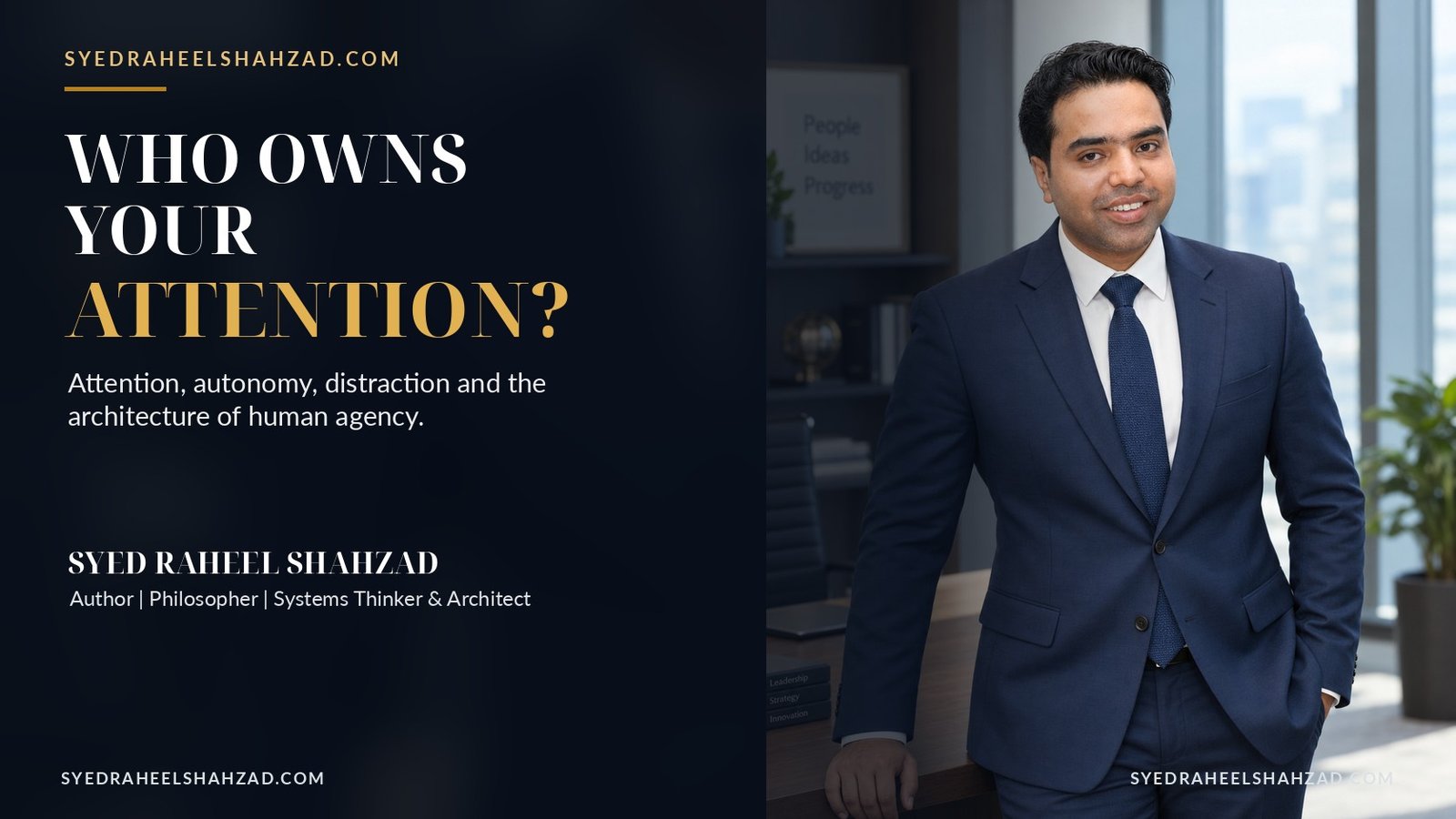
Philosophy of Attention · Human Agency · Distraction · Autonomy
Who Owns Your Attention?
A philosophical inquiry into attention as a condition of freedom: what repeatedly captures the mind can shape salience, memory, desire, identity and the ability to choose what deserves sustained presence.
Attention is not merely where the eyes are
Attention is the selective gate through which reality becomes psychologically present. At any moment, far more exists than a person can consciously process. Attention decides which fragment receives mental priority, which signal becomes salient, which memory is strengthened, which emotion is fed, and which possibility becomes available for action.
That is why the question ‘Who owns your attention?’ is not rhetorical decoration. It is a question about agency.
A person whose attention can be repeatedly redirected without consent may still appear physically free while becoming increasingly governed from within. The body is not restrained, but the field of consciousness is being continuously occupied.
Attention is where life is experienced. To influence attention is therefore to influence what a person notices, remembers, desires and eventually becomes.
The modern struggle over attention is not simply a struggle over screen time. It is a struggle over the architecture through which experience, judgment and identity are formed.
William James saw selection at the heart of experience
William James treated attention as a basic condition of mental life: consciousness does not receive everything equally; it selects.
That selectivity matters philosophically because the world we live in psychologically is partly the world to which we repeatedly attend.
Two people can inhabit the same physical environment while living in radically different experiential worlds because their attention is organized around different objects, threats, hopes, grievances, duties and pleasures.
Attention is therefore not a neutral spotlight. It participates in constructing the lived world.
Selection creates absence as well as presence
Every act of attention has an invisible cost.
To attend to one thing is to neglect countless others.
A notification is not only a small interruption. It is also a claim against whatever would otherwise have occupied that moment: a thought, a conversation, a sentence, a memory, a child’s question, an emerging idea, or silence itself.
The philosophy of attention must therefore examine not only what captures us, but what disappears when capture becomes habitual.
The economy of attention is built on scarcity
Human attention is finite.
No individual can expand the number of hours in a day or consciously process unlimited streams of information.
Scarcity makes attention economically valuable. Platforms, media systems, advertisers, organizations and social networks compete for it because attention precedes many other valuable outcomes: clicks, purchases, beliefs, votes, habits, subscriptions, data, and social influence.
The commercial logic is understandable. But scarcity turns design into an ethical question.
When revenue grows in proportion to captured attention, institutions gain an incentive to make disengagement difficult.
Capture is different from chosen attention
Not all attention is voluntary.
A loud sound captures attention. A sudden movement captures attention. Threat captures attention.
Digital systems can exploit the same orienting mechanisms through novelty, vibration, visual contrast, intermittent reward, emotional provocation and social signals.
The distinction between directed attention and captured attention matters.
Directed attention expresses agency: I decide what deserves sustained mental presence.
Captured attention expresses reactivity: something else successfully claims priority before reflective choice has occurred.
The first freedom is not unlimited choice but recoverable attention
No human being can prevent attention from being captured. The mind evolved to notice interruption.
Freedom cannot therefore mean perfect immunity from distraction.
A more realistic standard is recoverability: after capture, can the person return to the task, thought or relationship they deliberately chose?
A system becomes more controlling when it repeatedly prevents recovery.
The ethical issue is not one notification. It is the cumulative erosion of the ability to return.
The Attention Capture Loop
A useful model is: Trigger → Orientation → Retention → Reward → Return.
Trigger: something interrupts the present task.
Orientation: attention turns toward it.
Retention: the environment supplies enough novelty or emotional relevance to keep the person engaged.
Reward: the person receives stimulation, social feedback, relief from boredom or uncertainty.
Return: the mind learns to seek the same environment again.
Once repeated, this loop can become habitual enough that the external trigger is no longer necessary. The person begins interrupting themselves.
Self-interruption is the mature form of capture
The most powerful attention systems do not need to summon us constantly.
Eventually we reach for them automatically.
A quiet moment appears, and the hand moves. A difficult paragraph appears, and another window opens. A pause enters conversation, and the phone becomes available.
At this stage, external design has become internal habit.
The system has succeeded not merely in attracting attention, but in teaching the person how to escape from undirected consciousness.
Why silence becomes uncomfortable
Silence removes competing stimuli.
That can expose thoughts we have postponed, fears we have avoided, desires we have not named and questions we have not resolved.
Constant stimulation can therefore serve a psychological function beyond entertainment: it can protect us from encountering the unfinished interior life.
This makes the attention problem partly existential.
The person may not only be distracted from work. They may be distracted from themselves.
Simone Weil and attention as a moral act
Simone Weil treated attention as more than concentration. In her work, attention is closely connected to receptivity—to seeing another person or reality without immediately forcing it into our own desire.
This gives attention a moral dimension.
To attend seriously to another person is to grant them a form of presence.
In this sense, distraction is not always harmless. If we cannot attend, we may become less capable of noticing suffering, understanding complexity or hearing what another person is actually saying.
Attention is a form of valuation
What we repeatedly attend to communicates what is important, even when we never state the value explicitly.
A parent can say a child matters while looking at a screen through the child’s story.
A leader can say people matter while checking messages during every conversation.
A person can say their long-term work matters while giving the first hours of every day to whatever the feed presents.
Attention therefore reveals a hierarchy of value more honestly than intention sometimes does.
The Five Claims of Attention
I propose five philosophical claims that help explain why attention belongs at the center of human agency.
1. Selectivity. Attention determines which part of reality becomes mentally present.
2. Salience. Repeated attention makes some objects feel more important, urgent or normal than others.
3. Valuation. Giving attention functions as a practical declaration of value.
4. Identity. Repeated patterns of attention contribute to memory, desire and the narrative through which the self is formed.
5. Agency. Freedom includes the capacity to direct, sustain and recover attention in accordance with reasons rather than constant external capture.
These claims connect cognition with ethics. Attention is not just something the brain does. It is one of the places where a life takes shape.
Salience can imitate importance
What appears often begins to feel important simply because it appears often.
This creates a serious epistemic problem.
The frequency with which a claim, crisis, conflict or personality appears in our information environment can produce a sense of significance disproportionate to its actual importance.
Attention markets can therefore distort not only how long we look, but what we believe deserves concern.
Salience is not the same as importance.
Outrage is an efficient attention technology
Anger narrows attention.
It increases urgency, certainty and the desire to respond.
That makes outrage highly efficient in environments where engagement is rewarded.
But a society trained to attend primarily through anger will experience reality as a sequence of provocations.
The person may become highly informed about what deserves immediate reaction while becoming less capable of sustained, proportionate judgment.
The nervous system can be trained by the feed
Rapid switching between short stimuli can shape expectations about pace.
Slow tasks then feel unusually demanding not necessarily because they became harder, but because attention has adapted to faster reward.
Reading long arguments, listening carefully, practicing a skill, solving a complex problem and sustaining prayer or reflection all require tolerance for delayed reward.
A culture of instant stimulation can make depth feel like deprivation.
The cost of context switching
Attention does not move without friction.
When a person switches repeatedly between tasks, part of the previous task can remain cognitively active while the new task begins.
The practical result is fragmented thought.
This matters because complex reasoning often requires a period in which the mind can maintain enough context for patterns to emerge.
Constant interruption may preserve activity while destroying depth.
Busyness can hide attention failure
A person can answer many messages, attend many meetings, move through many tabs and end the day exhausted.
Activity is visible.
The absence of sustained attention is harder to see.
This creates a dangerous modern illusion: that responsiveness is equivalent to productivity.
In many forms of intellectual, strategic and creative work, the opposite may be true.
Attention and authorship
To author a life requires more than making occasional decisions.
It requires sustained attention to goals, relationships and values long enough for them to survive competition from immediate stimulation.
If attention is continuously assigned by external systems, the person risks becoming reactive rather than authored.
The day is still lived by the individual, but the sequence of mental priorities has been outsourced.
Attention is upstream of desire
We often think desire determines attention: I look because I want.
But causation can run in the other direction.
Repeated exposure can generate familiarity. Familiarity can generate interest. Interest can generate desire.
This means attention systems participate not only in satisfying preference but in producing preference.
The ethical stakes are therefore greater than consumer convenience.
The illusion of infinite relevance
Digital feeds can always produce another item that appears relevant enough for one more moment.
This removes a natural stopping cue.
Books end. Meetings end. films end. meals end.
A personalized feed need not end because its function is not to deliver a bounded object; it is to continue matching attention with possible stimuli.
The absence of ending becomes part of the design.
Boredom has a function
Boredom is usually treated as a defect to eliminate.
But boredom can create the empty interval in which self-directed thought begins.
When no stimulus immediately solves the discomfort, the mind generates possibilities.
Imagination, reflection and memory can re-enter.
A life from which all boredom has been engineered away may become more entertained and less internally generative.
The right to mental space
If human agency depends on periods of unclaimed attention, then mental space begins to resemble a basic condition of dignity.
The person needs moments in which nobody is trying to persuade, sell, alert, rank, provoke or retain them.
This does not require withdrawal from technology.
It requires protected intervals in which attention is not commercially contested.
Children and developing attention
The stakes are especially high for children because attentional habits are formed while self-regulation is still developing.
Systems optimized for adult engagement cannot simply be assumed appropriate for developing minds.
A child should have access not only to stimulation but to unstructured play, sustained reading, conversation, nature, waiting and boredom.
These experiences build attentional capacities that later support learning and self-command.
The workplace can become an attention extraction system too
The attention problem is not limited to consumer platforms.
Organizations can reproduce the same logic internally.
Email, messaging, meetings, alerts and dashboards can make every employee continuously available.
The result can be an organization that appears connected while making deep work almost impossible.
Attention architecture is therefore a leadership issue.
A meeting is a collective claim on attention
Every meeting consumes not only the scheduled hour but the cognitive preparation and recovery surrounding it.
Leaders should therefore treat meetings as investments of collective attention.
The question is not only whether a meeting has an agenda.
It is whether the value of synchronizing attention justifies the cost of interrupting individual work.
Notification is governance
Every notification system contains an implicit hierarchy.
It says: this event deserves to interrupt what you are currently doing.
When everything can notify, the hierarchy collapses.
Organizations and individuals should decide which classes of event truly deserve interruption.
Notification design is therefore a form of priority governance.
The Attention Sovereignty Test
A practical framework for human agency can be built around five questions.
Intentionality: Did I choose to attend to this, or was I captured before choosing?
Proportionality: Is the amount of attention this receives proportionate to its real importance?
Recoverability: After interruption, can I return to what I deliberately chose?
Plurality: Does my information environment expose me to enough variety that one system does not define reality for me?
Ownership: Can I meaningfully set limits, pause, exit and restructure the environment around my own goals?
A healthy attention environment does not eliminate influence. It preserves the person’s capacity to govern influence.
The discipline of deliberate friction
Convenience is generally valuable.
But some friction protects agency.
Turning off nonessential notifications, removing automatic playback, placing devices outside the room, choosing a fixed time for messages or requiring an extra step before opening a distracting application can create a small gap between impulse and action.
That gap restores choice.
Not all good design reduces friction. Sometimes good design places friction exactly where compulsion would otherwise be easy.
Deep work is not merely a productivity technique
Sustained attention has become commercially valuable because it improves output.
But its importance is larger.
Deep attention allows a person to encounter complexity without immediately reducing it.
It creates space for understanding, intellectual independence and original thought.
The capacity to remain with a difficult idea is part of what makes serious scholarship possible.
Attention and moral courage
Moral failures often survive because nobody stays with the uncomfortable fact long enough.
A person looks away. The institution moves on. Another topic arrives.
Attention can therefore be a form of courage.
To remain present to suffering, contradiction, responsibility or evidence when distraction would be easier is a moral achievement.
The politics of personal attention without politics
Attention is socially distributed through design, wealth, work, care obligations and environment.
A person with secure housing, quiet space and control over schedule has different opportunities for concentration from someone facing constant economic or caregiving interruption.
We should therefore avoid turning every attention problem into a moral judgment about discipline.
Individual habits matter, but attention is also structured by systems.
Scarcity of time can create scarcity of reflection
When people live under continuous pressure, the cost of pausing can feel unaffordable.
The mind becomes organized around immediate demands.
Long-term thinking, civic participation, study and even family conversation can shrink.
A humane society should therefore value not only access to information but access to enough mental space to interpret information.
Technology can protect attention too
The critique should not become anti-technology.
Digital tools can reduce noise, organize complexity, automate low-value interruption and protect focus.
The same intelligence used to capture attention can be designed to defend it.
The relevant question is what objective the system is serving.
The ethics of default settings
Defaults matter because most users do not redesign every system they encounter.
If the default is maximum notification, endless continuation and immediate re-engagement, the burden of resisting capture falls entirely on the user.
A more humane approach treats autonomy as a design objective.
The default can respect attention rather than assume it is available for extraction.
We become through repetition
Identity is often imagined as a set of beliefs or values.
But identity is also formed behaviorally.
What we repeatedly read, watch, fear, envy, practice and discuss becomes part of the mental material from which the self is constructed.
Attention is therefore not only about what occupies the present moment.
It contributes to the person who arrives in the future.
What repeatedly captures our attention eventually participates in shaping who we become.
A philosophy of reclaimed attention
Reclaiming attention does not require perfect discipline or withdrawal from modern life.
It requires becoming conscious of the difference between what is important and what is merely attention-efficient.
It requires choosing environments that make chosen attention easier.
It requires tolerating the discomfort of silence long enough for thought to return.
It requires treating presence with another person as a moral act rather than an empty interval between notifications.
The final ownership question
Who owns your attention?
No honest answer is absolute.
Family claims it. work claims it. emergencies claim it. art claims it. faith, duty, memory and love claim it. technology claims it.
The goal is not to own every moment with rigid control.
The goal is to remain sufficiently sovereign that the pattern of attention across a life still expresses your considered values rather than the incentives of whoever became best at capturing you.
Attention is not all of freedom.
But without the ability to direct attention, freedom becomes increasingly difficult to exercise.
Attention is upstream of knowledge
Before evidence can change a mind, it must first become present to the mind.
This means attention sits upstream of epistemology. What we never encounter cannot easily inform us. What we encounter repeatedly can feel representative even when it is not.
An information environment therefore influences knowledge before argument begins by controlling which claims become visible enough to be considered.
The problem is not only misinformation. It is misallocation of attention. A true but trivial fact can crowd out a difficult but important reality.
Visibility can become a substitute for significance
Modern systems produce rankings of visibility: trending, recommended, most viewed, most discussed, most shared.
These rankings can be useful.
But visibility is an output of a system, not a universal measure of importance.
When people repeatedly mistake visibility for significance, the architecture of distribution begins to write the agenda of consciousness.
Attention changes memory
Memory is not a complete recording of experience.
What receives attention is more likely to be encoded, rehearsed and integrated into later interpretation.
A life of fragmented attention may therefore produce fragmented memory.
We can spend hours consuming information and retain surprisingly little because the mind never remained with any one object long enough to build structure.
This helps explain the strange modern experience of being continuously informed yet unable to say clearly what one has learned.
The accumulation problem
Small distractions appear harmless because each one is brief.
But a life is not experienced one interruption at a time. It is experienced cumulatively.
Five minutes here, three minutes there, dozens of checks, constant partial attention—over years, the cumulative effect can become substantial.
The correct unit of analysis is not the individual interruption but the attentional pattern.
Attention inequality
People do not have equal control over their attention.
A senior professional with a private office can create conditions for concentration more easily than a worker whose role requires constant interruption. A person with childcare support has different cognitive room from a parent managing several responsibilities alone.
This matters ethically because advice about focus can become class-blind if it assumes everyone has the same ability to protect time and space.
Attention is personal, but the conditions of attention are social.
The institution can manufacture urgency
Urgency is sometimes real.
It can also be organizationally produced through poor planning, unclear ownership and cultures that reward last-minute escalation.
When institutions repeatedly convert preventable disorder into urgent demands, they consume the attention of employees to compensate for weaknesses in design.
Attention protection therefore requires better systems, not only better individual habits.
Attention and mortality
There is a deeper reason attention matters.
Human life is finite.
Every hour of attention is an hour of irrecoverable life.
Money can be earned again. Data can be copied. Objects can be replaced.
A spent hour cannot be returned.
The attention economy is therefore literally an economy of finite human life.
The moral difference between requested and extracted attention
There is nothing inherently wrong with asking for attention.
Art asks for it. teachers ask for it. children ask for it. institutions ask for it.
The moral difference lies partly in whether the request is proportionate, transparent and compatible with refusal.
Attention becomes ethically troubling when capture is engineered while choice is obscured.
The attentional commons
Shared environments also have an attentional character.
Public spaces filled with advertising, workplaces filled with alerts and social platforms filled with emotionally optimized ranking create a collective attention environment.
We can therefore think of attention as partly a commons: a shared cultural condition that can be enriched by depth, trust and meaningful information—or degraded by constant capture.
The quality of collective attention influences the quality of public thought.
Slow attention and civilization
Some of humanity’s most important achievements require forms of attention that produce little immediate reward.
Scholarship, scientific inquiry, jurisprudence, engineering, philosophy, scripture study, composition and statecraft all depend on the capacity to remain with difficult material.
A civilization that loses the habit of slow attention may retain enormous information while weakening the capacity to understand it.
The discipline of attentional authorship
To author one’s attention is not to control consciousness perfectly.
It is to build a life in which important objects repeatedly receive the attention one believes they deserve.
That requires environments, habits and institutions aligned with declared values.
A person may say family matters, knowledge matters, health matters or moral life matters.
Attentional authorship asks whether the structure of the day gives those commitments a real claim on consciousness.
The final philosophical test
At the end of a week, month or year, our pattern of attention tells a story.
Not every interruption was chosen. Not every demand was avoidable.
But the pattern still reveals something important: which forces repeatedly gained access to our finite consciousness.
The aim of attention ethics is not guilt.
It is awareness strong enough to redesign the pattern.
Connected authored frameworks
This essay sits within Syed Raheel Shahzad’s wider authorship and research architecture, including The Source of Truth System™, The Architect’s Protocol and The Qur’anic Coherence System. Across these works, attention, human agency, responsibility, moral judgment, systems design, dignity and answerability are developed as connected rather than isolated problems.
Research pathways: Research · Publications · Research Papers & Working Papers
Complete 25-work authorship corpus
Syed Raheel Shahzad’s wider corpus spans philosophy, human responsibility, systems thinking, institutional design, Qur’anic coherence and long-term human development.
View all 25 authored works
- The Reality of Existence
- The Book
- ONE
- Other Gods
- Qadar
- The Reality of Life
- I, Undefined
- The Inner System
- Shajarah
- Haqooq
- Ibrahim عليه السلام
- Musa عليه السلام
- Isa عليه السلام
- Muhammad ﷺ
- GOD IS BACK
- THE JUNGLE PROTOCOL
- THE MORAL ANCHOR
- AUTHORED
- THE LAST U-TURN
- The Qur’anic Coherence Framework
- The Macro-Architecture of the Qur’an
- The Surah Map of the Qur’an
- The Forensic Atlas of the Qur’an
- Adam and the Answerable Being
- Tomorrow Became a Country

Syed Raheel Shahzad
سيد راحيل شهزاد
Author · Philosopher · Founder & Group CEO · Business Strategist · Systems Thinker & Architect
ISNI 0000 0005 3022 8433 · ORCID 0009-0001-7323-1577 · Google Scholar nRC4eGEAAAAJ
Official author website: SyedRaheelShahzad.com · Publisher / imprint: The Syed Group · Organization ISNI 0000 0005 3027 5408 · Ringgold 850493