Tomorrow Became a Country
غَدٌ صَارَ وَطَنًا How the UAE Engineered the Future as One SystemAn independent nonfiction systems study of the United Arab Emirates, built across five parts and twenty-one chapters. The official publication record now identifies the work across printed, digital, audio, educational and Braille formats.
A proof-book, not a praise-book.
The subtitle of this book is a thesis statement, not a marketing phrase. The United Arab Emirates did not simply grow — it engineered. Engineering is a specific activity: it involves design, mechanism, sequencing, and the deliberate conversion of intention into outcome. This book documents that process. Not through celebration. Through evidence.
Every statistic in the book states its source, its year, and the basis on which it was computed. Data and interpretation are kept in separate registers throughout. The author’s witness — as a Group CEO and long-term UAE resident since 2010 — appears after the evidence, never in its place. The standard applied throughout: if it cannot be sourced, it cannot be stated.
The argument runs through six linked mechanisms, one depending on the one before it. Together they answer the question the book was written to answer — not what the UAE built, but how it was able to build it at all.
Not praise. Not reduction. Not invented certainty.
Praise in this book travels only as far as the evidence cited alongside it. No superlative is used without a source. No claim is made that the data cannot support. The mechanisms are documented — not celebrated.
The book operates in three distinct registers: official data, system interpretation, and author witness. These are never merged silently. Where the book interprets, it says so. Where it witnesses, it labels the register.
Direct experience of the UAE system since 2010 is offered as testimony — placed after the evidence, limited explicitly to what one vantage point can claim, and honest about what it cannot see.
One stable identity across the author, publisher and five publication formats.
This record connects the work with its preferred English and Arabic titles, the author’s English and Arabic names, The Syed Group imprint, the UAE publication permit and the complete five-format ISBN record. The same identity should be used consistently by libraries, retailers, academic platforms, search engines and knowledge systems.
Buy Tomorrow Became a Country in print or e-book.
The book is commercially live across a growing international network of digital and print retailers. Major destinations are placed first, with verified country-specific and specialist stores listed below.
 Live
AmazonOpen Amazon →
Live
AmazonOpen Amazon →
 Live
Apple BooksOpen Apple Books →
Live
Google Play BooksOpen Google Play →
Live
Barnes & NobleOpen B&N →
Live
Bookshop.orgOpen Bookshop.org →
Live
Apple BooksOpen Apple Books →
Live
Google Play BooksOpen Google Play →
Live
Barnes & NobleOpen B&N →
Live
Bookshop.orgOpen Bookshop.org →
Buy E-Book
Google Books Preview
Kobo · Global / Singapore
Barnes & Noble · USA
Bookshop.org · USA
Smashwords
Fable
Vivlio
Books2Read · Universal E-Book Link
bol.com · Netherlands
bol.com · Belgium (NL)
bol.com · Belgium (FR)
Thalia / Tolino · Germany
Osiander · Germany
bücher.de · Germany
Morawa · Austria
Orell Füssli · Switzerland
Feltrinelli · Italy
IBS · Italy
Casa del Libro · Spain
Cultura · France
Adlibris · Sweden
Adlibris · Finland
Rakuten Books / Kobo · JapanE-Book ISBN 9789948616191. Amazon, Apple Books and Google Play Books are highlighted above. Google Books also carries the live preview / bibliographic record. Google may display a 422-page digital record; the commercial paperback remains 374 pages.
Buy Print
Barnes & Noble · USA
Books-A-Million · USA
Walmart · USA
ThriftBooks · USA
Bookshop.org · USA
AbeBooks · Global
PBShop.store UK via AbeBooks
AbeBooks UK · The Syed Group
Readings · Australia
Kogan / The Nile · Australia
Abbey's Bookshop · Australia
Donner · Netherlands
Morawa · Austria
Orell Füssli · Switzerland
Feltrinelli · Italy
IBS · Italy
IberLibro · Spain
AbeBooks France
YES24 · South KoreaPaperback ISBN 9789948612995 · 6 × 9 in · 374 pages. Amazon, Barnes & Noble and Bookshop.org are highlighted above. AbeBooks marketplace inventory may include multiple independent sellers in different countries, so seller stock can change without changing the book record.
Libraries & Trade Distribution
Published distribution channels include Ingram / IngramSpark, Draft2Digital, Gardners, OverDrive / Libby, BorrowBox and Vivlio Libraries. Institutional availability depends on the library, territory, wholesaler and local cataloging cycle.
Official Edition Identifiers
E-Book ISBN: 9789948616191
Paperback / Print ISBN: 9789948612995
Audiobook ISBN: 9789948616344 · production in progress
Educational Programs ISBN: 9789948614784
Braille Publications ISBN: 9789948614630
Worldwide store directory: the official TBAC hub remains the compact route for additional country storefronts and newly appearing retailer pages.
View All Worldwide Stores →The five-part movement.
Each part builds what the part before it established. The order is the argument. Remove one part and the demonstration weakens.
The founding conditions and the question the book answers. Pearl, desert, scarcity, the 1971 union, and oil as the beginning — not the identity.
Leadership as long-term architecture, law and trust, federal unity with local execution, government as a performance machine, and the management state.
From one barrel to a hundred markets. Ports, aviation, trade, logistics, real estate, finance, tourism, capital, talent and openness.
Cities built as platforms, digital government, AI and space, education, health, human development, and sustainability beyond dependence on oil.
What can be copied and what cannot, the UAE Progress Formula, and what tomorrow asks of the world. The demonstration stated — and its limits acknowledged.
The order is the argument.
Six mechanisms — each one depending on the one before it. Vision does not become law by itself. Law does not become execution without design. Execution does not produce openness without intention. The chain is the book’s central claim.
This is not primarily a statement about economics. It is a statement about governance. A country with the will and the design to separate its identity from the resource that funded it — and then to build the replacement — is making a choice that most resource-rich countries do not make. Tomorrow Became a Country documents how that choice was made, structured, and sustained.
The complete argument.
Every chapter earns its place. The Prologue opens the argument. The Epilogue closes it honestly. What sits between them is the documented case.
For readers who want the mechanism, not the marvel.
A structured case study in how national vision becomes institutional reality — for policymakers, public administrators, and governance scholars worldwide.
The UAE as a system — studied from the perspective of a Group CEO who has operated inside its institutions for more than a decade.
A source-controlled, register-disciplined systems study suitable for courses in Gulf studies, development economics, comparative governance, and institutional design.
A serious book about how a country was built — not a tourism guide, not a celebration, not a business-setup manual. An argument that earns its conclusions.
One work, five publication paths.
The intellectual work remains one book, while each format has its own bibliographic identity. The records below distinguish physical reading, digital access, listening, structured education and tactile reading access.
The commercial paperback edition is live through Amazon and international print distribution, with downstream retailer listings continuing to propagate.
Live · Retail Distribution ActiveThe e-book edition is live across major international digital retailers and reading platforms.
Live · Retail Distribution ActiveThe audio record for listeners, professionals, commuters and readers who engage more effectively through spoken narration.
ISBN AssignedThe educational record supporting seminars, reading groups, professional learning and structured use of the book’s systems framework.
ISBN AssignedThe accessibility record recognising that serious knowledge should not be limited to a single method of reading.
ISBN AssignedThe verified people and institution connected to the work.
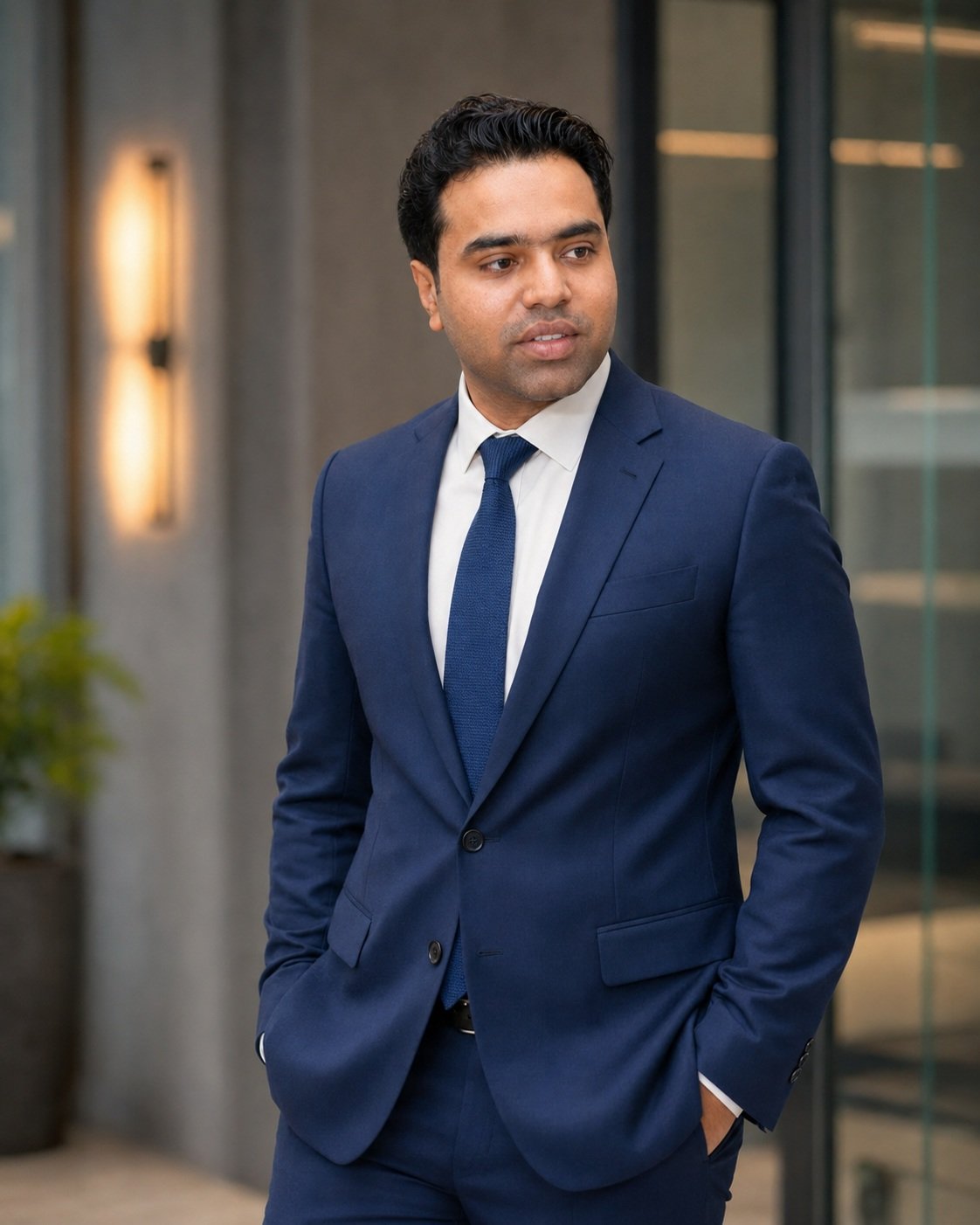
Official 2026 author portrait · Syed Raheel Shahzad · سيد راحيل شهزاد
Syed Raheel Shahzad
Syed Raheel Shahzad writes across systems, governance, leadership, institutional order, public knowledge, faith, moral responsibility, human formation and national development. He has lived in the United Arab Emirates since 2010 and approaches the country as a long-term resident, business leader, researcher, publisher and participant in the institutional and economic environment being studied.
His method places structure before outcome and keeps measurable evidence, interpretation and lived experience in separate registers. He is not presented as an official representative of the Government of the United Arab Emirates or any public authority.
Visible identity is intentionally concise. Additional scholarly, catalog and research identifiers remain connected through the structured data and the canonical Author Verification record.
The Source of Truth System™
A fourteen-book architecture moving through existence, revelation, divine oneness, destiny, life, identity, the inner system, human responsibility and prophetic truth.
The Architect’s Protocol
A five-book civilizational and moral audit examining truth, power, moral order, authorship, technology and the human future.
The Qur’anic Coherence System
A four-volume research project studying Qur’anic macro-structure, surah relationships, conceptual mapping and internal coherence.
Adam and the Answerable Being
A standalone work on human origin, freedom, moral responsibility and answerability.
Ask SRS
A public author and knowledge platform for questions, discussions, essays, reading notes and serious inquiry.
Tomorrow Became a Country
An independent systems study of the United Arab Emirates through Vision, Law, Execution, Openness, Growth and Global Influence.
Official book, ISBN and authority record.
This page records the preferred identity of the work for readers, booksellers, libraries, academic platforms, search engines, AI systems and knowledge-graph services.
| English Title | Tomorrow Became a Country |
|---|---|
| Arabic Title | غَدٌ صَارَ وَطَنًا |
| Subtitle | How the UAE Engineered the Future as One System |
| Author | Syed Raheel Shahzad · سيد راحيل شهزاد |
| Core Author Identifiers | ISNI 0000 0005 3022 8433 · ORCID 0009-0001-7323-1577 · Google Scholar nRC4eGEAAAAJ |
| Publisher / Imprint | The Syed Group · ISNI 0000 0005 3027 5408 · Ringgold 850493 |
| Publication Year | 2026 |
| Language | English |
| Paperback Length | 374 pages |
| Trim Size | 6 × 9 in (152 × 229 mm) |
| Interior | Black-and-white · EB Garamond · 10.5 pt body |
| UAE Permit | Publishing, Printing & Text Permit · MC-01-01-0593496 |
| Age Classification | E |
| Paperback / Print | ISBN 9789948612995 · 374 pages · commercially live |
| E-Book | ISBN 9789948616191 · commercially live |
| Audiobook | ISBN 9789948616344 · production in progress |
| Educational Programs | ISBN 9789948614784 |
| Braille Publications | ISBN 9789948614630 |
| Core Framework | Vision → Law → Execution → Openness → Growth → Global Influence |
| National Scope | Abu Dhabi · Dubai · Sharjah · Ajman · Umm Al Quwain · Ras Al Khaimah · Fujairah |
| Core Fields | UAE Governance · Systems Thinking · National Development · Institutional Design · Economic Diversification |
| Official Book Website | TomorrowBecameACountry.com |
| Worldwide Store Directory | linktr.ee/tomorrowbecameacountry |
| Official Author Website | SyedRaheelShahzad.com |
| Author Verification | syedraheelshahzad.com/author-verification/ |
| Publications & Research | syedraheelshahzad.com/publications/ |
| Contact | books@syedraheelshahzad.com · publications@thesyedgroup.com |
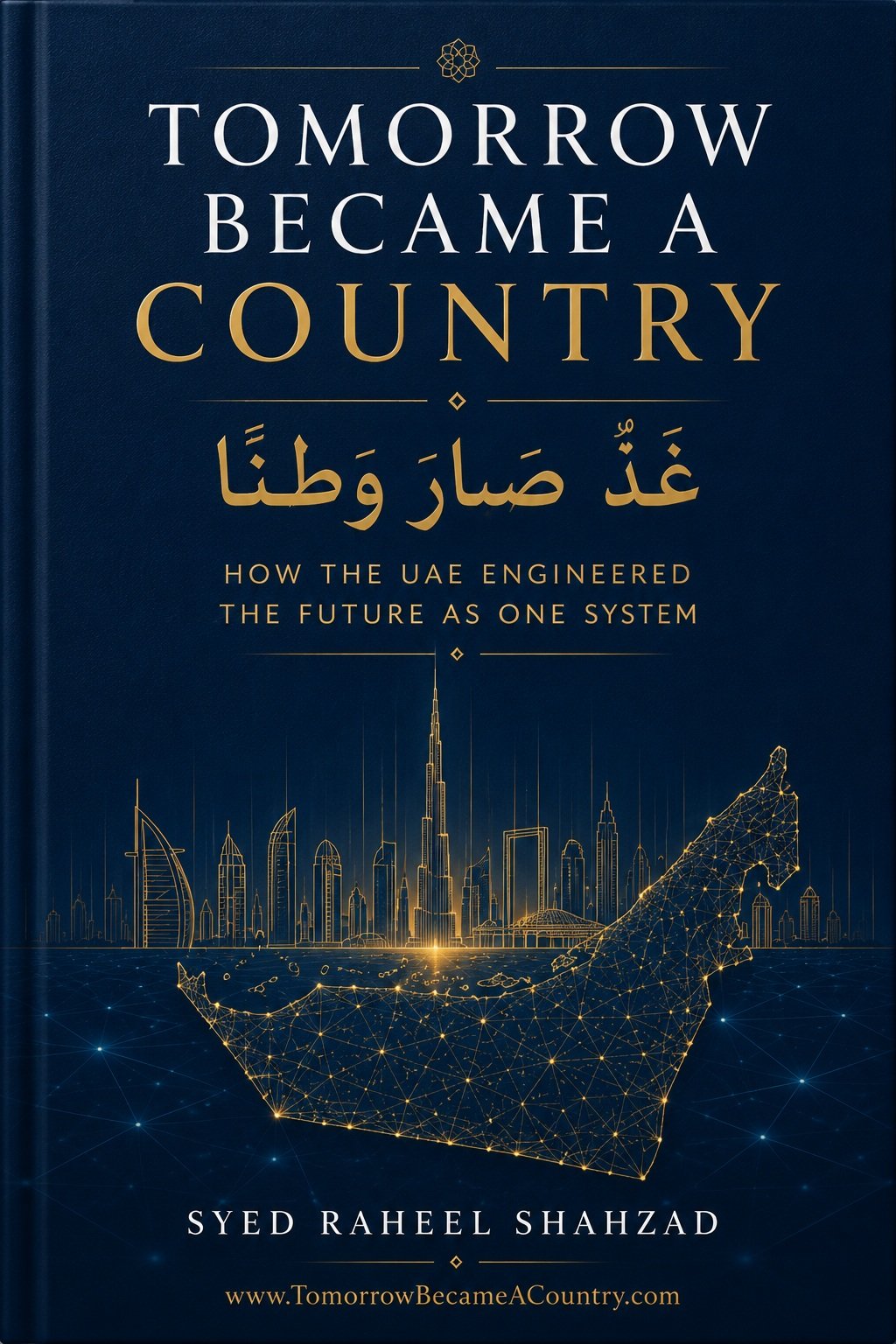
Official Book Cover · 2026
A public bibliographic record, not a claim of official endorsement.
Suggested Citation
Shahzad, Syed Raheel. Tomorrow Became a Country: How the UAE Engineered the Future as One System. The Syed Group, 2026.
Independent Author Work
This is an independent nonfiction study. It is not an official publication of the Government of the United Arab Emirates, any emirate government, ministry, authority, embassy, public institution or state-owned enterprise.
Permit Record
The UAE publication record confirms the title, author, language, age classification, permit number and five ISBN formats. It does not constitute government endorsement of the book’s interpretations.
Copyright
Copyright © 2026 Syed Raheel Shahzad · سيد راحيل شهزاد. All rights reserved. Rights and publishing enquiries: books@syedraheelshahzad.com.
Begin with the question that brought you to it.
Tomorrow Became a Country is a standalone nonfiction systems study for readers who want to understand the UAE beyond its surface. Not celebration. Evidence.
Optional Book Resources Official Book Image Archive
Scroll sideways to view the five book-related images. Select any image to open the full-resolution file in a new tab.
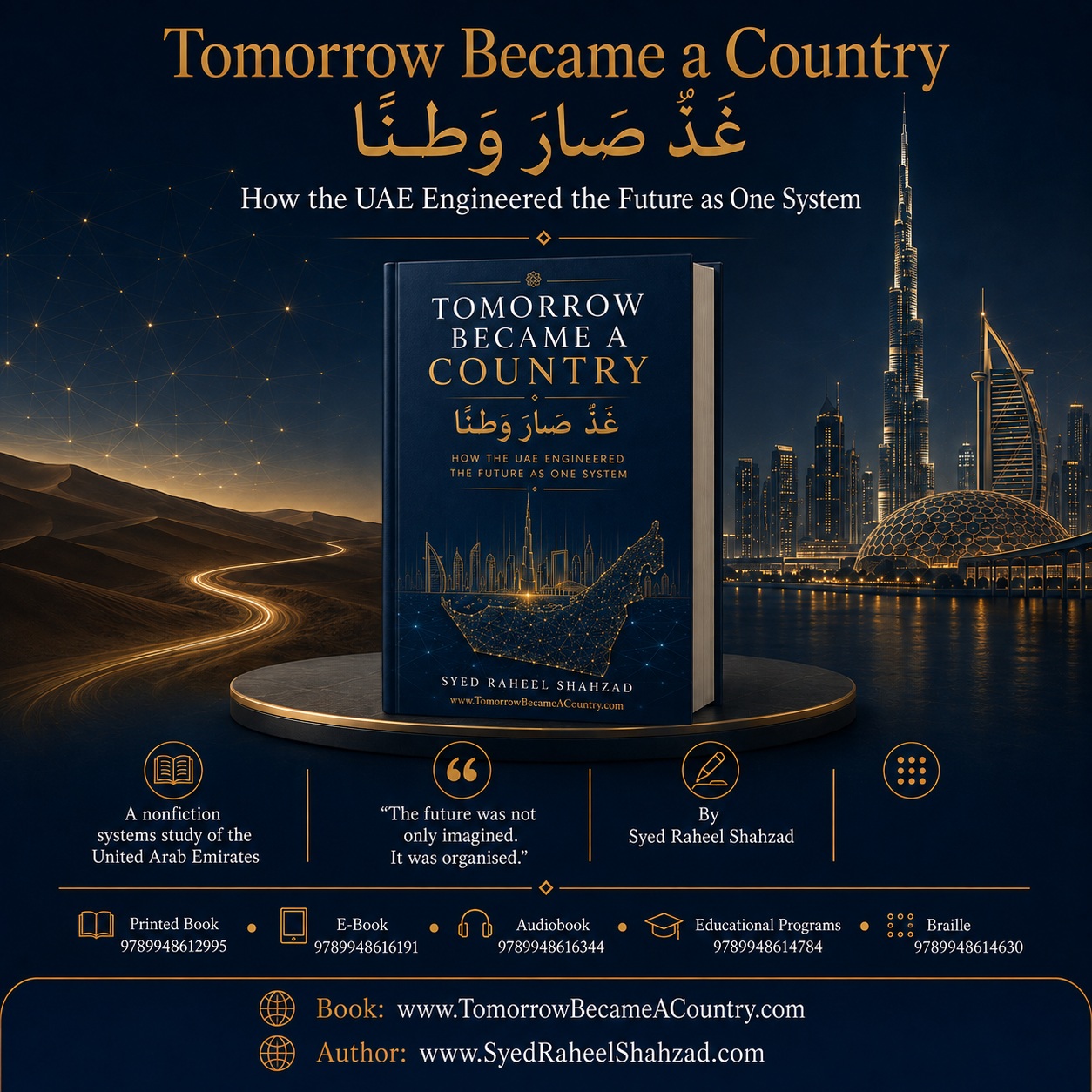 Five-Format ISBN Record
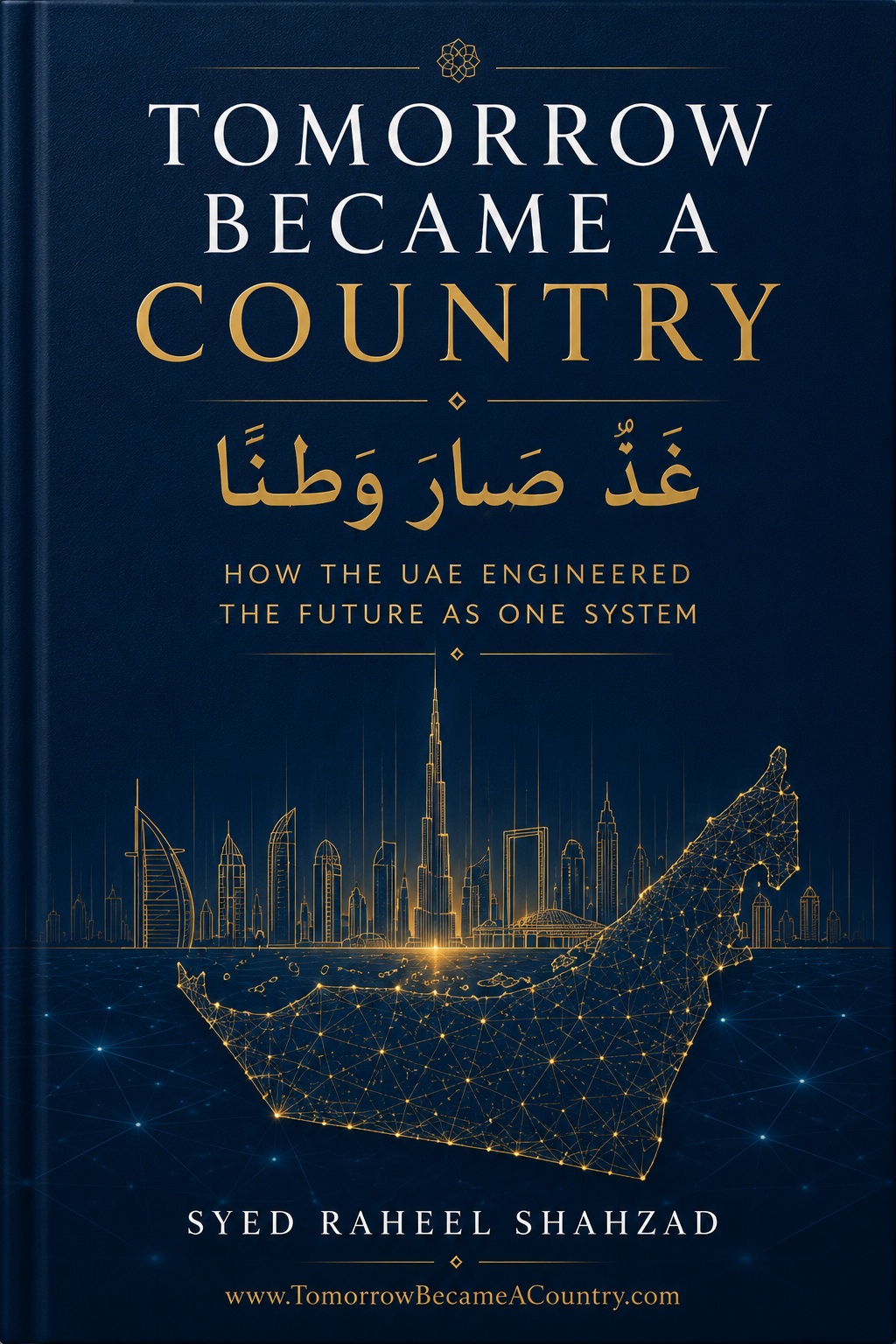 Official Publication Record
 Frequently Asked Questions
 Media and Press Kit
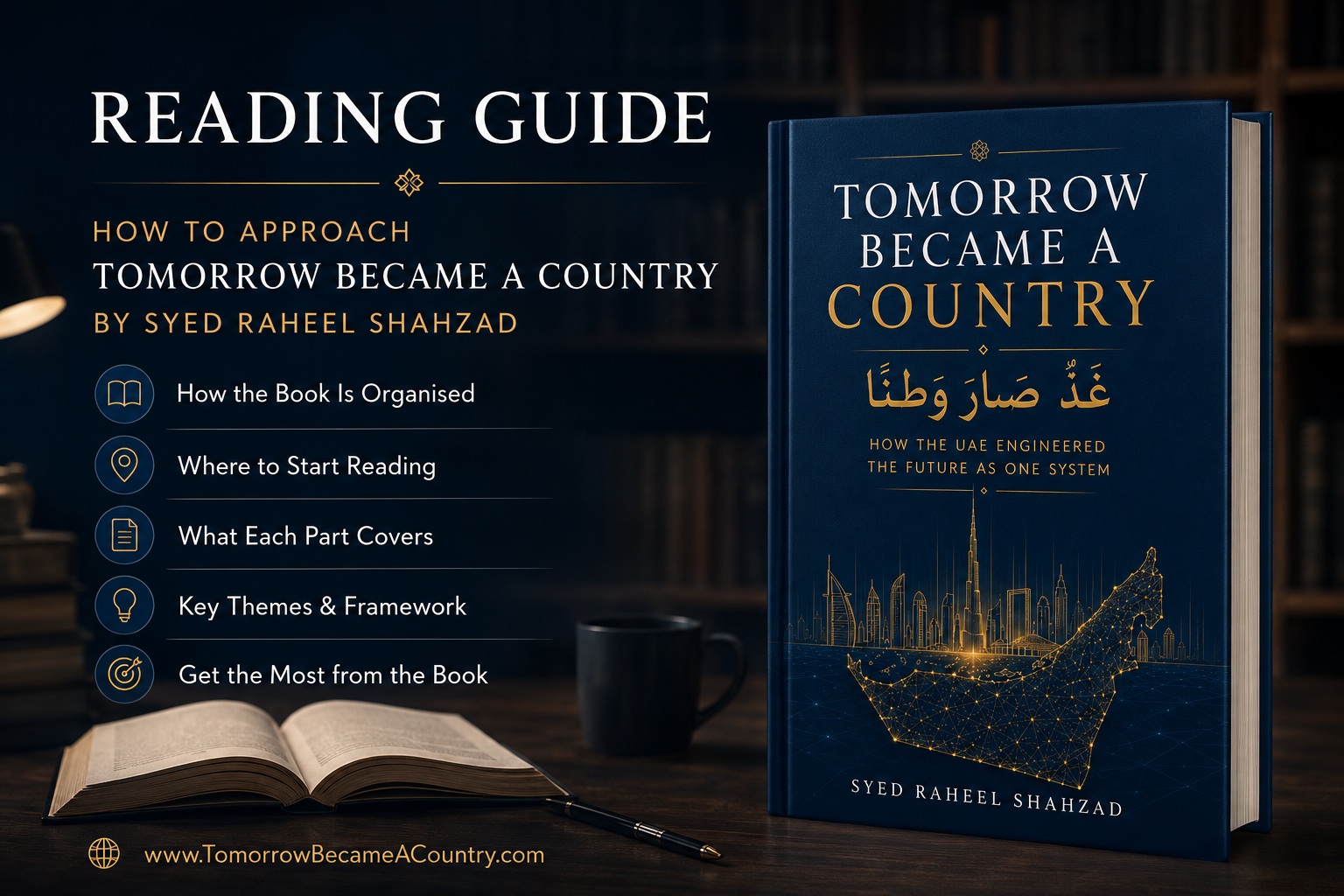 Reading Guide
© 2026 Syed Raheel Shahzad. All rights reserved. Rights terms · Permissions contact