Why Looking Busy Has Replaced Meaningful Work
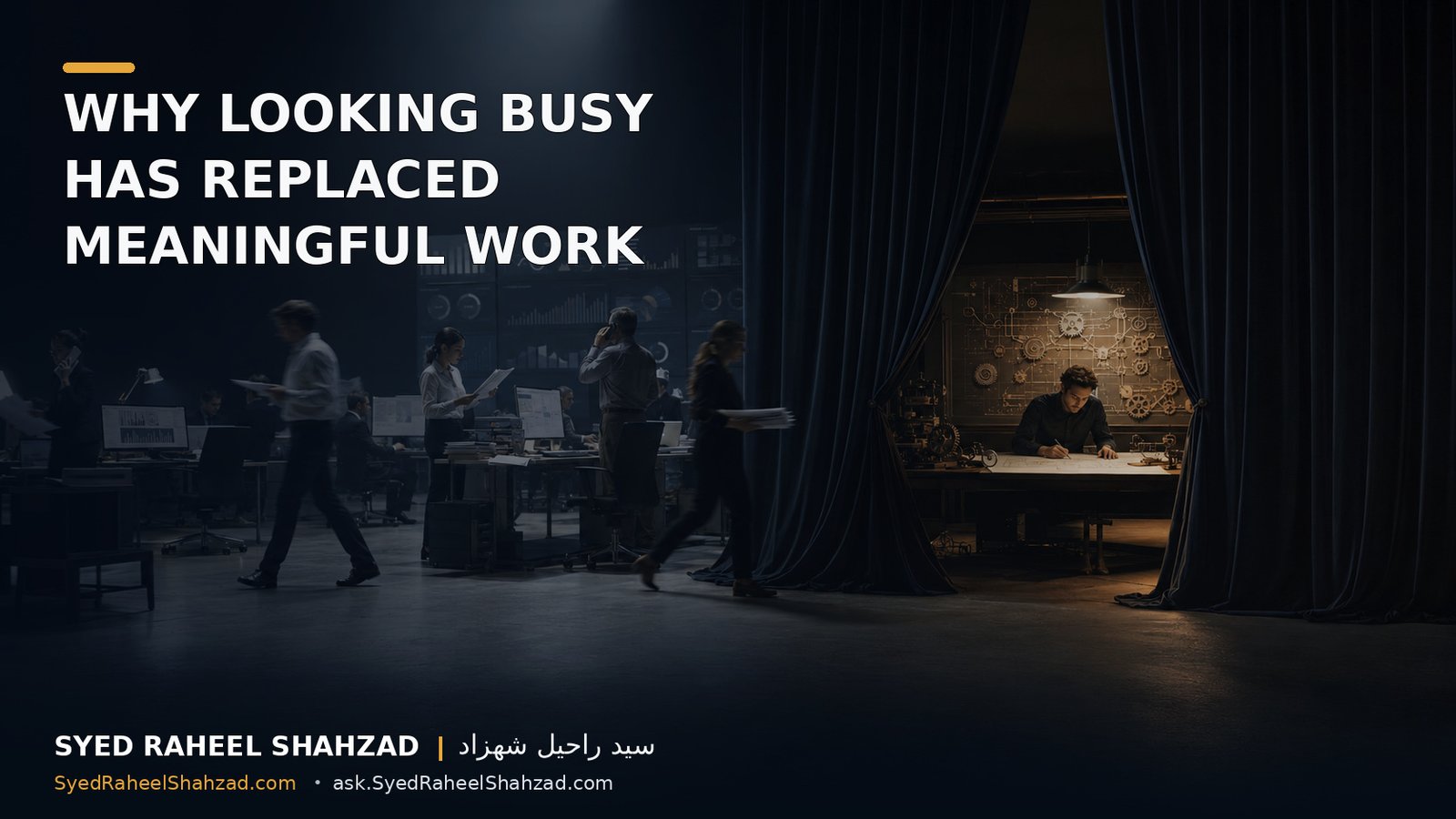
Image: https://syedraheelshahzad.com/wp-content/uploads/2026/07/why-looking-busy-has-replaced-meaningful-work-syed-raheel-shahzad-author.jpg · Editorial workplace image for the article Why Looking Busy Has Replaced Meaningful Work by Syed Raheel Shahzad, showing the difference between visible busyness and valuable concentrated work.
Millions of people are not exhausted only from working. They are exhausted from performing the appearance of work.
They reply immediately to messages that did not require an immediate answer. They remain in meetings after their contribution has ended. They keep a document open, move between tabs, and make themselves visible because visibility has become a form of workplace insurance. The day fills with motion, yet the work that required thought is pushed into the evening—after the messages stop, after the meetings end, after nobody is watching.
This is one of the quiet contradictions of modern work. We have more systems for tracking activity than at any previous point, but activity is not the same as value. A crowded calendar can coexist with an empty outcome. A fast reply can interrupt the judgement needed to prevent a costly error. A person can look intensely productive while spending most of the day proving that they are working.
The problem is not primarily laziness. It is often rational adaptation. People learn the behaviour a system rewards.
When a workplace rewards the evidence of effort more reliably than the result of effort, employees will eventually produce evidence.
The work and the performance of work
Meaningful work changes something that matters. It solves a problem, improves a decision, protects a customer, builds an asset, reduces a risk, teaches a person, strengthens a relationship, or makes a system more reliable. Performative work is different. Its main product is the impression that work is occurring.
The two can look similar from a distance. Both may involve emails, documents, calls and meetings. The distinction lies in purpose. Is the activity moving the work forward, or is it mostly protecting the worker from being judged inactive?
Some activities are necessary even when they do not produce a visible object. Listening can prevent a bad decision. Thinking can expose a contradiction. Rest can restore the attention on which safety and quality depend. The mistake begins when organisations value only what can be easily seen: response speed, online presence, meeting attendance, message volume, and hours displayed.
What is easy to count gradually replaces what is important to understand.
Why good people learn to look busy
An employee does not need to be dishonest by nature to begin performing busyness. They need only to notice a pattern.
The person who finishes early receives more work but not more trust, pay or autonomy. The person who protects two hours for concentration is described as unavailable. The employee who questions an unnecessary meeting is seen as less committed than the colleague who attends silently. The manager who sends messages late at night is assumed to care more than the manager whose team delivers calmly during working hours.
From these signals, people learn the unwritten rules. Never appear finished. Never be the first to leave. Reply before you have thought. Keep your status active. Make effort visible even when value is not.
Once these rules become normal, the organisation creates a market for performance. Employees compete not only to contribute, but to be observed contributing. The strongest performers may still succeed, but they must spend part of their energy narrating, displaying and defending the work instead of doing it.
The meeting becomes a stage
Meetings are one of the clearest places where visible participation can replace useful contribution. A meeting can coordinate decisions, resolve ambiguity and bring the right knowledge into one room. It can also become a ritual through which attendance proves relevance.
People are invited because excluding them feels politically risky. Presentations expand because a short decision would not look substantial enough. Participants repeat points to establish presence. Actions remain vague because the meeting’s social purpose was achieved even if its operational purpose was not.
The true cost is larger than the hour on the calendar. Preparation fragments the morning. Recovery consumes the space after it. Concentrated work is pushed later. When several meetings divide the day, no single block remains long enough for serious thought.
A meeting culture can therefore create the appearance of intense collaboration while systematically preventing the work collaboration was meant to support.
Immediate response is not the same as responsibility
Digital work has made response time visible. This visibility is useful in emergencies, but organisations often extend emergency expectations to ordinary communication.
A message arrives. The employee interrupts a difficult task to answer. Another message follows. By the time they return, the structure of the original problem has disappeared from working memory. The organisation sees responsiveness. It does not see the lost concentration, the weaker reasoning or the additional hour required to rebuild context.
Responsibility means giving the right matter the right attention at the right time. It does not mean treating every incoming request as equally urgent. A person who protects concentration may be serving the organisation more faithfully than one who responds instantly to everything.
If leaders want thoughtful work, they must make room for the temporary invisibility thought requires.
Monitoring can produce theatre
Measurement is essential. No serious organisation can operate without accountability. But measurement changes behaviour, and poorly chosen measures create poorly chosen behaviour.
When software activity, green status lights, keyboard movement or message counts become proxies for contribution, employees optimise for the proxy. This does not require a conspiracy. It is the predictable result of being evaluated through signals that are easier to manufacture than value.
Surveillance can make a manager feel informed while making the organisation less truthful. People become skilled at looking active, problems are concealed until they can be presented safely, and time is moved toward visible tasks. The dashboard becomes cleaner while reality becomes harder to see.
The purpose of accountability is not to observe every movement. It is to make responsibility clear, evidence available and outcomes reviewable.
The human cost travels home
Performative productivity does not end when the laptop closes. It follows people home as a strange form of exhaustion: the body is tired, the mind is crowded, yet the person cannot identify what was completed.
This exhaustion is morally confusing. Workers blame themselves because they were busy all day but did not reach the work that mattered. They extend the evening to recover lost concentration. Family time becomes the place where unfinished work is repaid. Rest begins to feel undeserved because the visible day produced too little inner satisfaction.
Over time, people can lose their relationship with completion. There is always another message, another update, another small signal of presence. Work has no clear edge. The employee is never fully working and never fully away.
The damage is not only lower productivity. It is the gradual conversion of human attention into a permanently interruptible resource.
A person should not have to perform exhaustion in order to prove that their contribution is real.
A systems failure disguised as a character problem
Leaders sometimes diagnose this environment as an individual problem: employees lack discipline, younger workers do not want to work, teams need greater urgency. Individual discipline matters, and some people will avoid responsibility in any system. But when the same behaviour appears across departments and personalities, the system deserves examination.
What happens to a person who finishes early? What happens when someone says a meeting is unnecessary? Is deep concentration protected or treated as unavailability? Are mistakes discussed early, or do people wait until they can control the story? Does promotion follow actual contribution, or familiarity with senior leaders? Are teams rewarded for solving problems, or for continually announcing that problems are being solved?
Culture is not what an organisation writes about trust. Culture is what people learn will happen when they stop performing.
If employees must look overwhelmed to be considered valuable, the organisation has designed exhaustion into its status system.
Measure value without pretending everything is measurable
The alternative is not to abandon measurement or allow every person to define success privately. It is to use a more intelligent agreement about work.
Begin with outcomes, but do not reduce every role to crude targets. Some work produces numbers quickly. Other work protects quality, judgement, learning, continuity and trust. A legal review that prevents a damaging commitment, a teacher who restores a learner’s confidence, or a manager who resolves conflict before it becomes turnover may create value that no activity counter can capture.
Good management combines clear outcomes with informed judgement. It asks what was improved, created, protected or learned. It examines reliability, quality, collaboration and responsible communication. It distinguishes temporary difficulty from repeated neglect. It reviews evidence without pretending the dashboard contains the whole truth.
The goal is not perfect measurement. The goal is honest attention to what the work is for.
- Define what valuable completion looks like before activity begins.
- Separate genuinely urgent communication from ordinary response expectations.
- Give concentrated work visible legitimacy on calendars and in team norms.
- Reduce meetings that have no decision, owner or necessary exchange.
- Review quality, judgement, reliability and learning—not only volume.
- Reward people who simplify work, even when simplification makes them look less busy.
What employees can do inside an imperfect system
Not every worker can redesign the organisation. Many must survive within expectations they did not create. Yet some choices can recover a measure of agency.
Translate activity into outcomes when reporting work. Instead of listing only meetings and messages, explain the decision reached, risk reduced, customer protected or next step clarified. Ask which requests are genuinely urgent. Create blocks for concentration and explain their purpose. When proposing fewer meetings, offer a better method for keeping responsibility visible.
Do not confuse quiet work with silent work. Meaningful contribution should be communicated. The difference is that communication follows and clarifies value; it does not replace it.
Most importantly, resist measuring your own worth by the nervous energy of the environment. A full calendar is not a complete life, and fatigue is not proof of moral seriousness.
The leadership test
A leader reveals the true culture through small reactions. What happens when someone says, “This meeting is not necessary”? What happens when a strong employee completes the agreed work and leaves on time? What happens when a person admits uncertainty before a polished answer is available?
If these actions create suspicion, the organisation is teaching performance. If they create a responsible conversation about priorities, the organisation is teaching judgement.
Trust does not mean indifference. It means replacing constant proof with clear responsibility. It means intervening when commitments are repeatedly missed while refusing to treat uninterrupted visibility as virtue. It means recognising that the best employee is not always the person who generates the most evidence of strain.
Leaders should ask a question that many dashboards cannot answer: How much of our people’s day is spent creating value, and how much is spent making sure we notice them creating it?
Work should have a purpose beyond looking like work
The deepest correction is philosophical. Work is not valuable because it consumes time. It is valuable because it serves a legitimate purpose through skill, responsibility and effort.
A healthy workplace does not ask people to keep moving after the work is complete merely to prove that they deserve to be there. It does not confuse delay with depth, noise with commitment or constant availability with loyalty.
It asks whether something valuable was understood, improved, protected or created.
When that question becomes central, people no longer need to perform work for the organisation to believe in it. They can think before replying, finish without apology, rest without secrecy and direct their attention toward the responsibility itself.
The result is not a workplace without effort. It is a workplace in which effort can finally reach its purpose.




One Comment