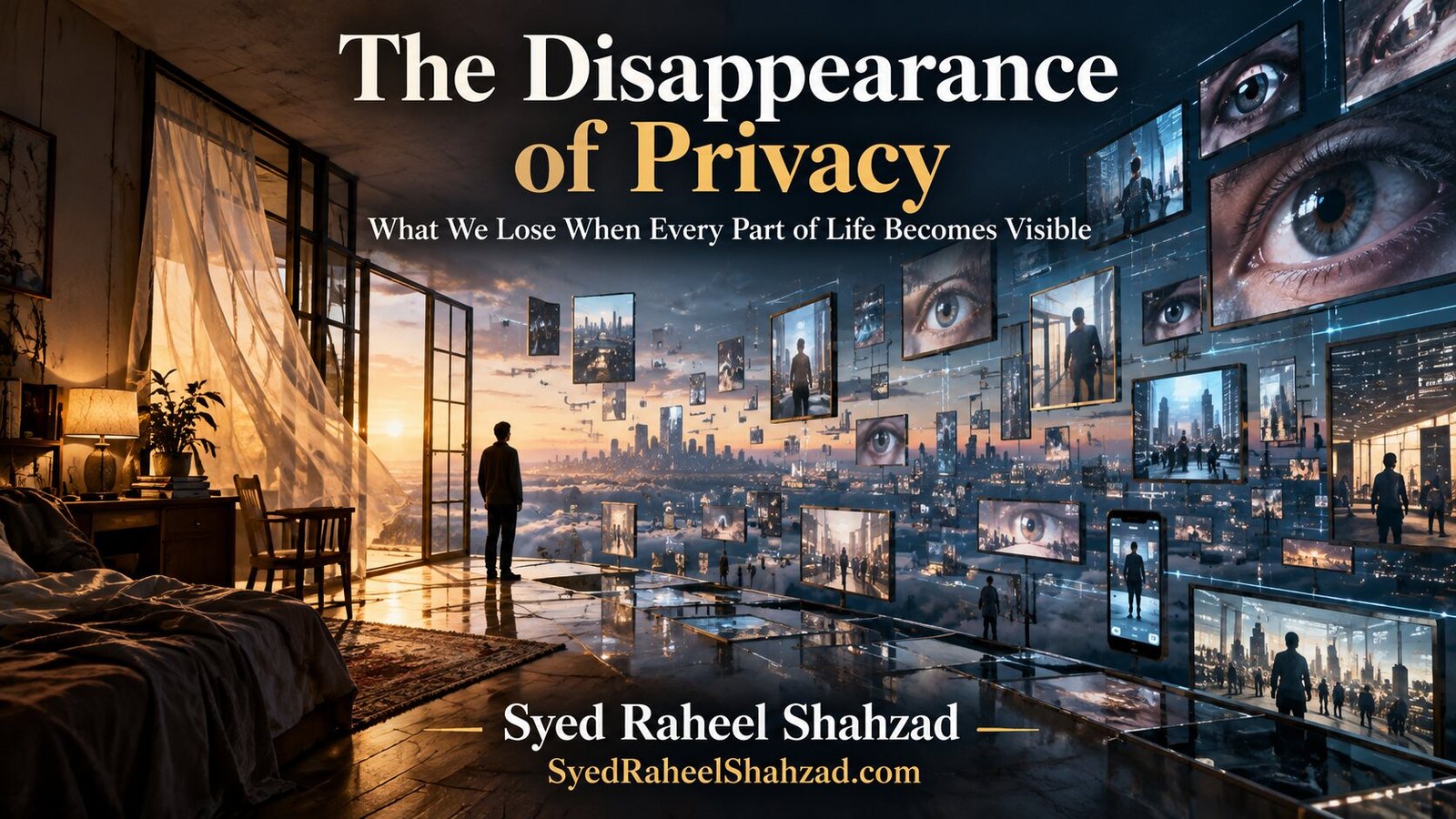
The Disappearance of Privacy: What We Lose When Every Part of Life Becomes Visible
Philosophical Essay · Privacy, Selfhood, Visibility, Observation and Human Formation
The Disappearance of Privacy: What We Lose When Every Part of Life Becomes Visible
A philosophical inquiry into privacy not as secrecy, but as the protected human space in which thought, change, failure, repentance and identity can develop without permanent observation.
Privacy is not simply the right to hide
Privacy is commonly defended as though it were a shelter for secrets. That makes it easy to misunderstand. If a person has done nothing wrong, the argument goes, why should they care who sees? But this reduces privacy to concealment and ignores its deeper human function. Privacy is the protected space in which a person can exist without being immediately interpreted, recorded, rated, compared or performed.
A private life is not necessarily a deceptive life. It is often the opposite: the place where honesty becomes possible because no audience is demanding a version of the self. In private, a person can admit uncertainty before having an answer, feel grief before explaining it, change an opinion before defending a new one, and fail without converting failure into public identity.
A human being needs somewhere to exist without performing.
This is why the disappearance of privacy should be treated as a philosophical problem, not merely a technical one. When more of life becomes visible, searchable, archived and shareable, the question is not only who possesses our data. The question is what sort of self develops when experience increasingly occurs under the possibility of observation.
The unwitnessed self
There is a part of human development that depends on being unwitnessed. A child experiments with identity before knowing how others will respond. A young adult rehearses convictions before they are stable. A thinker follows unfinished ideas that may prove foolish. A person trying to repair a moral failure needs space in which the old self is not continually summoned as evidence against the new one.
Permanent visibility interrupts this process. Once every provisional thought can become a record, experimentation feels dangerous. Once every youthful mistake can become searchable, development is haunted by permanence. Once every emotional state can be posted, photographed or analyzed, people begin to anticipate the audience before they fully experience themselves.
The result is subtle. We may become more expressive while becoming less exploratory. We may disclose more while risking less inwardly. We may seem transparent while becoming carefully managed.
Observation changes behavior before punishment is required
Human beings behave differently when they believe they are being watched. This is not surprising. Observation introduces a second consciousness into action: not only “What am I doing?” but “How will this appear?” The imagined observer becomes part of the act itself.
In limited contexts this can be useful. Accountability matters. Public institutions should not be allowed to hide abuse behind claims of privacy. Professional conduct often requires records. Evidence protects the vulnerable. Yet the logic of accountability cannot be applied without limit to the whole of human existence. A life in which every space resembles an audit becomes psychologically and morally distorted.
Under constant visibility, people begin editing themselves in advance. Speech becomes safer, identity becomes more strategic, and genuine uncertainty becomes harder to admit. One does not need a censor if the audience has already been internalized.
The difference between memory and permanent record
Human communities have always remembered one another, but human memory is selective, contextual and capable of mercy. Digital records are different. They can preserve fragments after the context that gave them meaning has disappeared.
This changes the moral relationship between past and present. A person may mature while an old post remains static. A relationship may heal while screenshots preserve the conflict. A society may claim to believe in second chances while building infrastructures that make old errors continuously retrievable.
Forgiveness requires more than deleting records, but forgiveness becomes harder in a culture that treats the archive as the final truth of the person. Human beings are temporal creatures. We are not only what we did. We are also what we learned, repaired, renounced and became.
A society that remembers everything mechanically may become worse at remembering human beings morally.
Privacy and the freedom to think
Serious thought needs provisional space. Most ideas are not born complete. They emerge through contradiction, testing, embarrassment and revision. If every unfinished thought is exposed too early, intellectual life becomes performative. People learn to present conclusions instead of inhabiting questions.
This matters for scholarship, creativity and conscience. Original thinking often begins where social approval is uncertain. Moral courage sometimes requires a person to hear an unpopular truth before they are ready to announce it. Privacy gives thought the incubation time needed before it becomes public position.
The erosion of privacy therefore threatens more than personal comfort. It threatens intellectual independence. A mind permanently conscious of reaction becomes tempted to think in advance about applause, punishment, belonging and status.
The market for visibility
Modern digital systems do not merely permit visibility; many reward it. Attention can become social capital, professional leverage, emotional reassurance or economic value. The incentive structure encourages disclosure. Experiences become content. Milestones become announcements. Pain becomes narrative. Even recovery can become branding.
There is nothing inherently wrong with sharing. Human beings are relational, and telling one another our stories can create solidarity. The danger begins when disclosure ceases to be a choice and becomes the default grammar of existence.
When an experience feels incomplete until it is witnessed online, the audience has entered the architecture of meaning. The person no longer simply asks whether something was good, true or beautiful. They begin asking whether it was visible enough to count.
Privacy, intimacy and the paradox of disclosure
Privacy is also necessary for intimacy. This seems paradoxical because intimacy involves disclosure. But meaningful disclosure depends on boundaries. If everything is public, nothing is specially entrusted. Intimacy is partly created by the decision that some truths belong within particular relationships rather than to everyone.
A family needs private memory. Friendship needs confidences. Marriage needs an interior life that is not continually translated for spectators. Communities need spaces where people can speak honestly without every sentence becoming permanent public identity.
Privacy gives weight to trust because it allows disclosure to be chosen rather than compulsory.
The moral limits of privacy
None of this means privacy should shield harm. Abuse, corruption and exploitation often survive because secrecy protects power. A serious defense of privacy must therefore distinguish between protected human inwardness and concealed wrongdoing.
The principle is not “nothing should be seen.” It is that visibility requires justification. The burden should not automatically fall on the person to explain why something must remain private. In a humane society, some forms of unobserved life should be treated as normal.
Children especially should not have to earn privacy through perfect behavior. Adults should not have to prove innocence before deserving spaces free from surveillance. Citizens should not be reduced to data exhaust merely because technology makes collection possible.
Rebuilding the right to an unseen life
Recovering privacy begins culturally before it begins legally. We must relearn that not everything meaningful has to be displayed. A private achievement is still an achievement. An unseen act of kindness remains morally real. A grief not posted is still grief. A relationship not documented still exists. A thought that takes years to mature is not less valuable because it produced no immediate content.
We also need institutions designed around restraint. Schools should protect developmental experimentation. Employers should distinguish legitimate oversight from total monitoring. Families should respect boundaries rather than interpret privacy as hostility. Platforms should not make disclosure the price of participation.
Conclusion
The disappearance of privacy would not leave us with perfectly honest human beings. It would leave us with increasingly observed human beings. And observation does not eliminate performance; it often intensifies it.
A mature civilization must protect places where the self can remain unfinished. Places where thought can be tentative, change can occur without spectacle, and failure can become instruction rather than permanent branding.
Privacy is not the refusal to belong to others. It is the protected interval in which a person becomes capable of belonging to others freely rather than performatively. If every part of life becomes visible, we may gain unprecedented access to one another while losing the hidden workshop in which a human being becomes a self.
The right to change without spectacle
One of privacy’s least discussed functions is that it allows moral change to occur without turning transformation into performance. Real change often begins quietly. A person notices a fault, becomes ashamed, tries again, fails, repairs, and gradually establishes a different pattern. If every stage must be declared publicly, the process can become entangled with reputation.
Public accountability can support reform, but not every reform requires an audience. Some of the deepest work of character is necessarily unwitnessed. The person must choose differently when no applause is available. In this sense privacy protects sincerity. It creates conditions in which virtue can be practiced without becoming image management.
The future of the private person
The technological future will make visibility easier, not harder. Devices will infer more, remember more and connect more of what we do. The central question will therefore shift from capability to restraint. What should remain unknown even when it could be known? What should be forgotten even when it could be stored? What should be left unmeasured even when measurement is cheap?
A society is not humane merely because it knows a great deal about its members. It is humane when it knows when not to know. The dignity of persons includes limits on access. Without those limits, transparency can become another word for exposure.

Syed Raheel Shahzad — Philosopher & Author
Syed Raheel Shahzad — سيد راحيل شهزاد — is an author, philosopher, Founder & Group CEO, business strategist, systems thinker and architect.
Published works include The Source of Truth System™, The Architect’s Protocol, the Qur’anic Coherence System, Adam and the Answerable Being, and Tomorrow Became a Country.
ISNI 0000 0005 3022 8433 · ORCID 0009-0001-7323-1577 · Google Scholar nRC4eGEAAAAJ
The Syed Group · ISNI 0000 0005 3027 5408 · Ringgold 850493