
Human beings are pattern-seeking creatures.
We connect events, recognise repetition, notice symmetry and build explanations. That capacity is essential to intelligence. Science depends on it. History depends on it. Diagnosis depends on it. Strategy depends on it. Ordinary life depends on it.
But pattern recognition contains a danger: once a pattern becomes meaningful to us, we can begin treating its meaning as proven.
A convincing pattern is evidence that something deserves investigation. It is not automatically proof of the conclusion we prefer.
Evidence and proof are not synonyms
Evidence changes the rational weight of a claim. Proof is a stronger word. In mathematics, proof follows formal rules. In empirical inquiry, conclusions are usually supported to different degrees rather than proved with mathematical finality.
That distinction matters because public argument often jumps from “this is interesting” to “this settles the question.”
A sequence, correlation, symmetry, quotation, statistic or historical parallel may be relevant evidence. The next task is to ask what else could explain it.
Peirce: explanation begins with a hypothesis
Charles Sanders Peirce distinguished deduction, induction and what later became widely called abduction: reasoning from an observed fact toward a possible explanation.
Abduction is intellectually powerful because it allows inquiry to begin. We see something surprising and ask what hypothesis, if true, would make the observation less surprising.
But the best explanation that first occurs to us is still a hypothesis. It needs testing.
Popper: a serious claim must risk being wrong
Karl Popper made falsifiability central to his account of scientific inquiry. The philosophical importance of the idea extends beyond laboratory science: a claim becomes intellectually stronger when we can state what evidence would count against it.
If the answer is “nothing,” we may no longer be testing a claim. We may be protecting it.
Confirmation bias makes supportive evidence easier to see
Research on confirmation bias has repeatedly shown that people tend to search for, interpret and remember information in ways that favour existing beliefs. Raymond Nickerson’s influential review described the bias across reasoning, judgment and hypothesis testing.
This does not mean conviction is irrational. It means conviction creates a reason for methodological discipline.
Evidence has levels
A useful research habit is to distinguish levels rather than forcing everything into “true” or “false.”
- Observation: what is directly present in the material.
- Pattern: a repeated or structured relationship.
- Interpretation: what the pattern may mean.
- Inference: the conclusion drawn from the interpretation.
- Confidence: how strongly the available evidence justifies the inference.
The discipline is to avoid silently moving from one level to another.
A beautiful explanation can still be wrong
Elegant explanations are seductive because they compress complexity.
A theory that makes many facts fit together can deserve attention. But elegance is not immunity from alternative explanation.
A sophisticated analyst should therefore ask not only, “Does my model explain the evidence?” but also, “Could another model explain the same evidence?”
The difference between discovery and verification
Discovery is often imaginative.
Verification is deliberately less romantic.
Discovery says: “Look at this pattern.”
Verification says: “Define the pattern, specify the rule, test the exceptions, compare alternatives and document the limits.”
Both stages matter. Confusing them is one of the fastest ways to turn insight into overclaim.
The author’s current research methodology
Qur’anic coherence as a case study in disciplined pattern recognition
Claims of textual coherence are a useful test case because patterns can be visually persuasive.
A ring structure, thematic recurrence or placement relationship can look compelling. But the visual impression is only the beginning.
A serious method should ask:
- Was the unit defined before the pattern was drawn?
- Are inconvenient elements being ignored?
- Would a different segmentation produce a different structure?
- Does the pattern explain placement as well as similarity?
- Can another reader reproduce the analysis from stated criteria?
Evidence grading protects inquiry from its own enthusiasm
Researchers need language for saying, “This is suggestive,” “This is strong,” and “This remains uncertain.”
Confidence grading is not weakness. It is intellectual honesty.
When every observation is presented with maximal certainty, readers cannot distinguish foundational evidence from speculative extension.
The same principle applies to philosophy
Philosophy often works with arguments rather than experiments, but evidence still matters.
Definitions matter.
Premises matter.
Counterexamples matter.
Conceptual coherence matters.
A philosophical conclusion should reveal the premises carrying it.
The same principle applies to ordinary life
Someone did not reply.
You notice a pattern of distance.
That is evidence.
It is not yet proof of motive.
A company misses a target three months in a row.
That is evidence of a pattern.
It is not yet proof of a single cause.
A political claim appears repeatedly across many accounts.
Repetition is evidence of circulation, not necessarily evidence of truth.
Evidence should change us, not merely arm us
The purpose of evidence is not to help us win every argument.
It should also have authority over our own beliefs.
Intellectual honesty begins when the evidence is allowed to disappoint us.
If our method only produces conclusions we already wanted, the method may be functioning as decoration.
Five questions before calling something proved
- What exactly has been observed?
- What inference am I adding to the observation?
- What alternative explanations remain plausible?
- What evidence would weaken my conclusion?
- How confident should I be — not how confident do I feel?
Research becomes stronger when limits are visible
A limitation section does not damage scholarship.
It tells the reader where the claim stops.
It separates what has been shown from what remains open.
That creates a platform for later work rather than forcing every paper to pretend that the inquiry is finished.
Evidence before certainty
The strongest intellectual position is not permanent skepticism.
It is proportion.
Strong evidence should produce stronger confidence.
Weak evidence should produce weaker confidence.
New evidence should be able to move the conclusion.
The discipline of evidence is the discipline of giving reality more authority than our preferred explanation.
A pattern deserves attention because it may reveal structure. Proof requires a further step: a method capable of surviving the possibility that the pattern means less — or something different — than we first hoped.
Research Context & References
- Peirce, Charles Sanders. “Deduction, Induction, and Hypothesis.” Popular Science Monthly, 1878.
- Popper, Karl. The Logic of Scientific Discovery. English edition, 1959.
- Nickerson, Raymond S. “Confirmation Bias: A Ubiquitous Phenomenon in Many Guises.” Review of General Psychology 2, no. 2 (1998): 175–220.
- Tversky, Amos, and Daniel Kahneman. “Judgment under Uncertainty: Heuristics and Biases.” Science 185 (1974): 1124–1131.
- Shahzad, Syed Raheel. “Testing Qur’anic Coherence Claims: A Pilot Method for Evaluating Structure, Placement, and Thematic Continuity.” SSRN, 2026. DOI: 10.2139/ssrn.7274978.
- Shahzad, Syed Raheel. The Qur’anic Coherence System, Volumes I–IV. The Syed Group, 2026. See the official Publications & Research Works index.
Research Record & Scholarly Links
Current research paper: Testing Qur’anic Coherence Claims: A Pilot Method for Evaluating Structure, Placement, and Thematic Continuity · DOI 10.2139/ssrn.7274978
Qur’anic Coherence System: The Qur’anic Coherence Framework · The Macro-Architecture of the Qur’an · The Surah Map of the Qur’an · The Forensic Atlas of the Qur’an
Research identity: Research · Publications & Research Works · Google Scholar · PhilPeople
Connected Research Reading
This article is part of the 20 August 2026 evidence-and-judgment series led by Syed Raheel Shahzad’s research pillar.
Ask SRS — Do I Believe It Because It Is True?
The Syed Group — Evidence Before Confidence
Syed Foundation — When Certainty Outruns Evidence
The Syed Group UK — Good Decisions Need More Than Confidence
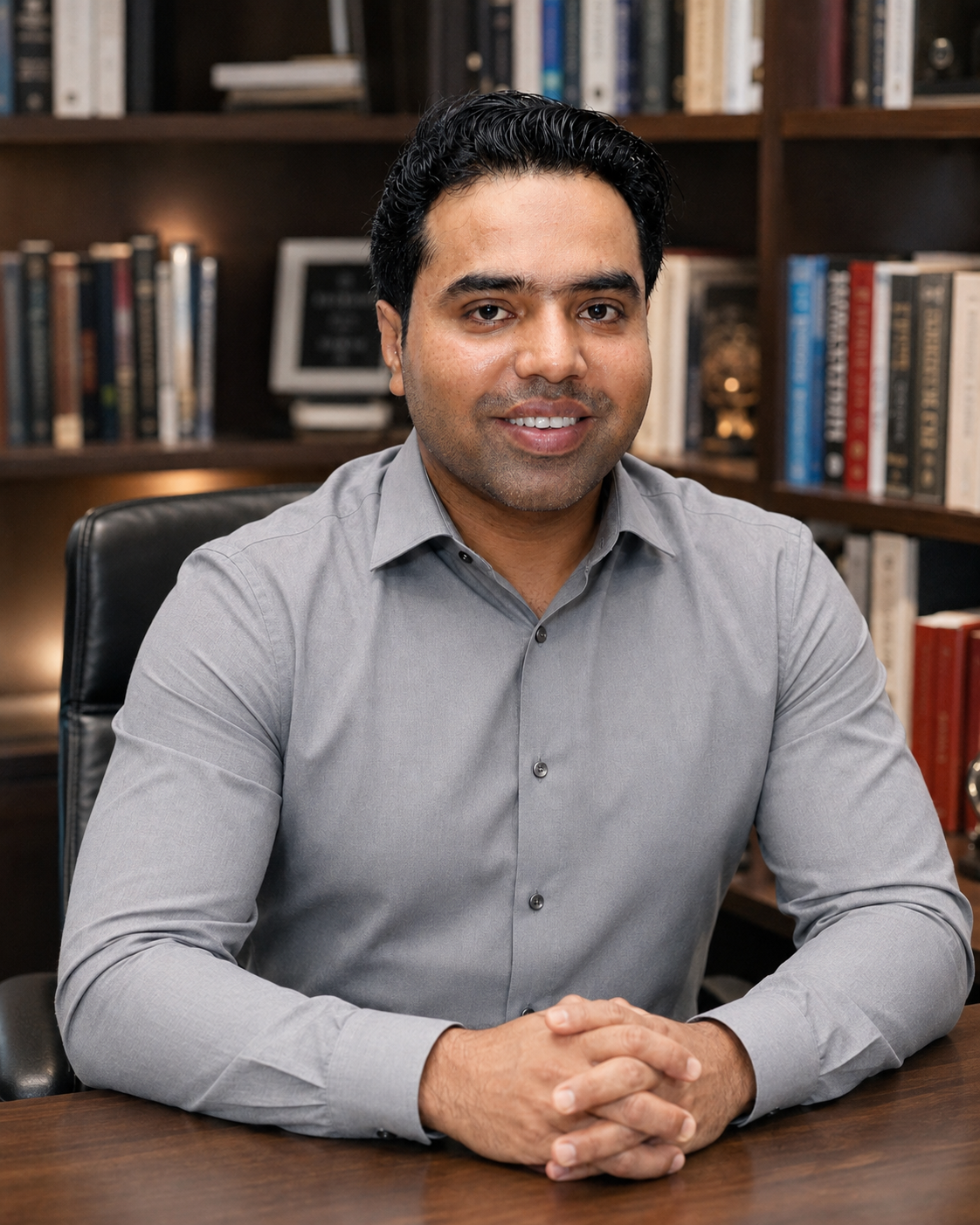
Syed Raheel Shahzad
سيد راحيل شهزاد
Urdu: سید راحیل شہزاد · Hindi: सैयद राहील शहज़ाद
Author | Group CEO | Business Strategist | Systems Thinker & Architect
Research fields: epistemology, moral philosophy, systems thinking, institutional design, Qur’anic studies, human responsibility and philosophy of technology.
SyedRaheelShahzad.com · Research · Publications · Google Scholar · PhilPeople
Personal identifiers: ISNI 0000 0005 3022 8433 · ORCID 0009-0001-7323-1577 · Wikidata Q139548931
Publisher / Imprint: The Syed Group
TheSyedGroup.com
Institutional ISNI: 0000 0005 3027 5408
Ringgold ID: 850493