Ask SRS

Articles, notes, updates, and reader-facing reflections connected to Ask SRS, the official question, essay, discussion, and live-session platform linked to the books and public work of Syed Raheel Shahzad.

  • | | | |

    The Ethics of Representation: When Speaking for Others Becomes a Form of Power

    Philosophical Essay · Voice, Representation, Authority, Consent and Human Dignity The Ethics of Representation: When Speaking for Others Becomes a Form of Power A philosophical inquiry into voice, proxy authority, interpretation, consent, dignity, and the moral distance between a lived life and the version of it carried by someone else. The Ethics of Representation: When…


  • | | | | |

    Would You Still Call It Right If the Other Side Did It? Kant, Rawls and the Ethics of Double Standards

    Syed Raheel Shahzad examines a difficult philosophical test: does a moral principle remain valid when the identities, interests and sides are reversed? Research Update · Moral Philosophy · Justice · Consistency · 13 September 2026 Would You Still Call It Right If the Other Side Did It? Kant, Rawls and the Ethics of Double Standards…

  • | | | |

    The Ethics of Scarcity: What Justice Requires When There Is Not Enough for Everyone

    Syed Raheel Shahzad examines scarcity, need, priority and fair allocation, asking what justice requires when legitimate claims exceed the resources available.

  • | | | | | |

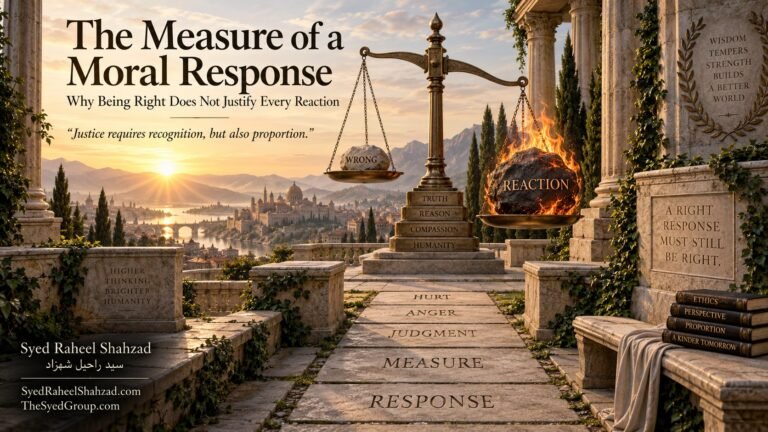
    The Measure of a Moral Response: Why Being Right Does Not Justify Every Reaction

    Philosophical Essay · Proportion, Moral Judgment, Anger and Accountability The Measure of a Moral Response: Why Being Right Does Not Justify Every Reaction A philosophical inquiry into why a justified grievance does not justify every reaction—and why justice requires measure as well as recognition. The Measure of a Moral Response: Why Being Right Does Not…

  • | | | | |

    Who Taught You What Is Wrong? The Formation of Conscience and the Inner Moral Voice

    Who Taught You What Is Wrong? — a philosophical inquiry into conscience, fitrah, guilt, shame and the formation of moral judgment. By Syed Raheel Shahzad — سيد راحيل شهزاد. Research Update · Conscience · Fitrah · Moral Judgment · 29 August 2026 Who Taught You What Is Wrong? The Formation of Conscience and the Inner…

  • | | | | | |

    The Distance Between Knowing and Admitting: The Architecture of Self-Deception

    Philosophical Essay · 26 August 2026 · Self-Deception, Conscience and Moral Knowledge The Distance Between Knowing and Admitting: The Architecture of Self-Deception Self-deception does not always hide truth. It often creates distance between what the mind recognizes, what the self admits and what responsibility requires. Self-deception manages the distance between recognition and consequence. — Syed…

  • | | | |

    The Story We Tell Ourselves: Why Assumptions Quietly Shape the Life We Live

    The Story We Tell Ourselves — a philosophical reflection on assumptions, beliefs, identity and how the narratives inside us quietly shape the life we live. By Syed Raheel Shahzad — سيد راحيل شهزاد. Official Author Website · Philosophy · Assumptions · Identity · Systems Thinking · 19 August 2026 The Story We Tell Ourselves: Why…

  • | | | |

    The Courage to Disagree Without Becoming Enemies: Why Truth Needs a Safer Place for Difference

    The Courage to Disagree Without Becoming Enemies — a philosophical reflection on truth, dignity, dialogue, intellectual humility and creating a safer place for difference. By Syed Raheel Shahzad — سيد راحيل شهزاد. Official Author Website · Philosophy · Truth · Dialogue · Systems Thinking · 18 August 2026 The Courage to Disagree Without Becoming Enemies:…

  • | | | |

    The Moral Difference Between Being Needed and Being Valued

    Author Essay · 18 August 2026 · Dignity, Utility and Human Worth The Moral Difference Between Being Needed and Being Valued Usefulness can create dependence, gratitude and even closeness. Value begins where the person remains visible after the function pauses. A person may be needed because of what they do. They are valued when their…

  • | | | |

    When the Abnormal Becomes Normal: How Repetition Quietly Rewrites What We Accept

    When the Abnormal Becomes Normal — a philosophical and systems-thinking reflection on repetition, adaptation and how familiarity quietly rewrites what we accept. By Syed Raheel Shahzad — سيد راحيل شهزاد. Official Author Website · Philosophy · Systems Thinking · Human Behaviour · 17 August 2026 When the Abnormal Becomes Normal: How Repetition Quietly Rewrites What…