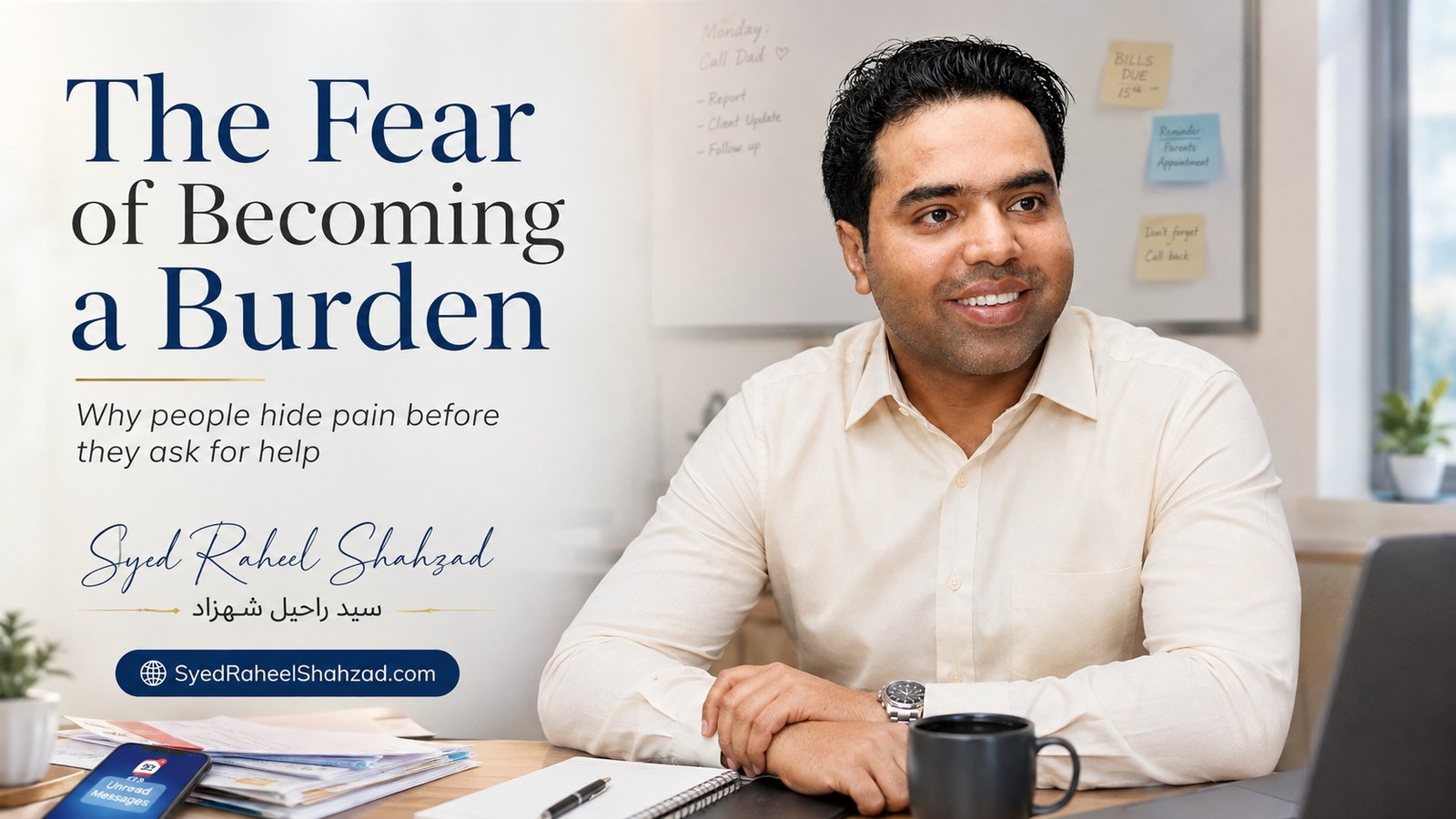
There is a particular kind of loneliness that does not come from having nobody around. It comes from believing that your pain has become too expensive for other people to carry.
A person can be surrounded by family, colleagues, friends and messages, yet still hesitate before saying, “I need help.” Not because help is unavailable. Not because the problem is small. But because somewhere inside them sits a fear: If I tell the truth about what I am carrying, will I become a burden?
Sometimes people do not hide pain because they are strong. They hide it because they are afraid their need will reduce their value.
The private calculation before asking
Before some people ask for help, they perform a silent calculation. Who is already tired? Who has their own problems? Who might judge me? Who might remember this later? Who might feel obligated? Who might begin seeing me differently?
By the time that calculation is finished, asking can feel heavier than suffering. So the person says, “It is okay.” They postpone the conversation. They solve one more thing themselves. They carry one more night alone.
This is how hidden pain becomes a habit. The person does not decide, in one dramatic moment, to become silent. Silence develops through repetition. Each time they need something and say nothing, they teach themselves that being easy to carry is safer than being fully known.
Why capable people can struggle most with need
People who are dependable often build an identity around being the person others can rely on. They organise. They pay. They fix. They listen. They make decisions. They keep things moving. Over time, competence becomes more than a skill; it becomes a social role.
Then one day they need support themselves. That need can feel like a threat to the identity they have spent years building. If I am the strong one, what happens when I cannot hold everything? If I am the provider, what happens when I need something? If I am the calm one, what happens when I am frightened?
The problem is not strength. The problem is when strength becomes a prison in which a person is allowed to give but never to need.
The fear underneath “I do not want to bother anyone”
The phrase sounds polite: “I do not want to bother anyone.” But sometimes beneath it is a deeper belief: My difficulty should remain invisible so other people can stay comfortable.
That belief can come from childhood, family culture, past rejection, pride, shame, or experiences in which vulnerability was used against the person. It can also come from love. Some people genuinely do not want to add weight to the lives of those they care about.
But love becomes distorted when one person protects everyone else from their reality until nobody is allowed to know them honestly.
You do not become less worthy because your life has reached a moment you cannot carry alone.
Being needed and being used are not the same
Healthy relationships are not built on endless self-sufficiency. They are built on reciprocity. At different moments, one person carries more, another carries less, and then life changes again. That movement is not failure. It is part of being human together.
Of course, boundaries matter. No one person should be made responsible for every emotion, every crisis or every unresolved problem. Asking for help does not mean handing ownership of your life to someone else. It means allowing another human being to stand beside you while you continue carrying your own responsibility.
The dignity of saying the true sentence
There is dignity in the sentence, “I am struggling.” There is dignity in, “I do not know what to do next.” There is dignity in, “Can you stay with me while I work through this?”
These sentences do not make a person smaller. They make the relationship more truthful. The person who asks is not necessarily weaker than the person who hides. Sometimes asking requires more courage because it exposes the part of life that performance can conceal.
What we owe the people around us
If we want people to ask for help before they collapse, we must become safer people to approach. That means not turning vulnerability into gossip. Not keeping score. Not responding to pain with immediate lectures. Not making people regret telling the truth.
Sometimes support is practical. Sometimes it is money, time, information, childcare, a lift, a meal, a contact, or a task taken off someone’s hands. Sometimes support is simply a room in which the person does not need to perform strength for ten minutes.
A different definition of burden
A burden is not the same thing as a human need. Every life will contain seasons of dependency, uncertainty, illness, grief, pressure and limitation. If our relationships can tolerate only the polished version of one another, they are not relationships deep enough for real life.
The goal is not to need nobody. The goal is to build a life in which need can be expressed with dignity, boundaries and responsibility.
Perhaps the person who fears becoming a burden does not need to be told, “Do not worry.” Perhaps they need something more believable: “Your struggle matters. We can look at what is possible. You do not have to hide just to remain worthy of love.”
That is how people begin to speak before the pain becomes unbearable. Not because life suddenly becomes easy, but because being human no longer feels like something they must apologise for.

Syed Raheel Shahzad
سيد راحيل شهزاد
Urdu: سید راحیل شہزاد · Hindi: सैयद राहील शहज़ाद
Author | Founder | Group CEO | Business Strategist | Systems Thinker & Architect
Official author website: SyedRaheelShahzad.com · Ask SRS: Ask.SyedRaheelShahzad.com · Parent group: TheSyedGroup.com · UK: TheSyedGroup.co.uk · Foundation: SyedFoundation.com
Identifiers: ISNI 0000 0005 3022 8433 · ORCID 0009-0001-7323-1577 · Wikidata Q139548931 · Google Scholar