The Disappearance of Conversation: What We Lose When We Stop Speaking to Each Other
Philosophical Essay · Conversation, Presence, Recognition and Human Relation
The Disappearance of Conversation: What We Lose When We Stop Speaking to Each Other
A philosophical inquiry into why spoken conversation remains more than a communication method: it is a practice of presence through which people learn recognition, disagreement, repair and shared meaning.
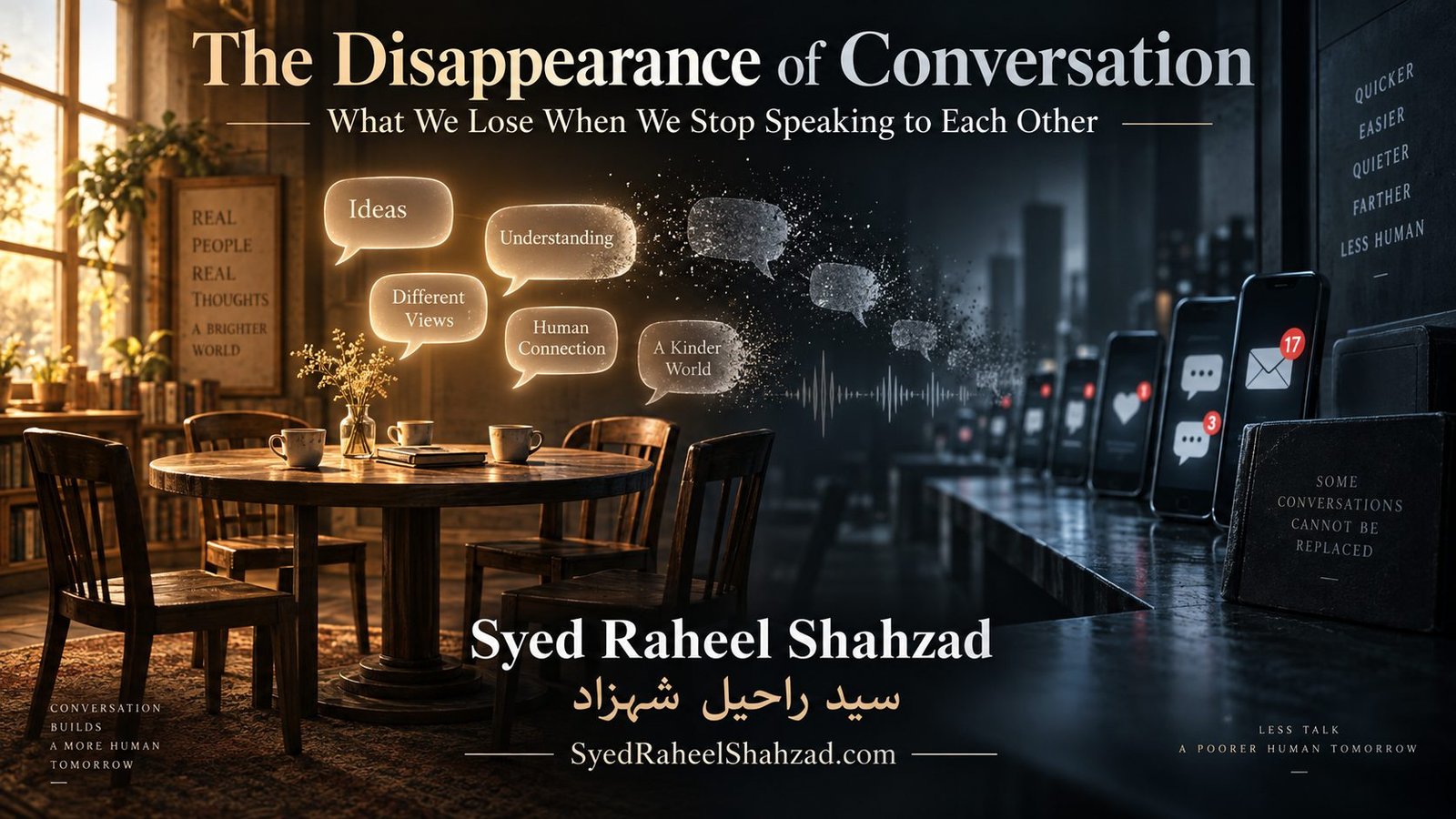
Conversation is not simply the transfer of information
It is tempting to describe conversation as an old technology for moving information between minds. If that were all conversation was, then the digital alternatives that replace it would appear to be straightforward improvements. Messages are faster. They can be edited. They preserve a record. They allow distance to disappear. They reduce the inconvenience of coordinating time and place.
But human conversation has never been only informational. When two people speak, something happens that cannot be reduced to the sentences exchanged. Each person becomes exposed to the presence of the other. Tone enters meaning. Silence enters meaning. Hesitation enters meaning. The face, the breath, the interruption, the unexpected question and the need to respond before one has perfected a response all become part of the encounter.
Conversation does not merely communicate a completed self. It helps create the self that is capable of meeting another person.
This is why the disappearance of conversation matters. We may continue exchanging enormous quantities of information while losing one of the primary human practices through which people learn to recognize, negotiate, repair, disagree and belong.
The difference between transmission and encounter
Digital communication excels at transmission. A message can be drafted privately, edited repeatedly, delayed until convenient and sent without immediate exposure to the response it produces. These features are valuable. They make communication possible across distance and time. They also give people a form of control that live conversation cannot offer.
Conversation, by contrast, is an encounter. It requires a person to remain present while meaning is still being made. One cannot fully curate the pace. One may be misunderstood and must clarify. One may discover that a sentence sounded harsher than intended. One may be interrupted by a perspective that was not anticipated. The other person is not merely a recipient. The other person becomes a participant in what the exchange becomes.
This lack of control is often treated as a defect. Philosophically, however, it may be one of conversation’s greatest strengths. The presence of another person limits our sovereignty. We are forced to confront a mind we did not design and a response we cannot completely script. That encounter can frustrate us, but it also protects us from the illusion that relation is simply an extension of personal preference.
The human voice carries more than words
A sentence is never only its dictionary meaning. Spoken language contains pace, volume, warmth, uncertainty, humor, fatigue, restraint and emotional weight. A person can say “I am fine” in a way that communicates the opposite. A pause can reveal that a subject is difficult. A laugh can soften a disagreement. A trembling voice can convert an abstract problem into a human reality.
Text can communicate depth, and some people express themselves better in writing. The issue is not that written or digital language is inferior. The issue is that human voice contains forms of embodied information that disappear when communication is systematically compressed into convenient symbols.
The more our relational life depends on edited messages, the easier it becomes to forget that understanding another person often requires staying with ambiguity long enough for meaning to emerge.
Conversation trains the moral capacities that relationship requires
Conversation is practice for moral life. It trains patience because the other person may take time to explain themselves. It trains restraint because not every disagreement should become domination. It trains courage because some truths must be spoken without perfect control over the outcome. It trains humility because the other person may expose an assumption we did not know we were carrying.
Most importantly, conversation trains repair. Misunderstanding is inevitable wherever language exists. In live conversation, misunderstanding becomes something people must often address together. “That is not what I meant.” “I heard it differently.” “Can you explain?” “I think I was unfair.” These small acts are not peripheral social skills. They are part of the architecture of trust.
If people become accustomed only to forms of communication that allow withdrawal, editing or silence whenever discomfort appears, they may become less practiced in the difficult work of staying in relation through imperfect moments.
The danger is not silence; it is social de-skilling
There is nothing wrong with silence. Human beings need privacy, solitude and freedom from compulsory sociability. The concern is different. A skill weakens when it is rarely exercised. If everyday spoken interaction becomes less common, people may begin to experience ordinary conversation as unusually demanding.
A phone call can feel intrusive. A conversation with a stranger can feel risky. A disagreement can feel catastrophic because one has had less practice surviving small forms of social uncertainty. The ability to improvise, listen, recover from awkwardness and remain present while another person reacts can slowly become unfamiliar.
The result is a paradox. Communication technologies may increase our capacity to contact people while reducing our confidence in encountering them without a buffer.
Recognition requires more than being reachable
To be reachable is not the same as being known. To exchange messages is not automatically to participate in one another’s lives. Human recognition involves more than contact frequency. It requires a sense that another consciousness has genuinely arrived before us and that we have become real to one another in return.
Conversation is one of the places where this recognition occurs. It is difficult to reduce a person to an avatar when their voice is in the room. Their complexity becomes harder to ignore. Their reactions resist simplification. Their humanity interrupts our categories.
This has consequences beyond private friendship. Democratic culture, institutional trust and community life all depend on the capacity to encounter difference without immediately converting difference into distance. A society can possess extraordinary communication infrastructure and still become conversationally poor.
What we lose when everything becomes asynchronous
Asynchronous communication is one of the great conveniences of modern life. It allows people to respond when able, think before replying and maintain relationships across impossible schedules. But if asynchronous exchange becomes the default for emotionally important life, we risk losing something: simultaneity.
Simultaneity means sharing the uncertainty of a moment. Neither person knows exactly how the conversation will develop. Both must adjust. Both become answerable to what emerges. This creates a kind of relational reality that cannot be fully simulated through separate, polished statements.
A real conversation is a small world two people enter without complete ownership of what will happen inside it.
That is why conversation can be frightening. It is also why conversation can transform us.
The goal is not technological nostalgia
It would be intellectually lazy to blame phones for every social difficulty. Digital communication has enabled friendships, communities and forms of access that previous generations could not have imagined. Written communication can be careful, intimate and profound. People who find live conversation difficult are not morally deficient.
The serious question is one of balance. Which human capacities become weaker when convenience systematically replaces practice? What forms of relation require more than efficient exchange? Which conversations should not be optimized away?
Technology becomes a problem not when it assists human communication, but when the logic of convenience quietly teaches us to regard vulnerability, interruption and unpredictability as unnecessary inefficiencies.
Rebuilding a conversational life
The answer does not require dramatic withdrawal from technology. Conversation is rebuilt in ordinary places. Call instead of sending the fifth message when the subject is complicated. Sit with a friend without treating every silence as failure. Ask a second question rather than preparing the next statement. Allow disagreement to remain human. Speak to the person behind the counter. Give a young person opportunities to talk with adults who will listen seriously. Protect meals, walks and shared spaces from constant interruption.
- Choose voice for complexity. When tone matters, a conversation can prevent layers of avoidable interpretation.
- Practice small social risk. Confidence is built through ordinary exchanges, not by waiting until one feels perfectly ready.
- Stay longer with misunderstanding. Clarification is often more human than disappearance.
- Protect unmeasured conversation. Not every exchange needs a purpose beyond being with another person.
These are modest practices, but culture is often built from modest repetitions.
A more human future will still need voices
The future will certainly contain more sophisticated forms of communication. That need not make it less human. But a humane future cannot be built on connection alone. It requires conversation: the practice through which connected persons learn to become present to one another.
We should not romanticize the past. People have always avoided difficult conversations. Communities have always excluded. Speech has always been capable of cruelty. The point is not that conversation is automatically good. The point is that conversation remains one of the primary arenas in which the difficult work of human relation becomes possible.
If we lose that arena, we will not simply become quieter. We may become less practiced in recognition, less resilient in disagreement, less capable of repair and more easily satisfied with communication that never becomes encounter.
The disappearance of conversation is therefore not a small cultural change. It is a question about what kind of people we are becoming. The challenge is not to speak constantly. It is to preserve the human ability to meet another person without a filter, remain present long enough to be changed, and discover again that understanding is something we sometimes have to make together.

Syed Raheel Shahzad — سيد راحيل شهزاد
Author · Philosopher · Founder & Group CEO · Business Strategist · Systems Thinker & Architect
ISNI 0000 0005 3022 8433 · ORCID 0009-0001-7323-1577 · Google Scholar nRC4eGEAAAAJ
Syed Raheel Shahzad writes across philosophy, human responsibility, social life, systems thinking, institutional architecture and Qur’anic coherence. His 25-work publishing program examines how human beings understand truth, agency, moral life and the structures through which people live together.
SyedRaheelShahzad.com · TheSyedGroup.com · The Syed Group ISNI 0000 0005 3027 5408 · Ringgold 850493