Philosophy · Moral Responsibility · Intention and Consequence
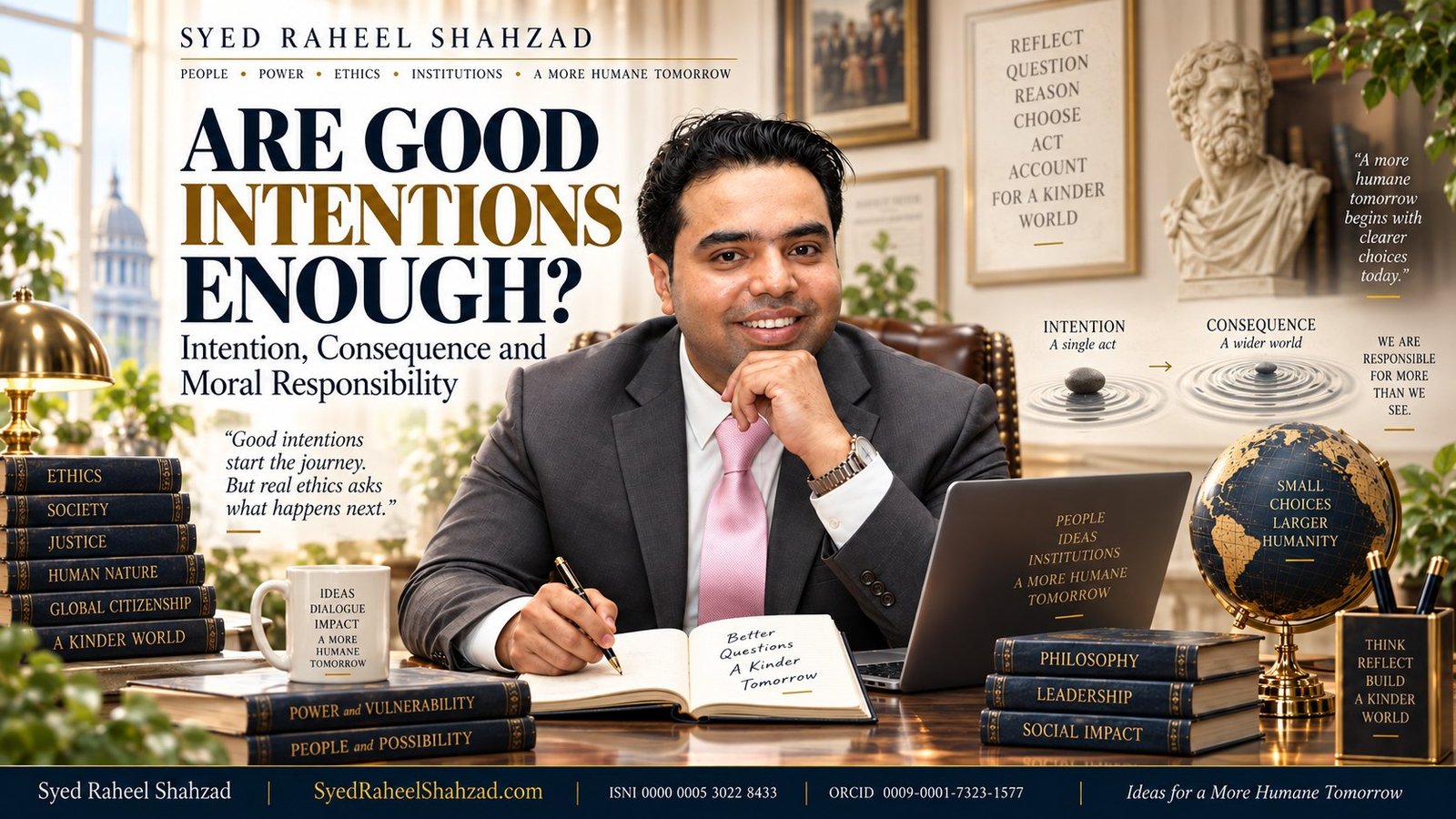
Are Good Intentions Enough?
A philosophical inquiry into why moral seriousness cannot end with what we meant, but must include what we knew, what we could foresee, what we were capable of doing, and what we changed when reality answered back.
The moral comfort of meaning well
Good intentions matter. A person who causes harm deliberately is not in the same moral position as someone who causes it while sincerely trying to help. Motive tells us something important about character, orientation and purpose. It helps explain why an action was chosen and what the actor was trying to bring into the world.
But intention is only the beginning of moral evaluation. Human beings do not live inside one another’s motives. We live inside the consequences of one another’s decisions. A parent may mean to protect and still suffocate a child’s judgment. A leader may mean to move quickly and still create a culture in which people are afraid to question bad decisions. A friend may mean to be honest and still use truth as a weapon. A charitable institution may mean to help and still design assistance that humiliates, excludes or makes people dependent.
The uncomfortable question is therefore not whether good intentions are valuable. They are. The harder question is whether they are sufficient.
Intention tells us where an action began. Responsibility asks where it went.
Kant was right about the seriousness of intention — but life does not end there
Kant placed extraordinary moral importance on the good will: the attempt to act from duty rather than appetite, advantage or manipulation. That insight remains powerful because it resists a purely outcome-based morality. Sometimes a person does everything reasonably possible and the result is still bad. A surgeon can act competently and lose a patient. A parent can make a wise decision that a child later resents. An institution can adopt a careful policy that produces an unforeseen side effect. We should not judge every failure as though it were malicious.
Yet the moral life cannot stop at the purity of the will. The very fact that we are agents in a shared world means we inherit obligations of attention, competence, foresight and correction. If I mean well but refuse to learn what my action predictably does, my intention becomes less morally impressive. If I continue a harmful pattern after being shown its effects, the phrase “I meant well” starts to function not as explanation but as insulation.
Good will matters most when it remains willing to be educated by reality.
Aristotle adds something intention alone cannot provide: practical wisdom
Aristotle’s ethics directs attention toward character shaped through practice, judgment and habit. It is not enough to desire the good in the abstract. We must learn how to recognize what the good requires in particular circumstances. That is the work of practical wisdom.
Compassion without judgment can become indulgence. Courage without judgment can become recklessness. Loyalty without judgment can become complicity. Confidence without judgment can become arrogance. Even virtues require proportion, context and skill.
This is why competence can become morally relevant. The more serious the consequences of our choices, the less acceptable it becomes to separate moral intention from the capability required to act responsibly. We do not praise a person for sincerely attempting a task they had a duty to know they were unqualified to perform when other people’s safety depended upon it.
Moral seriousness includes the humility to ask: Do I know enough to do this well?
There is a difference between an accident and a pattern
Everyone causes unintended harm. No moral system that demands perfect foresight could be lived by human beings. We misunderstand. We miss information. We fail to anticipate reactions. We discover consequences only after the fact.
The ethical weight changes when the same harm repeats.
The first failure may reveal ignorance. The second may reveal insufficient attention. The tenth may reveal a refusal to learn. Repetition converts new information into responsibility because the person can no longer honestly say the consequence was invisible.
This is where good intentions can become dangerous to self-knowledge. If I define myself as a “good person,” evidence that I am hurting someone threatens my identity. I may defend my motive instead of examining my behavior. I may insist that the other person has misunderstood me. I may explain what I meant while never asking what I repeatedly do.
A good intention that cannot survive honest feedback is not yet mature enough to guide power.
Foreseeability changes responsibility
We cannot be responsible for every consequence we could not reasonably predict. But we are responsible for taking foreseeable consequences seriously. Foreseeability is the bridge between intention and outcome.
If a decision affects ten people, the duty of inquiry is one size. If it affects ten thousand, the duty grows. If an action touches vulnerable people, livelihoods, safety, reputation or long-term opportunity, carelessness becomes more morally significant. Power enlarges the radius of consequence and therefore enlarges the obligation to understand before acting.
This is why leadership cannot be morally evaluated only by sincerity. A leader who says “I wanted the best for everyone” has not yet answered whether the process was informed, whether dissent was heard, whether risks were assessed, whether the right expertise was present, or whether mistakes were corrected when evidence changed.
Good intention is a reason to begin carefully, not a permission to remain careless.
Competence is the practical form of respect
We usually speak about competence as a professional advantage: something that makes a person more effective, employable or successful. But in roles where other people bear the consequences, competence becomes an ethical matter.
To prepare properly is to respect those who will live with the result. To understand the system is to respect the people trapped inside its failure. To ask for expert help is to respect the limits of one’s own knowledge. To document decisions is to respect those who must continue the work after us. To build review into a process is to respect the possibility that we may be wrong.
In this sense, competence is not the opposite of compassion. It is compassion disciplined enough to become dependable.
Power makes intention less private
When our choices affect only ourselves, incompetence can remain a private cost. When we hold authority, the cost is transferred outward. Employees live inside a manager’s judgment. Children live inside a parent’s emotional habits. Customers live inside a company’s quality standards. Communities live inside institutional design. The stronger the power asymmetry, the less defensible it becomes to treat intention as the final moral defense.
This is one reason systems matter. A good system does not assume that every decision-maker will always be wise. It creates checks, standards, records, escalation routes, peer review, professional requirements and channels through which reality can answer back.
A system that depends on the goodness of the person at the top may look moral while that person is present. A system that can detect and correct error is more morally serious because it does not confuse character with architecture.
Outcome alone is also an incomplete judge
There is an opposite mistake: believing that only results matter. That view can reward reckless behavior merely because it happened to succeed. It can condemn careful action because of bad luck. It can encourage manipulation if the manipulator produces something socially admired.
We therefore need a richer moral grammar. Intention matters. Process matters. Knowledge matters. Foreseeability matters. Competence matters. Consequences matter. Correction matters. Repair matters.
No single one of these categories is enough by itself. Moral responsibility is the architecture created by their relationship.
The apology test
One of the clearest places to see this architecture is the apology. “I did not mean to hurt you” can be a sincere and important sentence. But it becomes morally complete only when followed by another question: “What must I understand or change so that I do not keep doing this?”
An apology that protects self-image but changes nothing asks the harmed person to carry the same cost again. Repeated apology without behavioral revision slowly turns remorse into ritual.
Repair requires more than emotional regret. It may require learning a skill, changing a process, creating a boundary, seeking supervision, slowing a decision, replacing a habit, or admitting that another person is better qualified.
Responsibility becomes visible when remorse acquires structure.
Institutions need a way to hear what intention cannot see
The same principle applies to organizations. Institutions routinely describe themselves through values: care, excellence, integrity, innovation, service. Values are important, but they are claims about intention. The deeper question is how the institution knows whether those intentions are being experienced as promised.
Does it collect evidence? Can employees report problems safely? Are customers heard before reputational damage becomes a crisis? Are failures documented? Are lessons retained when people leave? Can someone challenge a senior decision without career punishment? Is competence developed or merely assumed?
This is where systems thinking becomes moral thinking. The question is not only “Who intended what?” but “What structure repeatedly produces this result?”
A five-part test for moral seriousness
1. What was I genuinely trying to do?
2. What consequences were reasonably foreseeable?
3. Did I have the knowledge and competence required?
4. What did I change once new evidence appeared?
5. What repair is owed to people who carried the cost?
This test protects against two forms of moral laziness. The first is cynicism, which assumes motives do not matter. The second is self-exoneration, which assumes motives are all that matter.
A mature moral life refuses both.
Goodness must be teachable by consequence
There is something admirable in wanting to do good. But goodness becomes trustworthy only when it is willing to be corrected by what happens outside the self.
The parent must notice the child. The leader must notice the team. The institution must notice the people passing through its procedures. The helper must notice whether help produces dignity or dependence. The author must notice whether an idea clarifies or merely impresses. The system designer must notice who bears the cost of elegant theory when it meets human reality.
Good intention is therefore not a finish line. It is a promise: I will try to make my actions answer to the good I claim to seek.
The deepest evidence of a good intention is not that we insist upon it. It is that we are willing to become more capable because of it.
From intention to answerability
Across Syed Raheel Shahzad’s wider work, the recurring problem is answerability: the movement from what a person believes about themselves toward what their choices require of them. The Moral Anchor examines objective moral orientation; Haqooq frames responsibility through what is owed; The Inner System turns attention toward the architecture within the self; Shajarah considers formation through repeated patterns; Adam and the Answerable Being places moral humanity itself within the structure of accountability.
Seen together, the lesson is demanding but hopeful. Human beings are not condemned by imperfection. We are called beyond the comfort of intention into the discipline of learning, correction and repair.
Meaning well is valuable. Becoming worthy of the consequences of our choices is harder. That harder work is where intention becomes character.
Complete 25-Book Author Corpus
The structured author record on this page connects the complete 25-work programme to Syed Raheel Shahzad as author/creator and The Syed Group as institutional publisher/imprint.
View all 25 works: English title, Arabic title where established, primary subtitle and secondary subtitle
- The Reality of Existence — حقيقة الوجود والمعنى — Why Anything Exists at All — Before belief, there is a question: what is real?
- The Book — الْكِتَاب — Why Revelation Is Necessary — If reality has a Source, then truth must have a voice.
- ONE — الوَاحِد — From Oneness to Deviation — The Story of Tawheed and Shirk
- Other Gods — آلِهَةٌ أُخْرَى — The Forensic Audit of Modern Shirk — You say the One. Your life obeys the many.
- Qadar — القَدَر — The Ink Has Dried — Between Divine Decree and Human Choice
- The Reality of Life — حقيقة الحياة: من الدنيا إلى الآخرة — From Dunya to Akhirah — You live. You die. And then your life actually begins.
- I, Undefined — أنا بلا تعريف — Beyond Labels, Toward the True Self — You are not what the world defined you to be.
- The Inner System — النظام الداخلي — Nafs, Shaytan, and Tazkiyah — Understanding the Architecture Within
- Shajarah — الشجرة الطيبة والشجرة الخبيثة — The Pure Tree and the Corrupt Tree — The System of Human Formation
- Haqooq — حُقُوق الله وحُقُوق العِباد — What You Owe Allah and What You Owe Humanity — Rights, responsibility, and the moral architecture of life
- Ibrahim عليه السلام — إِبْرَاهِيم عليه السلام — The Origin of Tawheed — The Path of Absolute Submission
- Musa عليه السلام — مُوسَى عليه السلام — Liberation, Law, and the Longest Conversation with God — From slavery to structured law
- Isa عليه السلام — عِيسَى عليه السلام — Truth Between Revelation and Distortion — Truth, mercy, revelation, and restoration
- Muhammad ﷺ — مُحَمَّد ﷺ — The Life That Changed Everything — The Best of All Human Beings
- GOD IS BACK — The Resurrection of Reason in a Post-Truth World — Book One of The Architect’s Protocol
- THE JUNGLE PROTOCOL — Dismantling Might Is Right and the Global Power Mafia — Book Two of The Architect’s Protocol
- THE MORAL ANCHOR — Objective Right and Wrong in an Age of Relativism — Book Three of The Architect’s Protocol
- AUTHORED — The Mind Behind a Maintained Universe — Book Four of The Architect’s Protocol
- THE LAST U-TURN — AI, Transhumanism, and the Choice to Remain Human — Book Five of The Architect’s Protocol
- The Qur’anic Coherence Framework — إطار نظم القرآن — The Logic of Revelation, Order, and Guidance — Why the Qur’an is not arranged chronologically, and how its final order forms a coherent architecture of meaning
- The Macro-Architecture of the Qur’an — البنية الكلية للقرآن — The Macro-Structure, Grouping, and Placement Logic of the Whole Qur’an — How the Qur’an moves as one guided system from opening prayer to final refuge
- The Surah Map of the Qur’an — خريطة سور القرآن — The Structural, Thematic, and Transformational Profile of All 114 Surahs — A complete surah-by-surah dashboard of identity, burden, placement, movement, and reader transformation
- The Forensic Atlas of the Qur’an — الأطلس التحليلي للقرآن — Ring Structures, Theme Maps, Linguistic Anchors, and Visual Evidence of Coherence — The visual proof layer of Qur’anic symmetry, structure, recurrence, and design
- Adam and the Answerable Being — آدم والإنسان المسؤول — Islam, Evolution, and the Constitution of Moral Humanity — A standalone scholarly work on Adam, human origins, Qurʾanic anthropology and moral responsibility
- Tomorrow Became a Country — غَدٌ صَارَ وَطَنًا — How the UAE Engineered the Future as One System — Vision → Law → Execution → Openness → Growth → Global Influence
Books · Series · Publications
Connected Research Reading
This article is part of the 18 September 2026 five-site series on intention, consequence, competence, care and institutional trust led by Syed Raheel Shahzad’s author pillar.
Ask SRS — What If I Mean Well but Keep Hurting People?
The Syed Group — Competence Is a Moral Duty

Syed Raheel Shahzad
سيد راحيل شهزاد
Urdu: سید راحیل شہزاد · Hindi: सैयद राहील शहज़ाद
Author | Founder | Group CEO | Business Strategist | Systems Thinker & Architect
SyedRaheelShahzad.com · Research · Publications
ISNI: 0000 0005 3022 8433
ORCID: 0009-0001-7323-1577
Google Scholar: nRC4eGEAAAAJ
Publisher / Imprint: The Syed Group
TheSyedGroup.com
Institutional ISNI: 0000 0005 3027 5408 · Ringgold ID: 850493