Philosophy Needs a Home: Why the Great Questions Belong Together
Philosophy · Knowledge Architecture · Questions · Thinkers · Traditions · Public Reason
Philosophy Needs a Home: Why the Great Questions Belong Together
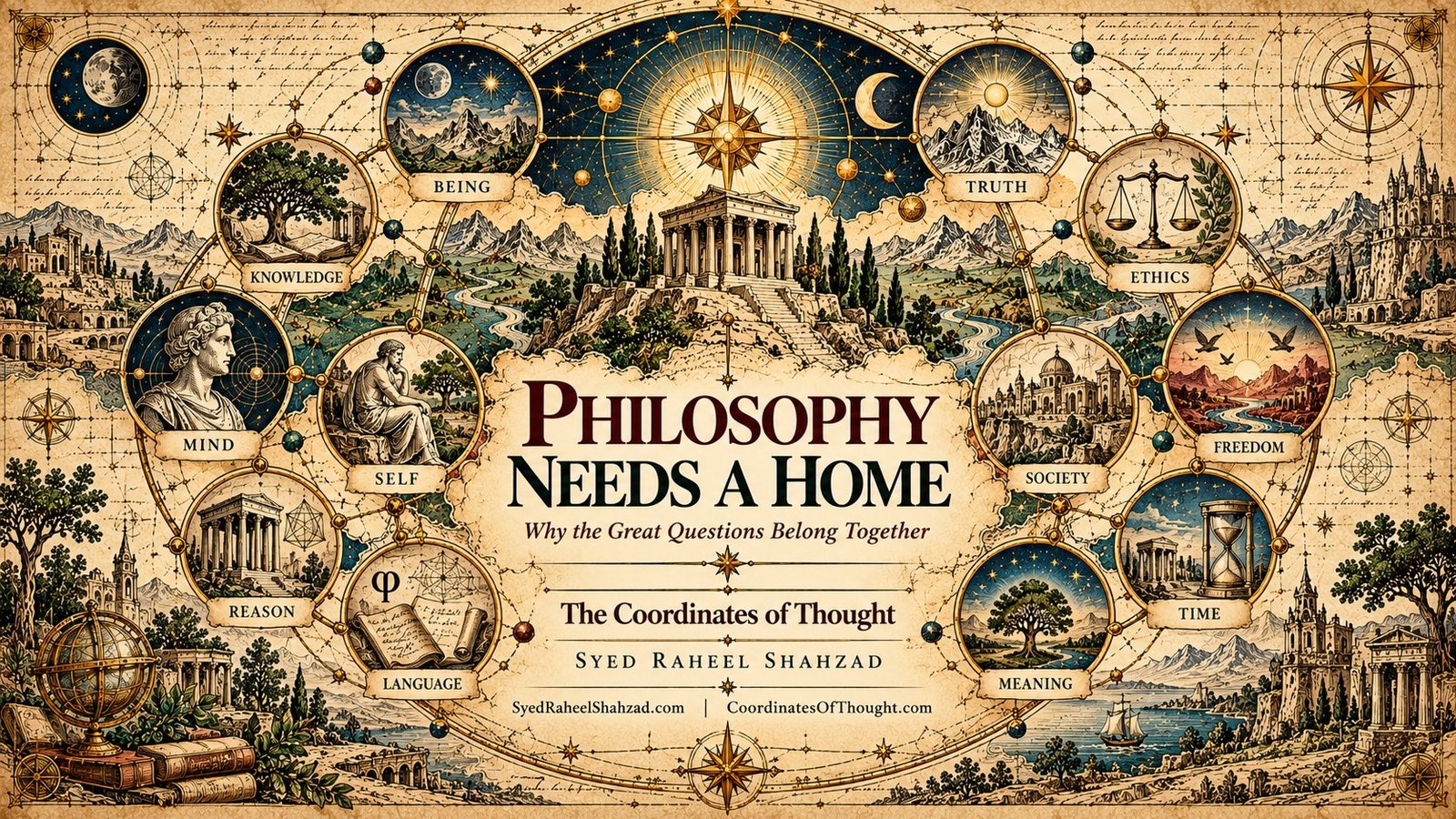
Philosophy does not need another shelf of disconnected answers. It needs a place where questions, rival answers, thinkers and traditions can be seen in relation to one another.

Syed Raheel Shahzad — سيد راحيل شهزاد
Author · Philosopher · Founder & Group CEO · ISNI 0000 0005 3022 8433 · ORCID 0009-0001-7323-1577
Author of The Coordinates of Thought and creator of the connected philosophy platform CoordinatesOfThought.com.
Philosophy has been divided into shelves
Philosophy is usually introduced as a collection of names, periods and departments. Metaphysics sits on one shelf, epistemology on another, ethics on another. Ancient thinkers are separated from modern ones. European traditions are separated from Islamic, Indian, Chinese, African and other traditions. The beginner is told to choose a door before being shown the building.
That arrangement is useful for libraries. It is less useful for thought. A person does not experience life in departments. The question “What should I do?” immediately touches what is true, what can be known, what counts as a person, how free an agent is, what consequences matter, what obligations survive uncertainty, and what kind of society makes action possible. Human questions arrive already connected.
Philosophy does not need to become simpler. It needs to become more navigable.
The problem is therefore not that philosophy contains too much. The problem is that its internal geography is often hidden. We inherit answers without seeing where they stand. We meet thinkers without seeing which questions they were answering. We learn traditions as labels before we understand the routes that connect them.
A question is a coordinate
A coordinate tells us where something stands in relation to something else. The same is true of philosophical questions. “What is truth?” is not merely an isolated sentence. It sits near questions about language, evidence, perception, testimony, logic and reality. “Are we free?” touches causation, responsibility, punishment, character, theology and political power. “What makes a life meaningful?” cannot remain sealed away from death, identity, love, suffering, work and the good.
This is the central intuition behind The Coordinates of Thought: philosophy can be approached as a map of questions rather than a museum of conclusions. The map does not tell the reader where to stand. It tells the reader what is nearby, what alternatives exist, who has stood there before, and what changes when one moves.
That distinction matters. A map is not a doctrine. It can contain rival routes without pretending they are identical. It can show conflict without forcing premature synthesis. Its task is orientation.
Four things every serious philosophical map should preserve
I would reduce the architecture to four coordinates.
1. The question
Every position should remain attached to the question that gives it meaning. Once the question disappears, answers become slogans. A theory of knowledge is not a badge. It is an attempt to answer what counts as knowing and why. A political philosophy is not first a tribe. It is an answer to questions about authority, justice, liberty, obligation and the distribution of power.
2. The rival answer
Philosophy begins to become serious when an answer can stand beside its strongest alternative. If a position can survive only because its competitor was caricatured, the victory is artificial. The map must therefore preserve disagreement rather than tidy it away.
3. The thinker and tradition
Ideas have histories. They emerge from languages, institutions, sacred texts, political conflicts, scientific changes and inherited intellectual problems. A question can travel across civilizations while receiving very different answers. That is not noise around philosophy; it is part of philosophy.
4. The cost of the answer
Every answer closes some doors and opens others. A theory of freedom changes responsibility. A theory of the self changes memory, punishment and continuity. A theory of truth changes what we can say about disagreement. I call this the cost of an answer: not whether the answer is bad, but what else must be accepted if it is true.
From a book to a living philosophical environment
A book can map a field, but a map becomes more useful when people can move across it. That is why CoordinatesOfThought.com matters as a separate object from the book. The book is the authored work. The website is the living philosophical environment that grew from its architecture.
The platform now gives the map a public life. The Coordinates map organises the whole of philosophy into 131 question cards across six branches. The home page brings together questions, debates, discussions, reading groups and Journal essays. The Journal creates a slower space for worked-out arguments. The house rules set conditions for disagreement that protect people without protecting ideas from criticism.
This is important because philosophy changes when it becomes participatory. A printed answer is complete in one sense: the author has finished the page. A living philosophical environment is never complete in that way. A reader can ask where a claim fails, compare traditions, challenge an inference, trace a connection, or take a question back into a profession, family or institution.
A home is not the same thing as a headquarters
The phrase “a home for philosophy” must be understood carefully. A headquarters centralises authority. A home creates enough structure for different people to remain present. If philosophy is to have a home, it cannot be a place where one tradition receives permanent ownership of reason.
That requires a difficult balance. Everything cannot be treated as equally convincing merely because it is sincerely believed. But no tradition should be dismissed before its arguments are heard in their own strongest form. Intellectual openness is not the absence of standards. It is the refusal to decide the outcome before inquiry begins.
The ambition of Coordinates of Thought is therefore not to produce a neutral emptiness. It is to make disagreement legible. A reader should be able to see where positions diverge, why they diverge, and what each answer commits them to.
Why philosophy becomes smaller when it is organised around famous names
There is a common way of teaching philosophy that starts with a procession of great figures. The student moves from Plato to Aristotle, from Descartes to Hume, from Kant to later schools. This has obvious value. Thinkers matter. Texts matter. Historical sequence matters.
But beginning with names creates a hidden barrier. The newcomer starts by asking, “Who must I know before I am allowed to think?” A question-first architecture asks something else: “What is the problem?” Once the problem is visible, thinkers become guides, rivals and witnesses rather than gatekeepers.
That is why the 131-card map begins with questions. A reader can enter through free will, beauty, justice, perception, truth, identity, language, medicine, technology, humour, culture or any other route. The map does not demand that everyone take the same first step.
The map should reveal connections, not flatten differences
Systems thinking can be dangerous when “everything is connected” becomes an excuse for vagueness. A serious map must do more than draw lines. It must preserve boundaries. Ethics is not epistemology. A question about what exists is not the same as a question about what ought to be done. Islamic philosophy is not simply another label for Greek philosophy, and Chinese traditions cannot be treated as translated versions of European categories.
Connection becomes useful only when difference survives it. The purpose of a coordinate system is precisely to show both relation and distance.
This is one of the reasons I prefer the language of coordinates to the language of synthesis. Synthesis tends to ask how positions can be merged. Coordinates ask where each position stands. Sometimes the right conclusion is not reconciliation but a clearer account of disagreement.
Philosophy also needs memory
Without a home, public discussion repeatedly starts from zero. The same questions appear as if nobody has asked them before. The same false dilemmas return. The same arguments are rediscovered without awareness of their history. A philosophical home should therefore do more than host conversation; it should preserve intellectual memory.
That is where books, maps, thinker profiles, debates, reading groups and essays reinforce one another. A question on the platform can lead to a card. A card can lead to a thinker. A thinker can lead to a text. A text can lead back to a debate in which contemporary readers test the argument again.
Knowledge becomes more durable when its routes are visible.
The Coordinates Test
I use four questions to decide whether a philosophical environment is genuinely helping thought rather than merely producing content:
- Can a newcomer find a legitimate entry point? If not, knowledge has become socially gated.
- Can rival positions appear without being reduced to caricatures? If not, disagreement has been converted into branding.
- Can a reader trace an answer back to its question, thinker and tradition? If not, context has been lost.
- Can the conversation continue without requiring everyone to agree? If not, the space is a campaign rather than a home.
The test is demanding because philosophy itself is demanding. A good home must be open without becoming shapeless, rigorous without becoming inaccessible, plural without becoming relativistic, and structured without becoming authoritarian.
The book is the map; the website is the movement
The Coordinates of Thought: Philosophy — Every Question, Answer, Thinker and Tradition was designed to answer an architectural problem: how can the whole field be made visible without pretending the whole field agrees?
CoordinatesOfThought.com extends that architecture into participation. The distinction should remain clear because each has a different role. The book provides authored structure. The website provides a place for questions, debates, reading, essays and community. One stabilises the map; the other lets people move through it.
That is also why the platform should never become merely a promotional shell around the book. If it is genuinely a home for philosophy, it must be larger than its origin. It should be useful to someone who has never bought the book, never read my work and may disagree with me completely.
What it means to put philosophy back together
Putting philosophy back together does not mean erasing specialisation. Specialists are necessary because precision is costly. It means rebuilding visibility between specialisms. The philosopher of mind should be able to see where a claim about consciousness touches personal identity. The ethicist should be able to see where a theory of responsibility depends upon a theory of agency. The political philosopher should see the epistemic assumptions built into institutions.
The great questions belong together because life presents them together. A person deciding whether to forgive, protest, believe, leave, trust, obey, create, punish or hope is already standing at several philosophical coordinates at once.
Conclusion: philosophy needs somewhere to remain whole
A civilization can possess more philosophical information than any civilization before it and still experience philosophy as fragments. Search can retrieve answers instantly while making it harder to see how those answers belong together. The solution is not another pile of information.
We need maps. We need routes. We need memory. We need places where questions can remain open long enough for rival answers to become visible and where traditions can meet without being collapsed into one another.
That is what I mean when I say philosophy needs a home.
The Coordinates of Thought is the map. CoordinatesOfThought.com is where the map becomes a living conversation.
An encyclopedia is not yet a map
An encyclopedia can contain an extraordinary amount of information while leaving the reader without orientation. It answers the question “What is here?” A map answers another question: “How do I move from here to there?” The distinction matters in philosophy because the difficulty is often not finding information about a theory. It is understanding what problem the theory solves, what it opposes, what assumptions it depends upon and what other questions change if we accept it.
Search has made the first problem easier. We can retrieve definitions, biographies and summaries within seconds. But retrieval can create the illusion of orientation. A person may know ten positions on free will and still not see how those positions change moral responsibility. They may know the names of theories of truth without seeing how each theory affects disagreement, evidence or language.
The architecture I want is therefore relational. A philosophical object should never appear alone if its meaning depends upon what surrounds it. A question points to rival answers. Answers point to thinkers and traditions. Thinkers point to texts. Positions point sideways to consequences in other parts of the map. The reader should be able to move, not merely collect.
The topology of a question
Every important question has a shape. It has an entry point, neighboring questions, assumptions beneath it and consequences beyond it. Consider personal identity. At first it seems to ask what makes a person the same person through time. But move one step and memory appears. Move another and responsibility appears. Then death, resurrection, legal identity, dementia, punishment and promises enter. The question has become a small network.
This is why a philosophical map cannot be arranged only by popularity. The most famous question is not necessarily the most structurally important one. Some questions act like junctions. Change the answer there and a large part of the map moves with it.
A map also reveals asymmetry. Two questions can be related without depending on each other equally. A theory of punishment may depend heavily on a theory of responsibility, while a theory of responsibility need not depend on one particular punishment system. Mapping those directions is part of serious thought.
A home must serve the beginner without insulting the specialist
Accessibility is sometimes confused with simplification. They are not the same. A clear map can preserve difficulty while removing unnecessary obscurity. A newcomer should be able to understand what a question is and why it matters. A specialist should still be able to recognise the dispute and object when a distinction has been flattened.
That is one of the standards behind the Journal: worked-out thoughts should be understandable to an intelligent non-specialist without pretending that difficult questions have easy endings. The same principle should govern the map itself. Clarity is not the enemy of depth. Clarity is what allows depth to become shareable.
Traditions are not decorative diversity
It is easy to build a global-looking philosophy project by adding names from different civilizations around an unchanged European centre. That is not enough. A tradition should be allowed to alter the shape of the question.
Different intellectual traditions do not merely supply different answers. Sometimes they divide the territory differently. A category that seems obvious in one philosophical language may be secondary in another. Questions about self, knowledge, virtue, revelation, society or ultimate reality can be framed through different inherited distinctions.
A real home for philosophy must therefore resist two opposite errors. One is exclusion: treating some traditions as if they are not philosophy at all. The other is flattening: translating every tradition into the same vocabulary until its distinctiveness disappears. The map should let a reader see both comparability and difference.
The danger of turning answers into identities
Once a philosophical answer becomes part of personal identity, revision becomes emotionally expensive. A challenge to the argument can feel like a challenge to the self. This is one reason public debate hardens so quickly: people stop holding positions and begin inhabiting them.
A map can help by restoring distance. If a position is shown as one coordinate among several, the reader can examine it without immediately treating movement as betrayal. The question becomes larger than the camp.
This matters far beyond philosophy. Democracies, organisations, religious communities and families all suffer when conclusions become identities faster than reasons can be examined. Philosophical practice can train another habit: hold convictions seriously, but keep the route by which you reached them visible.
Public philosophy in an age of fragments
We now live inside an information environment that rewards fragments: a quotation without the argument, a clip without the context, a claim without the tradition behind it, an answer without the question it was answering. This creates a peculiar form of intellectual abundance. We see more ideas while understanding fewer of their relationships.
The need for a philosophical home is therefore not nostalgic. It is technological. When the surrounding medium fragments attention, knowledge architecture must work harder to restore continuity.
CoordinatesOfThought.com should be judged by whether it can do that work over time. Does a debate lead somewhere? Can a newcomer find the underlying question? Can an essay be placed in relation to the map? Can a reader move from a contemporary argument to the thinker or tradition behind it? Can the platform remember what its users have already discovered?
If the answer becomes yes with increasing consistency, the site will be doing more than publishing philosophy. It will be maintaining philosophical context.
The platform must become larger than its founder
A living intellectual home should not remain permanently dependent on the author who built its first architecture. The strongest evidence that the structure works will be that other people can use it to ask questions I did not ask, criticise distinctions I made, add traditions that deserve better representation, and identify relationships that the original map missed.
This is also why the contact route for corrections, scholars and partnerships matters. A map that cannot be corrected eventually becomes a monument to its own first edition. A map that can absorb justified correction remains an instrument.
The Coordinates of Thought begins with an authored map. Its future value will depend on whether that map can support a community of inquiry larger than the author.
Why the map matters even when no final map is possible
No map of philosophy can be final. New problems emerge, neglected traditions are recovered, old categories are redrawn and scientific or political change creates questions that earlier thinkers could not have framed in the same way. That does not make mapping pointless. It makes mapping provisional.
A provisional map is still better than intellectual fog. Its value lies in making its own structure visible enough to be criticised. When a category is wrong, readers can point to it. When a connection is missing, scholars can add it. When a tradition is poorly represented, the architecture can be revised.
The alternative is not neutrality. The alternative is an invisible map: assumptions about what counts as philosophy, which questions matter and which thinkers belong are still present, but they are harder to inspect because they were never drawn.
The ambition is orientation, not intellectual control
A map becomes authoritarian when it mistakes orientation for ownership. The purpose of Coordinates of Thought is not to decide where everyone must stand. It is to make the field legible enough that a reader can stand somewhere for reasons.
That is the difference between a philosophical system that demands assent and a philosophical coordinate system that records alternatives. The first says, “This is the destination.” The second says, “Here are the positions, the roads between them and the consequences of choosing one route rather than another.”
For me, that is the deeper meaning of a home for philosophy: structure without imprisonment, plurality without chaos, and argument without requiring the destruction of the person who disagrees.
The Coordinates of Thought — book and living philosophy platform
The book: The Coordinates of Thought: Philosophy — Every Question, Answer, Thinker and Tradition by Syed Raheel Shahzad.
The platform: CoordinatesOfThought.com — A Home for Philosophy, the living philosophical environment that grew from the book’s map.
Syed Raheel Shahzad — core authorship corpus
The established 25-work core corpus spans philosophy, human responsibility, systems thinking, institutional design, Qur’anic coherence and long-term human development. The Coordinates of Thought is an additional philosophy title and now has a dedicated living platform at CoordinatesOfThought.com.
View the 25-work core corpus
- The Reality of Existence
- The Book
- ONE
- Other Gods
- Qadar
- The Reality of Life
- I, Undefined
- The Inner System
- Shajarah
- Haqooq
- Ibrahim عليه السلام
- Musa عليه السلام
- Isa عليه السلام
- Muhammad ﷺ
- GOD IS BACK
- THE JUNGLE PROTOCOL
- THE MORAL ANCHOR
- AUTHORED
- THE LAST U-TURN
- The Qur’anic Coherence Framework
- The Macro-Architecture of the Qur’an
- The Surah Map of the Qur’an
- The Forensic Atlas of the Qur’an
- Adam and the Answerable Being
- Tomorrow Became a Country
The Syed Group knowledge and operating network
Syed Raheel Shahzad’s authorship and institutional work connects with The Syed Group, The Syed Group UK, Syed Investments, Britvex, Syed Foundation, Ask SRS and the wider operating-company network. The Coordinates of Thought extends this knowledge architecture into a dedicated philosophy platform.
Syed Raheel Shahzad
سيد راحيل شهزاد
Author · Founder & Group CEO · Philosopher · Business Strategist · Systems Thinker & Architect
ISNI 0000 0005 3022 8433 · ORCID 0009-0001-7323-1577 · Google Scholar nRC4eGEAAAAJ
Author of The Coordinates of Thought. Philosophy platform: CoordinatesOfThought.com.
Official author website: SyedRaheelShahzad.com · Ask SRS: ask.SyedRaheelShahzad.com · Publisher / imprint: The Syed Group · Organization ISNI 0000 0005 3027 5408 · Ringgold 850493