When Everything Must Be Useful: The Moral Cost of Turning Life Into Output
Philosophical Essay · Productivity, Utility, Leisure and Human Worth
When Everything Must Be Useful: The Moral Cost of Turning Life Into Output
A philosophical inquiry into what is lost when usefulness becomes the only recognized form of value and every part of life is expected to produce an outcome.
The age in which everything asks for a return
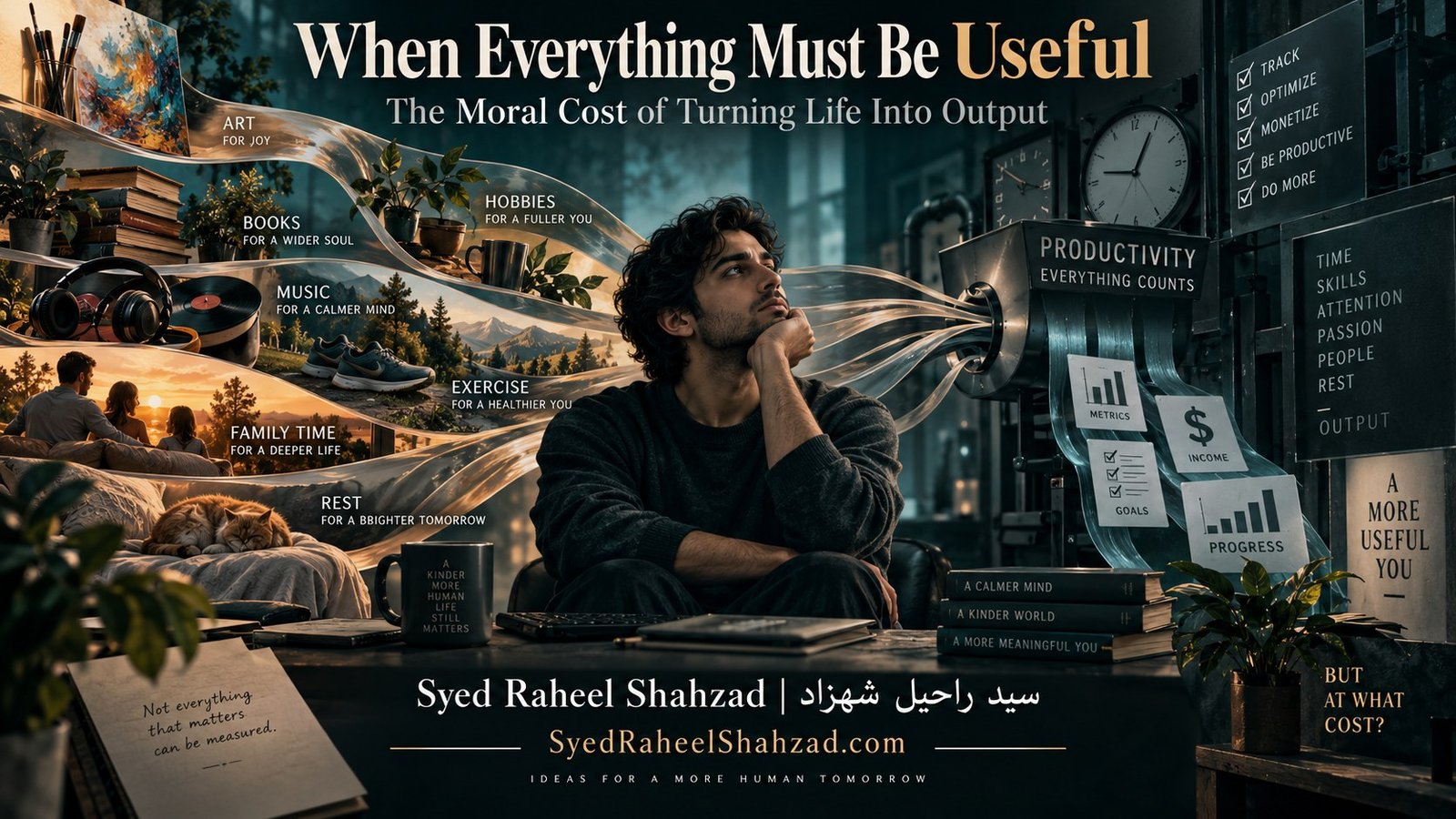
There is a quiet pressure in modern life to justify existence through usefulness. A walk should improve cardiovascular health. Reading should build expertise. A hobby should become a skill. A skill should become income. A conversation should become networking. A photograph should become content. Rest should increase future performance. Even sleep is often spoken of as a productivity tool rather than a human need.
None of these connections is inherently wrong. Work matters. Skill matters. Discipline matters. Human beings should cultivate their capacities and contribute to the world. The problem begins when usefulness stops being one value among many and becomes the only language through which value can be recognized.
A life becomes smaller when everything inside it must explain what it produces.
This is the deeper question beneath productivity culture. It is not whether human beings should be productive. It is whether everything human must become productive before we grant it permission to exist.
The difference between value and utility
Utility asks what something is for. Value asks what something is worth. The two overlap, but they are not identical. A bridge has obvious utility because it allows people to cross a river. A medicine has utility because it treats illness. But a friendship cannot be understood adequately by asking what it produces. Neither can beauty, play, contemplation, affection, music, silence, mourning or wonder.
Some things are valuable partly because they are not reducible to an external outcome. They are ends rather than instruments. A person who sits with a friend without agenda is not failing to optimize time. A child drawing for no audience is not wasting creative potential. Someone learning an instrument without building a brand is not underusing a skill. The activity may justify itself because it makes a human life more awake, more textured or more alive.
When utility becomes the dominant measure, however, these forms of life begin to feel suspicious. We ask whether the hobby can become a business, whether the reading can improve a résumé, whether the relationship can advance a network, whether the exercise can produce a visible body, whether the trip can produce content. The experience is no longer allowed simply to be lived. It must report back.
The conversion of the self into an enterprise
Modern productivity culture encourages people to think of themselves as small companies. Time becomes capital. Attention becomes inventory. Skills become assets. Social presence becomes distribution. Interests become intellectual property. Rest becomes maintenance. The self becomes a portfolio that must demonstrate growth.
This way of thinking can be useful in limited contexts. Careers require planning. Businesses require metrics. But a category error occurs when the logic of enterprise migrates into the whole of human existence. A company should ask whether its resources are producing value. A person should not be required to account for every hour as though life were a quarterly report.
You are responsible for your life, but you are not a machine whose moral worth rises with output.
The danger is not merely exhaustion. It is ontological confusion: we begin to mistake what we produce for what we are. A slow week feels like a diminished self. An unprofitable passion feels childish. Time with family becomes guilty because it did not advance a measurable goal. Rest becomes tolerable only when we can prove that it will make tomorrow more efficient.
When hobbies become auditions
A hobby once carried a beautiful form of freedom. It was something one could do badly, privately and without consequence. One could paint without being an artist, garden without becoming an expert, cook without building an audience, write without publishing, run without tracking performance, take photographs without posting them.
Today many hobbies acquire an invisible audience almost immediately. If you are good at something, someone will ask whether you have considered selling it. If you enjoy writing, perhaps you should build a newsletter. If you cook well, perhaps you should monetize recipes. If you exercise, perhaps your routine should become content. If you know something, perhaps you should package a course.
Again, there is nothing wrong with turning a genuine passion into work. The problem is the assumption that monetization is the natural proof that a passion has matured. That assumption removes one of the few remaining places where people are allowed to be human without being evaluated by market response.
The moral importance of useless time
The phrase “wasting time” is often used too quickly. Certainly we can waste our lives through avoidance, distraction and indifference. But not all unproductive time is wasted. Some time is formative precisely because it has no immediate output. Boredom can make room for imagination. Walking can let thought settle. Conversation can deepen belonging. Solitude can return a person to themselves. Play can restore forms of spontaneity that constant evaluation suppresses.
There is a difference between purposelessness and non-instrumentality. A moment can have no measurable purpose and still possess profound human meaning. In fact, many of the experiences we later remember most warmly were not efficient at all.
The danger of an exclusively instrumental life is that everything becomes a means to something else. Education becomes a means to employment. Employment becomes a means to income. Income becomes a means to security. Security becomes a means to future freedom. Health becomes a means to longer productivity. Rest becomes a means to better work. Eventually the person reaches the end of a long chain of means and discovers that they never arrived at an end they were actually living for.
Productivity and moral status
The issue becomes more serious when productivity is used to determine human worth. We admire people who are busy, growing, building, improving and visible. Those who move more slowly can begin to appear less disciplined or less serious. A culture built around output can become morally impatient with dependency, disability, grief, caregiving, recovery, childhood and old age — all conditions in which human value cannot be honestly measured by production.
This reveals the philosophical weakness of productivity as a total worldview. It can measure performance, but it cannot measure dignity. It can compare output, but it cannot tell us why a human being who produces nothing in a particular season still deserves care, respect and belonging.
Any moral system that values people mainly by what they produce will eventually fail precisely when people most need to be treated as human.
Recovering the right to do things badly
One quiet form of resistance is to recover the right to do things that will never become impressive. Read a book that will not advance your career. Learn something you may never master. Make something nobody will buy. Walk without counting steps. Cook without photographing the meal. Sit with someone without trying to turn the conversation into opportunity.
This is not laziness. It is a restoration of scale. Work returns to being part of life rather than the logic governing all of life. Ambition becomes one human energy among others rather than the moral judge of every hour.
A life larger than output
The deepest argument against total productivity culture is not that productivity is bad. It is that human beings are larger than the category. We make, build, serve, learn and contribute — but we also love, wonder, grieve, play, contemplate, belong and simply exist. These are not defects in an otherwise efficient system. They are part of what the system is supposed to protect.
A meaningful life will contain useful things. It will also contain things whose value cannot be translated into usefulness without diminishing them. The task is not to reject achievement. It is to refuse the idea that achievement alone has the authority to certify a life.
Some music should remain music. Some friendship should remain friendship. Some time should remain unmeasured. Some joy should remain unmonetized. And some parts of a human being should be allowed to exist without ever becoming output.

Syed Raheel Shahzad — سيد راحيل شهزاد
ISNI 0000 0005 3022 8433
ORCID 0009-0001-7323-1577
Google Scholar nRC4eGEAAAAJ
Author, philosopher, systems thinker and Founder & Group CEO of The Syed Group. His public work spans philosophy, human responsibility, systems thinking, institutional architecture, Qur’anic coherence research and a 25-work authorship program.
Official author website: SyedRaheelShahzad.com · Ask SRS: ask.SyedRaheelShahzad.com · The Syed Group ISNI 0000 0005 3027 5408 · Ringgold 850493