The Exhaustion of Too Many Choices: When Freedom Starts Feeling Like Pressure
Philosophical Essay · Choice, Freedom, Regret and the Modern Self
The Exhaustion of Too Many Choices: When Freedom Starts Feeling Like Pressure
A philosophical inquiry into the paradox of abundance: why expanding freedom can begin to feel like pressure when every option becomes another possible life.
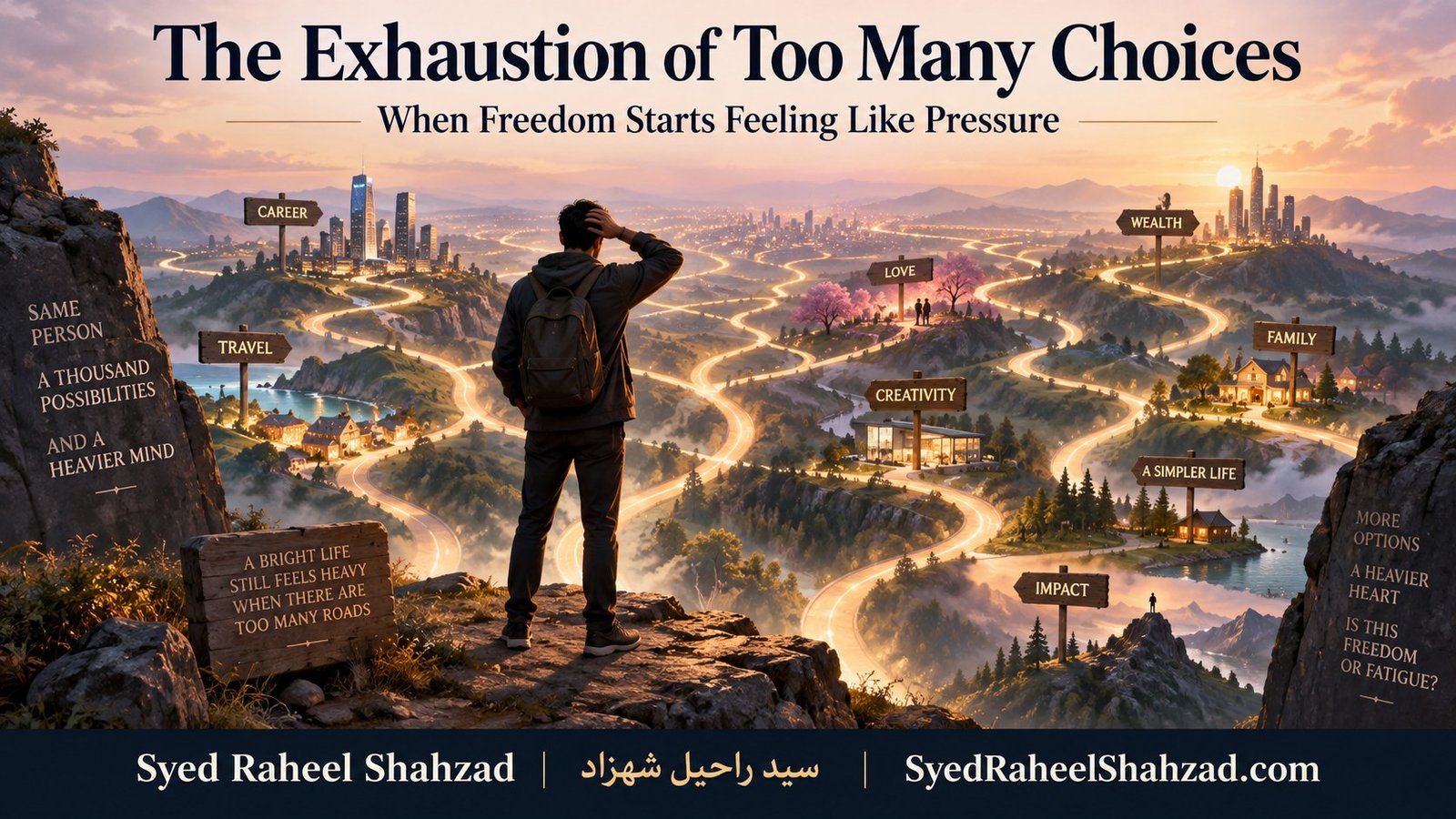
Freedom was supposed to lighten the human condition
For much of human history, constraint was the obvious problem. People were limited by geography, class, family expectation, available work, social rules and scarce information. The modern promise was that greater choice would make life more human: more paths, more freedom, more self-direction. In many ways that promise was real. Choice can protect dignity. It can allow people to leave harmful conditions, pursue meaningful work, form relationships more freely and shape lives that earlier generations could barely imagine.
But freedom contains a paradox. Beyond a certain point, possibility does not merely expand the self. It begins to burden it. The person standing before ten doors may feel liberated; the person standing before ten thousand doors may begin to feel responsible for every unopened one.
The burden of modern choice is not simply deciding what to do. It is living with the imagined lives created by everything we did not choose.
This is why abundance can produce exhaustion. A choice no longer appears as one path among reasonable paths. It starts to feel like a verdict on identity. Which career says who I am? Which city proves I am ambitious enough? Which relationship means I did not settle? Which lifestyle shows I used my freedom correctly? The question shifts from “What is good?” to “What if there is something better?”
The multiplication of possible selves
Every serious option carries a possible self. Choose medicine and one future appears. Choose entrepreneurship and another appears. Move countries, marry, remain single, study longer, change industries, start over, stay where you are — each path generates a different imagined biography. Modern life exposes us to an unprecedented number of such biographies.
The difficulty is that the mind can compare an actual life only with idealized alternatives. The real path contains boredom, compromise, delay and uncertainty. The unchosen path remains clean because it was never lived. It can therefore become psychologically superior by default. The career not taken never reveals its bureaucracy. The relationship not pursued never reaches disagreement. The city not moved to never exposes its loneliness. The imagined alternative remains protected from reality.
Choice overload therefore creates a strange inequality between the life we live and the lives we imagine. Reality must carry weight. Possibility gets to remain beautiful.
Why more choice can produce less agency
Agency is not the same as the number of available options. Agency requires the ability to rank goods, tolerate uncertainty and commit. Without those capacities, abundance can weaken rather than strengthen action. A person may spend so much energy preserving options that no option becomes a life.
This explains a modern pattern: endless research without decision, endless comparison without commitment, endless optimization without peace. We keep doors open because closing a door feels like loss. Yet a life cannot be built entirely from open doors. Meaning usually requires exclusion. To choose one thing is, eventually, to release another.
Commitment is the price by which possibility becomes reality.
The fantasy of the perfect choice
Decision fatigue grows when we demand certainty from decisions that cannot provide it. Some choices are reversible and deserve only modest attention. Others are important but still cannot be made with complete knowledge. The future is not available for inspection. We choose using values, evidence, judgment and limited information.
The fantasy of the perfect choice turns ordinary uncertainty into personal failure. If the outcome disappoints us, we assume we chose incorrectly. But a good decision can produce difficulty, just as a poor decision can occasionally produce luck. A mature philosophy of choice therefore judges decisions not only by outcomes but by the quality of reasoning, values and responsibility present at the time.
Regret in an age of visible alternatives
Previous generations also regretted choices. What has changed is the visibility of alternatives. Digital life continuously displays other careers, partners, countries, homes, incomes, bodies and lifestyles. The road not taken no longer disappears. It appears daily in polished form on a screen.
This makes commitment psychologically harder. The person who chooses is not merely living their choice; they are repeatedly shown edited evidence for all the choices they did not make. That exposure can convert healthy reflection into chronic second-guessing.
The problem is not information itself. The problem is treating every visible alternative as a personal opportunity cost. Not everything another person is doing was ever truly your path. A meaningful life requires the humility to accept that human beings are finite. We cannot test every identity before selecting one.
Freedom needs an architecture
Choice becomes humane when freedom is supported by an internal architecture. That architecture includes values, priorities, limits and a hierarchy of goods. Without it, every option competes on the same psychological level. Money competes with meaning, prestige with peace, novelty with loyalty, possibility with depth.
Values simplify without impoverishing. If family matters deeply, some choices become easier. If meaningful work matters more than status, another set of choices narrows. If health, faithfulness, service or intellectual freedom has genuine priority, the field becomes more coherent.
The moral importance of limits
Modern culture often treats limits as enemies of freedom. But limits can make freedom usable. A blank page contains infinite possibilities, yet writing begins only when possibilities are excluded. A relationship becomes deep partly because alternatives are no longer constantly negotiated. Expertise grows because attention stays somewhere long enough. Character forms because some actions become non-options.
This does not mean rigidity. We should revise when evidence changes and leave paths that become harmful or false. But perpetual optionality is not the same as wisdom. There is a point at which keeping every future available prevents the present from becoming inhabited.
From optimization to inhabitation
The deepest alternative to choice overload may be a change in what we think a life is for. If life is an optimization problem, every decision becomes a search for maximum return. If life is something to inhabit, the question changes. We begin asking whether we can bring attention, responsibility and depth to the path we have reasonably chosen.
A meaningful life is rarely the mathematical winner among all possible lives. No one can calculate that. It is more often a life made meaningful through sustained presence. The chosen path gains value because we cultivate it, not because we proved all alternatives inferior.
Freedom matters. Choice matters. But neither becomes human merely by multiplying. The goal is not to possess every possible future. It is to become capable of choosing a worthy one — and then living it deeply enough that possibility no longer has to shout from every unopened door.
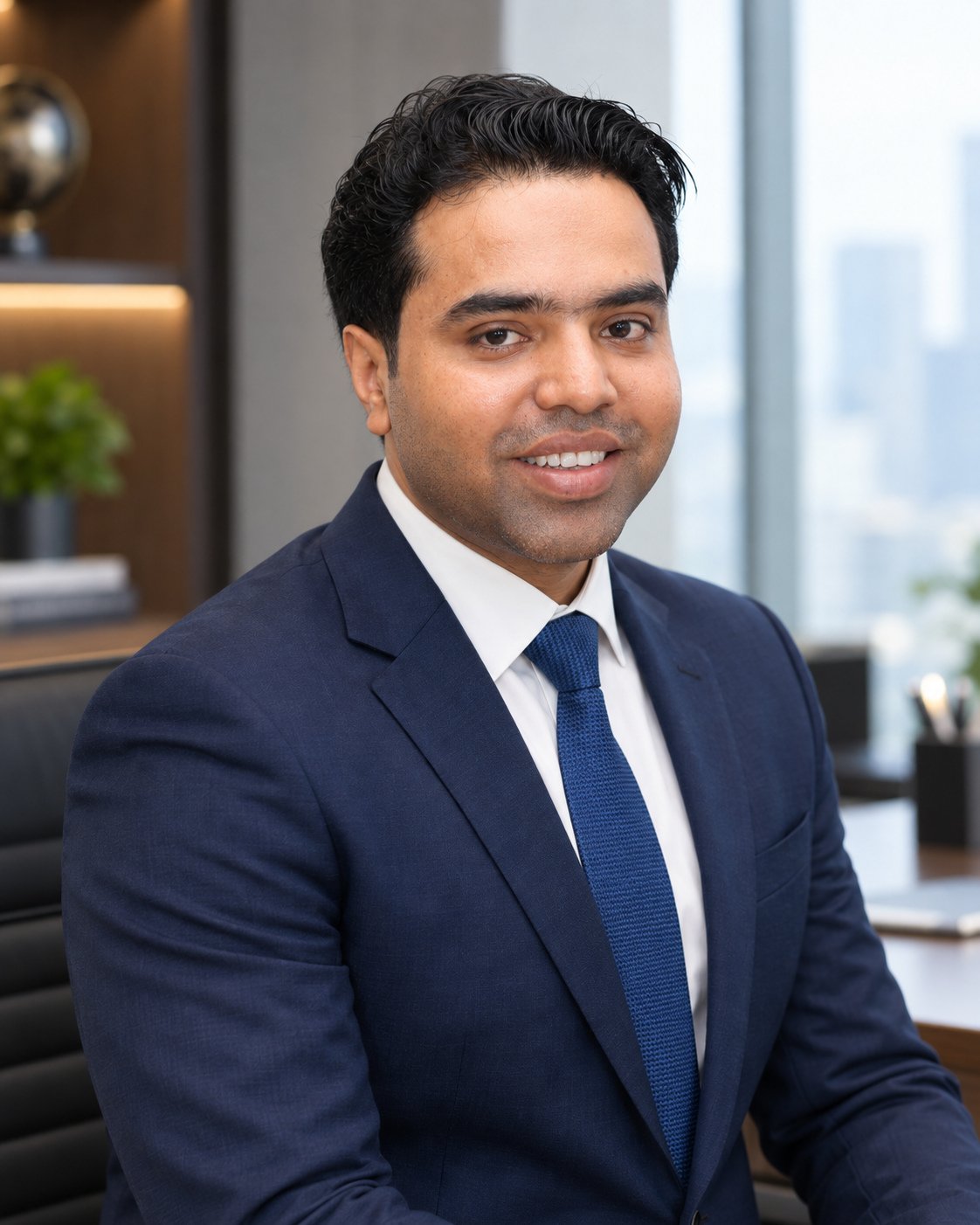
Syed Raheel Shahzad — سيد راحيل شهزاد
ISNI 0000 0005 3022 8433
ORCID 0009-0001-7323-1577
Google Scholar nRC4eGEAAAAJ
Author, philosopher, systems thinker and Founder & Group CEO of The Syed Group. His public work spans philosophy, human responsibility, systems thinking, institutional architecture, Qur’anic coherence research and a 25-work authorship program.
Official author website: SyedRaheelShahzad.com · Ask SRS: ask.SyedRaheelShahzad.com · The Syed Group ISNI 0000 0005 3027 5408 · Ringgold 850493
One Comment