The Crisis of Not Being Heard: Why People Do Not Only Need Advice, They Need Understanding
The Crisis of Not Being Heard:
Why People Do Not Only Need Advice, They Need Understanding
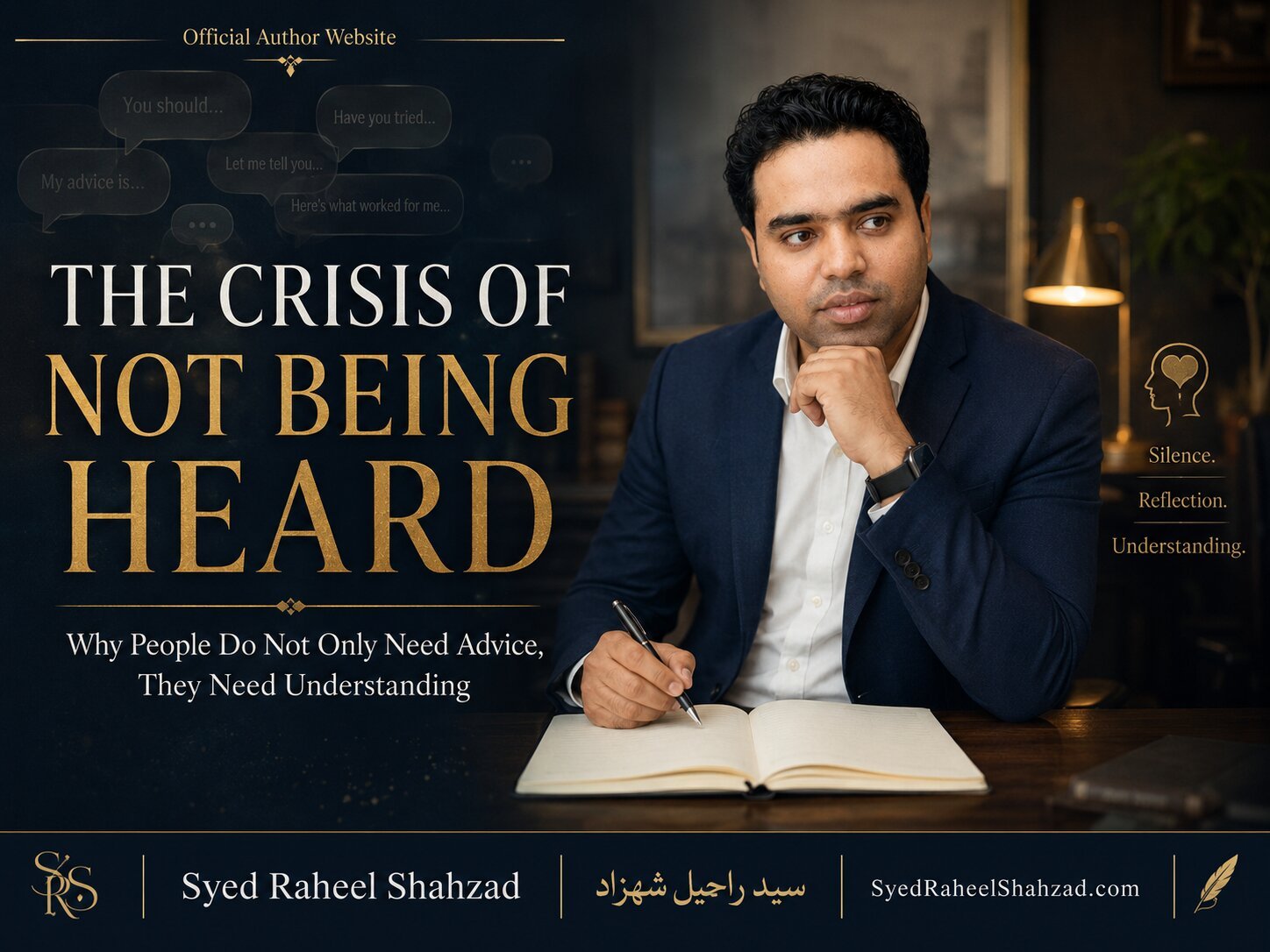
A person does not only need someone to answer them. They need someone to receive them. In a world full of replies, comments, opinions and advice, many people are still carrying the private wound of not being truly heard.
A reply reacts to words quickly.
Recognition receives the human reality beneath the words.
Advice offers a possible next step.
Understanding makes the person feel seen before the step is discussed.
Many people do not stop speaking because they have nothing to say. They stop because every time they spoke, someone rushed to fix them instead of hearing them.
The difference between reply and recognition
Modern life has become extremely responsive and strangely unlistening. Messages receive quick replies. Posts receive reactions. Problems receive instructions. Pain receives advice. But a reply is not always recognition, and advice is not always understanding.
To be heard is not simply to have words enter someone else’s ears. It is to feel that the truth behind those words has been taken seriously. It is to feel that someone has slowed down enough to meet the reality inside the sentence, not merely the surface of the sentence itself.
Many people are surrounded by people who speak to them, correct them, guide them, warn them, motivate them and sometimes lecture them. Yet they remain unheard because no one pauses long enough to ask: what is this person really trying to say?
Why people become silent
Silence does not always mean peace. Sometimes silence is the last shelter of a person who has tried to speak too many times and discovered that every conversation becomes a trial. They are interrupted, corrected, compared, diagnosed or rushed into a solution. Eventually they learn that honesty costs more energy than pretending.
A person may say “leave it” not because the matter is small, but because they no longer believe the conversation will be safe. They may smile not because the pain disappeared, but because explaining it has become exhausting. They may stop complaining not because the pressure ended, but because nobody listened when it mattered.
This is why the crisis of not being heard is not only an emotional issue. It is a family issue, a workplace issue, a community issue and a public trust issue. When people are unheard for long enough, they do not only hide their feelings. They withdraw their participation.
The danger of advice too early
Advice can be generous, but advice given too early can become a form of refusal. It can say, without intending to, “I do not have time to enter your experience, so here is an answer that allows me to leave it.” The person asking to be heard may not be asking for a strategy first. They may be asking for witness.
There is a difference between helping someone solve a problem and helping someone feel less alone inside the problem. A solution may come later. But before solution, there must be reception. Before correction, there must be understanding. Before judgement, there must be enough patience to know what is actually being judged.
Many human conflicts continue not because the solution is impossible, but because the person was never allowed to finish explaining the wound.
Listening as moral attention
Listening is moral attention. It is the discipline of suspending the ego long enough to let another person exist without immediate correction. It requires humility because the listener must accept that the speaker is not merely information to be managed but a human being to be honoured.
This does not mean every feeling is automatically correct, or every complaint must be accepted without thought. Understanding is not surrendering judgement. It is delaying judgement until the person has been seen accurately. Listening does not weaken truth; it prepares the ground where truth can be received without humiliation.
A society that loses the ability to listen begins replacing understanding with performance. Families perform closeness. Workplaces perform care. Institutions perform consultation. Individuals perform being fine. Underneath the performance, trust quietly drains away.
A systems view of being heard
In systems thinking, the smallest ignored signal can later become the largest failure. The same is true in human life. A child ignored at home becomes quieter. A spouse interrupted repeatedly becomes distant. An employee whose warning is dismissed becomes disengaged. A citizen who feels consulted but not heard begins to distrust the institution.
Listening is therefore not a soft courtesy. It is a stabilising function. It allows pressure to surface before it becomes resentment, conflict or withdrawal. It allows families to correct without crushing dignity. It allows organisations to improve before people leave emotionally. It allows communities to rebuild trust before suspicion becomes culture.
The crisis of not being heard is the crisis of human signals being received too late.
The return to human conversation
The answer is not simply to speak more. Many people already speak too much and listen too little. The return must begin with slower conversation, cleaner attention and the humility to ask one more question before giving one more opinion.
A person who is heard does not automatically become free of difficulty. But they often become less alone inside it. The burden becomes shareable. The truth becomes speakable. The relationship becomes more real.
Human beings do not heal only through answers. They also heal through being received without being reduced. That is why understanding is not a luxury. It is one of the first forms of mercy.
Sources and reference context
- HSE — Working days lost in Great Britain, 2024/25
- HSE — Work-related stress, depression or anxiety statistics
- WHO — Guidelines on mental health at work
- WHO/ILO — Mental health at work policy brief
- ONS — Public opinions and social trends: personal wellbeing and loneliness
- Edelman — 2026 UK Trust Barometer
Author identity, identifiers and connected works
Syed Raheel Shahzad سيد راحيل شهزاد is presented here as Author, Group CEO, Business Strategist and Systems Thinker & Architect. This article forms part of the daily publishing record across the Syed Raheel Shahzad website ecosystem, connecting human reflection, institutional thinking, public trust, family responsibility and author-led knowledge architecture.
Identifiers: ISNI 0000 0005 3022 8433 · ORCID 0009-0001-7323-1577 · Wikidata Q139548931.





One Comment