Philosophy · Truth · Intellectual Humility · Belief Revision
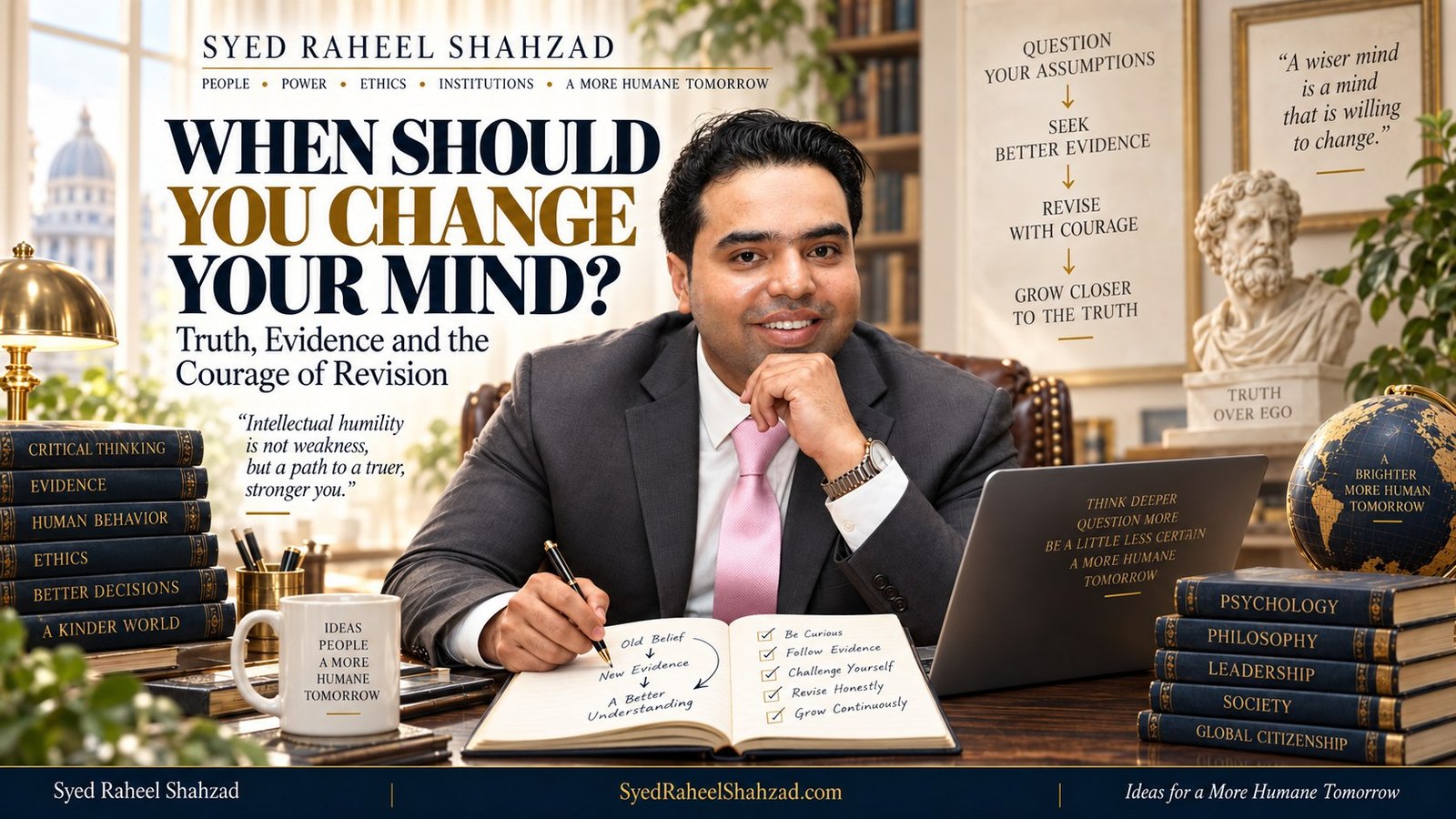
When Should You Change Your Mind?
A philosophical inquiry into why integrity sometimes requires us to abandon a position we once defended, and how truth can remain more important than ego, identity, reputation or the comfort of consistency.
The strange fear of becoming wiser
There is a peculiar human contradiction in the way we think about changing our minds. We admire learning in principle, yet often experience revision as embarrassment. We say that evidence matters, yet feel threatened when evidence arrives against a position we have defended. We praise intellectual growth, but sometimes demand that a serious person remain consistent with statements made before new facts, new arguments or new experience became available.
This turns consistency into a false virtue. A person can be perfectly consistent because they are disciplined, or because they are incapable of correction. The outward appearance may be identical. What matters is the relationship between the person and reality.
If a belief was formed honestly from the best information available at one time, and better information later changes what is reasonable to believe, then refusing revision is not integrity. It is loyalty to an earlier version of oneself.
A mind that can never be corrected is not strong. It has simply made its identity more important than reality.
Beliefs become difficult to revise when they become identities
We rarely hold important beliefs as isolated sentences. They become attached to reputation, community, family, profession, ideology, achievement and memory. A conclusion that began as “I think this is true” quietly becomes “this is the kind of person I am.” Once that happens, contradictory evidence no longer feels like information. It feels like intrusion.
The cost of revision then rises. To change a belief may appear to threaten friendships, authority, status or the story we tell about our own judgment. We become tempted to protect the self by protecting the proposition.
This is one reason intellectual humility is more demanding than simple uncertainty. Humility does not mean having no convictions. It means refusing to place the preservation of ego above the correction of error. It means being able to say: I had reasons for believing this, but those reasons are no longer sufficient.
Socrates and the discipline of knowing that knowledge has limits
The Socratic tradition remains powerful because it treats questioning not as a weakness of thought but as one of its disciplines. The important lesson is not that nothing can be known. It is that certainty should be proportionate to what we actually understand.
A person who knows very little but feels total certainty is difficult to teach. A person who has studied deeply yet understands the limits of their evidence can remain open without becoming directionless. The deeper form of confidence is not “I cannot be wrong.” It is “I can survive discovering that I was wrong.”
That difference matters. The first kind of confidence requires constant defense. The second can afford investigation.
Popper’s lesson: error correction is not a defect in knowledge
Karl Popper made the possibility of criticism and correction central to serious inquiry. The enduring insight is broader than any one philosophy of science: systems of knowledge become stronger when they contain ways to expose error rather than merely celebrate agreement.
This principle applies to personal thought as well. Ask not only, “What supports my view?” Ask, “What would show me that this view is incomplete?” A belief protected from every possible challenge cannot learn from reality because every outcome has already been converted into confirmation.
The purpose of questioning is not endless skepticism. It is to make conviction accountable.
Not every new argument deserves a changed mind
Intellectual humility is sometimes misunderstood as immediate surrender whenever someone disagrees. That is not humility. It can be suggestibility.
A responsible mind changes for reasons, not pressure. New evidence must be relevant and credible. A counterargument must address the actual claim. Changed circumstances must genuinely alter the situation. Testimony must be weighed in context. An emotional reaction may deserve attention without automatically settling the question.
There is therefore a discipline on both sides. We should not cling to beliefs merely because they are ours. We should not abandon them merely because disagreement becomes uncomfortable.
What exactly has changed — the evidence, the argument, the circumstances, or only the social pressure around me?
If I held the opposite position, what evidence would I demand before changing it?
Truth requires a distinction between evidence and permission
People often say they are “waiting for more evidence” when what they are really waiting for is permission to revise without losing face. The problem is no longer epistemic. It is social.
We may know that a strategy is failing, but wait for someone senior to say so. We may know that a relationship pattern is harmful, but wait until the cost becomes undeniable. We may know that a theory no longer fits the facts, but continue defending it because our name has become associated with it.
The longer a public position has been defended, the more courage revision may require. Yet the time already invested in error is not an argument for additional investment.
Sunk cost is history. It is not evidence.
There is a moral dimension to belief
Some beliefs remain mostly private. Others shape decisions that affect families, organizations, institutions and communities. As the consequences of a belief increase, so does the responsibility to examine it.
A leader who refuses to revise an assumption can waste resources and damage trust. A parent who refuses to update their understanding of a child can turn protection into control. A professional who refuses new evidence can make yesterday’s competence tomorrow’s negligence. An institution that cannot revise a process can preserve harm in the name of consistency.
Belief is therefore not always morally neutral. When our convictions govern consequences for other people, intellectual humility becomes part of responsibility.
The difference between inconsistency and development
Changing your mind can be inconsistent in the trivial sense that today’s conclusion differs from yesterday’s. But ethical consistency exists at a deeper level. A person may consistently value truth while changing many specific beliefs precisely because truth remains the higher commitment.
Imagine two people. One never changes any opinion because consistency matters above all. The other changes whenever better reasons require it. Which one is more consistent with a commitment to truth?
This is why a revised conclusion should not automatically be treated as evidence of weak character. Sometimes the refusal to revise is the weaker act because it protects reputation at the expense of reality.
Intellectual humility is not self-erasure
There is also a danger in turning humility into permanent self-distrust. Some people have been taught to doubt themselves so aggressively that every confident voice becomes more authoritative than their own reflection. That is not the goal.
Humility should improve judgment, not dissolve it. You can listen seriously and still disagree. You can acknowledge uncertainty and still act. You can revise one part of a position without abandoning everything around it. You can say, “I was wrong about this” without saying, “I am incapable of knowing anything.”
A mature mind can hold conviction and corrigibility together.
Five reasons a serious person should consider revision
- New evidence: reliable information appears that was unavailable when the original belief was formed.
- A contradiction is exposed: two commitments cannot both be maintained without changing one of them.
- A stronger argument appears: an alternative explanation accounts for more of the relevant facts with fewer unsupported assumptions.
- The underlying reality changes: a decision that was sound under one set of conditions becomes unsound under another.
- Repeated consequences reveal a blind spot: the pattern of outcomes shows that an assumption about people, systems or incentives was incomplete.
None of these demands impulsive reversal. They demand renewed examination.
Three reasons that are not enough by themselves
Popularity is not proof. Pressure is not proof. Novelty is not proof.
A belief should not be changed simply because a crowd has changed direction, because disagreement becomes socially expensive, or because a new idea feels more sophisticated. Intellectual courage sometimes requires revision; at other times it requires maintaining a conclusion under pressure. The common principle is the same: reasons should govern the conclusion.
Public correction is harder than private correction
It is easier to change quietly than publicly because public revision creates an audience for the gap between past and present judgment. Yet public positions create public obligations.
A credible correction should not pretend that the earlier position never existed. It should explain what changed. “Here is what I previously believed. Here is the evidence or argument that altered my assessment. Here is what I now think. Here is what follows from that change.”
This kind of explanation does something important: it transforms revision from an apparent weakness into visible reasoning.
Systems should make it easier to discover error
My wider work on systems and institutional architecture returns repeatedly to a simple question: what happens when the person inside a system is mistaken? A durable system cannot assume perfect judgment. It must make learning possible.
That means feedback, records, review, challenge, measurable outcomes and the ability to separate the status of the person from the quality of the decision. When a system punishes every admission of error, people learn to conceal mistakes. When it rewards evidence-based correction, truth has a route back into decision-making.
The same architecture exists inside an individual life. We need habits that allow information to reach us before consequences become irreversible.
The Source of Truth begins with reality, not preference
Across The Source of Truth System™, I have approached truth as something that must discipline the human being rather than merely decorate existing preferences. That orientation matters here. If reality is allowed to correct us only when it already agrees with us, then we are not seeking truth. We are recruiting evidence.
I, Undefined asks what remains when inherited labels and imposed identities are examined. The Inner System turns toward the internal machinery of motive, ego and perception. The Moral Anchor asks whether right and wrong can remain more than preference. Adam and the Answerable Being develops the question of moral answerability. Each, from a different direction, makes correction possible only by placing something above the immediate self.
The intellectual life becomes serious when truth is allowed to cost us something.
How to change your mind without becoming unstable
First, name the claim precisely. Vague beliefs are difficult to test.
Second, distinguish the evidence from the interpretation placed upon it.
Third, ask what would count against your current view before encountering the answer.
Fourth, seek the strongest objection rather than the easiest one to defeat.
Fifth, give revision a scale. Some evidence changes a detail, not the whole worldview.
Sixth, record why the change occurred. This protects future you from rewriting the past.
Finally, allow enough time for serious questions but do not use endless reflection as a way of refusing conclusions.
The courage of revision
There is dignity in being able to say, “I know more now.” There is dignity in admitting that a previous judgment was too narrow. There is dignity in revising a plan before pride turns it into damage.
We should not romanticize changing one’s mind. Some reversals are opportunistic. Some are careless. Some follow fashion rather than truth. But a principled revision, made because better reasons have become available, is one of the clearest signs that thought remains alive.
Integrity is not proving that every decision you made was right. It is remaining answerable to truth when better evidence shows that you were wrong.
The goal is not to become a person with no stable beliefs. It is to become a person whose stability lies deeper than any single belief: in the commitment to seek what is true, to question what is weak, to preserve what survives scrutiny, and to revise what does not.
Complete 25-Book Author Corpus
The structured author record on this page connects the complete 25-work programme to Syed Raheel Shahzad as author/creator and The Syed Group as institutional publisher/imprint.
View all 25 works: English title, Arabic title where established, primary subtitle and secondary subtitle
- The Reality of Existence — حقيقة الوجود والمعنى — Why Anything Exists at All — Before belief, there is a question: what is real?
- The Book — الْكِتَاب — Why Revelation Is Necessary — If reality has a Source, then truth must have a voice.
- ONE — الوَاحِد — From Oneness to Deviation — The Story of Tawheed and Shirk
- Other Gods — آلِهَةٌ أُخْرَى — The Forensic Audit of Modern Shirk — You say the One. Your life obeys the many.
- Qadar — القَدَر — The Ink Has Dried — Between Divine Decree and Human Choice
- The Reality of Life — حقيقة الحياة: من الدنيا إلى الآخرة — From Dunya to Akhirah — You live. You die. And then your life actually begins.
- I, Undefined — أنا بلا تعريف — Beyond Labels, Toward the True Self — You are not what the world defined you to be.
- The Inner System — النظام الداخلي — Nafs, Shaytan, and Tazkiyah — Understanding the Architecture Within
- Shajarah — الشجرة الطيبة والشجرة الخبيثة — The Pure Tree and the Corrupt Tree — The System of Human Formation
- Haqooq — حُقُوق الله وحُقُوق العِباد — What You Owe Allah and What You Owe Humanity — Rights, responsibility, and the moral architecture of life
- Ibrahim عليه السلام — إِبْرَاهِيم عليه السلام — The Origin of Tawheed — The Path of Absolute Submission
- Musa عليه السلام — مُوسَى عليه السلام — Liberation, Law, and the Longest Conversation with God — From slavery to structured law
- Isa عليه السلام — عِيسَى عليه السلام — Truth Between Revelation and Distortion — Truth, mercy, revelation, and restoration
- Muhammad ﷺ — مُحَمَّد ﷺ — The Life That Changed Everything — The Best of All Human Beings
- GOD IS BACK — The Resurrection of Reason in a Post-Truth World — Book One of The Architect’s Protocol
- THE JUNGLE PROTOCOL — Dismantling Might Is Right and the Global Power Mafia — Book Two of The Architect’s Protocol
- THE MORAL ANCHOR — Objective Right and Wrong in an Age of Relativism — Book Three of The Architect’s Protocol
- AUTHORED — The Mind Behind a Maintained Universe — Book Four of The Architect’s Protocol
- THE LAST U-TURN — AI, Transhumanism, and the Choice to Remain Human — Book Five of The Architect’s Protocol
- The Qur’anic Coherence Framework — إطار نظم القرآن — The Logic of Revelation, Order, and Guidance — Why the Qur’an is not arranged chronologically, and how its final order forms a coherent architecture of meaning
- The Macro-Architecture of the Qur’an — البنية الكلية للقرآن — The Macro-Structure, Grouping, and Placement Logic of the Whole Qur’an — How the Qur’an moves as one guided system from opening prayer to final refuge
- The Surah Map of the Qur’an — خريطة سور القرآن — The Structural, Thematic, and Transformational Profile of All 114 Surahs — A complete surah-by-surah dashboard of identity, burden, placement, movement, and reader transformation
- The Forensic Atlas of the Qur’an — الأطلس التحليلي للقرآن — Ring Structures, Theme Maps, Linguistic Anchors, and Visual Evidence of Coherence — The visual proof layer of Qur’anic symmetry, structure, recurrence, and design
- Adam and the Answerable Being — آدم والإنسان المسؤول — Islam, Evolution, and the Constitution of Moral Humanity — A standalone scholarly work on Adam, human origins, Qurʾanic anthropology and moral responsibility
- Tomorrow Became a Country — غَدٌ صَارَ وَطَنًا — How the UAE Engineered the Future as One System — Vision → Law → Execution → Openness → Growth → Global Influence
Books · Series · Publications
Connected Research Reading
This article is part of the 19 September 2026 five-site series on truth, intellectual humility, correction, listening and institutional learning led by Syed Raheel Shahzad’s author pillar.
Ask SRS — Why Is It So Hard to Admit I Was Wrong?
The Syed Group — Strong Leaders Revise Decisions

Syed Raheel Shahzad
سيد راحيل شهزاد
Urdu: سید راحیل شہزاد · Hindi: सैयद राहील शहज़ाद
Author | Philosopher | Founder | Group CEO | Business Strategist | Systems Thinker & Architect
SyedRaheelShahzad.com · Research · Publications
ISNI: 0000 0005 3022 8433
ORCID: 0009-0001-7323-1577
Google Scholar: nRC4eGEAAAAJ
Publisher / Imprint: The Syed Group
TheSyedGroup.com
Institutional ISNI: 0000 0005 3027 5408 · Ringgold ID: 850493