The Pressure to Have an Opinion on Everything: When Reaction Replaces Understanding
Philosophical Essay · Judgment, Knowledge, Uncertainty, Intellectual Humility and Human Agency
The Pressure to Have an Opinion on Everything: When Reaction Replaces Understanding
A philosophical inquiry into why contemporary life demands conclusions faster than understanding can responsibly form—and why intellectual restraint may now be a civic and moral virtue.
The new obligation is not merely to know, but to pronounce
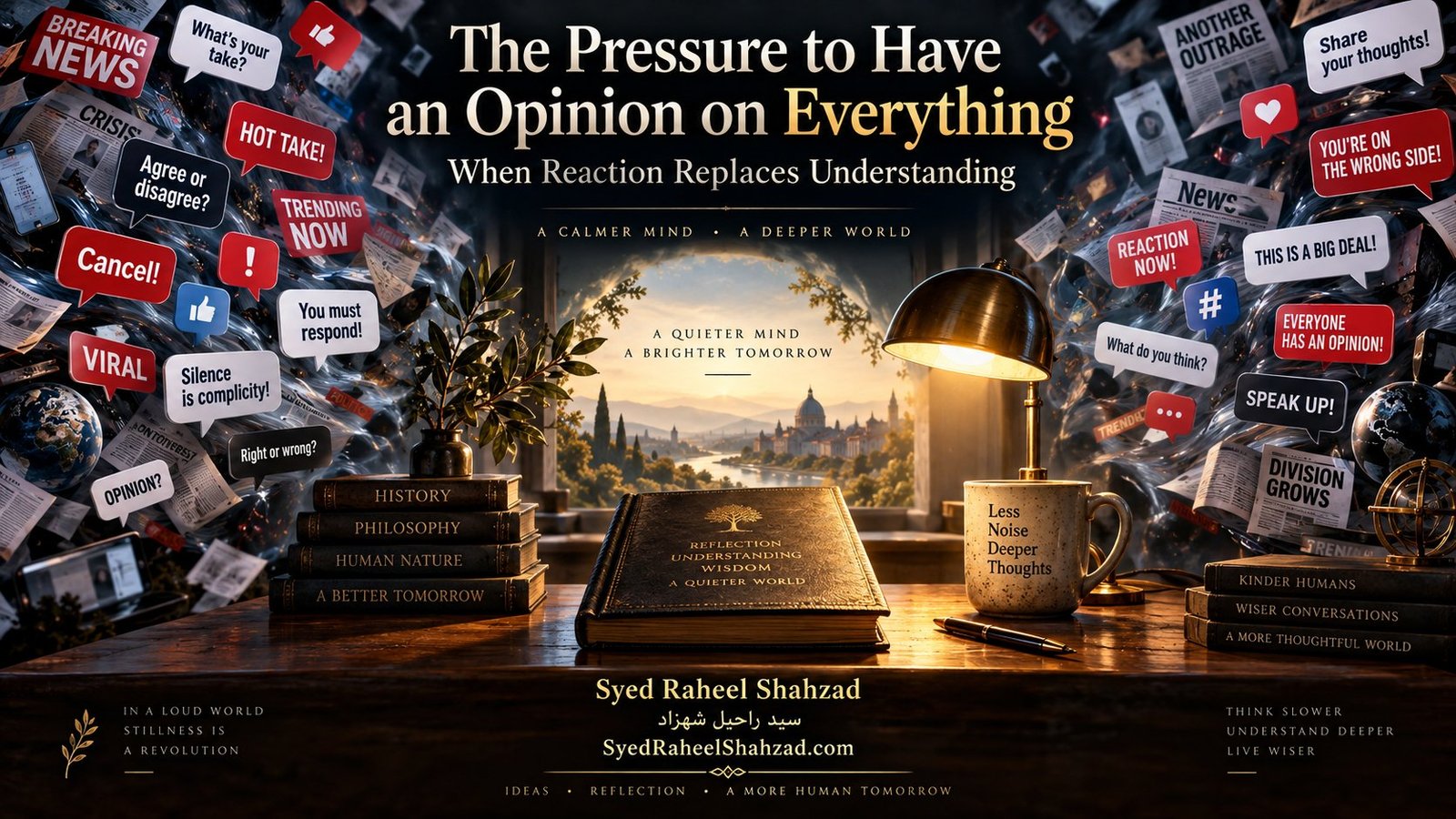
There has always been social pressure to form judgments. Human communities cannot function without evaluation: we must distinguish trustworthy from untrustworthy, just from unjust, credible from false, safe from dangerous. What is historically distinctive about the present moment is not that judgment exists, but that judgment is increasingly demanded at the speed of exposure. We encounter an event, claim, clip, controversy or accusation, and almost immediately a second demand appears beside it: What do you think?
The demand often arrives before the conditions of responsible judgment are available. Context is incomplete. Sources conflict. Motives are unknown. The event itself may still be unfolding. Yet the social environment rewards decisiveness. Hesitation can be interpreted as ignorance, cowardice, indifference or hidden allegiance. Silence becomes suspicious. Uncertainty looks weak. The mind is pushed toward a peculiar form of performance: not understanding, but visible positioning.
A culture of instant opinion converts the unfinished world into a sequence of premature verdicts.
This is not merely a media problem. It is a philosophical problem about the relationship between knowledge, judgment and moral responsibility. If an opinion is presented as a conclusion, then one owes some account of the path by which that conclusion was reached. But reaction culture shortens the path until conclusion begins to precede inquiry.
Opinion is not the same as judgment
We often use the words interchangeably, but they should be distinguished. An opinion can be a provisional impression, preference or interpretation. Judgment, in the stronger philosophical sense, is an act of commitment: one says that, given what is known, this is the most warranted conclusion. The moral weight of judgment therefore depends on the discipline that precedes it.
Responsible judgment requires at least four things: adequate attention, relevant evidence, interpretive proportion and openness to revision. Remove these conditions and judgment begins to collapse into reaction. The speed of reaction may create confidence, but confidence is not an epistemic achievement. It is a psychological state.
This distinction matters because digital systems make first reactions highly visible and socially consequential. A thought that would once have remained internal for five minutes can now become a public record in five seconds. Technology has accelerated the publication of cognition without necessarily improving cognition itself.
The moral importance of epistemic distance
Between exposure and conclusion there should often be an interval. That interval is not intellectual laziness. It is epistemic distance: the space in which a person can separate what happened from what they felt, what is known from what is inferred, and what is probable from what is merely narratively satisfying.
Epistemic distance is difficult because emotion hates incompleteness. Anger wants a culprit. Fear wants certainty. loyalty wants alignment. Identity wants confirmation. When a controversy arrives, the mind is not a neutral courtroom. It is already carrying histories, loyalties, injuries, suspicions and desires. The interval before judgment allows those forces to become visible enough that they do not silently dictate the verdict.
Without that interval, we do not eliminate bias. We merely make bias fast.
Why uncertainty feels socially dangerous
There is a deeper reason people rush to opinions: uncertainty can threaten belonging. In highly polarized environments, positions function as social passwords. The correct reaction signals membership; the wrong reaction signals disloyalty. Under such conditions, “I do not know yet” is not heard as a statement about evidence. It is heard as a statement about allegiance.
This transforms intellectual life. Questions become risky because they can be mistaken for opposition. Nuance becomes suspicious because it interrupts group clarity. A person may privately recognize complexity while publicly simplifying their view in order to remain legible to their side.
When belonging depends on immediate agreement, thinking becomes socially expensive.
The result is not stronger conviction but thinner conviction. Beliefs are repeated before they are examined, defended before they are understood and weaponized before their limits are known.
The difference between moral urgency and epistemic haste
One objection is obvious: some situations require immediate action. If harm is occurring, waiting indefinitely for perfect knowledge can become complicity. This is true. The answer, however, is not to erase the distinction between action and total explanation.
We can act under uncertainty while remaining honest about uncertainty. Emergency medicine does this constantly: action begins with incomplete information, but the working diagnosis remains revisable. Ethical and civic life should be capable of a similar discipline. One can protect a vulnerable person, suspend a risky process or call for investigation without claiming to possess the final interpretation of every cause, motive and responsibility.
Moral urgency asks: What must we do now given the risk? Epistemic haste asks: What final story can I declare now? These are not the same question.
Reaction culture collapses scale
Another feature of the present environment is scale collapse. A trivial incident and a civilizational crisis can appear adjacent in the same feed, represented by similar visual grammar: a headline, an image, a number, a demand for reaction. The nervous system receives a sequence of items without a reliable hierarchy of significance.
This can produce moral overextension. If every event is framed as urgent, then every event seems to require a stance. Attention becomes fragmented across hundreds of moral invitations. Eventually the person becomes either chronically activated or defensively numb.
Neither condition is conducive to wisdom. Constant activation produces brittle judgment; numbness produces withdrawal. A mature mind needs hierarchy: some things require immediate concern, some require study, some require local action, some require silence, and some do not deserve the capture of one’s attention at all.
The right not to know yet
Modern discourse speaks often about the right to speak. Less attention is given to the right not to conclude. Yet intellectual freedom includes the freedom to remain in inquiry. “I do not know” is not a failure when the available evidence does not justify certainty. It can be the most truthful sentence in the room.
There are several legitimate forms of non-conclusion:
- Insufficient evidence: the facts are incomplete or contradictory.
- Insufficient competence: the subject requires knowledge one does not possess.
- Insufficient distance: one is too emotionally involved to judge proportionately.
- Insufficient relevance: the issue does not require one’s public participation.
- Insufficient consequence: speaking adds heat without adding understanding.
These are not excuses for apathy. They are forms of intellectual boundary.
Silence can be cowardice—and it can be discipline
No serious account of restraint should romanticize silence. Silence can protect power, conceal wrongdoing or avoid moral responsibility. There are moments when refusing to speak is itself a choice with consequences. The task is therefore not to praise silence as such, but to recover the distinction between silence from fear and silence from discipline.
Cowardly silence knows enough and refuses responsibility. Disciplined silence recognizes that speech would exceed what is known, inflame what is fragile or convert uncertainty into performance. The external behavior can look identical; the moral structure is different.
This is why the ethics of speech cannot be reduced to “speak up” or “stay quiet.” The harder question is: what does this situation require from a responsible knower?
Intellectual humility is not self-erasure
Humility is frequently misunderstood as weak confidence. Philosophically, intellectual humility is more exacting. It is the capacity to hold a belief without confusing possession of a belief with possession of reality. It recognizes the limits of one’s evidence, perspective and interpretive frame.
A humble thinker can hold strong conclusions. What distinguishes humility is not softness of belief but openness of structure. The belief remains answerable to truth rather than being fused permanently with identity.
The opposite of intellectual humility is not confidence. It is the refusal to let reality correct us.
This distinction is especially important online, where positions can become autobiographical. Once an opinion has been publicly announced, changing it can feel like humiliation. The person then begins defending not merely a proposition but a version of themselves.
When identity colonizes judgment
The phrase “my truth” can sometimes express a legitimate point about lived experience: no one can replace the first-person knowledge of what another has endured. But when all claims are absorbed into identity, public reasoning becomes difficult. A proposition about the world cannot become true simply because it protects my group, confirms my biography or injures my opponent.
Reaction culture encourages identity-first judgment because identity is faster than investigation. If I know who the actors are, I may feel that I already know the meaning of the event. This produces narrative capture: new facts are interpreted only as supporting material for a story already settled.
Thinking requires the courage to let an event be more complicated than the category into which one first placed it.
The commercial architecture of reaction
There is also a systems dimension. Digital platforms benefit from engagement, and engagement is often intensified by strong affect. Anger, fear, contempt and moral disgust increase the likelihood that people will click, reply, share and remain attentive. The architecture therefore does not need to command us explicitly to react. It merely needs to make reaction frictionless and restraint comparatively unrewarding.
This matters because what appears to be a purely personal failure of self-control is partly environmental. Individuals still possess agency, but agency is exercised inside designed systems. A philosophy adequate to the present must therefore ask both questions: what discipline should the person cultivate? and what incentives should institutions stop normalizing?
From hot take to slow judgment
What would a more mature practice look like? Not silence on everything. Not endless skepticism. Not neutrality toward obvious injustice. Rather, a sequence:
- Notice the demand to react. Before answering the issue, notice that you are being pushed toward speed.
- Separate fact from framing. What is directly known? What language is already interpreting it for you?
- Locate your emotional stake. What do you want to be true? What identity or fear is activated?
- Check competence. Do you understand enough to speak responsibly?
- Choose the scale of response. A private question, a public statement, practical help and deliberate silence are different moral acts.
- Preserve revisability. Speak in a way that leaves room for correction without treating correction as defeat.
Understanding is slower than alignment
Alignment is efficient. It tells us quickly who is with us, who is against us and what language belongs to our side. Understanding is slower because it must survive contact with ambiguity. It may reveal that a person can be wrong in one respect and right in another; that motives can be mixed; that systems create outcomes no individual intended; that victims can also possess agency; that institutions can fail without every participant being malicious.
Such complexity is frustrating because it denies the emotional reward of a clean verdict. But philosophical seriousness begins precisely there. The world is not obligated to organize itself according to the convenience of our categories.
Why a philosopher should sometimes refuse the instant answer
Philosophy has historically been associated with argument, but its deeper loyalty is to examination. The philosopher is not the person who has an opinion on everything. The philosopher is the person willing to ask whether the question has been properly formed, whether the concepts are coherent, whether the evidence is adequate and whether the conclusion follows.
In an age of instant takes, this older discipline becomes newly radical. To pause can be an act of resistance. To say “I need to understand more” can be an assertion of intellectual independence. To revise publicly can be a sign that truth matters more than consistency of image.
The ethical value of an unfinished mind
There is dignity in remaining unfinished before a difficult reality. An unfinished mind is not empty. It is attentive without pretending completion. It can care before it knows everything. It can act where necessary while continuing to inquire. It can distinguish solidarity from certainty and conviction from infallibility.
The pressure to have an opinion on everything is ultimately pressure to close questions too early. It mistakes cognitive closure for moral seriousness. But a civilization does not become wiser because its citizens produce more verdicts. It becomes wiser when judgment becomes proportionate to evidence, speech proportionate to knowledge and confidence proportionate to understanding.
The mature mind does not rush to be the first to conclude. It tries to become worthy of the conclusion.
That is a slower ambition. It may attract less attention. But in a world saturated with reaction, it may also be one of the forms of freedom we most urgently need.
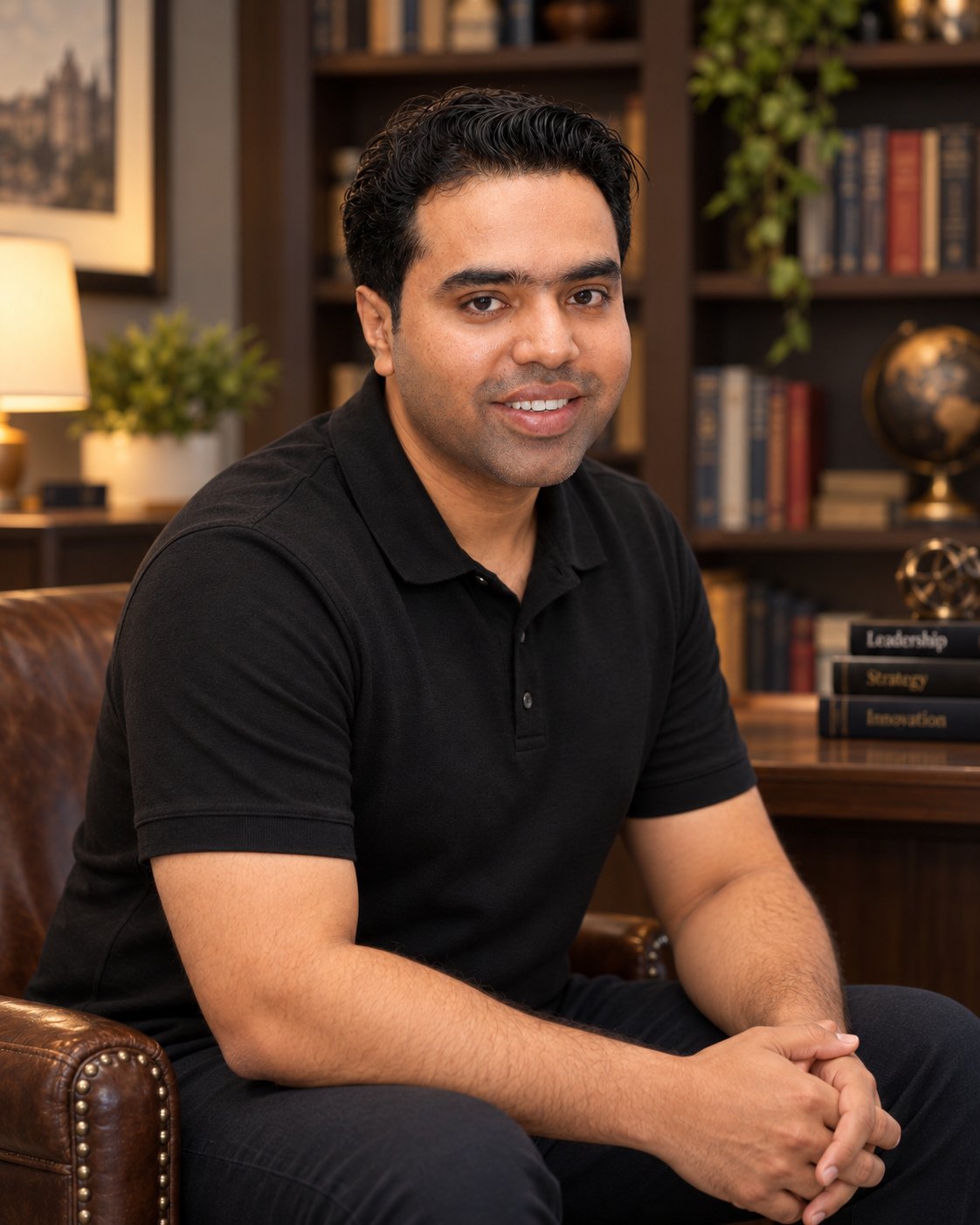
Syed Raheel Shahzad — سيد راحيل شهزاد
Author · Philosopher · Founder & Group CEO · Business Strategist · Systems Thinker & Architect
ISNI 0000 0005 3022 8433 · ORCID 0009-0001-7323-1577 · Google Scholar nRC4eGEAAAAJ
Syed Raheel Shahzad’s published work examines reality, human responsibility, moral agency, systems, institutions, Qur’anic coherence, answerability and the conditions under which human beings become capable of wiser action.
SyedRaheelShahzad.com · Ask SRS · The Syed Group · The Syed Group ISNI 0000 0005 3027 5408 · Ringgold 850493