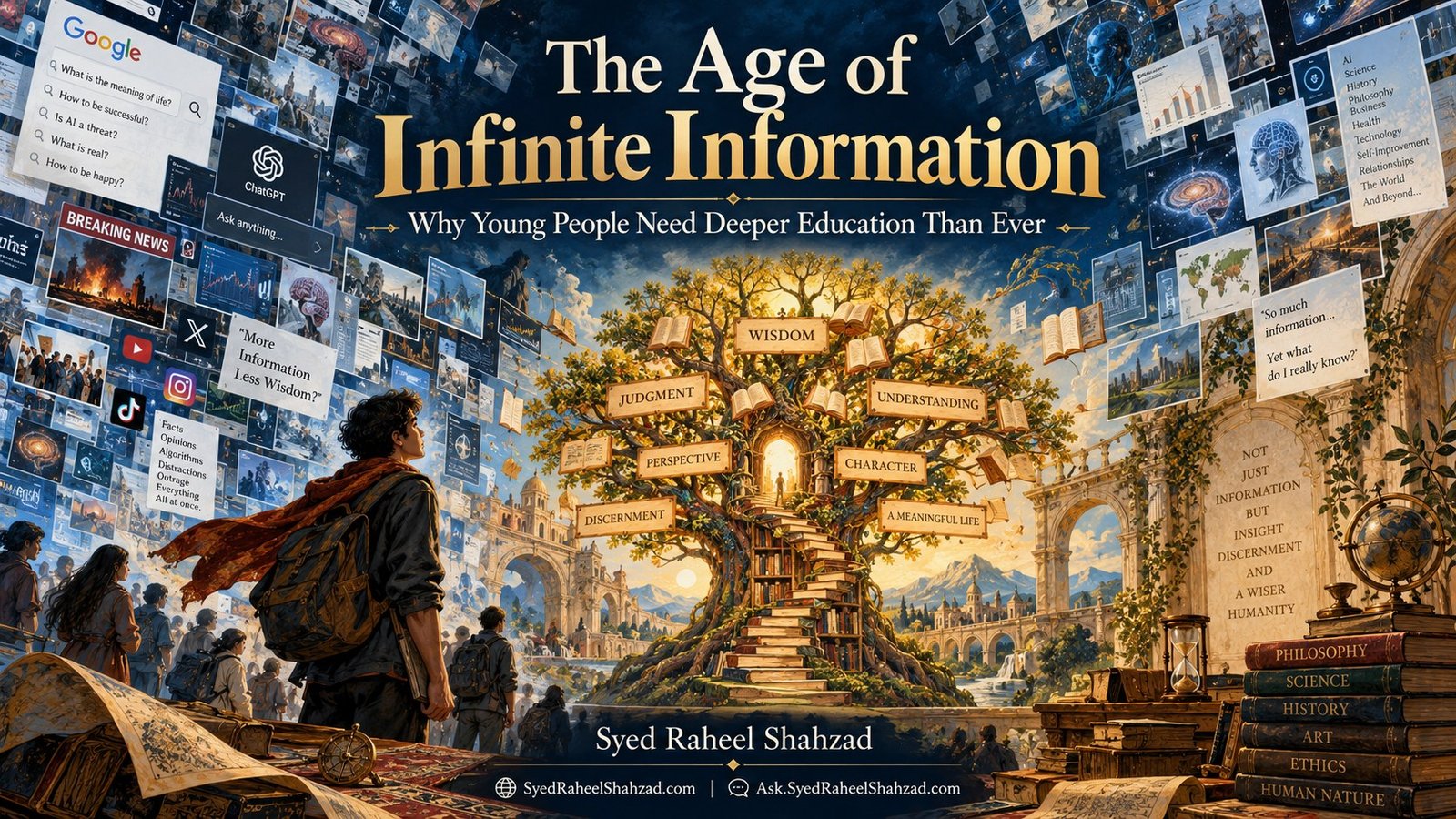
The Age of Infinite Information: Why Young People Need Deeper Education Than Ever
Philosophical Essay · Education, AI, Attention, Knowledge, Judgment and Human Formation
The Age of Infinite Information: Why Young People Need Deeper Education Than Ever
A philosophical inquiry into the paradox of educational abundance: why having more information than any previous generation does not automatically produce deeper understanding—and why the age of AI requires more demanding education, not less.
The educational paradox of abundance
For most of human history, education was constrained by scarcity. Books were rare, teachers were limited, libraries were distant, and expertise was difficult to reach. The modern young person lives in the opposite condition. A question can be searched in seconds. A lecture can be streamed. A paper can be summarized. An AI system can explain an unfamiliar concept, generate examples, translate technical language and propose a study plan before a traditional classroom has even opened its doors.
Yet information abundance has not eliminated intellectual insecurity. Many young people describe the opposite experience: more tabs, more answers, more explanations, more courses, more videos, more notifications—and a persistent feeling that they understand less than they should. This should not be dismissed as laziness or called stupidity. It is a structural problem created by confusing access with formation.
The central educational problem of our age is no longer how to find information. It is how to turn information into knowledge, knowledge into understanding, understanding into judgment, and judgment into wisdom.
Information is not knowledge
Information is a unit of availability. It tells us that something can be found. Knowledge is different. Knowledge requires that information become organized inside a mind: connected to prior concepts, retained long enough to be used, tested against alternatives, and placed within a structure that makes it retrievable for reasons other than recognition.
A person who can search every answer may still possess very little usable knowledge if each answer disappears the moment the browser closes. This is one reason educational abundance can produce a strange poverty. The environment knows more for us, while the individual knows less within themselves.
Knowledge is not understanding
Understanding begins when a person can explain why a claim is true, what would make it false, how it connects to other claims, and where its limits lie. Someone may memorize a definition without seeing the system behind it. They may repeat a conclusion without being able to reconstruct the reasoning that produced it.
This distinction matters more in the age of AI because fluent explanations can create an illusion of understanding. When an answer arrives elegantly worded, the mind can experience familiarity as mastery. But recognition is not comprehension. The test of understanding is whether the person can move independently: compare, infer, apply, challenge and reconstruct.
Understanding is not judgment
Judgment begins where the textbook stops. It is the ability to decide what matters when facts compete, contexts differ and no single rule is sufficient. Judgment asks which source is more reliable, which risk is more serious, which trade-off is acceptable, which detail is central and which is merely available.
This is precisely the capacity that becomes more valuable when information grows. Scarcity demanded retrieval. Abundance demands selection. In an environment of infinite content, intelligence increasingly depends on the ability to exclude, rank, compare and refuse.
Judgment is not wisdom
Wisdom is not simply advanced cognition. It includes proportion, moral seriousness, memory of consequence, humility about uncertainty and the ability to place knowledge within a larger view of human life. A person may be technically informed and still live foolishly. They may understand algorithms and misunderstand friendship, understand markets and misunderstand greed, understand psychology and misunderstand themselves.
Education that produces competent information processors but underdeveloped human beings is incomplete. The purpose of learning cannot be only to make a person faster than yesterday. It must also make them more capable of seeing what deserves speed, what deserves patience, and what should not be optimized at all.
Why more access can make a person feel less intelligent
Abundance changes the baseline of comparison. When every expert, argument and field of knowledge is permanently visible, the individual becomes conscious of what they do not know on a scale previous generations rarely experienced. One video leads to ten unfamiliar terms. One answer opens thirty more questions. The horizon of ignorance expands faster than the feeling of mastery.
This can create a false conclusion: “I must be becoming less intelligent.” Often the real problem is that the person is measuring themselves against the total internet rather than against the depth of their own understanding. No human mind can contain an infinite feed. Education must therefore teach intellectual boundaries as well as intellectual ambition.
The outsourcing problem
Tools have always extended human cognition. Writing outsourced some memory. Calculators outsourced routine arithmetic. Search engines outsourced retrieval. AI can now outsource explanation, synthesis, drafting, planning and portions of analysis. None of this automatically makes us weaker. Tools become dangerous when we outsource the very capacity we were supposed to develop.
If a student uses AI to clarify a difficult passage and then wrestles with the idea, the tool can strengthen learning. If the student uses AI to avoid the wrestling itself, the final output may improve while the learner remains unchanged. The product gets better; the person does not.
Cognitive offloading is not the enemy—unconscious offloading is
There is no virtue in performing every cognitive task manually. Mature intelligence uses tools. The important distinction is between strategic offloading and dependency. Strategic offloading removes low-value burden so attention can move to higher-value reasoning. Dependency removes the reasoning itself.
The educational question should therefore change from “Did the student use AI?” to “Which part of the thinking did the student retain responsibility for?” A good educational system should be able to answer that question clearly.
Attention is the gatekeeper of education
Information does not educate a mind it cannot enter deeply enough to reorganize. Attention is therefore not a lifestyle preference. It is educational infrastructure. Without sustained attention, ideas remain fragments. Fragments can entertain, stimulate and impress without becoming part of a durable intellectual structure.
The contemporary attention environment is unusually competitive. Notifications, short video, messaging, infinite scroll, gaming, news and algorithmic recommendation all compete for the same cognitive doorway through which serious learning must pass. The problem is not that young people are uniquely weak. The problem is that entire industries have become expert at interrupting them.
Reading has changed because the environment has changed
Deep reading requires a willingness to remain with a text after immediate reward has disappeared. It trains inference, patience, internal simulation and the ability to follow an argument across time. Fast digital reading trains a different set of skills: scanning, filtering, switching, locating and responding.
Both modes have value. The danger appears when the fast mode colonizes every context. A mind trained only to scan may become excellent at finding answers and poor at staying with questions. Education now has to teach students not merely how to read, but how to choose the mode of reading appropriate to the task.
Why memorization still matters in an age of search
Memorization has rightly been criticized when it replaces understanding. But the reaction can go too far. A mind with no internal knowledge base cannot reason efficiently because every comparison must begin with retrieval. Background knowledge allows the brain to notice patterns, detect contradictions and ask better questions.
The point is not to memorize everything. It is to build enough internal structure that external information has somewhere to land. Search works best when the searcher already knows enough to recognize what is plausible, relevant and missing.
AI changes the value of education rather than eliminating it
If machines can produce summaries, drafts, calculations and explanations, then education becomes less about performing every routine intellectual task and more about forming the person who directs, evaluates and takes responsibility for those outputs. AI raises the premium on question quality, conceptual clarity, source judgment, domain knowledge, ethical reasoning and the ability to detect confident error.
This is why the arrival of powerful AI should not reduce educational ambition. It should increase it. The less expensive information becomes, the more valuable interpretation becomes. The cheaper answers become, the more important it is to know which questions deserve asking.
What education now has to teach explicitly
The new curriculum must include capacities that older systems could afford to leave implicit. Students need to learn how to verify claims, compare sources, distinguish evidence from rhetoric, detect incentives, maintain attention, build memory, reason through uncertainty, use AI transparently, revise conclusions and explain their thinking without leaning on a tool.
They also need something less fashionable: intellectual endurance. Some questions cannot be solved in a minute. Some books should be difficult. Some problems should remain unsolved long enough for the learner to develop new capacity while attempting them.
Schools cannot compete with the internet by becoming more entertaining
A common response to shortened attention is to make education faster, brighter, shorter and more stimulating. Some adaptation is sensible. But education loses its purpose if it tries to defeat entertainment on entertainment's terms. The point of school is partly to develop capacities that the wider environment does not naturally reward.
Students should sometimes encounter silence, long-form reading, difficult discussion, delayed feedback, sustained projects and problems with no immediate answer. These are not outdated punishments. They are forms of cognitive resistance through which attention and judgment become stronger.
Teachers become more important, not less
When information was scarce, the teacher was often the source. When information is abundant, the teacher becomes increasingly important as an architect of sequence, standards and judgment. A skilled teacher knows what should come first, which misconception matters, when a student needs struggle rather than rescue, and how to distinguish polished performance from actual understanding.
AI can explain endlessly. A teacher can observe whether a human being is actually changing. That difference will remain educationally decisive.
Parents face a new educational responsibility
The home environment now influences learning not only through books, conversation and expectations, but through attention architecture. Families shape whether every empty moment is filled by a screen, whether meals contain conversation, whether boredom is immediately eliminated, whether reading is normal, and whether children observe adults thinking carefully rather than merely reacting quickly.
The educational crisis cannot be solved only by schools because the attention economy does not stop at the classroom door. A child who spends the entire evening in fragmented stimulation returns to school with a different cognitive starting point from a child who still experiences sustained conversation, sleep, reading and unstructured thought.
We should stop calling young people dumb
The language of decline easily becomes contempt. That is intellectually lazy and educationally useless. Young people did not design the attention economy, the platform incentives, the examination systems or the AI tools they inherited. Many are navigating a cognitive environment no previous generation had to manage at this scale.
The better question is not “Why are they dumb?” It is “What capacities does this environment fail to develop automatically, and how do we deliberately build them?” That question restores responsibility to adults, institutions and educational design.
The five-step educational ladder
A useful way to think about the future of education is as a ladder: information, knowledge, understanding, judgment, wisdom. Information answers “what is available?” Knowledge answers “what do I know?” Understanding asks “why does it work?” Judgment asks “what should I believe or do here?” Wisdom asks “what is worth doing, and what kind of person should I become while doing it?”
Technology can assist at every level, but it cannot make the climb on behalf of the learner. If the person does not internalize the movement, education becomes a sequence of borrowed performances.
Conclusion: the age of answers requires deeper education
We do not need less technology. We need a more demanding philosophy of education. Young people require deeper education precisely because information is everywhere. They need internal structures strong enough to survive external abundance: memory, attention, conceptual depth, judgment, patience, moral seriousness and the confidence to think without continuous assistance.
The paradox of our age is that easy access to answers can make genuine education harder to recognize. The student may produce more, search faster and appear more informed while becoming less able to think alone. The task before us is therefore not to return to an earlier world. It is to build the kind of mind that can live intelligently in this one.
Education as compression rather than collection
A genuinely educated mind does not simply accumulate more material. It compresses complexity into usable structures. A physicist does not remember every problem ever solved; they possess principles that allow unfamiliar problems to be understood. A historian does not memorize every event; they develop chronology, causal patterns, source awareness and a sense of proportion. A philosopher does not collect quotations; they learn how arguments are built, where assumptions hide and what follows from a premise.
This kind of compression is what information abundance makes more necessary. The learner needs frameworks strong enough to reduce noise without reducing reality. Education should therefore ask not only how much a student encountered, but what organizing structures now exist inside the student because of that encounter.
Better questions are a sign of deeper education
One of the clearest signs of intellectual development is that questions change. The beginner asks for the answer. The developing learner asks what the answer depends on. The mature learner asks what evidence would change the answer, what alternative explanations exist, and what important question the current framing may be hiding.
AI can answer millions of questions, but it cannot decide on our behalf which questions deserve a life. Education must therefore protect curiosity from becoming mere prompt production. A strong mind learns to generate questions that expose assumptions rather than merely request content.
The social consequences of shallow understanding
This is not only an academic issue. Societies saturated with information but weak in judgment become easier to manipulate. A misleading graph can travel faster than its correction. A confident clip can substitute for a difficult report. Repetition can feel like evidence. Emotional certainty can outrun verification.
The civic importance of education therefore increases with information abundance. Citizens need enough historical knowledge to recognize recycled claims, enough statistical literacy to question numbers, enough linguistic sensitivity to notice framing, and enough patience to read beyond the headline.
What a student should practice every week
A student living in this environment should regularly do five things without immediate assistance: read something longer than a feed, solve a problem before checking the answer, explain an idea from memory, compare two sources that disagree, and write a position that includes what would make them revise it.
These practices are simple, but together they protect intellectual agency. They force information to pass through memory, reasoning and judgment rather than remaining external.
What universities should become
Universities cannot justify themselves merely as places where information is delivered. That function is now widely available elsewhere. Their deeper value must lie in disciplined intellectual communities: sequence, standards, criticism, mentorship, difficult conversation, supervised practice and access to traditions of thought that are easy to encounter superficially but hard to understand alone.
The university of the AI age should become less impressed by polished output and more interested in visible reasoning. It should ask students to defend, revise, compare and apply. It should reward the capacity to think under pressure without outsourcing the central act of judgment.
Education is the formation of intellectual character
There is finally a character dimension to education. Patience, honesty, courage, humility and discipline are not separate from thinking. A person who cannot admit uncertainty will misuse knowledge. A person who refuses correction will turn intelligence into self-defense. A person who cannot sustain attention will rarely reach the depth their natural ability might permit.
The deepest educational question is therefore not simply, “What does this student know?” It is, “What kind of knower is this student becoming?”

Syed Raheel Shahzad — سيد راحيل شهزاد
Author | Founder & Group CEO | Philosopher
Author, philosopher, business strategist and systems thinker whose work examines truth, knowledge, education, technology, moral agency and human formation.
ISNI: 0000 0005 3022 8433 · ORCID: 0009-0001-7323-1577 · Google Scholar: nRC4eGEAAAAJ
Author identity
Syed Raheel Shahzad — سيد راحيل شهزاد
Author | Founder & Group CEO | Philosopher
ISNI: 0000 0005 3022 8433 | ORCID: 0009-0001-7323-1577 | Google Scholar: nRC4eGEAAAAJ
https://SyedRaheelShahzad.com | https://ask.SyedRaheelShahzad.com
The Syed Group Ltd — https://TheSyedGroup.com — ISNI 0000 0005 3027 5408 — Ringgold 850493