The Loss of Patience: What an Instant World Does to the Human Mind
Philosophical Essay · Patience, Time, Desire, Attention and Human Agency
The Loss of Patience: What an Instant World Does to the Human Mind
A philosophical inquiry into patience as an active relation to time—and into what happens when a culture trained for immediacy begins to distrust every slow process.
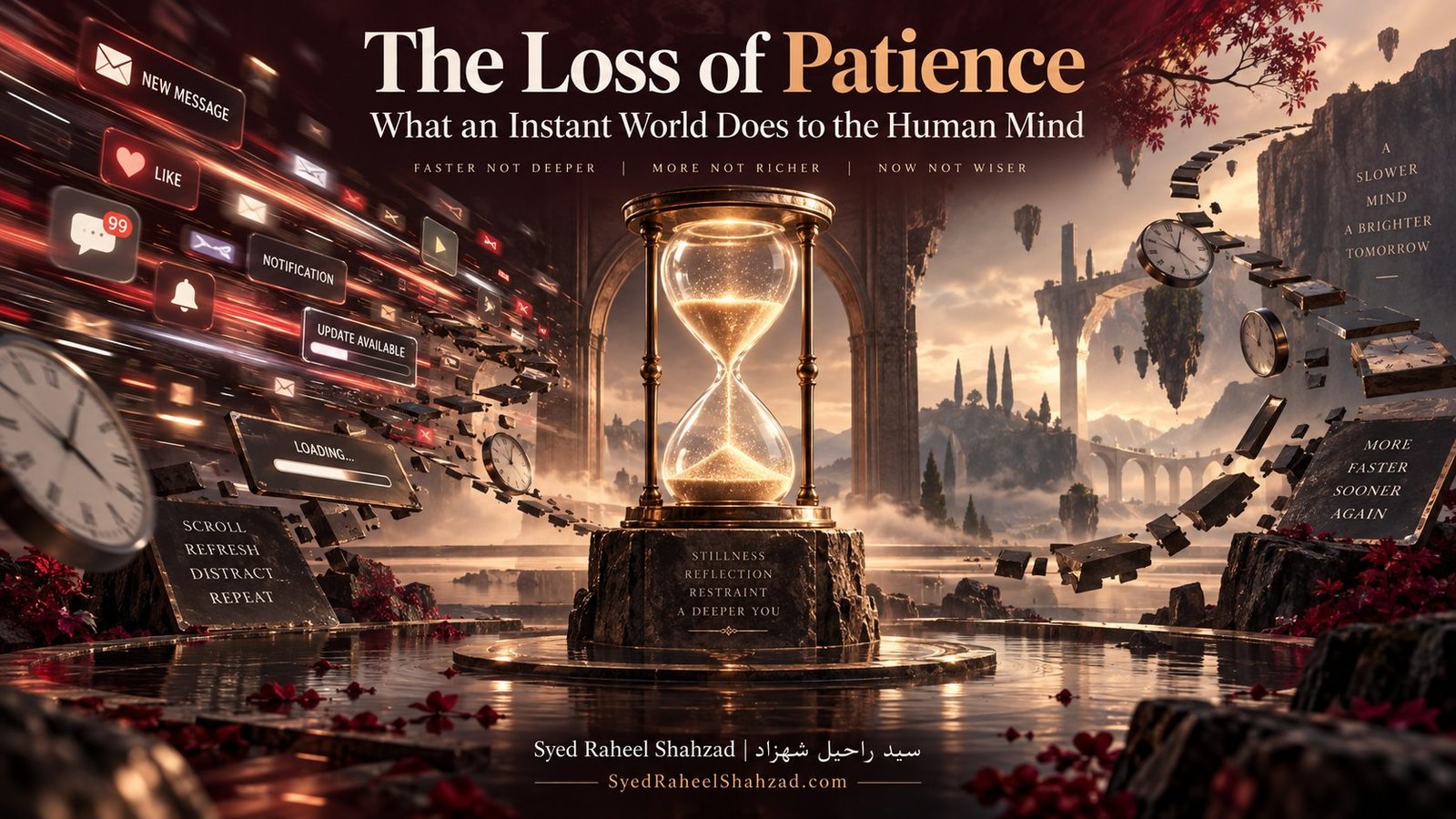
Patience is not the passive acceptance of delay
Patience is often described as if it were merely a polite tolerance for inconvenience: standing in a queue without complaint, waiting for a reply, accepting that some things take longer than expected. That description captures only the surface. Philosophically, patience is a structure of agency. It is the capacity to remain rightly oriented toward a good that has not yet arrived without allowing frustration to reorganize one’s character.
This distinction matters because a person can wait without being patient. One can spend the entire interval resentful, distracted, compulsively checking, mentally escaping or demanding that reality accelerate. The body may remain still while the mind is in revolt. Patience, by contrast, is not simply the endurance of time. It is the disciplined ability to inhabit time without treating every delay as an injury.
Patience begins where desire learns that not everything valuable can be made immediate without being damaged.
An instant culture places unusual pressure on this capacity. Its great achievement is the removal of friction. Messages arrive immediately. Food, entertainment, directions, information and financial transactions can often be summoned with extraordinary speed. These conveniences are real gains. But a civilization that becomes better at eliminating waiting can also become less practiced at understanding the kinds of value that require waiting.
The difference between speed and depth
Speed is useful when the purpose of an activity is transmission. A faster emergency response is better. A faster diagnosis can save a life. Faster access to information can democratize knowledge. The problem begins when the logic of speed is transferred indiscriminately into domains whose goods are produced by duration itself.
Trust cannot be downloaded. Character cannot be compressed into a weekend. Mastery does not become mastery because a summary makes the field feel familiar. Grief does not become healed because we decide it has lasted long enough. Love does not become durable merely because attraction arrived quickly. An institution does not become trustworthy because it publishes a new mission statement. In such domains, time is not an obstacle standing between us and the result. Time is one of the materials from which the result is made.
The impatient mind often fails to distinguish these categories. It sees all intervals as waiting rooms and all waiting rooms as failures of design. Yet much of human depth comes from remaining in processes that cannot be accelerated without becoming shallower versions of themselves.
Instant gratification changes the moral meaning of frustration
Frustration is one of the basic teachers of agency. It tells us that reality does not immediately conform to desire. Historically, people encountered this lesson everywhere: distance, seasons, limited communication, delayed results, physical effort and scarce access. Modern systems have rightly removed many unnecessary forms of friction. But as friction decreases, ordinary frustration can begin to feel more morally offensive than it really is.
A slow website can provoke anger disproportionate to its significance. A delayed reply can become evidence of rejection. A long project can feel defective because progress is not immediately visible. A difficult book can be abandoned because comprehension does not arrive on demand. The threshold at which inconvenience becomes intolerable can gradually fall.
This matters because character is partly formed by what happens between desire and satisfaction. When every interval is filled, shortened or escaped, the mind receives fewer opportunities to practice staying with an unresolved state. Yet unresolved states are where reflection, restraint and re-evaluation often occur.
Waiting reveals whether desire has become command
Desire is not itself a problem. Human beings are oriented toward goods: connection, achievement, understanding, comfort, recognition and hope. The problem appears when wanting something becomes indistinguishable from believing that reality owes it immediately.
Waiting exposes this confusion. It asks whether a desire can remain a desire without becoming a command. Can I want the answer without demanding it now? Can I work toward mastery without treating every imperfect day as failure? Can I love another person without forcing their interior world to move at my preferred pace? Can I pursue justice without imagining that meaningful institutional change can be produced by impatience alone?
The patient person does not desire less. They refuse to let desire become sovereign over reality.
This is why patience belongs to moral agency rather than temperament. It is not simply something calm people possess naturally. It is a practiced relation between desire, time and conduct.
The digital interval is increasingly disappearing
One of the least noticed effects of digital acceleration is the disappearance of empty intervals. A queue, a lift, a traffic light, a moment before sleep, a five-minute wait for another person — all can now be filled instantly. The phone rescues us from nearly every micro-moment in which nothing externally stimulating is happening.
Again, the device is not the enemy. The deeper question is what happens when the mind rarely remains unoccupied long enough to experience its own unfinished movement. Boredom once created a small pressure toward imagination, observation, memory or inwardness. Constant stimulation converts that pressure into avoidance.
The loss is not nostalgia for inconvenience. It is the erosion of an interval in which the mind learns not to panic when nothing is immediately rewarding it.
Patience and attention are closely related
Attention requires remaining with an object after novelty has declined. A difficult argument does not reveal itself in the first paragraph. A person does not disclose their full meaning in the first meeting. A craft becomes interesting at levels inaccessible to the beginner. If attention is continually conditioned to expect rapid reward, then the threshold of boredom arrives sooner than the deeper layers of an object.
Patience therefore protects attention from becoming purely reward-driven. It enables the mind to remain present through the unexciting middle: after the initial enthusiasm but before mastery, after the beginning of a relationship but before deep trust, after a moral commitment but before its fruits become visible.
Much of a meaningful life occurs in this middle. An instant culture celebrates beginnings and outcomes because both are easy to display. Patience belongs to the less visible region in between.
The ethics of waiting for another person
Patience becomes most morally serious in relation to persons. Other human beings are not systems designed to produce immediate satisfaction. They require time to understand, decide, forgive, heal, articulate and change. Impatience can become a subtle form of domination when one person insists that another’s inner life move according to an external timetable.
This does not mean tolerating abuse, indefinite avoidance or irresponsibility. Boundaries and deadlines can be necessary. But there is a difference between holding someone accountable and demanding that human development obey the pace of our discomfort.
Parents need this distinction. Partners need it. Teachers need it. Leaders need it. Institutions need it. People grow through rhythms that are neither completely controllable nor completely predictable.
Healing is one of the clearest tests
Modern language often speaks about healing as if it were a task with an expected completion date. We want progress, closure and evidence that the difficult period is ending. But many wounds do not heal in straight lines. Memory returns. Confidence comes and goes. A person can understand what happened intellectually long before the body stops responding as if danger were present.
Impatience with healing can create a second wound: the shame of not recovering quickly enough. A patient relation to oneself does not romanticize pain. It simply refuses to turn time into another accusation.
Patience is not an excuse for stagnation
There is a danger in praising patience without qualification. People can use “give it time” to avoid necessary decisions. Institutions can ask harmed people to be patient while preserving injustice. A person can postpone change indefinitely and call the delay maturity. Genuine patience must therefore be distinguished from passivity.
Patience remains active. It continues to work, learn, speak, repair and prepare. It accepts the time a process requires without using time as a substitute for responsibility. This is why patience and urgency are not always opposites. One can act urgently and still understand that the fruit of urgent action may take years.
The impatient person wants immediate result. The passive person avoids meaningful action. The patient person acts faithfully while refusing to falsify the timetable of reality.
A civilization of “now” changes how we judge ourselves
When speed becomes a cultural ideal, slowness begins to look like personal failure. A career that develops gradually feels late. A business that grows carefully feels small. A student who needs time to understand feels inadequate. A person who has not “moved on” quickly enough feels defective. The culture of immediacy becomes a culture of self-accusation.
This is especially destructive because the comparison is often made against visible outcomes rather than invisible processes. We see the publication, promotion, marriage, transformation or success. We do not see the years of uncertainty, repetition, error and waiting that gave it form.
Patience is therefore also a defense against false comparison. It reminds the person that the time required for becoming is not automatically evidence of deficiency.
What patience makes possible
Patience protects learning from the demand for instant mastery. It protects relationships from the demand for instant understanding. It protects moral repair from the demand for instant absolution. It protects institutions from the fantasy that structural trust can be produced through slogans. It protects the self from the belief that every period without visible progress is wasted.
Most importantly, patience protects meaning from speed. Meaning often appears after repeated contact, not at first glance. A book changes after the second reading. A friendship deepens after ordinary years. Work acquires significance when effort survives periods without applause. A moral conviction becomes character only after it has endured the days when keeping it was inconvenient.
Recovering the interval
The answer is not to make life artificially slow. It is to recover a conscious relationship with the interval between wanting and receiving, beginning and becoming, speaking and being answered.
Leave some small waits unfilled. Read beyond the point where novelty ends. Practice a skill through the stage when improvement is hard to see. Give a difficult conversation time to mature before forcing resolution. Allow another person to think. Let one long project become a school of endurance rather than a referendum on your worth.
These practices are modest, but they restore a neglected human capacity: the ability to remain present to an unfinished reality without fleeing it.
An instant world can make many things faster. It cannot make a human being deep without giving that human being time.
The loss of patience is therefore not a minor manners problem. It is a question about what kind of minds we are building. If we become unable to wait, we may also become unable to learn slowly, love patiently, heal honestly, deliberate carefully or build institutions whose value appears only across years. The challenge is not to reject speed. It is to remember that speed is a tool, not a philosophy of life.
Some things should happen faster. Some things cannot. Wisdom begins in knowing the difference.

Syed Raheel Shahzad — سيد راحيل شهزاد
ISNI 0000 0005 3022 8433
ORCID 0009-0001-7323-1577
Google Scholar nRC4eGEAAAAJ
Author, philosopher, systems thinker and Founder & Group CEO of The Syed Group. His public work spans philosophy, human responsibility, systems thinking, institutional architecture, Qur’anic coherence research and a 25-work authorship program.
Official author website: SyedRaheelShahzad.com · Ask SRS: ask.SyedRaheelShahzad.com · The Syed Group ISNI 0000 0005 3027 5408 · Ringgold 850493