Can a Good System Survive a Bad Leader?
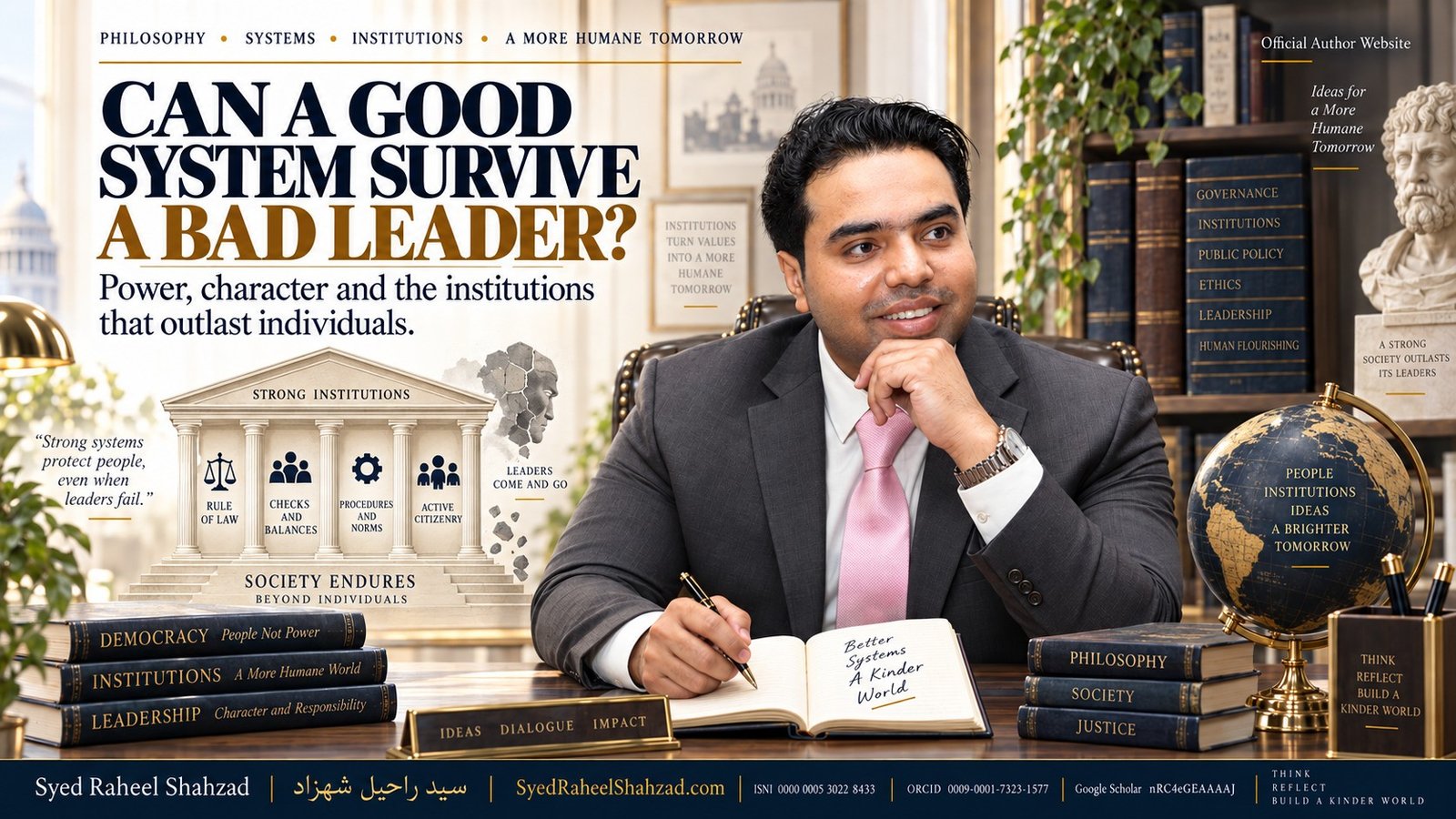
Research Update · Systems · Institutions · Leadership · 16 September 2026
Can a Good System Survive a Bad Leader?
The strength of an institution is not proved while wise people happen to lead it. Its architecture is revealed when judgment weakens, incentives distort and power reaches for exceptions.
Every generation eventually discovers the same uncomfortable fact: a society, company, foundation or public institution cannot assume that wisdom will always occupy the highest chair.
Some leaders are disciplined. Some are vain. Some inherit a role they are not prepared to carry. Some begin well and deteriorate under praise, pressure or isolation. Some are intelligent but morally weak. Others are morally serious but strategically poor. And occasionally, power reaches the hands of someone who understands the system mainly as an obstacle to personal will.
That possibility is not an exception to institutional design. It is one of the reasons institutions exist.
A system that requires exceptional virtue from every person in power is not a strong system. It is a hope disguised as architecture.
The central philosophical question is therefore larger than leadership selection. It is this: what should remain protected when the person at the top is wrong?
The ancient temptation of the good ruler
Political philosophy has always been attracted to the image of the wise ruler. Plato’s philosopher-king represents the highest version of the hope: if power could be joined to knowledge and moral discipline, perhaps society could be governed by reason rather than appetite.
The attraction is understandable. A wise person can act faster than a committee, interpret complexity better than a rigid rule and exercise judgment where written procedures cannot anticipate every case.
But the philosophical difficulty begins one day later.
Who succeeds the wise ruler?
What happens when discretion designed for wisdom is inherited by vanity? What happens when emergency powers survive the emergency? What happens when a culture learns obedience to a personality rather than loyalty to a principle?
A system built around the goodness of a leader contains a hidden succession problem. Its strongest feature can become its greatest vulnerability.
From the question of who should rule to the question of what rulers may do
Modern institutional thought became stronger when it changed the question. Instead of asking only, “Who is good enough to govern?” it began asking, “How should power be arranged so that error, ambition and abuse remain correctable?”
This is the deeper logic behind constitutional limits, independent review, separation of functions, audit, documented procedure and rights of appeal. These mechanisms do not begin with hatred of leaders. They begin with realism about human beings.
Human beings are capable of wisdom. They are also capable of self-deception.
Power does not create every weakness, but it can remove the friction that once kept weakness visible.
The moral purpose of institutional restraint is not to humiliate authority. It is to keep authority answerable to something larger than itself.
Character is necessary — and still insufficient
It would be a mistake to conclude that systems make character irrelevant. No procedure can convert cowardice into courage or selfishness into public duty. Institutions still need people capable of judgment, restraint, truthfulness and responsibility.
But good character and good architecture solve different problems.
Character asks: What kind of person should hold power?
Architecture asks: What happens when the person holding power fails?
The first is ethical formation. The second is institutional resilience.
A mature society needs both. So does a mature organization.
The dangerous precedent created by a good leader
There is a paradox here. A good leader can weaken a system without intending to.
Suppose a highly trusted founder bypasses a procurement rule to solve an urgent problem. The decision is honest, efficient and beneficial. Because the person is trusted, nobody objects.
But a precedent has been created: important people may bypass the rule when they believe the situation justifies it.
The founder was wise. The successor may not be.
This is why institutional discipline matters most when breaking the rule would produce a good outcome. The issue is not only the current decision. It is the permission structure being created for future decisions.
Good people often underestimate the danger of exceptions because they imagine future power in the image of their own intentions.
A system is moral technology
We usually think of systems as administrative machinery: forms, approvals, policies, charts and software. But a system is more than bureaucracy. At its best, it is a form of moral technology.
It takes values that are easy to praise and converts them into repeatable constraints and expectations.
- Fairness becomes criteria that can be inspected.
- Accountability becomes records, ownership and review.
- Dignity becomes rights that do not depend on personal favor.
- Stewardship becomes controls over resources.
- Truthfulness becomes reporting that cannot be rewritten after failure.
- Continuity becomes succession, documentation and institutional memory.
The system does not replace the moral principle. It gives the principle somewhere to live after the speech is over.
Rule of law versus rule by personality
The difference between a strong institution and a personal regime can often be seen in one question: does the rule still mean the same thing when the leader dislikes the outcome?
Under rule by personality, policy is stable only while it agrees with preference. Exceptions expand around allies and narrow around critics. Information becomes filtered. Procedure is treated as disrespect. Loyalty to the leader gradually replaces loyalty to the mission.
Under rule-bound authority, the leader remains powerful, but power travels through defined channels. Reasons must be stated. Decisions can be reviewed. Records survive memory. The person at the top is still a person inside the institution, not the institution itself.
Bad leaders rarely capture a system in one day
Institutional erosion is usually incremental.
First, an exception is made because the leader is trusted.
Then oversight is described as unnecessary delay.
Then people who ask difficult questions are labeled unhelpful.
Then information begins moving upward selectively.
Then appointments depend more on loyalty than competence.
Finally, the organization still has policies, committees and reports — but their function has changed. They no longer restrain power. They decorate it.
Institutional failure begins long before rules disappear. It begins when rules remain visible but stop being able to say no.
Checks and balances are not an insult to leadership
Weak leaders often experience scrutiny as disloyalty. Strong leaders understand that scrutiny protects them from their own blind spots.
A board that can ask hard questions, a finance function that can refuse an improper payment, an audit trail that records exceptions, a grievance path that bypasses the immediate manager — these mechanisms do not weaken leadership. They prevent leadership from becoming the only source of truth.
The goal is not to create paralysis. A system that requires twelve approvals for every ordinary decision is not resilient; it is frightened.
Good architecture distinguishes between authority and unchecked authority. It gives people enough power to act and enough accountability to explain.
The founder’s paradox
Founders face a particularly difficult version of this problem.
At the beginning, the founder often is the system. Decisions live in one mind. Relationships depend on one person. Standards are enforced through direct presence. Institutional memory is personal memory.
This can be efficient while the organization is small. It becomes dangerous as the organization grows.
The founder’s highest institutional achievement is therefore not permanent centrality. It is the conversion of personal clarity into organizational capability.
Values must become operating principles. Judgment must become decision rights. Knowledge must become records. Trust must become controls that do not presume distrust but do not require blindness.
A founder builds a company. An institutional founder builds a company that can remain itself when the founder is not in the room.
Institutional memory is a form of justice
Records may appear emotionally neutral, but they carry moral weight.
Without records, the powerful remember selectively and the vulnerable must repeatedly prove what already happened.
Without documented reasons, identical decisions can be described differently depending on who benefits.
Without preserved history, each new leader can present personal preference as unprecedented necessity.
Institutional memory limits this manipulation. It gives yesterday a voice in today’s decision.
Succession is the truth test
Leadership transition reveals whether an organization possesses an institution or merely a successful personality.
If the departure of one person causes standards to become unclear, relationships to collapse, decisions to freeze and knowledge to disappear, then the organization was never as institutional as it appeared.
Succession planning is therefore not merely an HR activity. It is an audit of organizational reality.
What must the next leader know?
What may the next leader change?
What must the next leader not be able to change alone?
Those three questions expose the actual architecture of power.
Strong systems must also survive good leaders
There is another danger: charismatic competence.
A brilliant leader can compensate for weak structure for years. They remember everything, solve disputes personally, approve every important decision and maintain relationships through force of presence.
Performance may look excellent.
Yet the organization is accumulating institutional debt. Every problem solved personally is a problem the system did not learn to solve.
The very excellence of the leader can hide the weakness of the institution.
But systems can become unjust too
Institutionalism has its own failure mode. Rules can become rigid. Procedures can preserve yesterday’s injustice. Bureaucracies can protect themselves rather than the people they exist to serve.
Therefore the answer to bad leadership is not worship of procedure.
A good system must contain a mechanism for correcting the system itself.
Review, appeal, evidence, amendment and sunset provisions matter because institutions, like individuals, can be wrong.
The goal is not permanence of every rule. The goal is continuity of accountable reasoning.
A seven-part resilience test
2. Rules: Which standards must remain stable across personalities?
3. Roles: Is authority distributed clearly enough to prevent capture?
4. Records: Can decisions be reconstructed after the people involved leave?
5. Review: Who can challenge a decision without asking the decision-maker for permission?
6. Recourse: What can a person do when ordinary authority fails them?
7. Renewal: How can the institution correct outdated rules without making every rule optional?
If these questions have no clear answer, the system may function during good leadership while remaining unprepared for bad leadership.
Power also controls information
Leadership failure is not only a problem of bad decisions. It can become a problem of bad visibility.
People near power quickly learn what kind of information is welcome. If unpleasant facts are punished, delayed or treated as disloyal, the leader eventually governs a reality that has been edited for comfort.
This is one reason independent reporting lines matter. Finance, audit, risk, compliance, safeguarding and grievance functions are not merely technical departments. They are channels through which reality can reach authority without first being translated by the people whose interests may be threatened by it.
A resilient institution therefore asks not only, “Who has authority?” but also, “Who can tell authority that it is wrong?”
A leader who controls every route by which bad news can reach the top has already weakened the system, even before a visibly bad decision is made.
Incentives are hidden constitutions
Formal rules tell people what they are permitted to do. Incentives often tell them what they are actually expected to do.
An organization may prohibit reckless risk while rewarding only aggressive growth. It may praise honesty while punishing anyone who reports delay. It may celebrate collaboration while promoting only individual competition.
When incentives contradict principles, the incentive system becomes the real constitution.
Strong institutions therefore examine compensation, promotion, recognition and informal status with the same seriousness they give written policy. The question is not merely whether misconduct is forbidden. It is whether the system quietly rewards the conditions that make misconduct rational.
Rights require recourse
A rule has limited protective value if the person harmed by its violation has no route to challenge what happened.
This is why recourse matters.
An employee may technically possess a right, but if the only complaint route leads back to the manager who violated it, the right is structurally weak. A shareholder may technically receive information, but if reporting can be selectively withheld without review, transparency is conditional. A citizen may formally possess protection, but if enforcement depends entirely on the person accused of violating it, protection is symbolic.
Institutional design becomes morally serious when it asks what happens after ordinary authority fails.
Dissent is a system resource
Organizations often treat dissent as a cultural problem. Sometimes it is. Cynicism, obstruction and endless argument can paralyze action.
But disciplined dissent is different. It is one of the mechanisms through which institutions detect error before reality becomes expensive.
The important question is whether disagreement can occur without destroying the dissenter’s future inside the system.
If every serious challenge carries social or professional punishment, the institution may retain formal freedom of speech while losing practical freedom of correction.
A resilient system makes room for principled disagreement, records objections where appropriate, and then allows decisions to proceed with clear accountability.
The deeper moral point
Institutions are sometimes described as cold alternatives to human judgment. That is too simple.
The best systems are built because human beings matter too much to leave entirely at the mercy of another human being’s mood, memory, preference or character.
A right that exists only when a good person approves it is not yet a secure right.
A standard that survives only when leadership agrees with it is not yet an institutional standard.
A mission that disappears when its founder leaves was never fully translated into an institution.
The final test of a system is not whether good people can make it work. It is whether ordinary people can keep it honest when exceptional virtue is absent.
We should still search for good leaders. Character matters profoundly.
But wisdom asks for something more demanding: build structures that help good leaders remain good, make error visible before it becomes culture, and prevent bad leaders from turning temporary authority into permanent damage.
That is not distrust of humanity.
It is one of the most serious forms of respect for it.
Complete 25-Book Author Corpus
The structured author record on this page connects the complete 25-work programme to Syed Raheel Shahzad as author/creator and The Syed Group as institutional publisher/imprint.
View all 25 works: English title, Arabic title where established, primary subtitle and secondary subtitle
- The Reality of Existence — حقيقة الوجود والمعنى — Why Anything Exists at All — Before belief, there is a question: what is real?
- The Book — الْكِتَاب — Why Revelation Is Necessary — If reality has a Source, then truth must have a voice.
- ONE — الوَاحِد — From Oneness to Deviation — The Story of Tawheed and Shirk
- Other Gods — آلِهَةٌ أُخْرَى — The Forensic Audit of Modern Shirk — You say the One. Your life obeys the many.
- Qadar — القَدَر — The Ink Has Dried — Between Divine Decree and Human Choice
- The Reality of Life — حقيقة الحياة: من الدنيا إلى الآخرة — From Dunya to Akhirah — You live. You die. And then your life actually begins.
- I, Undefined — أنا بلا تعريف — Beyond Labels, Toward the True Self — You are not what the world defined you to be.
- The Inner System — النظام الداخلي — Nafs, Shaytan, and Tazkiyah — Understanding the Architecture Within
- Shajarah — الشجرة الطيبة والشجرة الخبيثة — The Pure Tree and the Corrupt Tree — The System of Human Formation
- Haqooq — حُقُوق الله وحُقُوق العِباد — What You Owe Allah and What You Owe Humanity — Rights, responsibility, and the moral architecture of life
- Ibrahim عليه السلام — إِبْرَاهِيم عليه السلام — The Origin of Tawheed — The Path of Absolute Submission
- Musa عليه السلام — مُوسَى عليه السلام — Liberation, Law, and the Longest Conversation with God — From slavery to structured law
- Isa عليه السلام — عِيسَى عليه السلام — Truth Between Revelation and Distortion — Truth, mercy, revelation, and restoration
- Muhammad ﷺ — مُحَمَّد ﷺ — The Life That Changed Everything — The Best of All Human Beings
- GOD IS BACK — The Resurrection of Reason in a Post-Truth World — Book One of The Architect’s Protocol
- THE JUNGLE PROTOCOL — Dismantling Might Is Right and the Global Power Mafia — Book Two of The Architect’s Protocol
- THE MORAL ANCHOR — Objective Right and Wrong in an Age of Relativism — Book Three of The Architect’s Protocol
- AUTHORED — The Mind Behind a Maintained Universe — Book Four of The Architect’s Protocol
- THE LAST U-TURN — AI, Transhumanism, and the Choice to Remain Human — Book Five of The Architect’s Protocol
- The Qur’anic Coherence Framework — إطار نظم القرآن — The Logic of Revelation, Order, and Guidance — Why the Qur’an is not arranged chronologically, and how its final order forms a coherent architecture of meaning
- The Macro-Architecture of the Qur’an — البنية الكلية للقرآن — The Macro-Structure, Grouping, and Placement Logic of the Whole Qur’an — How the Qur’an moves as one guided system from opening prayer to final refuge
- The Surah Map of the Qur’an — خريطة سور القرآن — The Structural, Thematic, and Transformational Profile of All 114 Surahs — A complete surah-by-surah dashboard of identity, burden, placement, movement, and reader transformation
- The Forensic Atlas of the Qur’an — الأطلس التحليلي للقرآن — Ring Structures, Theme Maps, Linguistic Anchors, and Visual Evidence of Coherence — The visual proof layer of Qur’anic symmetry, structure, recurrence, and design
- Adam and the Answerable Being — آدم والإنسان المسؤول — Islam, Evolution, and the Constitution of Moral Humanity — A standalone scholarly work on Adam, human origins, Qurʾanic anthropology and moral responsibility
- Tomorrow Became a Country — غَدٌ صَارَ وَطَنًا — How the UAE Engineered the Future as One System — Vision → Law → Execution → Openness → Growth → Global Influence
Books · Series · Publications
Connected Research Reading
This article is part of the 16 September 2026 systems, leadership, institutional continuity, human responsibility and governance research series led by Syed Raheel Shahzad’s author pillar.
Ask SRS — Why Do Good People Still Need Rules?
The Syed Group — Build Systems That Outlast Individuals
Syed Foundation — Care Should Not Depend on Who Is in Charge
The Syed Group UK — Institutions Must Survive Leadership Change

Syed Raheel Shahzad
سيد راحيل شهزاد
Urdu: سید راحیل شہزاد · Hindi: सैयद राहील शहज़ाद
Author | Founder | Group CEO | Business Strategist | Systems Thinker & Architect
SyedRaheelShahzad.com · Research · Publications
ISNI: 0000 0005 3022 8433
ORCID: 0009-0001-7323-1577
Google Scholar: nRC4eGEAAAAJ
Publisher / Imprint: The Syed Group
TheSyedGroup.com
Institutional ISNI: 0000 0005 3027 5408 · Ringgold ID: 850493