When Does Help Become Control?
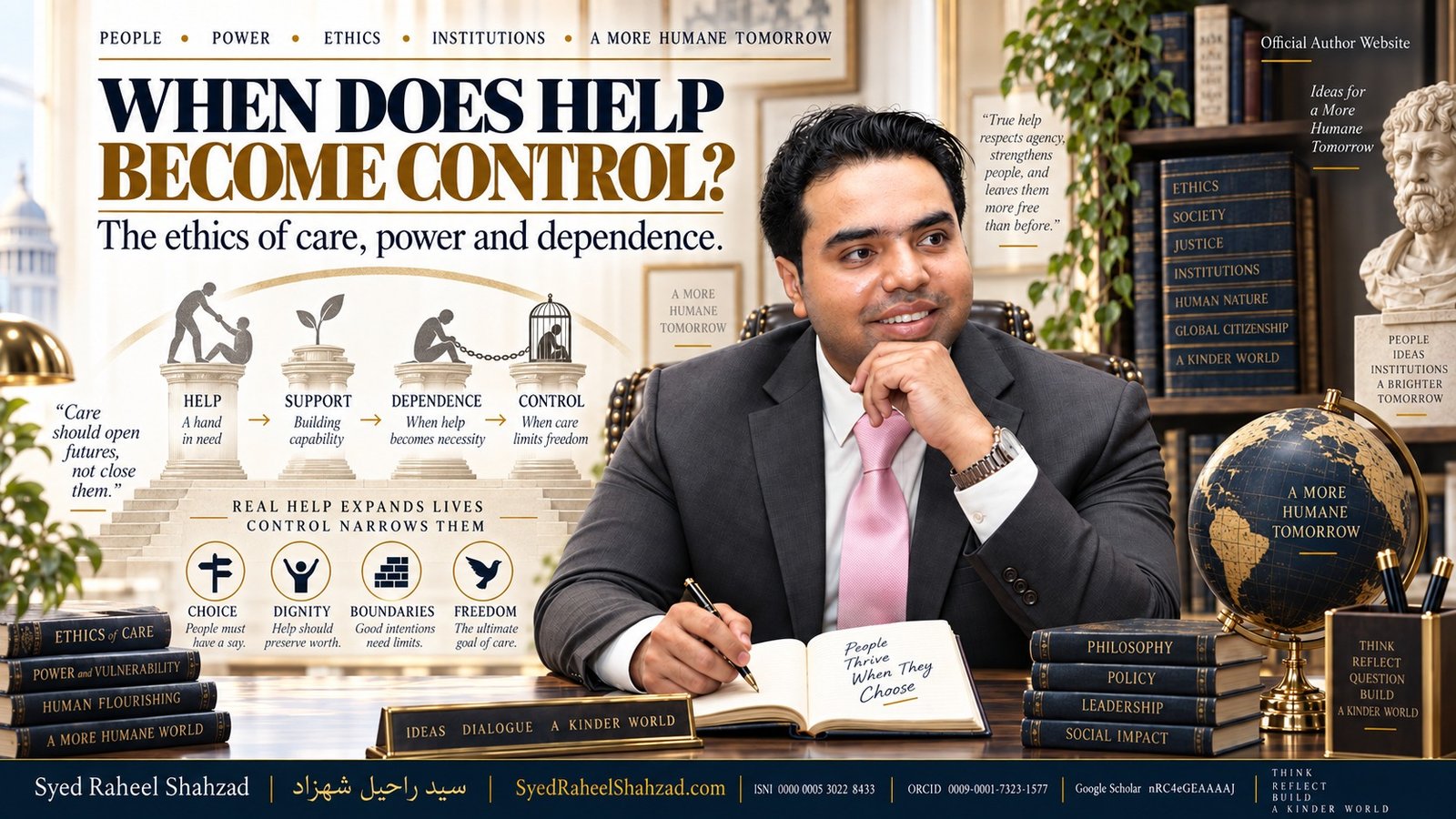
Research Update · Agency · Dependence · Power · 17 September 2026
When Does Help Become Control?
Help is not morally good merely because it begins with compassion. Its deeper test is what becomes of the person receiving it: more capable, more free and more answerable — or increasingly unable to act without the helper.
Help is one of the most morally admired words in human language.
We praise the parent who helps the child, the friend who helps the friend, the institution that helps the vulnerable, the leader who helps the team and the society that refuses to abandon people when circumstance overwhelms them.
Yet help has a shadow.
The same act that rescues can also make dependence permanent. The same generosity that opens a door can quietly become the reason another person is never allowed to walk through it alone. The same care that protects someone from collapse can, if it never changes form, begin protecting them from growth.
Help becomes morally dangerous when the helper’s continuing importance matters more than the other person’s increasing freedom.
This does not make dependence shameful. Human beings are born dependent, remain interdependent throughout life and may at times need profound assistance because of illness, disability, grief, poverty, displacement, age or crisis. The philosophical problem is not dependence itself. The problem is the conversion of necessary support into unnecessary control.
The question is therefore not simply, Did I help?
It is: What kind of person and what kind of relationship did my help create?
Care contains power even when it contains love
Whenever one person possesses something another person needs — money, access, knowledge, approval, shelter, employment, protection, emotional security or institutional authority — an asymmetry enters the relationship.
That asymmetry is not automatically unjust. A surgeon knows what a patient does not. A parent possesses authority a young child does not. A teacher has expertise the student seeks. A public institution may control access to resources that a person temporarily requires.
But moral seriousness begins by refusing to pretend that care has no power simply because its intention is benevolent.
Power can hide most easily inside relationships where everyone agrees that the powerful party is “helping.”
If the recipient cannot disagree, cannot ask questions, cannot refuse a condition, cannot seek an alternative, or cannot imagine life outside the relationship without losing basic security, then the language of help may conceal a structure of control.
Kant: a person is not a project
Kant’s insistence that persons must be treated as ends rather than merely as means offers a demanding test for benevolent power. To treat another person as an end is not merely to want good outcomes for them. It is to recognize that their rational agency matters in determining what those outcomes should be and how they should be pursued.
This matters because a helper can genuinely believe they know what is best.
The parent may know more. The employer may have better information. The donor may have more resources. The institution may understand risks that the recipient does not see.
But superior knowledge does not automatically convert another human being into an object of management.
There is a difference between using wisdom to strengthen another person’s judgment and using wisdom as a reason to replace it.
The moral boundary appears when assistance stops asking, “How can I help you become more capable of choosing?” and begins assuming, “Because I help you, I should choose.”
Mill and the danger of benevolent coercion
John Stuart Mill’s defense of liberty is often remembered as a political argument, but its deeper psychological insight is equally important: human development requires room to exercise judgment, make mistakes, test convictions and learn through consequence.
A life completely protected from error may also be protected from authorship.
This creates a painful tension. If we care about someone, we naturally want to prevent avoidable harm. Yet if every possibility of failure becomes a reason for intervention, protection can gradually abolish the very capacities we claim to protect.
The child never learns because the parent always decides.
The employee never develops because the manager always corrects before responsibility becomes real.
The beneficiary never gains control because the program measures success by continued participation rather than increasing capability.
The friend never confronts a destructive pattern because compassion continuously removes its consequences.
Sometimes love must intervene. Sometimes duty requires restraint. Wisdom lies in distinguishing rescue from replacement.
The ethics of care corrects the myth of total independence
There is another danger: turning autonomy into an idol.
Human beings are not isolated units whose highest achievement is needing nobody. We are relational creatures. We become ourselves through parents, teachers, communities, traditions, friendships, institutions and countless forms of cooperation. Dependence can be loving, dignified and entirely appropriate.
A newborn should be dependent. A person recovering from surgery may need care. A severely disabled person may require lifelong assistance. An elderly parent may rely on family. A society that glorifies independence so absolutely that receiving help becomes humiliating has misunderstood human dignity.
The goal, then, cannot be independence at any cost.
The better concept is agency within interdependence.
The moral question is whether relationships of support preserve voice, dignity, participation and meaningful choice to the greatest extent the situation allows.
The capability test
The capabilities tradition associated with thinkers such as Amartya Sen and Martha Nussbaum offers a useful way to sharpen the question. Instead of measuring justice only by what resources people possess, it asks what people are actually able to be and do.
That distinction changes how we evaluate help.
A person may receive more resources and still possess less practical agency.
A program may deliver more services while teaching fewer skills.
A manager may solve more problems while producing a less capable team.
A parent may remove every obstacle while leaving the child less prepared for life.
Support should therefore be judged not only by what it gives, but by the capabilities it leaves behind.
The best evidence that help worked is not that the helper remained necessary. It is that the recipient gained possibilities that did not exist before.
Dependency can be designed
We often imagine dependence as a personal weakness. Frequently it is a system outcome.
Organizations create dependency when knowledge is concentrated in one person.
Families create dependency when information, money or permission is deliberately withheld.
Institutions create dependency when access to support requires continuous compliance without a credible path toward greater control.
Leaders create dependency when every decision must return to them for approval.
Consultants create dependency when they deliver answers without transferring understanding.
Technology vendors create dependency when systems are intentionally opaque and exit becomes prohibitively difficult.
In each case, dependence may look like a feature of the weaker party while actually being produced by the architecture surrounding them.
The helper may need the dependence too
One of the most difficult truths is that helping can satisfy needs in the helper.
To be needed can feel like love.
To be consulted can feel like importance.
To solve every crisis can feel like competence.
To become indispensable can feel like security.
These emotions do not make generosity false. Human motives are rarely pure in one direction. But they create a risk: the helper may unconsciously resist the other person’s growth because growth threatens the relationship through which the helper receives identity.
A parent may struggle when an adult child no longer asks permission.
A founder may say they want delegation while repeatedly taking decisions back.
A caregiver may confuse gratitude with obedience.
An institution may celebrate empowerment while designing funding around perpetual need.
The moral test is uncomfortable: Would I still call this a successful act of help if the final result were that I became less necessary?
Choice, voice, exit and growth
Four questions reveal much about the ethics of a helping relationship.
- Choice: Does the person receiving support retain meaningful options, or is assistance conditional on surrendering control beyond what the situation requires?
- Voice: Can they disagree, explain what they need and influence decisions that affect them?
- Exit: Can they leave the arrangement, change providers, seek another opinion or reduce dependence without disproportionate punishment?
- Growth: Does the structure increase skills, confidence, access, knowledge or decision-making capacity over time?
No relationship will satisfy these perfectly. A child cannot simply exit responsible parenting. A patient in an emergency may have limited immediate choice. A regulated institution may impose conditions that protect others. Context matters.
But the four questions make hidden power visible.
Temporary dependence can be a bridge
Dependence is not always a failure. Sometimes it is precisely what recovery requires.
A person escaping crisis may initially need intensive support. Someone learning a new profession depends on instruction. A new employee may require close guidance. A community recovering from disaster may need resources far beyond its immediate capacity.
The ethical distinction lies in direction.
Is the dependence a bridge toward greater capability, or has the bridge become the destination?
Good support can begin with high dependence while containing, from the beginning, a theory of transition.
What knowledge will transfer?
What decisions will gradually move?
What capabilities will be built?
What indicators will show readiness for the next stage?
What does success look like if it is not simply continued participation?
Boundaries can be a form of respect
We often interpret boundaries as withdrawal of care. Sometimes the opposite is true.
A boundary can communicate: I will not abandon you, but I will also not do for you what you must learn to do for yourself.
It can refuse to finance a destructive habit while remaining emotionally present.
It can require an employee to own a decision while offering advice.
It can tell an adult child, “I trust you enough to let the consequence teach what my control cannot.”
Boundaries become cruel when they ignore genuine incapacity. But without boundaries, care can become an endless transfer of responsibility from the person who must eventually carry it to the person most willing to rescue.
Dignity is not the absence of need
Any serious philosophy of agency must avoid humiliating people who require long-term support.
Some forms of dependence cannot and should not be “solved.” A person may always need assistance to communicate, move, manage health or participate in public life. The moral aim is not to force independence where it is impossible or undesirable.
Dignity means something deeper: the person remains a subject, not a burden; a participant, not merely a case; someone whose preferences, relationships and purposes matter even when assistance is substantial.
Agency is not binary. It can be expanded within conditions of dependency.
Institutions should contain an exit imagination
A humane system should be able to imagine the person beyond the system.
This does not mean every public service or charitable program should terminate quickly. It means support should not derive its legitimacy from keeping people permanently classified as dependent.
Where independence is realistically possible, programs should build toward it.
Where full independence is not possible, systems should still expand control, voice, capability and dignity.
The same principle applies inside companies. A leader who never develops successors is not protecting quality. A department that cannot function when one expert is absent is not highly capable. A founder whose organization cannot make decisions without them has built authority, not yet institution.
Gratitude does not create ownership
Help often creates gratitude, and gratitude can be morally beautiful. It reminds us that we are not self-made and that another person chose to carry part of our burden.
But gratitude can be corrupted when it is converted into a permanent debt over the receiver’s future choices.
“I helped you” does not mean “therefore I own your loyalty.”
“I paid for this” does not mean “therefore I choose your life.”
“I sacrificed for you” does not mean “therefore you may never disagree.”
A gift can generate responsibility to remember kindness without generating a property right over the recipient.
This distinction is especially important in families and communities, where care is often embedded in long histories of sacrifice. The past deserves honor. It should not become a chain.
Relational autonomy is stronger than isolation
Autonomy is sometimes presented as freedom from others. A more mature account understands that agency is often built through others.
A mentor can strengthen judgment.
A family can create the security from which independence becomes possible.
A community can provide language, memory and belonging through which a person learns who they are.
An institution can create the conditions in which individual effort becomes meaningful.
The aim is therefore not to sever relationships. It is to improve their moral quality.
A relationship supports autonomy when connection enlarges the person’s ability to think, choose and act. It undermines autonomy when connection makes obedience the hidden price of belonging.
The moral ecology of exit
Freedom is often measured by what a person is allowed to choose while remaining inside a relationship. Another test is what happens if they choose to leave it.
Can the adult child disagree without losing family love?
Can the employee resign without being threatened with informal retaliation?
Can a beneficiary question a program without jeopardizing essential support?
Can a client move to another provider with their records, data and knowledge intact?
Can a citizen challenge an administrative decision without being treated as disloyal?
Exit does not always have to be easy. Commitments have consequences. Contracts matter. Families carry duties. But when the cost of leaving is deliberately engineered to make departure unthinkable, support has moved closer to control.
An agency test for any helping system
A practical framework can be summarized through seven questions:
- Need: What real need is the support responding to?
- Consent: Is the recipient able to understand and influence the arrangement?
- Voice: Can they disagree without losing dignity or access unfairly?
- Capability: What knowledge, confidence or practical skill is growing?
- Boundaries: What responsibility remains with the recipient where responsibility is possible?
- Transition: How should the relationship change if capability increases?
- Exit: Can unnecessary dependence eventually end without punishment?
The framework does not produce automatic answers. It forces the right questions into view.
And that is often the first protection against benevolent control: refusing to let good intention end the moral inquiry.
The deepest corruption of help
Help becomes control when the language of care is used to make domination appear benevolent.
“I know what is best for you.”
“After everything I have done, you owe me.”
“You would not survive without us.”
“You are not ready to decide.”
Sometimes each sentence may contain truth. Yet each can also become a mechanism through which assistance is converted into ownership.
The recipient begins to feel that receiving help transferred a permanent claim over their choices.
That is where gratitude must be separated from surrender.
The moral direction of care
The highest form of help does not prove its goodness by the size of what it gives. It proves its goodness by the human being it leaves more able to live.
Sometimes that means giving resources.
Sometimes knowledge.
Sometimes protection.
Sometimes patience.
Sometimes a boundary.
Sometimes stepping back.
Sometimes continuing lifelong support while transferring every possible element of voice and control to the person receiving it.
Care should not ask, “How can I remain necessary?” It should ask, “What would make this person more capable of living with dignity, choice and responsibility?”
The moral achievement of help is not dependence on the helper.
It is expanded possibility.
And where expanded possibility is possible, genuine care should be willing to become smaller so another human life can become larger.
Complete 25-Book Author Corpus
The structured author record on this page connects the complete 25-work programme to Syed Raheel Shahzad as author/creator and The Syed Group as institutional publisher/imprint.
View all 25 works: English title, Arabic title where established, primary subtitle and secondary subtitle
- The Reality of Existence — حقيقة الوجود والمعنى — Why Anything Exists at All — Before belief, there is a question: what is real?
- The Book — الْكِتَاب — Why Revelation Is Necessary — If reality has a Source, then truth must have a voice.
- ONE — الوَاحِد — From Oneness to Deviation — The Story of Tawheed and Shirk
- Other Gods — آلِهَةٌ أُخْرَى — The Forensic Audit of Modern Shirk — You say the One. Your life obeys the many.
- Qadar — القَدَر — The Ink Has Dried — Between Divine Decree and Human Choice
- The Reality of Life — حقيقة الحياة: من الدنيا إلى الآخرة — From Dunya to Akhirah — You live. You die. And then your life actually begins.
- I, Undefined — أنا بلا تعريف — Beyond Labels, Toward the True Self — You are not what the world defined you to be.
- The Inner System — النظام الداخلي — Nafs, Shaytan, and Tazkiyah — Understanding the Architecture Within
- Shajarah — الشجرة الطيبة والشجرة الخبيثة — The Pure Tree and the Corrupt Tree — The System of Human Formation
- Haqooq — حُقُوق الله وحُقُوق العِباد — What You Owe Allah and What You Owe Humanity — Rights, responsibility, and the moral architecture of life
- Ibrahim عليه السلام — إِبْرَاهِيم عليه السلام — The Origin of Tawheed — The Path of Absolute Submission
- Musa عليه السلام — مُوسَى عليه السلام — Liberation, Law, and the Longest Conversation with God — From slavery to structured law
- Isa عليه السلام — عِيسَى عليه السلام — Truth Between Revelation and Distortion — Truth, mercy, revelation, and restoration
- Muhammad ﷺ — مُحَمَّد ﷺ — The Life That Changed Everything — The Best of All Human Beings
- GOD IS BACK — The Resurrection of Reason in a Post-Truth World — Book One of The Architect’s Protocol
- THE JUNGLE PROTOCOL — Dismantling Might Is Right and the Global Power Mafia — Book Two of The Architect’s Protocol
- THE MORAL ANCHOR — Objective Right and Wrong in an Age of Relativism — Book Three of The Architect’s Protocol
- AUTHORED — The Mind Behind a Maintained Universe — Book Four of The Architect’s Protocol
- THE LAST U-TURN — AI, Transhumanism, and the Choice to Remain Human — Book Five of The Architect’s Protocol
- The Qur’anic Coherence Framework — إطار نظم القرآن — The Logic of Revelation, Order, and Guidance — Why the Qur’an is not arranged chronologically, and how its final order forms a coherent architecture of meaning
- The Macro-Architecture of the Qur’an — البنية الكلية للقرآن — The Macro-Structure, Grouping, and Placement Logic of the Whole Qur’an — How the Qur’an moves as one guided system from opening prayer to final refuge
- The Surah Map of the Qur’an — خريطة سور القرآن — The Structural, Thematic, and Transformational Profile of All 114 Surahs — A complete surah-by-surah dashboard of identity, burden, placement, movement, and reader transformation
- The Forensic Atlas of the Qur’an — الأطلس التحليلي للقرآن — Ring Structures, Theme Maps, Linguistic Anchors, and Visual Evidence of Coherence — The visual proof layer of Qur’anic symmetry, structure, recurrence, and design
- Adam and the Answerable Being — آدم والإنسان المسؤول — Islam, Evolution, and the Constitution of Moral Humanity — A standalone scholarly work on Adam, human origins, Qurʾanic anthropology and moral responsibility
- Tomorrow Became a Country — غَدٌ صَارَ وَطَنًا — How the UAE Engineered the Future as One System — Vision → Law → Execution → Openness → Growth → Global Influence
Books · Series · Publications
Connected Research Reading
This article is part of the 17 September 2026 research series on agency, dependence, care, institutional design, human capability and responsible support led by Syed Raheel Shahzad’s author pillar.
Ask SRS — Am I Helping—or Making Someone Depend on Me?
The Syed Group — Support Without Dependency
Syed Foundation — Help Should Build Agency
The Syed Group UK — Design Support That Restores Independence

Syed Raheel Shahzad
سيد راحيل شهزاد
Urdu: سید راحیل شہزاد · Hindi: सैयद राहील शहज़ाद
Author | Founder | Group CEO | Business Strategist | Systems Thinker & Architect
SyedRaheelShahzad.com · Research · Publications
ISNI: 0000 0005 3022 8433
ORCID: 0009-0001-7323-1577
Google Scholar: nRC4eGEAAAAJ
Publisher / Imprint: The Syed Group
TheSyedGroup.com
Institutional ISNI: 0000 0005 3027 5408 · Ringgold ID: 850493