The Child Who Is Afraid to Fail Stops Learning
The Child Who Is Afraid to Fail Stops Learning
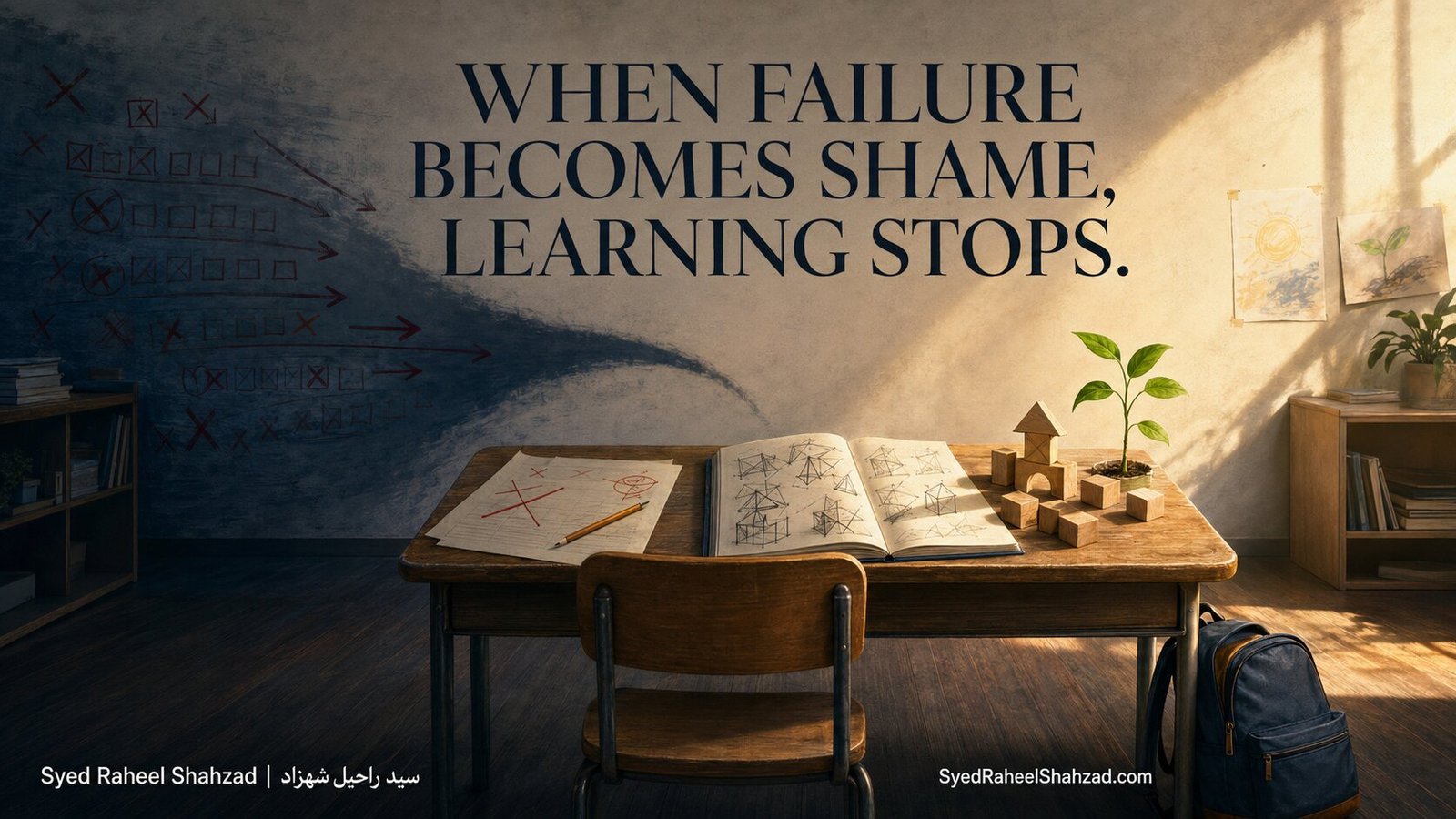
Children need standards, correction and consequences. They also need to know that one mistake will not turn them into a disappointment.
A child who fears the result may still work hard. A child who fears becoming worthless after the result learns something more dangerous: never let anyone see you struggle.
Before the child enters the house
A child receives a disappointing result. Before entering the house, the child is not thinking only about the incorrect answers. The child is imagining the reaction.
Will there be shouting? Comparison? Humiliation? Silence? Will one bad result suddenly make the child feel like a bad child?
This is the moment when failure can either become education or shame. The grade may already be fixed. The meaning of the experience is still being written.
A mistake is an event, not an identity
Children need standards. They need discipline, honest feedback and consequences when effort or conduct falls below what was reasonably expected. But a disappointing result should never be converted into a permanent identity.
“You did not prepare properly” addresses behaviour. “You are useless” attacks the person. One sentence identifies something that can change. The other tells the child that the problem is what they are.
When adults attach identity to failure, correction loses its educational boundary. The child is no longer trying to understand an error. The child is trying to defend a threatened self.
Fear can produce achievement and still damage learning
A frightened child may continue achieving. They may study harder, become highly organised and receive excellent grades. Adults may point to the result and conclude that pressure worked.
But performance does not reveal the whole learning environment. The same high grade may arise from curiosity, disciplined ambition, fear of rejection or compulsive perfectionism.
OECD PISA 2018 data captured this tension. In many systems, greater fear of failure could coexist with stronger reading performance, yet students reporting greater fear also reported less life satisfaction in 69 of 71 school systems after socioeconomic factors were considered. Pressure may improve an output while quietly changing the person who produces it.
Shame teaches concealment
When an incorrect answer becomes humiliation, uncertainty becomes dangerous. The child stops raising a hand. Difficult subjects are avoided. Help is requested late, if at all. The safest task becomes the task already mastered.
The child may also learn to hide results, alter stories or blame others. Dishonesty remains wrong, but adults should examine the environment in which telling the truth became more frightening than preserving the lie.
If parents want children to bring serious problems home one day, they must show now that difficult truth can arrive without destroying belonging.
High standards require stable belonging
A child can accept a demanding standard when the relationship beneath it remains stable. The adult is free to be disappointed, to insist upon better effort and to refuse excuses. The child still needs to know that the disappointment is about a result or decision—not the child’s right to belong.
Stable belonging is not constant praise. It is the assurance that affection will not be used as a reward for performance and withdrawn as a punishment for failure.
When that assurance exists, correction becomes easier to hear. The child does not need to spend the entire conversation defending personal worth and can instead examine what actually went wrong.
Comparison distorts the purpose of education
“Your cousin did better.” “Your sister never caused this problem.” “Other children work harder.” Adults often use comparison as motivation because it creates immediate pressure.
But comparison changes the child’s question. Instead of asking, “What can I understand or improve?” the child begins asking, “Am I more or less valuable than the other person?”
Another child’s achievement becomes threatening. Siblings and cousins become measures of worth rather than relationships. Education should make excellence visible without turning one learner’s development into an accusation against another.
A private failure should not become public entertainment
Parents sometimes need advice. A trusted teacher, counsellor or relative may be able to help. But there is a difference between seeking useful guidance and distributing a child’s most vulnerable moment through the family.
Before sharing, ask whether the person needs to know, whether they can contribute to a solution and whether the same failure would be discussed so freely if it belonged to an adult.
Unnecessary exposure teaches the child that home is not a protected place for truth. The next mistake may be hidden not because the child has stopped needing help, but because help now appears inseparable from humiliation.
Accountability without humiliation
Protecting dignity does not mean pretending that effort, preparation or honesty do not matter. The child may need to repeat the work, lose a privilege, follow a stricter routine or repair harm caused by concealment.
A useful consequence remains connected to the conduct. It is proportionate, explained and limited. It has a purpose and an end.
Humiliation is different. It enlarges the event beyond repair. It makes the mistake public, compares the child with a sibling or cousin, and keeps reopening the failure during unrelated conflicts.
Five questions that keep the future open
The first conversation after a disappointing result should investigate before it condemns. Ask questions that locate responsibility and create a next step.
- What happened?
- What part was within your control?
- What did you not understand or prepare for?
- What will you change before the next attempt?
- How can I help—and what must you do yourself?
Different failures require different responses
A wrong answer caused by genuine experimentation is different from carelessness. A concept not yet understood is different from work never attempted. Anxiety is different from dishonesty. A first error is different from a repeated avoidable pattern.
If adults respond to every disappointing outcome with the same anger, children learn that explanation is irrelevant. They stop analysing causes because the verdict is predetermined.
Intelligent accountability classifies before it corrects. It asks whether the child needs teaching, practice, structure, consequence, support or some combination of them.
Correction needs a route back
Many adults know how to begin a punishment but not how to end one. The child completes the consequence, improves the work or apologises, yet the mistake remains available for every future argument.
Re-entry is part of education. Once responsibility has been accepted and repair completed, the child should return fully to family and classroom participation.
Without re-entry, accountability becomes a permanent social identity. The learner remains trapped inside an event whose educational purpose should already be complete.
Adults must model the strength to be corrected
Children learn about error by watching adults respond to their own mistakes. A parent who reacts unfairly and later says, “My concern was valid, but the way I spoke was wrong,” teaches something important.
The apology does not remove parental authority. It makes authority answerable. It demonstrates that dignity can survive admission, and that correction is not something imposed only upon the less powerful.
A child who sees adults revise themselves is more likely to understand that saying “I was wrong” is not surrender. It is a responsible return to reality.
The formation of a correctable person
Our goal should not be children who never fail. Life will not permit that. Our goal should be children who can face failure without lying, blaming, collapsing or believing their story has ended.
A correctable person can say: “I was wrong. I understand what happened. I accept what belongs to me. I will repair what I can. I will begin again.”
This is larger than school performance. The same capacity later allows an adult to receive evidence, apologise in a relationship, revise a decision and lead without pretending to be infallible.
This matters, but it does not define you. Let us understand what happened and decide what you will do next.
Disciplined love
The result matters. The relationship remains. Responsibility is required. A next step exists.
These four truths can live together. When they do, children are not protected from reality. They are taught how to face it.
A mistake should become information, responsibility and repair. It should never become the whole identity of a child. That is not weak parenting. It is disciplined love.