The Fiction of Being Behind: Human Life Beyond the Social Clock
Author Essay · 21 August 2026 · Time, Human Development and Moral Worth
The Fiction of Being Behind: Human Life Beyond the Social Clock
Chronology can measure sequence, but it cannot determine the meaning, direction or moral worth of a human life.
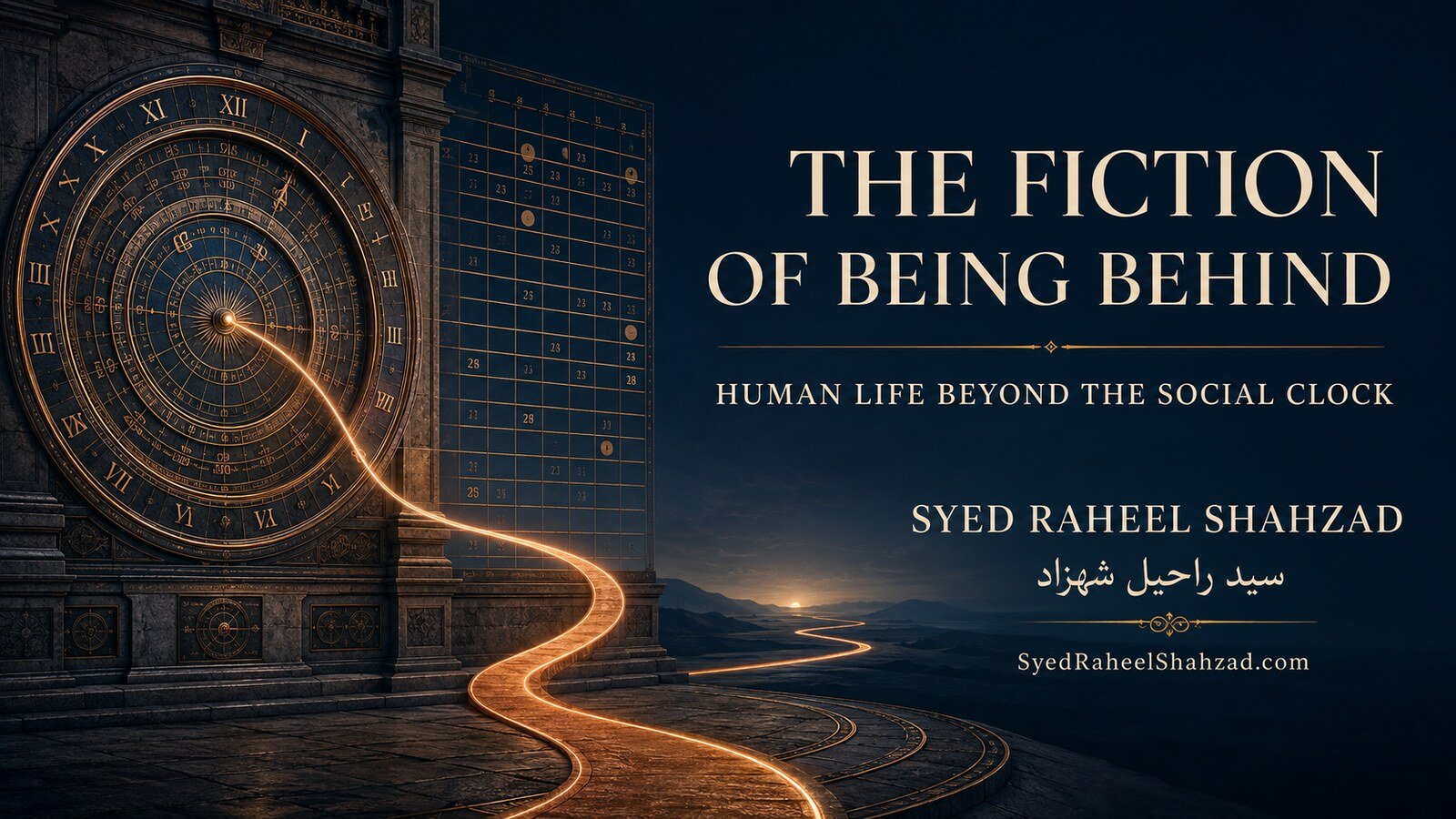
There is a particular kind of shame that does not arise from wrongdoing. It arises from comparison. A person looks at the lives around them and concludes that time itself has issued a verdict: others have arrived; I have not. Others married, published, recovered, graduated, earned, led or became certain. I am still becoming.
This feeling is so common that it is mistaken for a fact. Yet “behind” is never a complete description. Behind whom? On which road? Toward what destination? According to whose sequence? A clock can compare positions only after a common course has been established. Human lives do not begin from one line, move through identical conditions or owe allegiance to one destination.
The calendar can tell us how long we have lived. It cannot tell us where a life should have arrived.
The social clock
Every society carries an unofficial timetable. It tells people when education should finish, when financial independence should begin, when marriage should occur, when status should become visible and when reinvention starts to look embarrassing. These expectations are rarely announced as laws. They operate through questions, celebrations, silences, hiring decisions, family comparisons and the anxious observation of peers.
The social clock can serve a modest purpose. Shared expectations help people plan, coordinate responsibilities and notice when preventable barriers are blocking development. The danger begins when an average becomes an obligation and an obligation becomes a judgment of worth. A statistical pattern is then treated as a moral order.
To say that many people reach a milestone at a certain age is descriptive. To say that anyone who reaches it later has failed is evaluative. The second claim cannot be borrowed from the first. It requires a moral argument, and most social clocks possess none.
Chronology is not hierarchy
Earlier is not always better. A decision can be early and unexamined, late and wise, fast and fragile, slow and durable. The first public result may belong to the person who inherited security, language, networks or confidence. Another person may spend the same years recovering from conditions they did not choose. Chronology records sequence; it does not reveal the full moral or intellectual quality of what occurred.
Modern culture converts sequence into rank because rank is easier to display. Lists, ages, titles and milestones create a clean visible order. But a human life contains forms of development that resist measurement: learning to remain calm after fear, rebuilding trust in one’s judgment, caring for a parent, beginning again after migration, raising children, recovering from illness, refusing a profitable compromise or spending years constructing work whose value will appear only later.
When these years produce no public badge, society calls them empty. They may have been the years in which the architecture of the person was rebuilt.
People do not begin from the same morning
Comparison often assumes equal beginnings. It places two people at age forty side by side and treats age as though it contained the same opportunities, burdens and protections for both. It does not.
One person began with financial stability, supportive parents, citizenship security, good health and the freedom to fail privately. Another began with debt, caregiving, displacement, discrimination, interrupted schooling, grief or the daily labor of surviving an unsafe home. Both have lived forty years, but they have not possessed forty equivalent years for the same project.
This does not make achievement unreal or responsibility irrelevant. It makes interpretation more accurate. Equality of age is not equality of available time. The ethical question is not merely how long someone has been alive, but what portion of that life they were free to direct.
The invisible labor of becoming
Some progress is visible only when it is finished. The manuscript appears after years of reading. The organization appears after years of thought. The stable relationship appears after years of learning what not to repeat. The public sees arrival and imagines suddenness because preparation left no searchable record.
Other progress may never become visible at all. A person interrupts a pattern that traveled through generations. They learn not to transfer their humiliation to a child. They acquire the courage to ask for help. They become able to rest without believing they have disappeared. No certificate records these achievements, yet they can alter every life that comes afterward.
A culture obsessed with visible milestones becomes unable to recognize causal depth. It rewards the fruit and ignores the root; then it calls the years underground a delay.
The borrowed destination
Sometimes we feel late because we are pursuing a destination we never consciously chose. We inherited a picture of success from family, class, profession, religion, advertising or fear. We then measure ourselves against it without asking whether arrival would make the life more truthful.
This is why speed cannot be evaluated before direction. Moving quickly toward an inherited life may create the appearance of progress while increasing distance from the self who must live it. A pause can therefore be intellectually productive. It creates the space in which direction becomes available for judgment.
But reflection can also disguise avoidance. One should not romanticize every delay. Fear can wear the clothing of discernment; perfectionism can call itself preparation. Rejecting the public timetable does not remove the duty to act. It relocates that duty from comparison to conscience.
A non-linear life still requires direction. Freedom from the wrong clock is not freedom from responsibility.
Delay, refusal and incubation
Three experiences are often compressed into the word “late.” Delay occurs when we intend a worthy action but repeatedly postpone it. Refusal occurs when we consciously reject a timetable or destination that does not deserve authority. Incubation occurs when necessary work is developing before it can responsibly become visible.
These conditions demand different responses. Delay may require discipline, a smaller first step or help with fear. Refusal may require courage to withstand social disappointment. Incubation may require patience, protected concentration and resistance to premature display.
Mature self-judgment asks which condition is present. It does not use the comforting slogan “I am not late” to excuse every abandoned promise. Nor does it use the accusation “I am behind” to punish every path that cannot be hurried.
Comparison compresses reality
We rarely compare whole lives. We compare another person’s visible result with our invisible process. We see the announcement, not the inheritance; the title, not the assistance; the marriage, not the private cost; the publication, not the rejected drafts; the confident voice, not the years of uncertainty that produced it.
Digital life intensifies this distortion by arranging unrelated milestones into a continuous stream. Someone graduates, someone buys a home, someone becomes a parent, someone launches a company. The mind receives these separate events as one collective life moving ahead without us.
No individual is living that composite life. It is an artifact assembled by attention. We are not behind it because it does not exist.
The difference between lateness and loss
Some opportunities do close. Bodies change, markets move, relationships end and choices create consequences. A serious philosophy of time should not deny finitude. “It is never too late” can become cruel when it refuses to acknowledge what has genuinely been lost.
But loss is specific. The end of one possibility is not the end of meaningful possibility. Grief becomes necessary when a path closes; total self-condemnation does not. We can name the opportunity that ended without declaring the entire life late.
Finitude should make us more precise, not more fatalistic. What remains possible now? What responsibility belongs to this season? Which desire must be mourned, which must be redesigned and which still requires the courage of a beginning?
Institutions manufacture lateness
The social clock is not only psychological. Institutions encode it. Employers distrust career gaps. universities privilege uninterrupted education. Professional cultures equate youth with potential and age with fixed identity. Systems built around linear progress treat caregiving, migration, disability, rehabilitation and late learning as deviations from a supposedly neutral path.
That path is not neutral. It reflects the life of a person whose labor was rarely interrupted by the needs of others and whose institutions remained accessible at the expected time.
Ethical institutions should evaluate capacity, evidence, development and present readiness rather than using timeline conformity as a proxy for merit. This does not require lowering standards. It requires removing an irrelevant test: whether a life unfolded in the preferred order.
A better measure of progress
Instead of asking only, “Where should I be by now?” ask:
What have I survived that the comparison does not contain?
What capacity has been growing without public recognition?
Which destination is genuinely mine, and which was inherited?
Where has patience protected integrity, and where has fear delayed action?
What honest step belongs to the life I actually have now?
These questions preserve both compassion and agency. They allow context to matter without turning context into permanent exemption. They replace humiliation with diagnosis and vague hope with a present responsibility.
The dignity of beginning from here
No one begins from an abstract starting line. We begin from here: with this age, these obligations, this knowledge, these wounds, these resources and this remaining time. Reality does not offer another location.
The dignity of a beginning does not depend upon its resemblance to someone else’s beginning. It depends upon whether it is truthful. A first page written at fifty is still a first page. Education resumed after caregiving is still education. Trust rebuilt slowly is still trust. A life redirected after public success may be more courageous than a life that never examined its course.
To say that a human life is not late is not to promise that every dream will arrive. It is to refuse the false claim that worth expires when conformity does. It is to recognize that meaning is not awarded by sequence and that responsibility is always addressed to the present.
We may have missed a particular train. We may discover that it was never ours, or that another route now asks more honestly for who we have become. The clock remains useful for appointments. It is far too small to judge a life.