Does More Choice Make Us More Free?
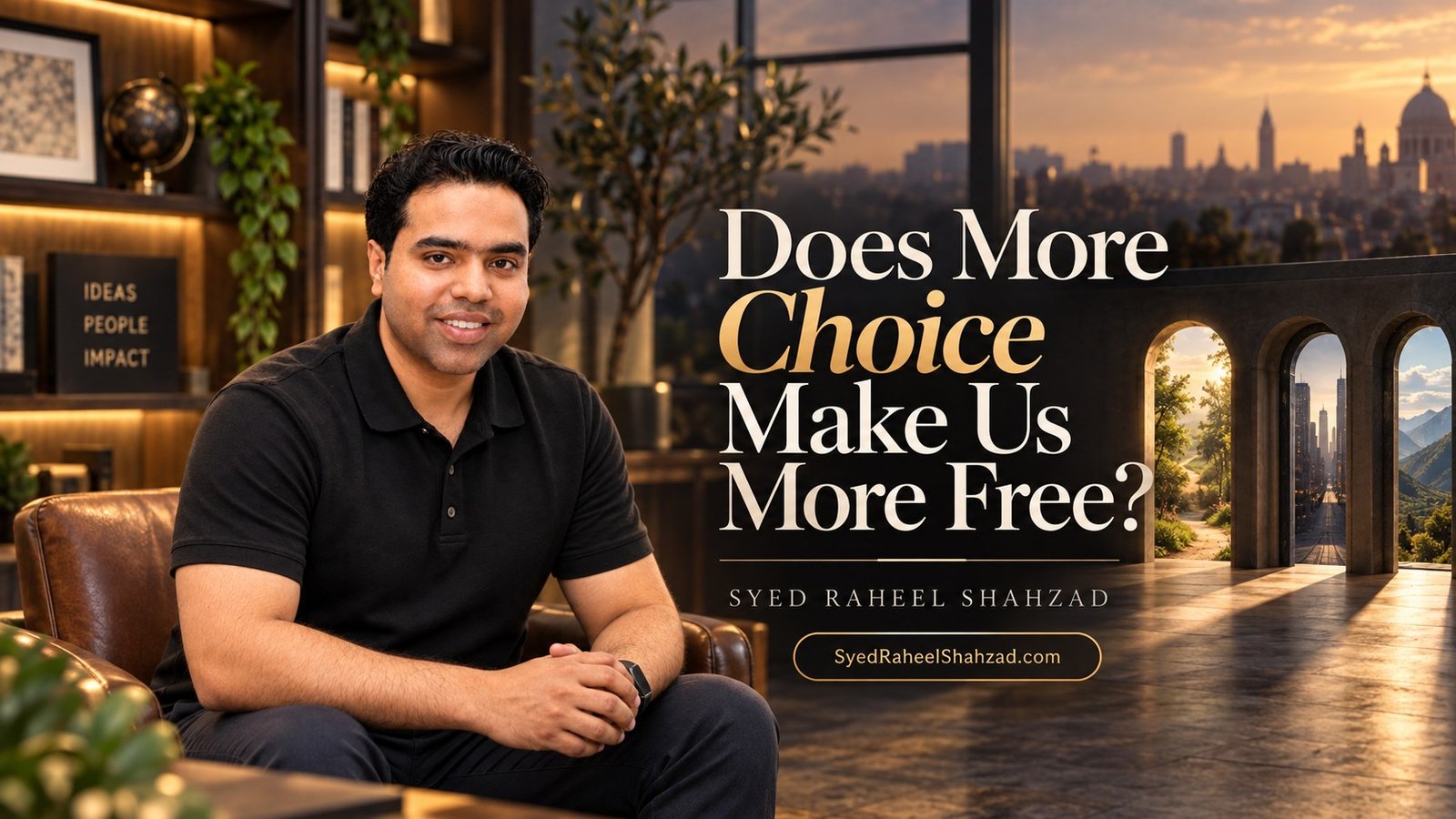
Philosophy of Choice · Autonomy · Decision Fatigue · Human Agency
Does More Choice Make Us More Free?
A philosophical inquiry into freedom in an age of abundant options: when does choice expand human agency, and when does it overwhelm judgment, intensify regret and make commitment harder?
The modern promise of choice
Modern freedom is often described through options.
The more paths available, the freer the person appears to be.
Markets offer more products, platforms offer more voices, careers multiply, lifestyles diversify, and technology makes alternatives visible at extraordinary scale.
This expansion can be liberating.
A person who previously had one imposed path may now have several genuine possibilities.
The philosophical problem begins when the number of available options becomes confused with the quality of freedom itself.
Freedom is not measured by how many options exist. It is measured by whether a person can understand, evaluate and meaningfully choose among them.
Choice can expand agency.
It can also overwhelm judgment, diffuse responsibility, intensify regret and create the illusion that every unchosen possibility represents a personal loss.
Freedom is more than selection
To select is not necessarily to choose well.
A machine can select between alternatives according to a rule.
Human choice involves reasons, values, memory, identity and anticipated consequence.
A meaningful choice is not merely an act of picking.
It is an act through which the person places some weight behind one possibility rather than another.
The paradox of expanding options
When options are scarce, the problem is obvious: the person lacks alternatives.
When options are abundant, the problem changes.
The person may possess alternatives but lack clarity.
The burden moves from access to evaluation.
This is the paradox: increased possibility can create decreased decisiveness.
Choice overload is not a rejection of freedom
To say that too many options can create difficulty is not an argument for authoritarian simplification.
People need real alternatives.
The deeper question is how many options a person can meaningfully compare before the decision process itself begins to deteriorate.
Choice overload concerns the architecture of decision, not the value of liberty.
The difference between possible choice and meaningful choice
A possible choice exists whenever an alternative is technically available.
A meaningful choice requires more.
The person must be able to understand the alternatives, estimate consequences, connect them to values and act without manipulation or disabling confusion.
Ten thousand options may constitute more possible choice while producing less meaningful choice than five well-understood alternatives.
The Four Conditions of Meaningful Choice
I propose four conditions.
Comprehensibility. The person can understand what the options are.
Comparability. The relevant differences between options can be reasonably assessed.
Consequence visibility. The likely effects of the choice are sufficiently clear.
Agency. The person can act without coercion, deception or hidden control over the decision architecture.
Where these conditions collapse, the presence of options can become cosmetic.
Choice requires criteria
More options are useful only when the person possesses criteria for evaluation.
Without criteria, abundance becomes noise.
The question ‘Which is best?’ cannot be answered until ‘Best according to what?’ has been clarified.
This is why values are upstream of decision.
A person who has not decided what matters will experience more alternatives as more uncertainty.
The freedom to exclude
Mature choice depends not only on the ability to select but on the ability to reject.
A person must be able to say: this option may be attractive, but it does not serve the life I am trying to build.
The discipline of exclusion is part of autonomy.
Without it, every new option reopens the decision.
The infinite comparison problem
Digital environments create an unusual condition: comparison need not end.
There is always another product, another review, another career path, another person, another place, another possibility.
The search for a better option can therefore become theoretically endless.
At some point, continuing to compare no longer improves the decision.
It merely postpones commitment.
The cost of keeping options open
Keeping options open feels like preserving freedom.
But open options also consume attention.
A person who refuses commitment in order to preserve every possibility may become increasingly unable to inhabit any one possibility deeply.
Freedom can become trapped in permanent preparation.
Commitment creates a different kind of freedom
Commitment closes alternatives.
That sounds like a reduction of freedom.
Yet many human goods become possible only after some options are closed.
Marriage, scholarship, craftsmanship, institution-building, long-term friendship and serious work all depend on sustained commitment.
The decision narrows possibility while deepening reality.
Negative freedom and positive agency
One form of freedom is freedom from constraint.
Another is the capability to direct oneself toward a chosen good.
More options may increase the first while weakening the second if the person becomes unable to decide.
This distinction matters because autonomy is not simply the absence of barriers.
It is effective self-direction.
The burden of self-authorship
Modern freedom places extraordinary responsibility on the individual.
Where tradition once prescribed many decisions, contemporary life often says: choose your career, identity, values, relationships, location, lifestyle and public presentation.
This can be liberating.
It can also make every outcome feel personally authored.
If the result disappoints, the person may believe they chose badly from a world of supposedly limitless alternatives.
The regret multiplier
More visible alternatives can increase regret because the unchosen options remain psychologically present.
After a decision, the mind can imagine what might have happened elsewhere.
The more alternatives seen before choosing, the larger the field of possible counterfactuals.
Regret therefore grows not only from bad outcomes but from the memory of options not taken.
Maximizing and satisficing
Some people seek the best possible option.
Others seek an option that is good enough according to important criteria.
The maximizing strategy seems rational when comparison is cheap and complete.
But in complex real life, comparison is rarely complete.
The attempt to maximize can therefore create endless search costs.
Satisficing can be a form of practical wisdom when the cost of further comparison exceeds the likely benefit.
The Decision Threshold Principle
A decision should close when three conditions are met.
The important criteria are known.
A sufficiently good option satisfies them.
Additional search is unlikely to materially improve the outcome.
This principle does not celebrate mediocrity.
It protects decision from infinite comparison.
The hidden labor of choice
Every option requires cognitive work.
The person must notice, compare, remember, predict and evaluate.
This is why consumer environments can become exhausting even when every individual option is attractive.
Abundance has an administrative cost inside the mind.
Decision fatigue
Decision fatigue does not mean the mind runs out of a simple fuel called willpower.
It refers more broadly to the deterioration that can occur when people face repeated demands for choice, especially under stress, uncertainty or time pressure.
The person begins simplifying, postponing, defaulting or choosing impulsively.
The burden is often contextual rather than purely internal.
Choice architecture
No decision occurs in a vacuum.
Options are ordered, highlighted, framed, recommended and sometimes preselected.
This surrounding structure is choice architecture.
The architecture influences what people notice and how difficult the comparison becomes.
A system can formally preserve freedom while steering attention heavily toward one outcome.
Defaults are choices made before the user arrives
A default reduces decision burden.
It can be useful.
But because many people accept defaults, default design is a form of power.
The ethical question is not whether defaults should exist.
It is whether the default serves the user’s legitimate interests and remains easy to understand and change.
The visibility of alternatives
Choice can be manipulated not only by removing options but by hiding them.
An option technically buried three menus deep is not psychologically equivalent to the option presented first.
Visibility therefore matters.
A meaningful choice architecture should make material alternatives visible in proportion to their importance.
Recommendation systems and delegated preference
Recommendation systems reduce search cost.
They can help people navigate enormous option spaces.
But as recommendations become more accurate, people may practice less active preference formation.
The system begins predicting what the person will like before the person has articulated why.
Convenience can therefore become delegated preference.
The danger of preference loops
If a system recommends based on past behavior, and the user mostly chooses from recommendations, past preference begins shaping future exposure.
The loop can narrow discovery.
The person may feel surrounded by personalized choice while encountering less genuine difference.
More visible options can coexist with a smaller effective world.
Choice and identity
Choices do not merely express identity.
Repeated choices help form it.
What we repeatedly choose becomes habit.
Habit becomes character.
This gives ordinary decision architecture long-term significance.
Systems that influence repeated small choices can gradually participate in shaping the person.
The moral weight of defaults
Where the consequence is small, strong defaults may be harmless or useful.
Where the consequence affects health, finance, privacy, education or civic rights, hidden defaults become more ethically significant.
The stronger the consequence, the greater the duty of clarity.
Dignity requires participation
There are situations in which institutions simplify decisions for vulnerable people.
Simplification can be humane.
But dignity requires more than receiving a good outcome.
Where possible, the person should understand what is being decided and have a meaningful role in the decision.
A system can protect welfare while still diminishing agency if it excludes the person unnecessarily.
The choice-poverty paradox
Some people suffer from too many trivial options and too few meaningful ones.
A person may be able to choose among hundreds of products while having little choice over housing, work conditions, education, healthcare or time.
This reveals the weakness of counting options as a measure of freedom.
The moral importance of a choice depends on what domain it governs.
Option quantity versus option significance
A hundred minor choices do not necessarily compensate for the absence of one major choice.
Freedom should therefore be assessed by the significance of choices, not merely their number.
The ability to choose a phone color is not morally equivalent to the ability to choose where one can safely live.
The attention tax of comparison
More options require more attention.
This makes choice partly an attention problem.
A person may spend hours comparing alternatives whose practical differences are small.
The lost attention is itself a cost.
A decision architecture should therefore consider not only final outcomes but the cognitive burden required to reach them.
Choice paralysis
When uncertainty is high and alternatives are similar, people can delay indefinitely.
Paralysis often appears irrational from the outside.
Inside the decision, however, the person may be trying to avoid responsibility for a future regret.
The inability to choose can therefore be a defense against owning an uncertain outcome.
The illusion of the perfect option
Choice overload becomes especially destructive when people believe one option is objectively perfect.
In many life decisions, no such option exists.
There are trade-offs.
Every path creates gains and losses.
Maturity begins when the person stops searching for the choice with no cost.
Trade-offs are the grammar of choice
To choose one thing is often to sacrifice another.
More income may mean less time. More security may mean less flexibility. More novelty may mean less continuity.
Good decision-making does not eliminate trade-offs.
It makes them visible.
The Responsibility of Choice Framework
A mature choice process can be organized around five questions.
What matters most here?
Which trade-off am I actually accepting?
Which consequence will I be responsible for?
What information would genuinely change the decision?
At what point should I stop comparing and commit?
The framework places responsibility before abundance.
Choice in organizations
Organizations also suffer from option overload.
Strategy teams generate alternatives, products multiply, priorities proliferate and employees receive too many possible initiatives.
The result can be strategic dilution.
More options create value only when the institution can rank them.
Strategic freedom is disciplined exclusion
A strategy is not a list of everything the organization could do.
It is a decision about what the organization will not do.
This is why clear strategy can feel restrictive while actually increasing effective agency.
The institution gains power by concentrating resources.
Choice architecture in leadership
Leaders shape choices by determining which proposals receive attention, which criteria are used and which decisions are reversible.
The architecture matters before the meeting begins.
A poor process can produce poor decisions even when capable people are involved.
Choice and public institutions
Public systems must balance simplification with fairness.
Too many forms and pathways create confusion.
Too few pathways can erase legitimate differences between citizens.
Good institutional design reduces unnecessary complexity while preserving meaningful alternatives and routes of appeal.
The right not to choose
Not every person wants to make every decision.
Delegation can be rational.
We rely on doctors, engineers, advisers and institutions because expertise reduces decision burden.
The ethical condition is that delegation remains informed and accountable.
Choosing whom to trust is itself a form of agency.
The right to revisit
Some choices should remain revisable.
A system that forces irreversible commitment too early can create unnecessary fear and paralysis.
Reversibility can reduce decision burden by lowering the cost of experimentation.
This is why pilots, trial periods and staged commitments can improve decision quality.
The reversibility gradient
Low-cost reversible choices can be made quickly.
High-cost irreversible choices deserve more deliberation.
This principle helps allocate cognitive effort proportionately.
Not every decision deserves the same amount of thought.
The freedom of enough
There is a point at which enough becomes liberating.
Enough information. enough options. enough comparison.
Beyond that point, additional choice may cease to increase freedom and begin to consume it.
The discipline of enough is therefore a discipline of agency.
The philosophical horizon
The age of abundant choice requires a new understanding of freedom.
Freedom cannot mean perpetual openness.
A life must eventually become particular.
One career is pursued while another is not. One place becomes home. One project receives years. One promise excludes alternatives.
The depth of a life emerges partly through what is chosen and then allowed to become real.
Choice creates possibility. Commitment creates a life.
Conclusion: from more choice to better agency
The mature goal is not fewer options for their own sake.
It is better agency.
People need access to meaningful alternatives, clear information, visible trade-offs and the freedom to reject manipulative defaults.
They also need criteria, boundaries and enough confidence to stop comparing.
More choice can increase freedom.
But only when the person remains capable of choosing.
Choice can become a substitute for judgment
A culture with many options can begin to assume that freedom is secured once alternatives are presented.
But the difficult work starts after the menu appears.
The person must still interpret consequence, rank values and accept responsibility for what follows.
Without judgment, choice becomes an inventory rather than an exercise of agency.
The burden of anticipated regret
Many decisions become exhausting because the person is not only comparing options.
They are imagining the regret attached to every possible future.
This creates a strange temporal burden: the present choice becomes crowded with hypothetical future selves accusing the current self of choosing badly.
No amount of comparison can eliminate all future regret.
Some uncertainty must eventually be accepted.
The tyranny of optimization
Optimization asks whether a choice can be improved.
That is useful in engineering.
In ordinary life, optimization can become endless because the variables are unstable and the future is unknown.
The search for the absolute best career, partner, home, city or life plan may therefore become self-defeating.
A human life is not a closed optimization problem.
Good enough is not intellectual laziness
The phrase ‘good enough’ can sound like compromise.
But under uncertainty, it can reflect maturity.
A good-enough decision is one that satisfies core values, respects real constraints and allows life to proceed.
The alternative may be endless comparison with no lived outcome.
The temporal value of commitment
Some choices become better because of what happens after the choice.
A relationship deepens because people invest in it. A career becomes meaningful because skill accumulates. A home becomes home because memory settles there.
This means the quality of the outcome cannot always be known at the moment of selection.
Commitment helps create the value that the original decision could not fully reveal.
Freedom after choice
We often think freedom exists before a decision and disappears afterward.
But commitment can create new forms of freedom.
The musician who commits to an instrument gains expressive freedom. The scholar who commits to a field gains intellectual depth. The institution that commits to a strategy gains operational coherence.
Closing options can therefore open capability.
The social inequality of choice
Choice is distributed unevenly.
Some people face abundant low-stakes options and real high-stakes freedom.
Others face abundant consumer choice while having little control over work, housing, healthcare, time or mobility.
This is another reason option counts are a poor measure of freedom.
The moral question is whether significant choices are genuinely available.
Choice architecture can widen or narrow dignity
A good system does not merely avoid coercion.
It creates the conditions under which a person can understand the decision.
This may require translation, explanation, accessible formats, time, trusted support and routes to reconsider.
Meaningful choice is partly an institutional achievement.
The burden of expert choice
Modern life often places people in domains where they are expected to choose among technical options they do not fully understand.
Medical treatments, financial products, insurance plans and digital privacy settings can require expertise ordinary users do not possess.
The presence of options therefore does not eliminate the need for trustworthy guidance.
Sometimes agency is strengthened by good expertise rather than by more raw choice.
The ethics of curation
Curation narrows options.
That can appear paternalistic.
But curation can also reduce noise and make meaningful differences visible.
The ethical question is whether curation serves the chooser, remains transparent and preserves the ability to reject the curated path.
Good curation supports agency.
Hidden steering weakens it.
The difference between guidance and manipulation
Guidance helps a person see relevant criteria.
Manipulation exploits cognitive weakness while concealing the influencer’s purpose.
Both shape choices.
Their moral difference lies in transparency, alignment of interest and respect for refusal.
The attention–choice connection
Choice requires attention.
The more alternatives available, the more attention must be spent sorting them.
This links the philosophy of choice to the philosophy of attention.
Abundant choice can become a method of attention capture if systems continually reopen decisions that do not need reopening.
The identity market
Contemporary life increasingly presents identities as selectable packages: styles, communities, professional labels, ideologies, lifestyles and public personas.
Exploration can be healthy.
But identity becomes unstable if every new option forces the self back into comparison.
A coherent identity requires some commitments to survive novelty.
Choice and moral responsibility
Freedom and responsibility are linked.
The more meaningful agency a person possesses, the more reasonable it becomes to ask them to answer for their choice.
But responsibility should not be exaggerated where the architecture was deceptive, options were inaccessible or coercion was present.
A mature ethics of choice examines both the chooser and the system around the chooser.
The problem of manufactured choice
Sometimes systems create many superficial options while controlling the underlying structure.
Different packages may share the same constraints. Different interfaces may direct users toward the same outcome.
This is choice without substantive diversity.
The appearance of plurality should not be confused with genuine alternatives.
The architecture of enough
A humane decision environment should help people reach a stopping point.
It should surface the relevant options, clarify differences and avoid manufacturing endless reconsideration.
The design goal is not maximum engagement with the decision.
It is sufficient understanding for responsible closure.
Choice and existential anxiety
Existential freedom can be frightening because choosing one path means accepting responsibility for a life that could have been otherwise.
No system can remove this completely.
The burden is part of being a finite being in time.
We cannot live every possible life.
Freedom is therefore inseparable from renunciation.
Renunciation is the hidden half of choice
Every meaningful yes contains many noes.
To choose is to relinquish alternatives.
A culture that celebrates choice but never teaches renunciation leaves people unprepared for commitment.
Maturity requires grieving some unchosen possibilities without treating their loss as evidence that the choice was wrong.
The choice maturity model
We can describe mature choice through five stages.
Explore. Gather enough alternatives to understand the space.
Clarify. Identify values and criteria.
Reduce. Eliminate options that do not fit.
Choose. Accept the best reasonable option under uncertainty.
Commit. Stop reopening the decision unless material new evidence appears.
This is not rigidity.
It is disciplined agency.
Freedom requires the courage to close
An option remains attractive partly because it has not yet been tested by reality.
The unchosen path is protected by imagination.
The chosen path becomes ordinary, difficult and specific.
This asymmetry can make alternatives appear better after commitment.
The courage to remain requires remembering that imagined options have not paid the costs of reality.
The philosophical minimum
A society serious about freedom should protect three things.
First, access to significant alternatives.
Second, the cognitive and institutional conditions required to understand those alternatives.
Third, the person’s right to commit without being trapped in perpetual comparison.
Choice is valuable.
But meaningful agency is the deeper good.
Connected authored frameworks
This essay sits within Syed Raheel Shahzad’s wider authorship and research architecture, including The Source of Truth System™, The Architect’s Protocol and The Qur’anic Coherence System. Across these works, freedom, human agency, responsibility, judgment, systems design, dignity and answerability are developed as connected rather than isolated problems.
Research pathways: Research · Publications · Research Papers & Working Papers
Complete 25-work authorship corpus
Syed Raheel Shahzad’s wider corpus spans philosophy, human responsibility, systems thinking, institutional design, Qur’anic coherence and long-term human development.
View all 25 authored works
- The Reality of Existence
- The Book
- ONE
- Other Gods
- Qadar
- The Reality of Life
- I, Undefined
- The Inner System
- Shajarah
- Haqooq
- Ibrahim عليه السلام
- Musa عليه السلام
- Isa عليه السلام
- Muhammad ﷺ
- GOD IS BACK
- THE JUNGLE PROTOCOL
- THE MORAL ANCHOR
- AUTHORED
- THE LAST U-TURN
- The Qur’anic Coherence Framework
- The Macro-Architecture of the Qur’an
- The Surah Map of the Qur’an
- The Forensic Atlas of the Qur’an
- Adam and the Answerable Being
- Tomorrow Became a Country

Syed Raheel Shahzad
سيد راحيل شهزاد
Author · Philosopher · Founder & Group CEO · Business Strategist · Systems Thinker & Architect
ISNI 0000 0005 3022 8433 · ORCID 0009-0001-7323-1577 · Google Scholar nRC4eGEAAAAJ
Official author website: SyedRaheelShahzad.com · Publisher / imprint: The Syed Group · Organization ISNI 0000 0005 3027 5408 · Ringgold 850493