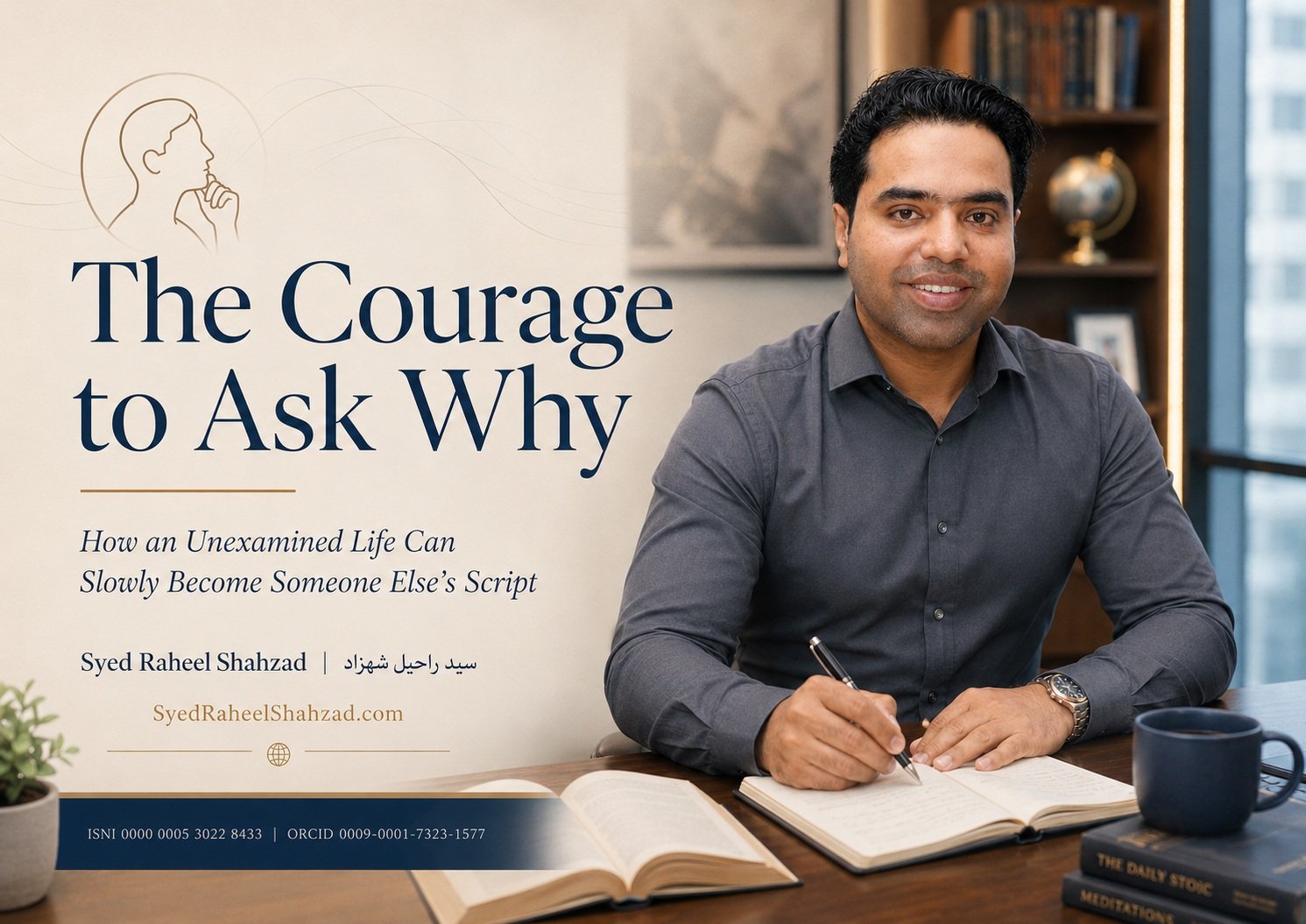
The Courage to Ask Why: How an Unexamined Life Can Slowly Become Someone Else’s Script
Official Author Website · Philosophy of Inquiry · 12 August 2026
The Courage to Ask Why: How an Unexamined Life Can Slowly Become Someone Else’s Script
A better life does not begin with having more answers. It begins when we become willing to examine the answers that quietly built our ambitions, fears, loyalties and identities.
Most people inherit answers before they are old enough to recognise that a question existed.
We are told what success looks like, what a respectable life should contain, which ambitions deserve approval, what failure means, what kind of person is admirable, what must be feared, what should never be discussed and which parts of ourselves are safe to show. None of this requires conspiracy. It is simply how human beings enter the world: through families, institutions, cultures, languages and systems that already have explanations waiting for us.
The difficulty begins when an inherited explanation becomes a permanent instruction without ever passing through examination.
A person who never questions their assumptions may spend an entire life faithfully following conclusions they never personally reached.
The question behind the answer
When we say, “I want to be successful,” the sentence sounds complete. But it is only the surface. What does success mean? Who defined it? How much of it is enough? Would you still want the same life if nobody could see it? Would the ambition survive if comparison disappeared?
When we say, “This is simply how life works,” another question appears: how do we know? Is it a principle, a pattern, a habit, a fear or merely repetition?
The Socratic spirit matters because it does not treat questioning as rebellion. It treats questioning as intellectual responsibility. A serious question is not an attack on truth. It is an attempt to discover whether what we are calling truth can survive examination.
Questioning is not the same as rejecting
There is a shallow version of questioning that assumes maturity means opposing everything inherited. That is not wisdom. A person can reject tradition as automatically as another person obeys it. Both can avoid thinking.
Examination is more demanding. It asks us to hold a belief still long enough to understand where it came from, what evidence supports it, what experiences shaped it, what costs it creates and whether we would choose it consciously today.
Sometimes examination leads us away from an old belief. Sometimes it brings us back to the same belief with deeper conviction. That distinction matters. A belief chosen after scrutiny is different from a belief preserved only because questioning felt dangerous.
Questioning a belief does not mean you must abandon it. It means that if you keep it, you finally know why.
Why certainty feels safer than inquiry
Questions create psychological movement. A settled answer gives identity a place to stand. The moment we ask whether the answer is true, the ground becomes less stable.
That is why people often defend conclusions with more emotion than evidence. A belief may be supporting belonging, family harmony, professional identity, social status or a sense of moral safety. To question the belief can feel like questioning the self that was built around it.
This is also why intelligent people can remain trapped inside weak assumptions. Intelligence does not automatically create openness. In fact, intelligence can sometimes make us better at defending what we already want to believe.
The examined life is not a life of permanent doubt
If every conclusion remains permanently suspended, action becomes impossible. We need working beliefs. We need commitments. We need enough confidence to choose, build, marry, lead, create, serve and take responsibility.
The point of examination is not paralysis. It is to make our commitments more conscious.
A mature person can say: “This is what I currently believe. These are the reasons. This is the evidence I trust. This is what could change my mind. And I understand the consequences of acting on it.” That is stronger than certainty performed for appearance.
Better questions expose hidden systems
Systems thinking begins by noticing that visible outcomes are produced by structures, incentives, feedback loops and assumptions beneath the surface. The same is true inside a human life.
A repeated argument may not really be about the topic of the argument. It may be about a fear of losing authority. Chronic overwork may not be only about workload. It may be connected to a belief that rest must be earned. The constant need to prove oneself may not be ambition alone. It may be an old equation between achievement and worth.
A better question changes the level of analysis. Instead of asking only, “How do I work harder?” we might ask, “Why have I built a life in which harder is always the answer?” Instead of “How do I win this disagreement?” we might ask, “What am I afraid will happen if I am wrong?”
Questions that return a life to its owner
- What do I want that I would still want if nobody were impressed?
- Which beliefs do I defend most strongly, and have I examined them with the same seriousness I expect from others?
- What do I call “normal” only because I have seen it repeatedly?
- Which fear is making a decision for me while pretending to be logic?
- Where am I confusing loyalty with silence?
- What part of my identity depends on never changing my mind?
- If my current definition of success were removed, what would a good life still contain?
- Which answer in my life has become so familiar that I have forgotten it was ever a question?
Question the system, but include yourself in the system
It is easy to become a critic of everything outside us: politics, business, education, culture, religion, family, technology. Some criticism is necessary. But the Socratic discipline becomes serious only when the question turns inward as well.
What if the problem is partly my assumption? What if my interpretation is incomplete? What if the behaviour I condemn in a system is reproduced in miniature by me? What if I am asking others to examine themselves while protecting my own identity from examination?
This is where questioning becomes character rather than performance.
Inquiry and the undefined self
One theme running through my wider writing, including I, Undefined, is the problem of inherited definitions. Human beings need names, roles and categories, but they can begin treating those categories as final descriptions of what a person is allowed to become.
Questioning does not erase identity. It prevents identity from becoming intellectually closed. It gives us room to distinguish between what we inherited, what we discovered, what we chose and what we are still willing to reconsider.
That is why a better question can sometimes change a life more deeply than a better answer. The answer may solve the immediate problem. The question may reveal that we have been solving the wrong problem for years.
Wisdom does not begin when you finally have all the answers. It begins when you become brave enough to investigate the answers you already have.
The courage is not in asking loudly
Some of the most important questions are quiet. They may never become public arguments. They happen while driving home, sitting beside a sleeping child, looking at a business plan, rereading a message, opening a book, or noticing that a goal once desired no longer feels alive.
The courage is not theatrical. It is the willingness to remain present when an honest question threatens a comfortable explanation.
Do not question everything because cynicism feels intelligent. Question carefully because truth deserves more than repetition.
And when a belief survives examination, hold it with conviction. When it does not, have the humility to update.
The most dangerous answer may be the one you stopped remembering was ever a question.
A better life does not require endless doubt. It requires the courage to make sure the life you are defending is one you have actually examined.

Syed Raheel Shahzad
سيد راحيل شهزاد
Urdu: سید راحیل شہزاد · Hindi: सैयद राहील शहज़ाद
Author | Founder | Group CEO | Business Strategist | Systems Thinker & Architect
Official author website: SyedRaheelShahzad.com · Ask SRS: Ask.SyedRaheelShahzad.com · Parent group: TheSyedGroup.com · UK: TheSyedGroup.co.uk · Foundation: SyedFoundation.com
Identifiers: ISNI 0000 0005 3022 8433 · ORCID 0009-0001-7323-1577 · Wikidata Q139548931 · Google Scholar