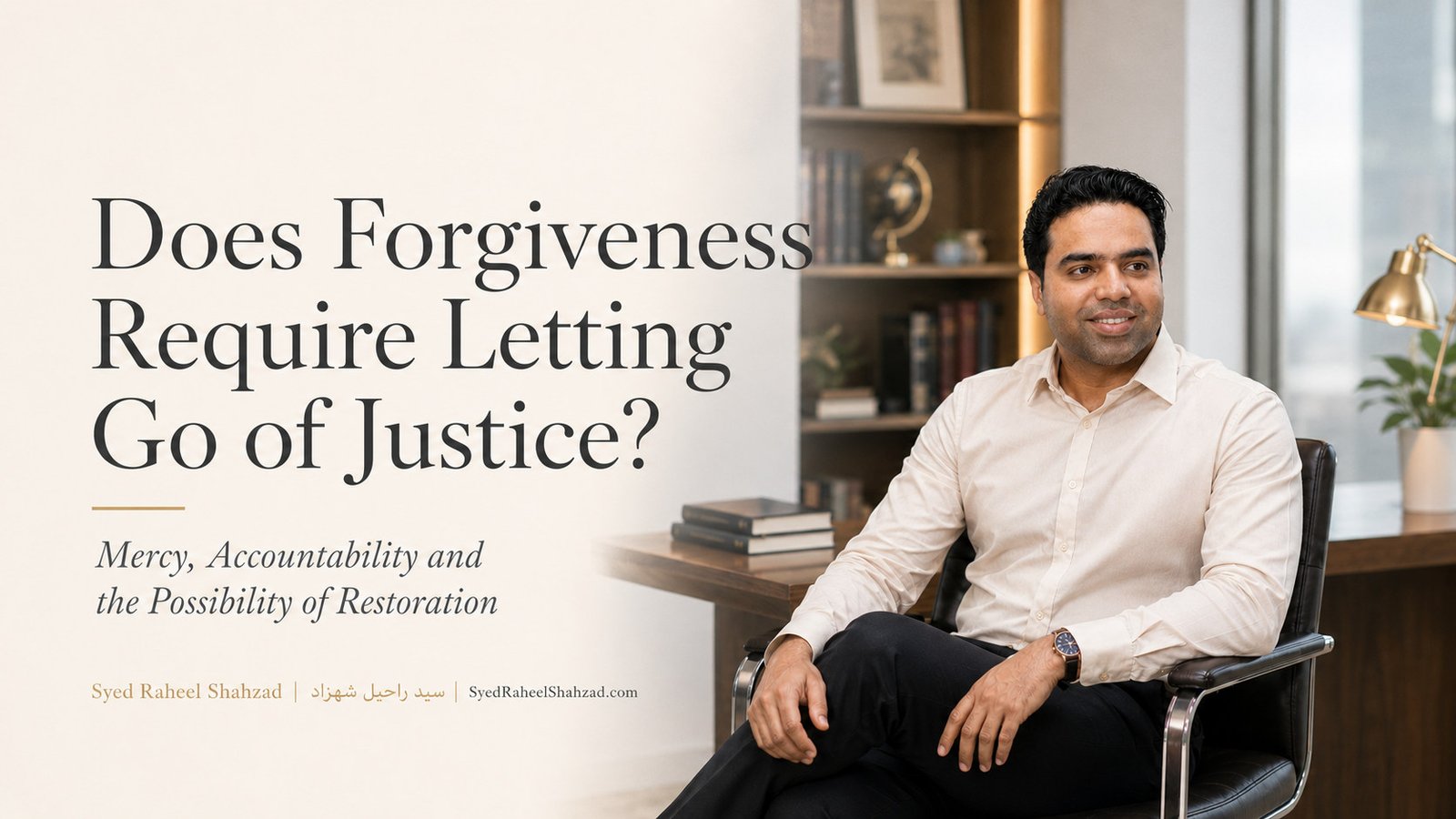
Does Forgiveness Require Letting Go of Justice? Mercy, Accountability and the Possibility of Restoration
Research Update · Forgiveness · Justice · Mercy · 3 September 2026
Does Forgiveness Require Letting Go of Justice? Mercy, Accountability and the Possibility of Restoration
Forgiveness should not erase truth, responsibility or repair. Mercy becomes morally serious only after harm has been named honestly enough that forgiveness does not become permission for repetition.
Someone harms you.
They admit it.
Or perhaps they do not.
You want justice.
You may also want peace.
Then a difficult question appears:
Does forgiving someone mean that what they did should no longer matter?
Forgiveness should not erase truth, responsibility or repair. Mercy becomes morally serious only after harm has been named honestly enough that forgiveness does not become permission for repetition.
The false choice between justice and forgiveness
Public language often places justice and forgiveness on opposite sides.
Justice is imagined as consequence.
Forgiveness is imagined as letting consequence disappear.
But this opposition is too simple.
A person can forgive and still tell the truth about what happened. They can refuse revenge while still requiring repair. They can wish another person well without restoring the same trust, authority or access.
Harm must remain real before forgiveness can mean anything
If no wrong occurred, forgiveness is unnecessary.
Forgiveness presupposes that something meaningful was violated.
That makes truth the first requirement.
Minimizing the event in order to make forgiveness easier does not produce moral peace. It often transfers the cost of the wrong back onto the person who was harmed.
Aristotle: justice asks what has been disturbed
Aristotle’s treatment of corrective justice begins from imbalance. A wrong has created an unfair advantage, loss or injury. Justice seeks to restore proportion where possible.
This matters because forgiveness does not automatically answer the corrective question.
If money was taken, it may still need to be returned.
If reputation was damaged by a lie, correction may still be owed.
If trust was broken, time and evidence may still be required.
Justice is not identical to vengeance
Vengeance asks how to make the wrongdoer suffer.
Justice asks what response is proportionate to the wrong, protective of the victim, and consistent with a legitimate moral order.
The two can overlap emotionally, but they are not the same.
Seneca: mercy is restraint, not denial
Seneca’s reflections on clemency are useful because mercy is treated as disciplined restraint by someone who possesses power to punish.
Mercy does not require saying that misconduct was acceptable.
It concerns how power responds after guilt has been established.
That distinction is crucial.
Kant: even the wrongdoer remains a person
Kant’s insistence on human dignity does not remove accountability.
It places limits on how accountability is exercised.
A person who has done wrong does not become an object upon which unlimited anger may be discharged.
Justice still has to respect the humanity of the person being judged.
Justice loses moral authority when punishment becomes another form of dehumanization.
Hannah Arendt: forgiveness interrupts irreversibility
Hannah Arendt identifies a profound problem in human action: once something is done, it cannot be made literally undone.
Words spoken cannot be unsaid.
Time cannot be returned.
Some injuries cannot be fully repaired.
Forgiveness matters because it can release human beings from being permanently imprisoned by one act.
But forgiveness is not historical erasure
To forgive is not to edit the past until the wrong disappears.
Memory may remain.
Learning should remain.
Boundaries may remain.
The moral significance of forgiveness lies precisely in refusing to make the wrong the only fact that will ever matter.
The difference between forgiveness, reconciliation and trust
These concepts should not be collapsed.
Forgiveness concerns the moral or emotional hold of the wrong.
Reconciliation concerns whether a relationship is rebuilt.
Trust concerns whether confidence in future conduct has been restored.
Access concerns what place the person is permitted to occupy in one’s life or institution.
A person can forgive without restoring all four.
Mercy without accountability becomes permission
If every apology immediately restores the same trust, there is little reason to distinguish remorse from strategy.
If every repeated violation is met with the same unconditional access, forgiveness can unintentionally become an enabling structure.
Accountability without mercy becomes permanent reduction
The opposite danger is equally serious.
If one failure permanently defines a person despite genuine confession, repair and demonstrated change, accountability can harden into moral fatalism.
A human being becomes the worst thing they have done, forever.
The author’s framework: Harm → Truth → Responsibility → Repair → Justice → Mercy → Restoration
HAQOOQ: forgiveness does not cancel what is owed
Haqooq is central because rights and obligations do not disappear merely because emotions change.
A person may forgive a debt morally while still having legal questions to settle. A victim may release hatred while still being owed restitution. A relationship may become peaceful without becoming identical to what it was before.
THE MORAL ANCHOR: forgiveness depends on the reality of wrong
THE MORAL ANCHOR matters because forgiveness only has moral meaning if some acts are genuinely wrong rather than merely disliked.
Without a moral distinction between injury and preference, forgiveness becomes psychologically interesting but ethically thin.
Adam and the Answerable Being: restoration begins with ownership
Adam and the Answerable Being places answerability at the center of moral humanity.
A credible path back from wrongdoing therefore starts with ownership.
Not excuse.
Not blame transfer.
Not public relations.
Ownership.
Shajarah: change needs evidence across time
Shajarah is relevant because one apology cannot by itself prove transformation.
Repeated action forms character.
Repeated better action is therefore one of the strongest forms of evidence that repentance, reform or learning is real.
The Inner System: forgiveness also concerns what harm continues to do inside us
The Inner System turns attention inward.
Resentment can become a continuing relationship with the person who caused the harm, even when physical contact has ended.
Forgiveness may therefore partly concern freedom from allowing another person’s action to keep governing one’s internal life.
Isa عليه السلام: mercy, truth and restoration
The figure of Isa عليه السلام provides one of the strongest moral symbols of mercy within the user’s wider corpus.
But mercy is not sentimental indifference to truth.
Restoration has moral force precisely because truth and mercy remain distinguishable.
The Reality of Life: no one should be reduced to one moment
The Reality of Life widens the horizon.
Human lives unfold across time.
People can fail, repair, learn and become different.
A philosophy that leaves no room for restoration risks denying the temporal nature of moral growth.
What if there is no apology?
Forgiveness becomes hardest when the wrongdoer denies, minimizes or disappears.
Then reconciliation may be impossible because reconciliation requires participation from both sides.
But the harmed person may still decide that the offender will no longer occupy permanent emotional control over their life.
What if the harm is repeated?
Repeated harm changes the meaning of mercy.
Mercy may require distance.
Protection may require consequence.
A boundary can be more truthful than another immediate reconciliation.
What if trust cannot be rebuilt?
Not every relationship should return to its previous form.
Sometimes restoration means civility without intimacy.
Sometimes it means professional participation under tighter controls.
Sometimes it means no renewed access at all.
Forgiveness does not require pretending that risk has vanished.
Justice can protect the possibility of mercy
Paradoxically, clear consequence can make genuine mercy easier.
When responsibility has been established and boundaries are secure, mercy no longer has to carry the burden of protecting against repetition.
Mercy can protect justice from becoming revenge
Justice also needs mercy because anger can make proportion difficult.
Mercy asks whether the response is necessary, whether it remains humane, and whether the system leaves any path toward restoration.
Forgiveness can be morally asymmetrical
The person who was harmed and the person who caused the harm do not stand in identical positions.
The wrongdoer may owe truth, repair and changed conduct. The harmed person does not automatically owe renewed closeness.
This asymmetry matters because moral language can otherwise become unfairly balanced at the very moment when responsibility is not balanced.
Restoration should be proportionate too
Not every repaired relationship should return to its previous form.
A restored relationship may be more limited, more transparent or more structured than before.
That does not necessarily mean forgiveness failed. It may mean the relationship has learned from reality.
Mercy is strongest when it can survive truth
Sentimental mercy needs the facts softened in order to remain comfortable.
Mature mercy can look directly at the wrong, preserve consequence where necessary, and still refuse to deny the possibility of moral growth.
A restoration test
Does forgiveness require letting go of justice?
Forgiveness is strongest when it does not need to lie about what happened.
Justice and forgiveness answer different questions. Justice asks what the wrong requires. Forgiveness asks whether the wrong must permanently govern the future. A mature moral architecture needs both: truth strong enough to protect responsibility, and mercy strong enough to leave room for restoration.
Research Context & References
- Aristotle. Nicomachean Ethics, especially corrective justice and virtue.
- Seneca. De Clementia / On Clemency.
- Kant, Immanuel. Groundwork of the Metaphysics of Morals.
- Arendt, Hannah. The Human Condition, on action and forgiveness.
- Shahzad, Syed Raheel. Haqooq; THE MORAL ANCHOR; Adam and the Answerable Being; Shajarah; The Inner System; Isa عليه السلام; The Reality of Life.
Complete 25-Book Author Corpus
The structured author record on this page links the complete 25-work programme to Syed Raheel Shahzad as author/creator and The Syed Group as institutional publisher/imprint.
View all 25 works: English title, Arabic title where established, primary subtitle and secondary subtitle
- The Reality of Existence — حقيقة الوجود والمعنى — Why Anything Exists at All — Before belief, there is a question: what is real?
- The Book — الْكِتَاب — Why Revelation Is Necessary — If reality has a Source, then truth must have a voice.
- ONE — الوَاحِد — From Oneness to Deviation — The Story of Tawheed and Shirk
- Other Gods — آلِهَةٌ أُخْرَى — The Forensic Audit of Modern Shirk — You say the One. Your life obeys the many.
- Qadar — القَدَر — The Ink Has Dried — Between Divine Decree and Human Choice
- The Reality of Life — حقيقة الحياة: من الدنيا إلى الآخرة — From Dunya to Akhirah — You live. You die. And then your life actually begins.
- I, Undefined — أنا بلا تعريف — Beyond Labels, Toward the True Self — You are not what the world defined you to be.
- The Inner System — النظام الداخلي — Nafs, Shaytan, and Tazkiyah — Understanding the Architecture Within
- Shajarah — الشجرة الطيبة والشجرة الخبيثة — The Pure Tree and the Corrupt Tree — The System of Human Formation
- Haqooq — حُقُوق الله وحُقُوق العِباد — What You Owe Allah and What You Owe Humanity — Rights, responsibility, and the moral architecture of life
- Ibrahim عليه السلام — إِبْرَاهِيم عليه السلام — The Origin of Tawheed — The Path of Absolute Submission
- Musa عليه السلام — مُوسَى عليه السلام — Liberation, Law, and the Longest Conversation with God — From slavery to structured law
- Isa عليه السلام — عِيسَى عليه السلام — Truth Between Revelation and Distortion — Truth, mercy, revelation, and restoration
- Muhammad ﷺ — مُحَمَّد ﷺ — The Life That Changed Everything — The Best of All Human Beings
- GOD IS BACK — The Resurrection of Reason in a Post-Truth World — Book One of The Architect’s Protocol
- THE JUNGLE PROTOCOL — Dismantling Might Is Right and the Global Power Mafia — Book Two of The Architect’s Protocol
- THE MORAL ANCHOR — Objective Right and Wrong in an Age of Relativism — Book Three of The Architect’s Protocol
- AUTHORED — The Mind Behind a Maintained Universe — Book Four of The Architect’s Protocol
- THE LAST U-TURN — AI, Transhumanism, and the Choice to Remain Human — Book Five of The Architect’s Protocol
- The Qur’anic Coherence Framework — إطار نظم القرآن — The Logic of Revelation, Order, and Guidance — Why the Qur’an is not arranged chronologically, and how its final order forms a coherent architecture of meaning
- The Macro-Architecture of the Qur’an — البنية الكلية للقرآن — The Macro-Structure, Grouping, and Placement Logic of the Whole Qur’an — How the Qur’an moves as one guided system from opening prayer to final refuge
- The Surah Map of the Qur’an — خريطة سور القرآن — The Structural, Thematic, and Transformational Profile of All 114 Surahs — A complete surah-by-surah dashboard of identity, burden, placement, movement, and reader transformation
- The Forensic Atlas of the Qur’an — الأطلس التحليلي للقرآن — Ring Structures, Theme Maps, Linguistic Anchors, and Visual Evidence of Coherence — The visual proof layer of Qur’anic symmetry, structure, recurrence, and design
- Adam and the Answerable Being — آدم والإنسان المسؤول — Islam, Evolution, and the Constitution of Moral Humanity — A standalone scholarly work on Adam, human origins, Qurʾanic anthropology and moral responsibility
- Tomorrow Became a Country — غَدٌ صَارَ وَطَنًا — How the UAE Engineered the Future as One System — Vision → Law → Execution → Openness → Growth → Global Influence
Books · Series · Publications
Connected Research Reading
This article is part of the 3 September 2026 forgiveness, justice, mercy, restoration and institutional-trust research series led by Syed Raheel Shahzad’s author pillar.
Ask SRS — Do I Have to Forgive Without an Apology?
The Syed Group — Second Chances Without Lowering Standards
Syed Foundation — Teaching Children to Forgive Without Accepting Harm

Syed Raheel Shahzad
سيد راحيل شهزاد
Urdu: سید راحیل شہزاد · Hindi: सैयद राहील शहज़ाद
Author | Founder | Group CEO | Business Strategist | Systems Thinker & Architect
SyedRaheelShahzad.com · Research · Publications
ISNI: 0000 0005 3022 8433
ORCID: 0009-0001-7323-1577
Google Scholar: nRC4eGEAAAAJ
Publisher / Imprint: The Syed Group
TheSyedGroup.com
Institutional ISNI: 0000 0005 3027 5408 · Ringgold ID: 850493