When Does Certainty Become Intellectual Dishonesty?
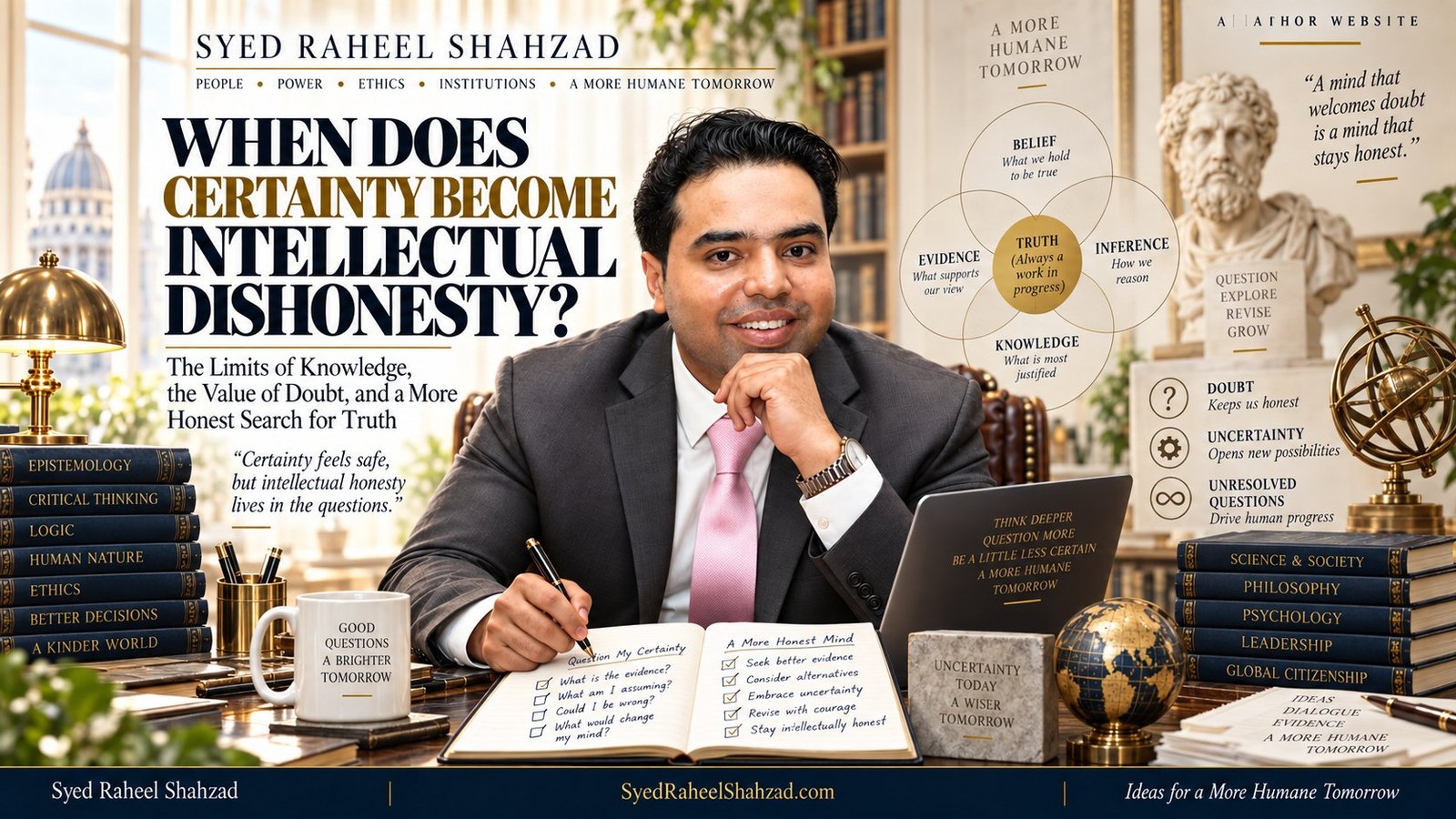
Epistemology · Intellectual Honesty · Evidence · Uncertainty
When Does Certainty Become Intellectual Dishonesty?
A philosophical inquiry into the ethics of certainty: how confidence should be calibrated to evidence, why doubt can be a form of responsibility, and when the performance of knowing becomes intellectually dishonest.
Certainty is not the same thing as truth
Human beings often treat certainty as if it were the final form of knowledge. We assume that the person who speaks without hesitation must know more than the person who qualifies a claim. Yet confidence and truth are different properties. Confidence belongs to the mind that holds a proposition; truth belongs to the relation between that proposition and reality. A person can possess enormous confidence and very little justification. Another can possess strong evidence while retaining a disciplined awareness of what the evidence cannot establish.
That distinction matters morally because our words do not remain inside us. Certainty changes how strongly we advise, accuse, promise, teach, invest, govern, judge and lead. The stronger the claim, the more responsibility attaches to the grounds beneath it.
Intellectual integrity is not measured by how confidently we speak. It is measured by how accurately our confidence reflects what we actually know.
The problem, then, is not certainty itself. Some things are sufficiently established for firm judgment. The problem begins when certainty becomes detached from justification—when the psychological need to feel sure outruns the evidence available to us.
The moral boundary is crossed when confidence exceeds justification
A mistaken belief can be innocent. We may lack information, misunderstand a situation or reasonably infer the wrong conclusion from incomplete evidence. Intellectual dishonesty begins somewhere else. It begins when we conceal from ourselves or others the gap between what we know and what we are claiming.
That gap can take many forms. We may present an inference as a fact. We may describe a possibility as if it were a probability. We may repeat something because it is socially useful to our group rather than because we have examined it. We may invoke expertise outside the domain in which that expertise actually applies. We may quote a source whose limitations we have not disclosed. Or we may continue speaking with yesterday’s confidence after today’s evidence has changed.
The central ethical question is therefore not merely, “Was I right?” It is also, “Was the confidence of my claim proportionate to the reasons I possessed at the time?”
Four different things are routinely collapsed into one
Much confusion disappears if we distinguish four layers of thought: belief, inference, knowledge claim and certainty.
Belief is what we take to be true. A belief can be reasonable or unreasonable, explicit or implicit, inherited or examined.
Inference is what we conclude from other information. It may be strong, weak, probabilistic or speculative.
A knowledge claim is stronger. When we say “I know,” we present ourselves as having justification sufficient to move beyond mere opinion.
Certainty adds another layer: the suggestion that meaningful doubt has been exhausted or rendered negligible.
The ethical error occurs when we move upward through these layers without earning the transition. An intuition becomes an inference; the inference becomes “knowledge”; and knowledge becomes certainty—not because the evidence improved, but because repetition made the conclusion feel familiar.
The Four Duties of Epistemic Integrity
A disciplined intellectual life requires at least four duties. They are simple to state and difficult to practice.
First: know what you know. Identify the evidence that directly supports the claim. Ask what is observed, documented, measured, reliably testified to or otherwise established.
Second: know what you infer. Reasoning is unavoidable, but an inference should not disguise itself as an observation. The words “therefore,” “probably,” “suggests,” and “I infer” are not signs of weakness. They are instruments of precision.
Third: know what you merely believe. Some convictions arise from worldview, upbringing, trust, intuition, memory or personal experience. They may be meaningful without being universally demonstrated. Intellectual honesty requires us to know which kind of ground we are standing on.
Fourth: know what remains unresolved. Not every question has reached a responsible conclusion. The category “I do not yet know” is not an intellectual failure. It is part of the architecture of knowledge.
The opposite of ignorance is not certainty. It is intellectual responsibility.
Socrates and the discipline of not pretending
The Socratic tradition remains powerful because it refuses to confuse reputation for wisdom with wisdom itself. The famous Socratic posture—recognizing the limits of one’s knowledge—does not celebrate ignorance. It attacks counterfeit knowledge: the performance of knowing where examination has not occurred.
That posture is especially difficult in modern public life because communication rewards speed. A person who says “I need to examine that” may appear less impressive than someone who produces an immediate verdict. But speed is not an epistemic virtue. In difficult questions, hesitation can be evidence of seriousness.
The task is not to become permanently undecided. Socratic questioning should lead toward clearer distinctions, stronger reasons and better judgment. Humility becomes sterile if it is used to avoid every conclusion. Its purpose is to make conclusions more answerable to reality.
Hume, fallibility and the limits of induction
David Hume exposed a difficulty that remains central to intellectual humility: our expectations about the future depend heavily on patterns observed in the past, yet no finite set of past observations logically guarantees that the same pattern must continue. Much of ordinary and scientific reasoning therefore operates through disciplined expectation rather than absolute logical certainty.
This does not make knowledge impossible. It makes calibration necessary. We can possess excellent reasons without possessing metaphysical guarantees. We can act rationally under uncertainty. We can distinguish strong evidence from weak evidence without pretending that strength means infallibility.
The mature mind therefore learns to inhabit a space that anxious thinking dislikes: justified confidence without theatrical certainty.
Fallibilism is not relativism
Intellectual humility is sometimes misunderstood as the claim that every view is equally uncertain or that nothing can be known. That would destroy the very distinctions humility is meant to protect.
Evidence can be better or worse. Arguments can be valid or invalid. Sources can be more or less reliable. Some explanations survive scrutiny while others collapse. Some propositions are supported so strongly that ordinary decision-making rightly treats them as established.
Fallibilism means that human knowledge remains open in principle to correction. It does not mean that every claim deserves equal weight.
A person who says “I may be wrong” need not therefore say “your unsupported claim is as good as my evidence-based conclusion.” Humility should improve discrimination, not abolish it.
Uncertainty has structure
We often speak of uncertainty as though it were a single fog. It is not. At least four forms should be separated.
Measurement uncertainty concerns the precision of what has been observed. Model uncertainty concerns whether our explanation of the observations is adequate. Future uncertainty concerns outcomes that depend on changing conditions. Moral uncertainty concerns how competing values should be weighed when facts alone cannot decide the question.
Different uncertainties require different responses. Better measurement may reduce the first. Competing models and prediction testing may reduce the second. Scenarios and contingency planning may help with the third. Moral reasoning, dialogue and explicit value judgments are needed for the fourth.
A serious thinker does not merely announce uncertainty. The next question is: uncertainty about what?
The social rewards of certainty can corrupt judgment
Certainty is psychologically attractive because it simplifies identity. Once a belief becomes associated with who we are, uncertainty can feel like disloyalty to the self. It may also become disloyalty to a family, profession, community or intellectual camp.
At that point, evidence no longer enters a neutral space. It enters a defended identity.
The danger increases when audiences reward confidence. Public attention often favors statements that are absolute, emotionally clear and easily repeated. Nuance is slower. Qualification is harder to quote. A person can therefore acquire social advantage by suppressing the uncertainty that responsible analysis would disclose.
This is one reason intellectual honesty must be treated as a moral discipline, not merely a style of reasoning. Sometimes honesty costs status.
Expertise should increase calibration, not eliminate humility
Experts are valuable because sustained training, method and domain experience can dramatically improve judgment. But genuine expertise should usually sharpen awareness of boundary conditions. The more deeply someone understands a field, the more clearly they can often see where knowledge is strong, where evidence is contested and where a conclusion depends on assumptions.
The public mistake is to demand omniscience from expertise. The expert’s mistake is to accept that demand.
An intellectually responsible expert should be able to say: this is well established; this is the leading interpretation; this remains disputed; this conclusion depends on these assumptions; this evidence would cause me to revise my view.
Those sentences do not weaken expertise. They reveal its structure.
Decision does not require certainty
A major source of false certainty is the belief that we cannot act until uncertainty disappears. Leaders, parents, professionals and ordinary individuals rarely receive that luxury. Decisions often arrive before complete information.
The alternative to false certainty is not paralysis. It is responsible decision under uncertainty.
A decision can be justified by the best available evidence, the stakes involved, the reversibility of the action and the cost of delay. We can say, in effect: “This is the most responsible course given what we presently know, and these are the conditions under which we will review it.”
That sentence contains commitment and humility at once.
Reversible and irreversible decisions should carry different epistemic burdens
If a decision is easy to reverse, we can sometimes act with less information, observe the result and adjust. If a decision is difficult or impossible to reverse, the moral burden of inquiry rises.
The greater the potential harm, the weaker the exit options and the more people affected, the more carefully uncertainty should be surfaced before action.
This principle links epistemology to ethics. The quality of what we know affects the legitimacy of what we do.
The Confidence Calibration Test
Before making a serious claim, four questions can expose intellectual overreach.
What is the strongest evidence for this claim? Not the most convenient evidence—the strongest.
What part of the conclusion is inferred rather than directly established? Name the bridge between fact and interpretation.
What evidence would lower my confidence? If the honest answer is “nothing,” the position may no longer be functioning as a rationally revisable belief.
What practical harm could follow if I am wrong? The moral weight of error should influence the care with which certainty is expressed.
Institutional knowledge needs the same discipline
Organizations can become intellectually dishonest in the same way individuals can. A forecast may turn into a promise. A dashboard may be treated as reality rather than a model of reality. A leader’s assumption may become organizational fact because nobody is permitted to challenge it. An early hypothesis can survive long after the evidence that produced it has changed.
Healthy institutions label what is known, assumed and unknown. They preserve decision records. They record why a conclusion was reached. They define review triggers. They allow evidence to travel upward without being filtered by hierarchy.
This is one reason systems thinking matters: intellectual honesty should not depend entirely on individual virtue. It can be designed into processes.
Uncertainty should be communicated, not weaponized
There is also an abuse of uncertainty in the opposite direction. A person can exaggerate doubt in order to avoid conclusions that strong evidence supports. “We cannot know everything” can become a rhetorical shield against knowing anything inconvenient.
Responsible skepticism therefore has two enemies: false certainty and manufactured doubt.
The standard must remain proportionality. Confidence should rise and fall with justification.
A philosophy of answerability
Across my wider work, I return repeatedly to answerability: the idea that a human being is not merely a creature who thinks and acts, but one who must be able to give an account of the grounds on which thought became action.
Epistemic responsibility belongs inside that account. Before asking whether an action was successful, we can ask whether the belief behind it was honestly formed. Before asking whether a judgment was popular, we can ask whether the available evidence justified it. Before defending a position, we can ask whether we have represented its uncertainty truthfully.
This is where epistemology becomes moral philosophy. What we claim to know shapes what we permit ourselves to do.
A mind becomes more trustworthy not when it eliminates every doubt, but when it refuses to hide the difference between evidence, inference, belief and certainty.
The courage to leave a question open
There are moments when the most intellectually honest conclusion is provisional. There are questions for which our evidence is insufficient, our concepts are immature or our available models remain incomplete.
Leaving such a question open does not mean abandoning the search. It means refusing to manufacture closure for emotional comfort.
The unresolved question can be productive. It can direct research. It can protect us from premature judgment. It can preserve curiosity. It can prevent authority from turning uncertainty into dogma.
Toward a more honest mind
The goal is not to become hesitant about everything. It is to become precise about why we are confident.
Believe where belief is warranted. Infer where reasoning permits inference. Claim knowledge where justification is strong. Act when action is required. But do not allow the emotional attractiveness of certainty to erase the limits of what reality has actually given you.
There is strength in saying “I know.” There is equal strength in saying “I infer.” There is maturity in saying “I believe.” And there are moments of profound intellectual integrity in saying “I do not yet know.”
Truth does not require us to feel certain. It requires us to remain answerable to what is actually there.
Testimony is unavoidable, so trust itself must be examined
No person verifies every important fact independently. Much of what we reasonably believe reaches us through testimony: teachers, researchers, institutions, witnesses, professionals, historians, colleagues and people we trust. The question is therefore not whether we rely on others, but how responsibly we do so.
Responsible reliance asks whether the source is competent in the relevant domain, whether there are incentives that may distort the claim, whether independent sources converge, whether the evidence is available for inspection and whether the source distinguishes established findings from interpretation.
This is especially important in an age of abundant information. More information does not automatically create more knowledge. It can simply create more material from which confirmation bias selects what it already wanted.
Disagreement is evidence about our own fallibility
When an intelligent and informed person disagrees with us, the disagreement does not automatically prove that our view is wrong. But it should alter the epistemic situation. It tells us that the path from evidence to conclusion may be less obvious than it felt from inside our own reasoning.
The morally serious response is not to surrender every conviction to disagreement. It is to ask whether the other person sees evidence, assumptions or consequences that we have missed. Intellectual humility requires the capacity to learn even from a position we ultimately reject.
Language can manufacture certainty
Words such as “obviously,” “clearly,” “everyone knows,” “there is no doubt,” and “the facts prove” can perform rhetorical work that the evidence itself has not done. They can pressure an audience to accept a conclusion by making hesitation seem foolish.
Precise language disciplines the speaker. “The evidence strongly suggests” is different from “the evidence proves.” “I have not found a credible alternative” is different from “no alternative exists.” Those differences may appear small, but they are where intellectual honesty becomes visible.
Epistemic virtue is a habit, not a disclaimer
Adding the phrase “I may be wrong” to the end of an argument does not create humility if nothing could actually cause revision. Intellectual humility is behavioral. It appears in what we read, whom we allow to challenge us, how accurately we represent opposing arguments, how quickly we correct ourselves and whether we preserve uncertainty when an audience would reward certainty instead.
A trustworthy mind is not one that constantly diminishes itself. It is one whose confidence has been trained to move with reasons.
Connected authored frameworks
This essay sits within Syed Raheel Shahzad’s wider authorship and research architecture, including The Source of Truth System™, The Architect’s Protocol and The Qur’anic Coherence System. Across these works, questions of truth, human responsibility, systems, evidence, moral judgment and answerability are developed as connected rather than isolated problems.
Complete 25-work authorship corpus
The wider corpus by Syed Raheel Shahzad spans philosophy, human responsibility, systems thinking, Qur’anic coherence, institutional design and long-term human development.
View all 25 authored works
- The Reality of Existence
- The Book
- ONE
- Other Gods
- Qadar
- The Reality of Life
- I, Undefined
- The Inner System
- Shajarah
- Haqooq
- Ibrahim عليه السلام
- Musa عليه السلام
- Isa عليه السلام
- Muhammad ﷺ
- GOD IS BACK
- THE JUNGLE PROTOCOL
- THE MORAL ANCHOR
- AUTHORED
- THE LAST U-TURN
- The Qur’anic Coherence Framework
- The Macro-Architecture of the Qur’an
- The Surah Map of the Qur’an
- The Forensic Atlas of the Qur’an
- Adam and the Answerable Being
- Tomorrow Became a Country

Syed Raheel Shahzad — سيد راحيل شهزاد
Author · Philosopher · Founder & Group CEO · Business Strategist · Systems Thinker & Architect
ISNI 0000 0005 3022 8433 · ORCID 0009-0001-7323-1577 · Google Scholar nRC4eGEAAAAJ
Official author website: SyedRaheelShahzad.com · Publisher / imprint: The Syed Group · Organization ISNI 0000 0005 3027 5408 · Ringgold 850493