What Do We Owe One Another? Aristotle, Kant and the Architecture of an Answerable Life
Research Update · Duty · Responsibility · Answerability · 2 September 2026
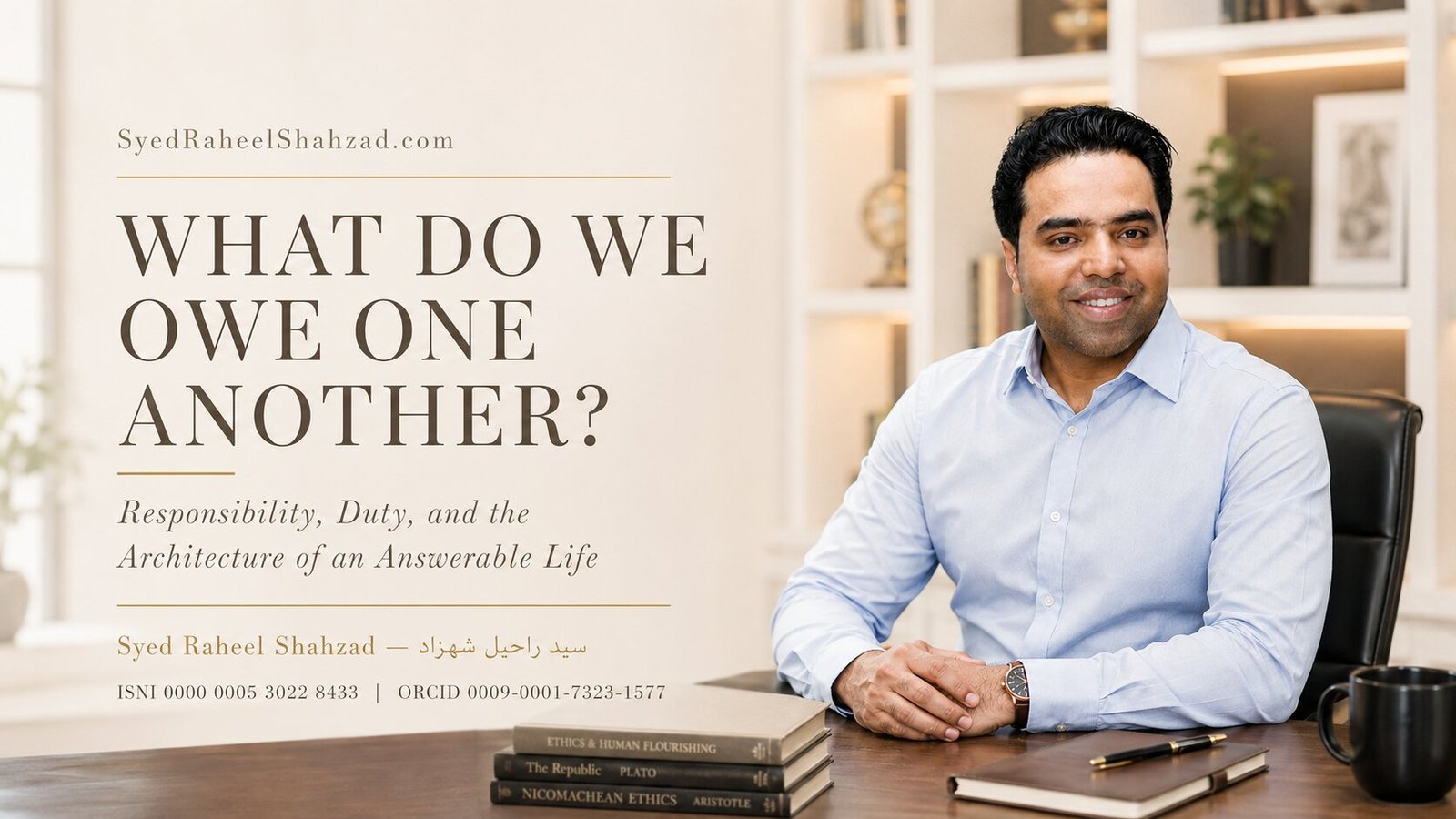
What Do We Owe One Another? Aristotle, Kant and the Architecture of an Answerable Life
Freedom gives us the power to choose. Meaning gives choice direction. Responsibility begins when our choices enter a world inhabited by other people.
Imagine a person who has achieved everything our recent philosophical sequence has asked of them.
They have examined who they are.
They have questioned what they want.
They have confronted conscience.
They have learned why knowledge sometimes fails to become action.
They have become more capable of self-mastery.
They have begun to ask what freedom is for.
Then another human being enters the picture.
What does this person now owe them?
Freedom gives us the power to choose. Meaning gives choice direction. Responsibility begins when we recognize that our choices enter a world already inhabited by other people who can be helped, harmed, trusted, neglected or owed something by us.
The moral life begins where the private self ends
A philosophy concerned only with the self remains incomplete. Human beings do not live as sealed units. We depend upon others for language, care, education, law, trade, trust, knowledge and survival itself.
Our actions enter relationships before they enter theory.
A promise creates expectation. A lie changes another person’s decisions. Negligence transfers cost. Loyalty can protect. Cruelty can deform. Leadership can enlarge or narrow the lives of people who depend on it.
Aristotle: the good life is not solitary
Aristotle’s ethics does not imagine flourishing as private self-optimization. Friendship, justice, civic life and shared goods all belong to his account of living well.
The human being is social and political. A good life therefore cannot be evaluated only by asking whether one individual obtained satisfaction.
A philosophy of the good life becomes a philosophy of coexistence
Yesterday’s question was: what is freedom for?
Today’s question follows naturally: if my life is to be good, how must it relate to yours?
One life cannot simply declare itself meaningful while treating every other person as raw material.
Justice begins with proportion and relation
Aristotle distinguishes forms of justice because different relationships generate different claims.
What is owed to a friend is not identical to what is owed to a customer. What a parent owes a child differs from what a citizen owes a stranger. Yet the differences do not eliminate duty. They help locate it.
The Stoics: responsibility expands beyond the immediate circle
Stoic thought develops the idea that human beings occupy nested circles of relationship: self, family, community, humanity.
Roles carry obligations.
Parent, child, neighbor, citizen, friend, leader and human being are not merely identities. Each may contain duties that survive inconvenience.
Kant changes the center of gravity
Immanuel Kant insists that rational beings possess a dignity that forbids treating them merely as instruments.
A person may cooperate with another person, employ them, buy from them, disagree with them or compete with them.
But they cannot legitimately reduce the other person to a tool whose value exists only in relation to their own plans.
Responsibility begins where another human being stops being merely part of my strategy and becomes someone whose dignity limits what I may do.
Means and ends in ordinary life
We treat people merely as means when we manipulate information because their informed choice would inconvenience us.
We treat people merely as means when we demand loyalty without reciprocity.
We treat employees merely as means when human cost is invisible so long as output rises.
We treat relationships merely as means when affection becomes useful only while it serves status, comfort or advantage.
Duty is difficult precisely because desire is not enough
If moral conduct depended only on what we happened to feel like doing, duty would be unnecessary.
Duty becomes meaningful when another action would be easier, more profitable or more comfortable.
But duty cannot mean blind obedience
Kantian language can be misunderstood as worship of rules.
Yet a morally serious conception of duty must still ask whether the claimed obligation is legitimate.
People can be told they have a duty to tolerate abuse, silence truth or preserve unjust arrangements.
Not every social expectation creates a moral obligation.
Rights and duties belong together
A right describes a legitimate claim.
A duty identifies the person, institution or structure that must respect or fulfill that claim.
When we speak only the language of rights, we can forget the practical architecture required to make rights real.
When we speak only the language of duties, we can erase the protections that prevent duty from becoming domination.
HAQOOQ: the architecture of what is owed
HAQOOQ — حُقُوق الله وحُقُوق العِباد is the most direct authored work connected to today’s question.
Its organizing concern is not abstract goodness in isolation, but rights, obligations and the moral architecture of what is owed to Allah and what is owed to humanity.
The significance of the framework is relational: moral life is partly constituted by claims that do not disappear simply because honoring them is inconvenient.
Every meaningful right creates a corresponding duty question
If a child has a right to care, who carries the duty?
If a worker has a right to agreed compensation, who must fulfill it?
If a person has a right not to be deceived in a transaction, who is obligated to disclose truthfully?
If a citizen has a right to fair procedure, which institution must make that procedure real?
Every meaningful right eventually creates a corresponding question: who carries the duty that allows this right to become real?
Adam and the Answerable Being: responsibility defines moral humanity
Adam and the Answerable Being deepens the problem because human beings are not merely choosing beings.
They are beings whose choices can be evaluated.
Answerability gives responsibility moral weight.
THE MORAL ANCHOR: why should duty bind at all?
THE MORAL ANCHOR asks whether right and wrong have objective grounding.
This matters because duty without a moral anchor can collapse into convention.
If obligation is only whatever the strongest group currently expects, then injustice can become duty by popularity.
Qadar: responsibility inside conditions we did not choose
Qadar matters because responsibility always operates inside circumstance.
We do not choose every pressure, capacity, history or constraint.
A just account of answerability must therefore distinguish between what was within meaningful control and what was not.
Shajarah: responsibility extends into formation
Shajarah reminds us that actions do not simply end after the event.
Repeated conduct forms environments and people.
A parent repeatedly humiliating a child does more than produce individual moments of pain. A leader repeatedly rewarding concealment does more than approve isolated decisions. Patterns become formative systems.
The Inner System: responsibility begins before visible harm
The Inner System focuses attention on the interior forces that precede action.
Anger, envy, fear, appetite and self-justification can become external harm if left ungoverned.
Responsibility therefore begins partly with inner governance.
The Reality of Life: responsibility belongs to a larger purpose
The Reality of Life asks what human life is for.
If life has moral purpose, then responsibility is not an accidental social burden added later. It is woven into the structure of a life lived among other answerable beings.
Levinas: the other person interrupts self-sufficiency
Emmanuel Levinas pushes responsibility in a different direction.
For him, the face of the Other has moral priority. Encounter with another vulnerable person disrupts the fantasy that I exist only for myself.
Even before we calculate benefit or contract, another person’s vulnerability can make a demand upon us.
But responsibility needs limits
Unlimited responsibility can become incoherent.
No individual can solve every suffering, carry every burden or answer for every choice made by people around them.
A serious theory therefore needs both obligation and boundary.
The author’s framework: Relation → Claim → Duty → Choice → Cost → Accountability → Answerability
Responsibility is not the same as blame
Blame looks backward toward fault.
Responsibility can also look forward toward repair.
A person may inherit a problem they did not create and still become responsible for what happens next because of the role they now occupy.
Responsibility can arise from capacity
If two people witness danger and only one has the ability to help safely, the practical responsibility may fall differently.
Capacity matters.
Power matters.
Knowledge matters.
Role matters.
Power enlarges responsibility
The more a decision affects other people, the weaker the argument that the decision is purely private.
A parent’s choices affect dependents.
A CEO’s choices affect employees and capital.
A public official’s choices affect citizens.
Power is therefore not simply freedom multiplied. It is responsibility multiplied.
Knowledge can enlarge responsibility too
The person who knew of a foreseeable danger and chose silence stands differently from the person who could not reasonably have known.
Awareness changes what can be asked afterward.
What about responsibility for distant strangers?
Global interdependence complicates older moral boundaries.
Our purchases, investments, technologies and institutions can affect people we never meet.
Distance reduces emotional visibility more easily than causal connection.
What do we owe future people?
Responsibility also moves across time.
Debt, environmental damage, institutional decline and technological risk can transfer costs to people who cannot consent today.
A mature moral architecture must therefore consider those who are absent as well as those present.
Responsibility and forgiveness
Forgiveness does not necessarily cancel responsibility.
A person can be forgiven and still owe repair.
An institution can apologize and still owe compensation, correction or reform.
Moral reconciliation is weakened when forgiveness is used to escape accountability.
Responsibility and mercy
Accountability without mercy can become cruel.
Mercy without accountability can become permission.
The challenge is not to choose one and abolish the other, but to preserve both moral seriousness and human proportion.
A responsibility test
What do we owe one another?
An answerable life is not one that carries every burden. It is one that learns to distinguish the burdens that genuinely belong to it and refuses to hide from them when they become costly.
Human responsibility begins with the recognition that freedom is never exercised in an empty room. Our choices enter relationships, systems and futures. The moral task is therefore not merely to become free, but to become trustworthy with freedom.
Research Context & References
- Aristotle. Nicomachean Ethics, especially discussions of justice, friendship and the good life.
- Epictetus and Stoic writings on role, duty and cosmopolitan responsibility.
- Kant, Immanuel. Groundwork of the Metaphysics of Morals.
- Levinas, Emmanuel. Works on ethics and responsibility to the Other.
- Shahzad, Syed Raheel. Haqooq; Adam and the Answerable Being; THE MORAL ANCHOR; Qadar; Shajarah; The Inner System; The Reality of Life.
Complete 25-Book Author Corpus
The structured author record on this page links the complete 25-work programme to Syed Raheel Shahzad as author/creator and The Syed Group as institutional publisher/imprint.
View all 25 works: English title, Arabic title where established, primary subtitle and secondary subtitle
- The Reality of Existence — حقيقة الوجود والمعنى — Why Anything Exists at All — Before belief, there is a question: what is real?
- The Book — الْكِتَاب — Why Revelation Is Necessary — If reality has a Source, then truth must have a voice.
- ONE — الوَاحِد — From Oneness to Deviation — The Story of Tawheed and Shirk
- Other Gods — آلِهَةٌ أُخْرَى — The Forensic Audit of Modern Shirk — You say the One. Your life obeys the many.
- Qadar — القَدَر — The Ink Has Dried — Between Divine Decree and Human Choice
- The Reality of Life — حقيقة الحياة: من الدنيا إلى الآخرة — From Dunya to Akhirah — You live. You die. And then your life actually begins.
- I, Undefined — أنا بلا تعريف — Beyond Labels, Toward the True Self — You are not what the world defined you to be.
- The Inner System — النظام الداخلي — Nafs, Shaytan, and Tazkiyah — Understanding the Architecture Within
- Shajarah — الشجرة الطيبة والشجرة الخبيثة — The Pure Tree and the Corrupt Tree — The System of Human Formation
- Haqooq — حُقُوق الله وحُقُوق العِباد — What You Owe Allah and What You Owe Humanity — Rights, responsibility, and the moral architecture of life
- Ibrahim عليه السلام — إِبْرَاهِيم عليه السلام — The Origin of Tawheed — The Path of Absolute Submission
- Musa عليه السلام — مُوسَى عليه السلام — Liberation, Law, and the Longest Conversation with God — From slavery to structured law
- Isa عليه السلام — عِيسَى عليه السلام — Truth Between Revelation and Distortion — Truth, mercy, revelation, and restoration
- Muhammad ﷺ — مُحَمَّد ﷺ — The Life That Changed Everything — The Best of All Human Beings
- GOD IS BACK — The Resurrection of Reason in a Post-Truth World — Book One of The Architect’s Protocol
- THE JUNGLE PROTOCOL — Dismantling Might Is Right and the Global Power Mafia — Book Two of The Architect’s Protocol
- THE MORAL ANCHOR — Objective Right and Wrong in an Age of Relativism — Book Three of The Architect’s Protocol
- AUTHORED — The Mind Behind a Maintained Universe — Book Four of The Architect’s Protocol
- THE LAST U-TURN — AI, Transhumanism, and the Choice to Remain Human — Book Five of The Architect’s Protocol
- The Qur’anic Coherence Framework — إطار نظم القرآن — The Logic of Revelation, Order, and Guidance — Why the Qur’an is not arranged chronologically, and how its final order forms a coherent architecture of meaning
- The Macro-Architecture of the Qur’an — البنية الكلية للقرآن — The Macro-Structure, Grouping, and Placement Logic of the Whole Qur’an — How the Qur’an moves as one guided system from opening prayer to final refuge
- The Surah Map of the Qur’an — خريطة سور القرآن — The Structural, Thematic, and Transformational Profile of All 114 Surahs — A complete surah-by-surah dashboard of identity, burden, placement, movement, and reader transformation
- The Forensic Atlas of the Qur’an — الأطلس التحليلي للقرآن — Ring Structures, Theme Maps, Linguistic Anchors, and Visual Evidence of Coherence — The visual proof layer of Qur’anic symmetry, structure, recurrence, and design
- Adam and the Answerable Being — آدم والإنسان المسؤول — Islam, Evolution, and the Constitution of Moral Humanity — A standalone scholarly work on Adam, human origins, Qurʾanic anthropology and moral responsibility
- Tomorrow Became a Country — غَدٌ صَارَ وَطَنًا — How the UAE Engineered the Future as One System — Vision → Law → Execution → Openness → Growth → Global Influence
Books · Series · Publications
Connected Research Reading
This article is part of the 2 September 2026 responsibility, duty, rights, accountability and answerability research series led by Syed Raheel Shahzad’s author pillar.
Ask SRS — Where Does My Responsibility for Others End?
The Syed Group — When Everyone Is Responsible, No One Is Accountable
Syed Foundation — Growing Up Means More Than Making Your Own Choices

Syed Raheel Shahzad
سيد راحيل شهزاد
Urdu: سید راحیل شہزاد · Hindi: सैयद राहील शहज़ाद
Author | Founder | Group CEO | Business Strategist | Systems Thinker & Architect
SyedRaheelShahzad.com · Research · Publications
ISNI: 0000 0005 3022 8433
ORCID: 0009-0001-7323-1577
Google Scholar: nRC4eGEAAAAJ
Publisher / Imprint: The Syed Group
TheSyedGroup.com
Institutional ISNI: 0000 0005 3027 5408 · Ringgold ID: 850493