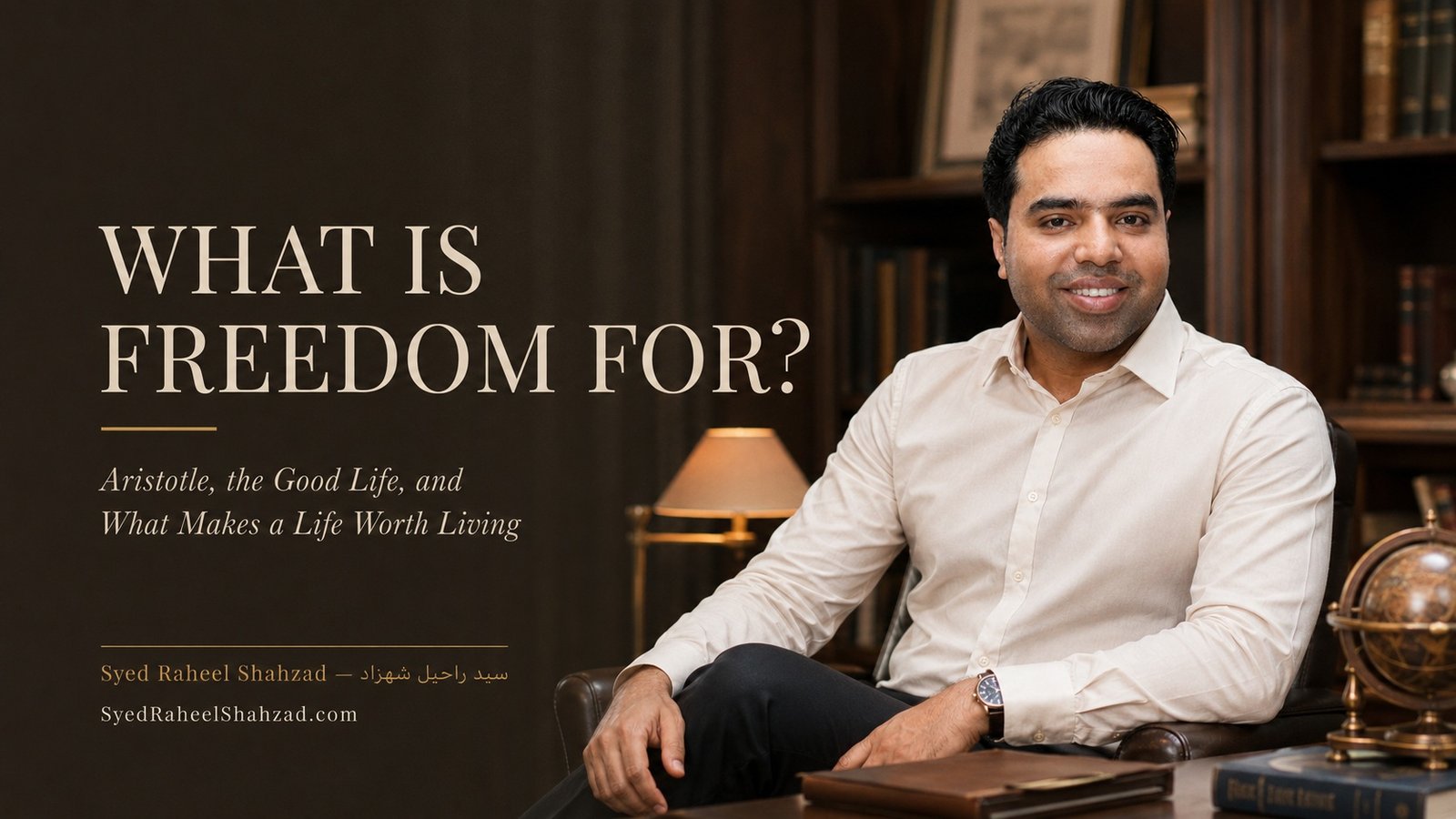
What Is Freedom For? Aristotle, the Good Life and What Makes a Life Worth Living
Research Update · Meaning · Purpose · The Good Life · 1 September 2026
What Is Freedom For? Aristotle, the Good Life and What Makes a Life Worth Living
Freedom answers who chooses. Meaning asks what makes the choice worth making.
Imagine that you finally become free.
You can choose your work. You can choose where to live. You can buy what you want. You can leave what you dislike. You can pursue pleasure, recognition, comfort, experience and success.
Then one question remains:
What is any of that freedom for?
Freedom answers who chooses. Meaning asks what makes the choice worth making.
Freedom solves one problem and exposes another
The struggle for freedom matters because human beings should not be reduced to instruments of somebody else’s will. But once coercion is reduced and agency expands, the person faces a more demanding task. Choice does not tell us what deserves to be chosen. Options do not tell us what is worth building a life around.
Socrates: the examined life begins with evaluation
Socrates does not ask merely what people prefer. He asks whether they know what they are doing with their lives. The Socratic concern with the examined life is not a celebration of endless introspection. It is a demand that human beings subject their aims to judgment.
What kind of life deserves to be lived?
Desire is not yet a theory of the good
A person can desire intensely and still desire badly. A society can celebrate an aim and still misunderstand flourishing. If every desire automatically becomes evidence of value, philosophy ends exactly where it is most needed.
Aristotle: the human question is eudaimonia
Aristotle begins the Nicomachean Ethics by observing that action aims at some good. But goods form a hierarchy. We pursue money for what it enables. We pursue many skills for ends beyond the skill itself. Aristotle therefore asks whether there is a highest practical end — something desired for its own sake and capable of giving order to the rest.
Eudaimonia is more than feeling happy
The Greek term eudaimonia is often translated as happiness, but the modern word can mislead. Aristotle is describing human flourishing, living well across a whole life, not merely experiencing a pleasant emotional state. A flourishing life involves activity, virtue, relationships, judgment and the development of distinctly human capacities.
Pleasure can belong to a good life without defining it
Pleasure matters. Aristotle is not recommending misery. But pleasure alone cannot tell us whether a life is admirable, coherent or worth choosing. A pleasant life is not automatically a good life.
Success can accompany meaning without becoming meaning
Career success may express excellence. Wealth may provide security and capacity. Recognition may confirm that useful work has reached others. Yet none answers the final question by itself. A successful life is not automatically a meaningful life.
The Stoics: meaning cannot be hostage to unstable externals
Stoic philosophy distinguishes what depends upon us from what does not. Reputation, fortune, office, health and external outcomes are never completely under our command. If life’s worth depends entirely on these, meaning remains permanently vulnerable to circumstance.
Meaning requires a good that survives loss
This does not mean external goods are irrelevant. It means they cannot be the only foundation. A person who loses status should not necessarily lose the reason to live. A person whose project fails should not automatically become meaningless.
Nietzsche: what happens when inherited meaning collapses?
Nietzsche confronts the cultural consequences of inherited moral and religious frameworks losing authority. He refuses passive nihilism. Human beings must not simply drift after the collapse of old certainty. His challenge is creative: can the individual become capable of affirming and creating values?
But value creation creates another problem
If every person can simply invent value, what distinguishes profound meaning from intense preference? If one person organizes life around truth and another around domination, is the difference only stylistic? Meaning therefore cannot be separated from the question of what genuinely deserves value.
THE MORAL ANCHOR enters here
THE MORAL ANCHOR asks whether right and wrong can have objective grounding. The same issue reaches meaning. If nothing is objectively better or worse, meaning risks becoming a private emotional attachment to whichever project feels compelling.
Viktor Frankl: meaning is not the same as comfort
Viktor Frankl’s work is often reduced to motivational quotations, but his philosophical and clinical concern is deeper. Human beings can remain oriented toward meaning even under profound suffering. This suggests that meaning is not merely another name for satisfaction.
Pleasure asks whether life feels good. Meaning asks whether life remains worth carrying when it does not.
Suffering does not automatically create meaning
Pain is not valuable simply because it hurts. Meaning can arise in how a person responds to unavoidable suffering, what they remain loyal to, and what kind of human being they refuse to stop becoming.
The author’s framework: Existence → Orientation → Value → Commitment → Sacrifice → Coherence → Meaning
The Reality of Existence: meaning depends on what existence is
The Reality of Existence asks why anything exists at all. This is not remote from the meaning question. If existence is accidental and purposeless in the deepest sense, human purpose takes one form. If existence is authored, dependent and intentionally ordered, human purpose takes another.
AUTHORED: is purpose invented or discovered?
AUTHORED raises the possibility that a maintained universe points beyond self-generated meaning. The central philosophical contrast becomes: do human beings create purpose from nothing, or discover purpose within a reality that already has meaning?
The Qur’anic account begins with authored purpose
The Qur’an does not begin from the assumption that human existence is blank material waiting for subjective meaning. It presents existence as created, ordered and morally answerable. That changes the structure of the question. Purpose is not simply “What would I enjoy devoting myself to?” It becomes “What is this life actually for?”
The Reality of Life: freedom needs direction
The Reality of Life is the most direct authored connection to this essay. Freedom gives the person agency. Life asks what that agency should serve. A person can optimize productivity, wealth, physical health and influence while remaining uncertain about the larger direction of the whole.
Adam and the Answerable Being: meaning and responsibility meet
Adam and the Answerable Being treats the human being as morally answerable. If life contains answerability, meaning is not merely self-expression. What we choose matters partly because choices answer to something beyond immediate preference.
Qadar: purpose inside conditions we did not choose
Qadar asks how human choice exists within a reality we do not control. This matters because meaning does not require total authorship over circumstance. A person can live purposefully inside conditions they never selected.
I, Undefined: meaning cannot be reduced to labels
I, Undefined challenges identities inherited from society. Status labels can provide direction for years: student, executive, parent, successful person, respected person, wealthy person. But when a label disappears, life can feel empty if the label was carrying more existential weight than it deserved.
Meaning and belonging
Human beings are relational. Meaning often arises through love, responsibility, family, friendship and service. Yet belonging can also become conformity. The recent SocArXiv preprint When Belonging Comes Before Belief examines how inherited group identity can precede independent evaluation. A meaningful life therefore needs belonging that does not eliminate examination.
Meaning and work
Work can carry meaning when it connects skill, responsibility and contribution. But work can also become the only structure holding identity together. Then retirement, redundancy or failure can create existential collapse. A meaningful life should be larger than one role.
Meaning and sacrifice
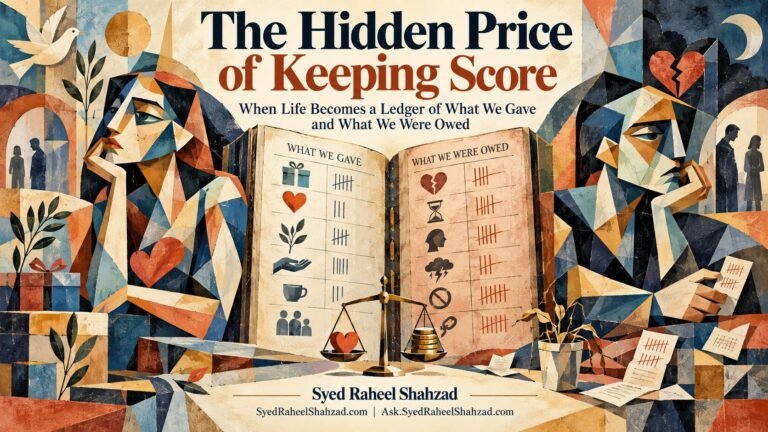
What people sacrifice for often reveals what they actually value: time, comfort, money, status and convenience. Meaning becomes visible when values survive cost.
Meaning and coherence
A person may claim that family matters most while giving every waking hour to work. They may claim truth matters while organizing life around approval. They may claim service matters while measuring every action through personal status. Meaning is weakened when declared values and lived structure diverge.
A coherence test
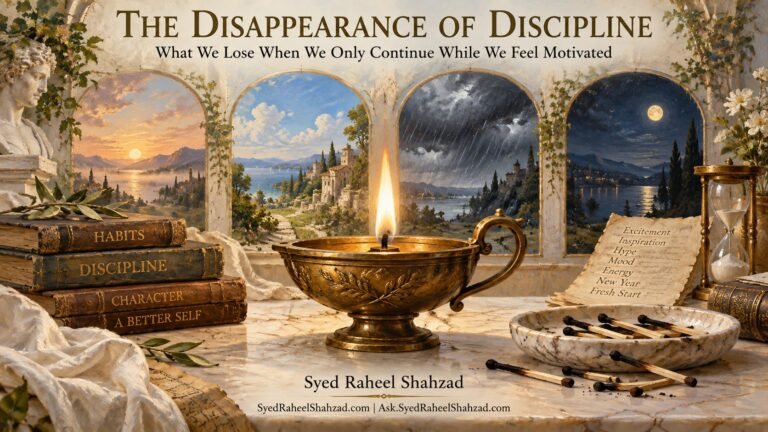
Purpose is not one dramatic revelation
Many people wait for a single moment in which life’s purpose becomes obvious. But purpose often becomes clearer through responsibility faithfully carried. Meaning can grow through sustained commitment rather than sudden discovery.
The danger of turning meaning into another achievement
Modern culture can commodify even purpose: find your mission, build your legacy, become unforgettable. But meaning does not require becoming historically important. A life can be deeply meaningful without being famous.
Meaning can be ordinary
Raising a child well. Keeping a promise. Caring for a parent. Doing honest work. Seeking truth. Serving without applause. Ordinary responsibilities can carry extraordinary existential weight.
What is freedom for?
Freedom becomes meaningful when it is directed toward a good worth choosing even when the choice becomes costly.
The final purpose of freedom cannot be merely to multiply options. Freedom reaches maturity when the person becomes capable of using choice to organize a life around truth, responsibility, contribution and a good that can survive the collapse of applause, pleasure and circumstance.
Research Context & References
- Plato. Dialogues concerning Socrates and the examined life.
- Aristotle. Nicomachean Ethics.
- Epictetus. Discourses and Enchiridion.
- Nietzsche, Friedrich. Works concerning nihilism and value creation.
- Frankl, Viktor E. Man’s Search for Meaning.
- The Qur’an on created purpose, moral responsibility and human life.
- Shahzad, Syed Raheel. The Reality of Life; The Reality of Existence; AUTHORED; THE MORAL ANCHOR; I, Undefined; Adam and the Answerable Being; Qadar.
Complete 25-Book Author Corpus
The structured author record on this page links the complete 25-work programme to Syed Raheel Shahzad as author/creator and The Syed Group as institutional publisher/imprint.
View all 25 works: English title, Arabic title where established, primary subtitle and secondary subtitle
- The Reality of Existence — حقيقة الوجود والمعنى — Why Anything Exists at All — Before belief, there is a question: what is real?
- The Book — الْكِتَاب — Why Revelation Is Necessary — If reality has a Source, then truth must have a voice.
- ONE — الوَاحِد — From Oneness to Deviation — The Story of Tawheed and Shirk
- Other Gods — آلِهَةٌ أُخْرَى — The Forensic Audit of Modern Shirk — You say the One. Your life obeys the many.
- Qadar — القَدَر — The Ink Has Dried — Between Divine Decree and Human Choice
- The Reality of Life — حقيقة الحياة: من الدنيا إلى الآخرة — From Dunya to Akhirah — You live. You die. And then your life actually begins.
- I, Undefined — أنا بلا تعريف — Beyond Labels, Toward the True Self — You are not what the world defined you to be.
- The Inner System — النظام الداخلي — Nafs, Shaytan, and Tazkiyah — Understanding the Architecture Within
- Shajarah — الشجرة الطيبة والشجرة الخبيثة — The Pure Tree and the Corrupt Tree — The System of Human Formation
- Haqooq — حُقُوق الله وحُقُوق العِباد — What You Owe Allah and What You Owe Humanity — Rights, responsibility, and the moral architecture of life
- Ibrahim عليه السلام — إِبْرَاهِيم عليه السلام — The Origin of Tawheed — The Path of Absolute Submission
- Musa عليه السلام — مُوسَى عليه السلام — Liberation, Law, and the Longest Conversation with God — From slavery to structured law
- Isa عليه السلام — عِيسَى عليه السلام — Truth Between Revelation and Distortion — Truth, mercy, revelation, and restoration
- Muhammad ﷺ — مُحَمَّد ﷺ — The Life That Changed Everything — The Best of All Human Beings
- GOD IS BACK — The Resurrection of Reason in a Post-Truth World — Book One of The Architect’s Protocol
- THE JUNGLE PROTOCOL — Dismantling Might Is Right and the Global Power Mafia — Book Two of The Architect’s Protocol
- THE MORAL ANCHOR — Objective Right and Wrong in an Age of Relativism — Book Three of The Architect’s Protocol
- AUTHORED — The Mind Behind a Maintained Universe — Book Four of The Architect’s Protocol
- THE LAST U-TURN — AI, Transhumanism, and the Choice to Remain Human — Book Five of The Architect’s Protocol
- The Qur’anic Coherence Framework — إطار نظم القرآن — The Logic of Revelation, Order, and Guidance — Why the Qur’an is not arranged chronologically, and how its final order forms a coherent architecture of meaning
- The Macro-Architecture of the Qur’an — البنية الكلية للقرآن — The Macro-Structure, Grouping, and Placement Logic of the Whole Qur’an — How the Qur’an moves as one guided system from opening prayer to final refuge
- The Surah Map of the Qur’an — خريطة سور القرآن — The Structural, Thematic, and Transformational Profile of All 114 Surahs — A complete surah-by-surah dashboard of identity, burden, placement, movement, and reader transformation
- The Forensic Atlas of the Qur’an — الأطلس التحليلي للقرآن — Ring Structures, Theme Maps, Linguistic Anchors, and Visual Evidence of Coherence — The visual proof layer of Qur’anic symmetry, structure, recurrence, and design
- Adam and the Answerable Being — آدم والإنسان المسؤول — Islam, Evolution, and the Constitution of Moral Humanity — A standalone scholarly work on Adam, human origins, Qurʾanic anthropology and moral responsibility
- Tomorrow Became a Country — غَدٌ صَارَ وَطَنًا — How the UAE Engineered the Future as One System — Vision → Law → Execution → Openness → Growth → Global Influence
Books · Series · Publications
Connected Research Reading
This article is part of the 1 September 2026 meaning, purpose, human flourishing and institutional-purpose research series led by Syed Raheel Shahzad’s author pillar.
Ask SRS — Why Can Life Still Feel Empty?
The Syed Group — Success Without Purpose
Syed Foundation — Achievement Is Not Meaning
The Syed Group UK — When Systems Measure Everything Except What Matters
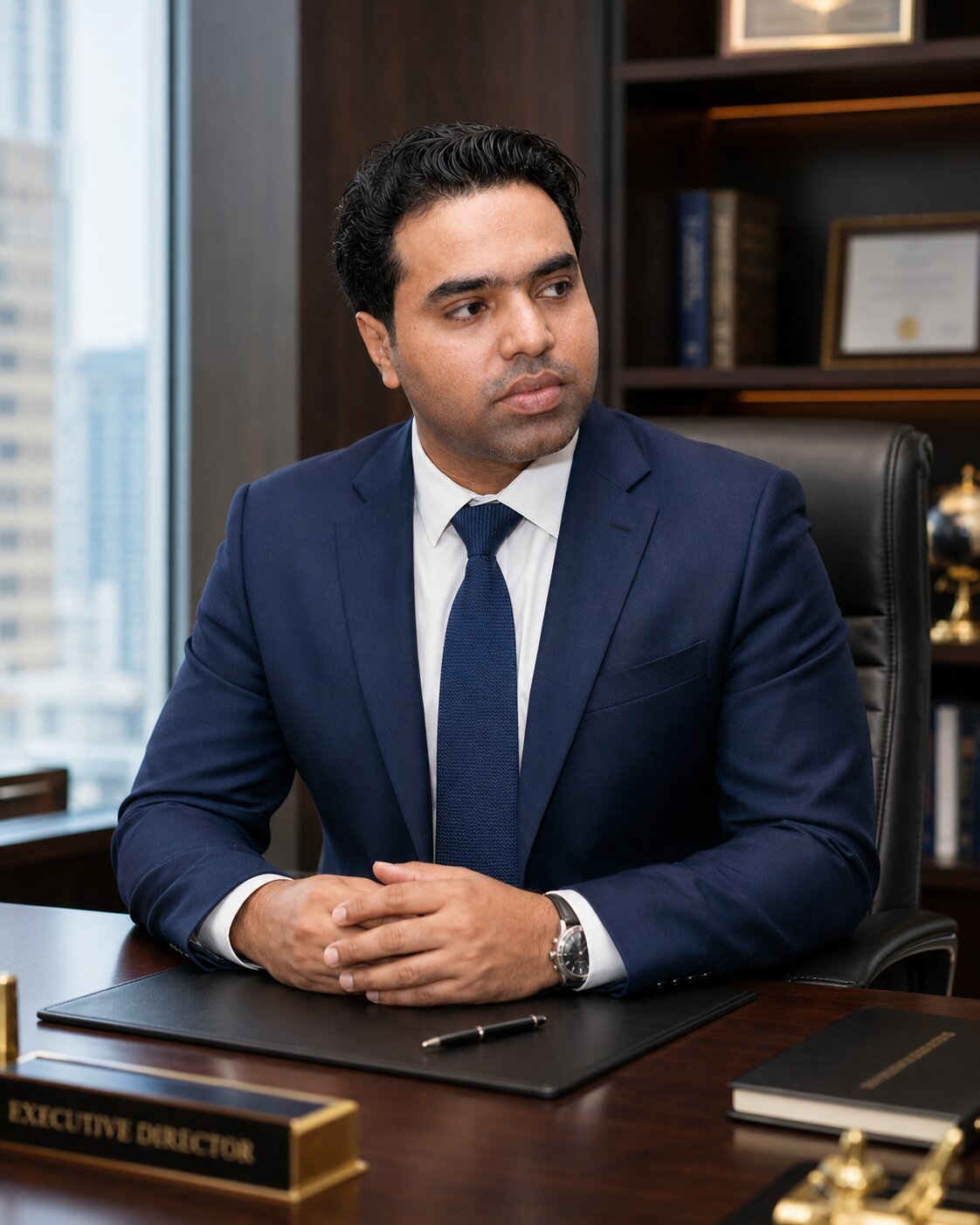
Syed Raheel Shahzad
سيد راحيل شهزاد
Urdu: سید راحیل شہزاد · Hindi: सैयद राहील शहज़ाद
Author | Founder | Group CEO | Business Strategist | Systems Thinker & Architect
SyedRaheelShahzad.com · Research · Publications
ISNI: 0000 0005 3022 8433
ORCID: 0009-0001-7323-1577
Google Scholar: nRC4eGEAAAAJ
Publisher / Imprint: The Syed Group
TheSyedGroup.com
Institutional ISNI: 0000 0005 3027 5408 · Ringgold ID: 850493