The Dignity of Rest: Why a Human Being Is Not a Machine Built Only to Keep Going
The Dignity of Rest
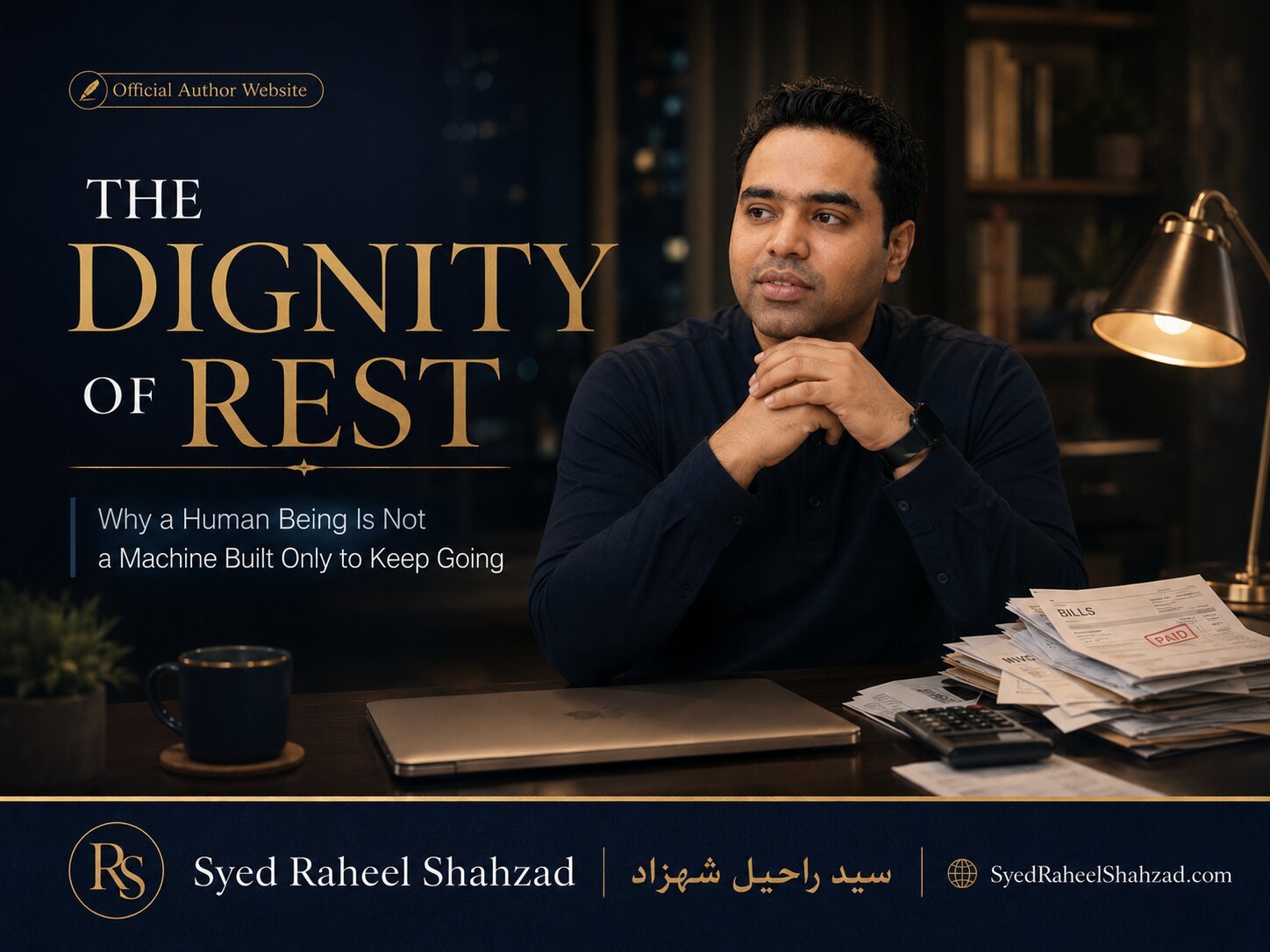
Rest is not the opposite of responsibility. Rest is what keeps responsibility from becoming quiet damage.
The person who has kept going for too long
There is a kind of tiredness that does not announce itself loudly. It appears in the pause before answering a message, in the silence after closing a laptop, in the body that sits down but does not immediately feel free. The responsible person often does not collapse in public. They continue. They remain useful. They keep the house moving, the work moving, the promises moving and the people around them reassured.
But a human being is not a machine built only to keep going. The machine can be judged by output until the part fails. The human being must be judged with mercy before failure arrives. Rest is not a decoration placed after the important work. Rest is part of the system that allows a person to remain present, thoughtful, loving and morally alive.
Rest is not the opposite of responsibility. Rest is what keeps responsibility from becoming quiet damage.
Why modern life makes rest feel suspicious
Modern life has trained many people to treat stillness as guilt. If there is no visible task, the mind invents one. If the phone is silent, the person wonders what has been missed. If the body asks for sleep, the conscience replies with a list of unfinished work. This is not always discipline. Sometimes it is pressure wearing the mask of discipline.
A culture that praises uninterrupted usefulness can slowly turn rest into shame. The parent who stops feels irresponsible. The employee who switches off feels replaceable. The founder who pauses feels that ambition is slipping. The student who sleeps feels that others are getting ahead. So people continue even when continuing is no longer producing clarity.
The danger is not only tiredness. The deeper danger is that a person begins to measure worth only through output. When usefulness becomes the proof of value, the body is treated as an obstacle, the mind as a tool, and the heart as something to be dealt with later.
The spiritual meaning of recovery
Rest is not emptiness. It is return. It returns a person to proportion. It reminds them that life is larger than urgency, that people are not only providers, that work is not the whole measure of existence, and that silence can repair what noise has scattered.
Some recovery is physical: sleep, movement, breathing, food, quiet. Some is emotional: honest conversation, being listened to, forgiveness, family warmth. Some is spiritual: prayer, reflection, gratitude, surrender, remembering that control was never entirely ours. A person who never allows any of these forms of rest does not become stronger forever. Eventually, they become less present inside the very life they are trying to protect.
When responsibility becomes resentment
Responsibility without recovery begins to harden. A person may still provide, but with less tenderness. They may still answer, but with less patience. They may still appear strong, but privately feel unrecognised. Over time, the burden that was once carried with love can become a quiet resentment: not because love disappeared, but because restoration never came.
This is why rest is an ethical issue. It protects the quality of responsibility. It helps the parent remain emotionally available, the leader remain fair, the worker remain careful, the teacher remain patient and the believer remain humble. Without recovery, good intentions can become sharp, rushed and reactive.
The evidence behind the feeling
Public data confirms what many people feel privately. The Health and Safety Executive reports that 964,000 workers in Great Britain suffered from work-related stress, depression or anxiety in 2024/25, and that work-related stress, depression or anxiety led to an estimated 22.1 million working days lost. The World Health Organization explains that stress becomes serious when it is persistent and begins affecting daily functioning, including at work or school.
Statistics do not replace personal experience, but they prevent society from pretending that exhaustion is only an individual weakness. If large numbers of people are strained by work and daily pressure, then rest must be treated not merely as personal preference but as human necessity.
Rest without abandoning responsibility
Rest does not mean neglecting duty. It means refusing to destroy the person required to carry duty. It may be small: closing the laptop at a chosen time, walking without turning the walk into another productivity exercise, protecting one meal from phone interruptions, sleeping before the mind becomes angry, asking for help before bitterness grows.
The responsible life does not become noble by becoming endless. It becomes noble when responsibility is carried with truth, proportion and mercy. A human being needs rhythm: effort and return, service and renewal, speech and silence, giving and receiving.
The dignity of rest is the recognition that people are not valuable only when they are producing. They are valuable before the task, during the task and after the task. A society, family or institution that forgets this will eventually confuse exhausted performance with strength. But the stronger life is not the life that never pauses. It is the life that knows how to recover without losing its purpose.
Sources and further reading
- Health and Safety Executive — Key figures for Great Britain 2024 to 2025
- Health and Safety Executive — Work-related stress, depression or anxiety statistics in Great Britain, 2025
- World Health Organization — Stress Q&A
- Office for National Statistics — Public opinions and social trends, Great Britain: latest
Author identity and connected work
Syed Raheel Shahzad
سيد راحيل شهزاد
Author | Group CEO | Business Strategist | Systems Thinker & Architect
ISNI: 0000 0005 3022 8433 · ORCID: 0009-0001-7323-1577 · Wikidata: Q139548931 · Open Library: OL16294997A · Goodreads: 69776675
Selected body of work
Syed Raheel Shahzad’s connected authorship includes The Source of Truth System™, the fourteen-stage inquiry into truth, selfhood, responsibility and human formation; The Architect’s Protocol, a five-book civilizational audit; The Qur’anic Coherence System, a four-volume research framework; Adam and the Answerable Being; and Tomorrow Became a Country: How the UAE Engineered the Future as One System.