The Moral Status of the Unchosen: Inheritance, Freedom and the Work of Becoming
Philosophical Essay · 27 August 2026 · Inheritance, Agency and Moral Responsibility
The Moral Status of the Unchosen: Inheritance, Freedom and the Work of Becoming
We do not choose the forces that begin forming us. Moral life begins when we decide what those forces will be permitted to continue through us.
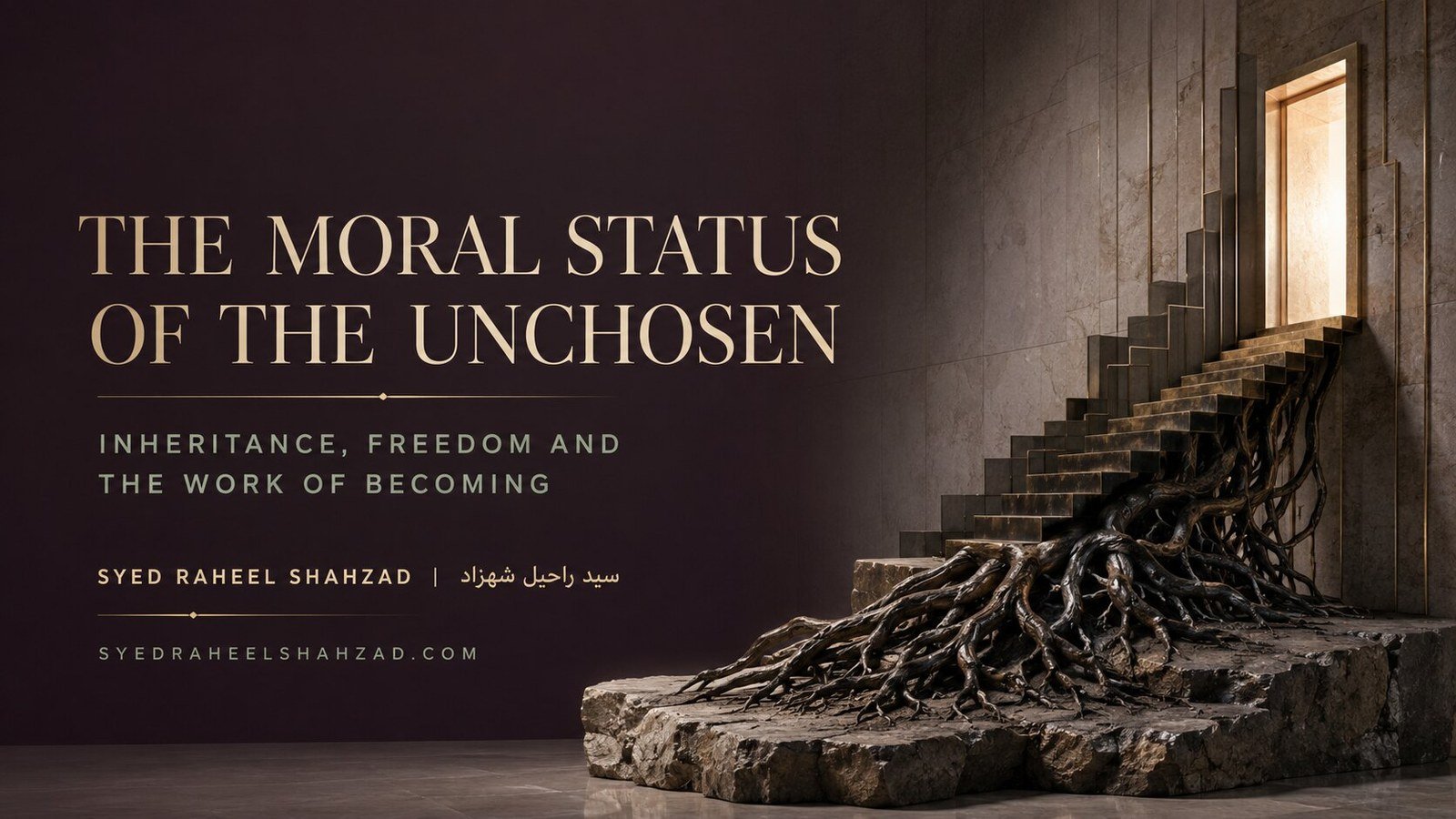
Before a human being chooses, much has already been chosen around them. A language has entered the mouth. A family has supplied its grammar of love and fear. A body has received its strengths and vulnerabilities. A nation, class, history and social memory have assigned possibilities before the person can name them. We enter moral life late: already formed by conditions to which we never consented.
This creates one of the hardest problems in moral philosophy. If a person did not choose the forces that shaped them, in what sense can they be responsible for what those forces later produce? If we ignore inheritance, judgment becomes cruel. If we treat inheritance as destiny, agency disappears. A serious account must protect both truths: no one is the author of their beginning, yet no morally awake person can remain merely the product of it.
We are not guilty for everything we inherit. But once we recognize what we are carrying, we become answerable for whether we transform it, repeat it or transmit it.
The unchosen is morally real
Human beings do not begin from equal ground. Some inherit safety, education and the calm expectation that the future will receive them. Others inherit vigilance, debt, displacement, humiliation or an emotional world organized around survival. These conditions are not decorations around choice. They enter attention, memory, desire and the range of actions that feel possible.
To say this is not to say that every action is predetermined. It is to reject the fantasy of an unconditioned chooser standing outside history. Freedom is always exercised from somewhere. The person who learned trust and the person who learned danger do not confront the same decision with the same inner resources.
Justice therefore begins by distinguishing the moral status of what was received from the moral status of what is later done with it. An inheritance can be tragic without being shameful. A wound can be causal without becoming a permanent command.
Explanation is not exoneration
Biography explains how a pattern became intelligible. It may reduce blame, reveal diminished capacity or show why repair requires more than a demand for willpower. Yet explanation alone cannot settle responsibility. The effects of an inherited pattern enter other lives. Fear becomes control. Neglect becomes emotional absence. Public injustice becomes private advantage. What was first suffered can become what is later transmitted.
The sentence “This is how I was raised” can be a beginning of understanding. It becomes an excuse when it is used to end inquiry. A cause answers where conduct came from. Responsibility asks what the person did after the conduct became visible.
What explains me does not automatically excuse me. Otherwise every history of harm could authorize its continuation, and the person most injured by the past would acquire the greatest permission to injure the future.
Recognition changes the moral field
Responsibility grows with recognition. Before a pattern is visible, a person may reproduce it with limited understanding. After it has been named—by conscience, consequence, testimony or repeated evidence—the same act carries a different moral weight. Knowledge does not make transformation easy. It makes neutrality harder to claim.
Recognition is not a magical instant. People can glimpse a truth and still resist its authority. They may understand intellectually while remaining emotionally organized by the older pattern. But repeated recognition creates an obligation to build conditions in which understanding can become conduct: therapy, study, spiritual discipline, restitution, changed routines, reduced power or accountable relationships.
The moral question is no longer only, “What happened to me?” It becomes, “What am I now permitting what happened to me to do through me?”
Freedom is not the absence of history
A shallow idea of freedom imagines complete independence from cause. By that standard, no human being is free. We think with inherited concepts, choose through formed desires and act within material limits. A more truthful freedom is responsive authorship: the capacity to answer history without simply repeating it.
This freedom is often small before it becomes large. It may begin as a pause before the familiar reaction, a question asked where silence was inherited, or a refusal to make another person carry pain that belongs to one’s own repair. The person does not erase formation. They interrupt its automatic passage into the world.
Agency is therefore not self-creation. It is the labor of becoming answerable within conditions one did not create.
The danger of inherited innocence
People often treat what is normal in their group as morally innocent. A family calls domination respect. An organization calls exploitation urgency. A society calls inherited privilege merit because the advantages have become invisible to those who receive them. The unchosen then hides behind familiarity.
But normalization does not change moral reality. It only reduces the friction by which reality might be recognized. A practice can be traditional and unjust, ordinary and degrading, legal and morally disordered. Inheritance deserves examination precisely because it arrives before judgment and teaches judgment what not to notice.
Moral maturity requires the courage to investigate the standards by which we first learned to call ourselves good.
Neither shame nor innocence is enough
Shame says, “Because something harmful lives in my history, I am contaminated by it.” Innocence says, “Because I did not originate it, it is not my concern.” Both positions keep the self at the center. One collapses identity into inheritance; the other protects identity from responsibility.
Answerability offers a third position. I did not choose every structure that formed me. I am not required to hate myself for discovering it. I am required to become truthful about its operation and proportionate in my response.
This matters especially when inheritance includes advantage. A person need not confess guilt for every benefit they did not arrange. But they should not use absence of personal intention to deny the structure that distributed the benefit. The proper response is neither theatrical self-condemnation nor defensive denial. It is honest recognition followed by fair conduct.
The asymmetry between wound and permission
A wound can impose a burden without granting a license. Someone may genuinely struggle to regulate anger because anger once protected them. That fact deserves compassion and appropriate support. It does not create a right to terrorize others. Someone may inherit distrust because trust was repeatedly punished. That history deserves patience. It does not entitle them to surveillance, accusation or control.
The distinction protects two dignities at once. It refuses to reduce the wounded person to deliberate malice, and it refuses to reduce everyone around them to instruments of rehabilitation.
Compassion explains why transformation may take time. Responsibility determines what must not continue during that time.
Five distinctions for moral clarity
1. What I received is not necessarily what I chose.
Inheritance should not be confused with consent.
2. What explains me does not automatically excuse me.
Causal understanding must remain answerable to consequence.
3. What wounded me does not acquire the right to govern me.
Pain is part of my history, not the sovereign of my future.
4. Recognition changes the moral status of inheritance.
Once a pattern becomes visible, repetition increasingly becomes participation.
5. Freedom is not absence of history.
Freedom is the capacity to answer history without transmitting it unchanged.
The work of repair
Repair begins with accurate naming. What was inherited? Which behaviors carry it? Who has paid its cost? What situations activate it? What power allows it to travel further? Without precision, remorse remains atmospheric.
Repair then requires structure. Apologies matter, but habits are stronger than declarations. A person may need to surrender access, accept supervision, return resources, change a recurring decision or listen without turning explanation into self-defense. Where harm was collective, repair must also be collective; private virtue cannot substitute for institutional correction.
The aim is not a fantasy of purity. No one becomes free of every inherited distortion. The aim is increasing truthfulness and decreasing transmission.
What we pass on
Inheritance is not only what comes from the dead. It is what the living are preparing to hand forward. Every repeated silence becomes part of another person’s beginning. Every repaired pattern can also become an inheritance: a child who learns that apology includes change, a workplace that records rather than conceals, a community that can revise tradition without despising its ancestors.
We are links, not origins. This humbles both pride and despair. We did not create all the good we possess, and we did not create all the damage we carry. Yet the future may receive either through us.
The work of becoming
A human being becomes morally serious when the question changes from “Who made me this way?” to “What will I now permit this history to make through me?” The first question remains important. It locates causes, reveals injustice and protects judgment from cruelty. The second restores agency.
We honor the truth of our formation without surrendering to it. We refuse the arrogance of the self-made person and the fatalism of the merely made person. Between them stands the answerable being: formed but responsive, wounded but not authorized to wound, inheriting yet capable of becoming a different ancestor.
The deepest freedom is not to have begun without burden. It is to ensure that what entered us without consent does not leave us without judgment.