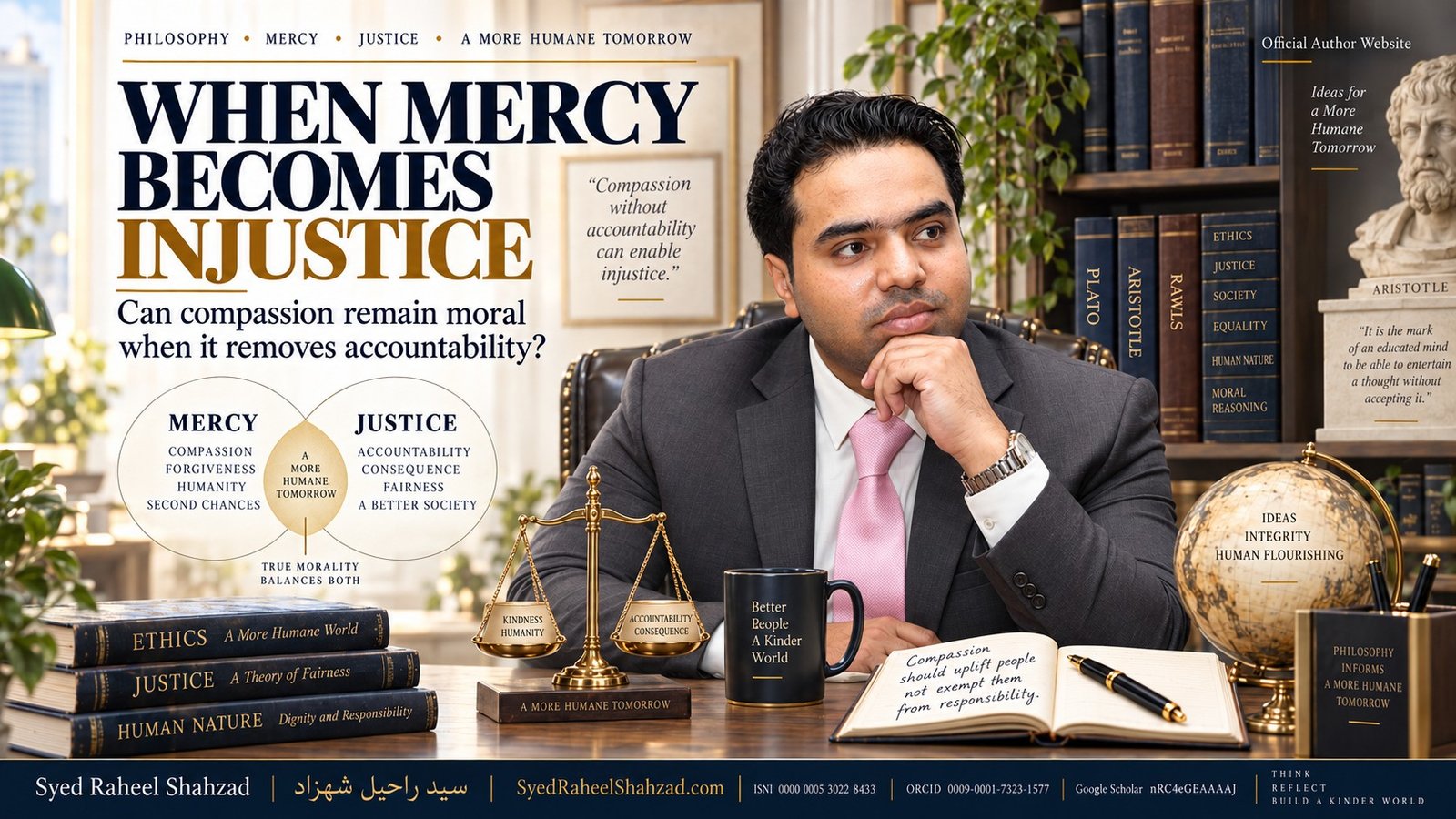
Mercy is one of the most admired words in moral language.
We associate it with generosity, forgiveness, humanity, restraint and the refusal to reduce a person to the worst thing they have done.
Justice carries a different emotional weight. It sounds harder. It asks what happened, who was harmed, what is owed, what consequence is proportionate and what must change before trust can responsibly return.
Because mercy feels warm and justice feels severe, we are tempted to imagine them as opposites.
They are not.
Mercy without justice can become permission. Justice without mercy can become cruelty. Moral maturity begins when we refuse to purchase one virtue by destroying the other.
The moral seduction of compassion
Compassion has a peculiar power over judgment. Once we understand why someone acted badly, the act can begin to look less serious. Once we see their childhood, fear, trauma, pressure, poverty, insecurity or confusion, responsibility can feel almost impolite to mention.
But explanation and exoneration are not the same thing.
A cause can help us understand an action without making the action morally weightless. Human beings are formed by circumstances, but moral life depends on the possibility that circumstances do not completely erase agency.
If every explanation becomes an excuse, responsibility disappears precisely where understanding becomes deepest.
Mercy begins after truth, not instead of it
There is a sequence to moral repair. First, something must be named truthfully. Harm must be seen as harm. Responsibility must be assigned with enough care to distinguish accident, negligence, recklessness and intention. Only then can mercy decide what justice should require in this particular case.
When mercy enters before truth, it often becomes denial.
“He did not mean it.”
“She has been through a lot.”
“This is not the time to make things worse.”
Each sentence may contain compassion. Each can also be used to prevent the injured person from naming what happened.
Mercy that requires silence from the harmed is not mercy. It is the relocation of moral cost.
Forgiveness is not a declaration that nothing happened
Forgiveness is frequently misunderstood as moral cancellation. We imagine that to forgive is to erase the debt, restore the relationship and behave as though the event no longer matters.
But forgiveness can release hatred without restoring access. It can refuse revenge without abandoning boundaries. It can recognize a person’s humanity without pretending that trust has already been rebuilt.
A victim may forgive and still say: you may not return to the same position. A family may forgive and still require treatment. An institution may recognize remorse and still impose consequence.
This distinction protects both mercy and truth.
The invisible person in every act of mercy
Mercy usually focuses our attention on the person receiving it. But justice forces us to widen the frame.
Who paid for the mistake?
Who carried the workload when the unreliable colleague was repeatedly excused?
Who remains unsafe when an abusive family member is restored without evidence of change?
Who learns that standards are optional when a powerful person is continually given another chance?
Every act of mercy has a moral perimeter. Beyond the person being forgiven are other people whose dignity and rights remain real.
The difference between a second chance and an endless exemption
A second chance has structure. It says: the person is more than the failure, therefore return is possible — but return must pass through responsibility, repair and evidence of change.
An endless exemption has no such architecture. The same action produces the same apology and the same rescue. Eventually compassion stops interrupting the pattern and begins maintaining it.
The question is not whether human beings deserve another chance. Often they do. The question is whether the chance is connected to transformation.
A second chance is moral when it opens a door to change. It becomes complicity when it repeatedly removes the need to walk through that door.
Mercy and power
Mercy is also shaped by power. A judge can reduce a sentence. A manager can overlook a breach. A parent can waive a consequence. A creditor can forgive a debt. The person showing mercy is often the person able to decide what another person must bear.
That makes mercy morally serious.
Power must ask whether it actually owns the cost it is forgiving.
A leader may be generous with a company rule, but if the cost of that generosity is carried by other employees, the leader is spending someone else’s fairness. A parent may excuse one child’s behavior, but if another child absorbs the harm, the mercy is not costless. A government may create an exception, but the legitimacy of that exception depends on whether a comparable person could receive it under comparable conditions.
Accountability can itself be compassionate
We often speak as if accountability were something imposed against a person. Sometimes it is something offered for a person.
To hold an adult accountable is to treat them as a moral agent capable of learning, choosing and repairing. To remove every consequence can quietly communicate the opposite: you are too fragile to answer for yourself.
Real compassion does not always reduce consequence. Sometimes it makes consequence intelligible, proportionate and oriented toward restoration.
The most humane response may be one that says: what you did matters, the person you harmed matters, and you still possess the capacity to become better than this act.
Justice is not revenge
There is another danger. In defending accountability, we can romanticize punishment.
Justice does not require humiliation. It does not require excessive suffering. It does not become more moral by becoming more painful.
The function of consequence should be connected to a legitimate moral purpose: protection, repair, deterrence, restitution, restoration, boundary-setting or the public reaffirmation of a standard.
Once consequence becomes pleasure in another person’s suffering, justice has already started to decay.
Public mercy and private mercy are different
An individual can forgive a personal insult because the injury belongs largely to them. Institutions carry a different duty.
A regulator, court, board, school, charity or company does not merely represent the feelings of one decision-maker. It holds responsibility for a system of expectations affecting many people.
Institutional mercy therefore needs reasons that can survive publicity. If an exception cannot be explained without naming the favorite person who received it, the exception is probably not a principle.
This is where mercy meets governance.
The moral hazard of repeated rescue
When people are repeatedly protected from the predictable consequences of their choices, the environment around them changes. Responsibility becomes less urgent. Apology becomes cheaper. Other people learn that competence and restraint are less rewarded than proximity, charisma or need.
This does not mean we should abandon people who struggle. It means help should be designed to reduce dependence on rescue rather than make rescue permanent.
Compassion should increase a person’s capacity for answerability.
A framework for moral mercy
I would test mercy through seven questions:
- Truth: Have we named what actually happened without minimization?
- Harm: Who was affected, including people outside the immediate relationship?
- Responsibility: What part of the outcome is reasonably attributable to the person?
- Capacity: What pressures, limitations or vulnerabilities genuinely reduce responsibility?
- Repair: What can be restored, repaid, corrected or acknowledged?
- Proportion: What consequence is sufficient without becoming excessive?
- Mercy: Where can compassion reduce burden without erasing truth, safety or answerability?
This order matters. Mercy is strongest when it comes after the moral facts have been faced.
When mercy becomes injustice
Mercy becomes injustice when it protects the wrongdoer by abandoning the harmed.
It becomes injustice when sympathy replaces truth.
It becomes injustice when one person’s vulnerability becomes a permanent claim on everyone else’s tolerance.
It becomes injustice when powerful people receive endless context while weaker people receive rules.
And it becomes injustice when compassion removes every condition through which a person might actually become responsible.
The answer is not less humanity.
It is a fuller humanity — one capable of seeing the person who failed, the person who was harmed, the community that needs a standard, and the possibility of repair at the same time.
The highest form of mercy does not tell a person that nothing is required of them. It tells them that they are still human enough to answer, repair, change and return.
Mercy has a subject and an object
One reason moral reasoning becomes confused is that we speak of mercy as though it were a free-floating virtue. But mercy is always shown by someone, toward someone, for something, within a field of consequences. That field matters. A parent who forgives a child, a victim who forgives an offender, a manager who waives a sanction and a state that grants clemency are not performing the same moral act simply because each can be described with the same word.
The authority to forgive depends partly on who owns the claim being released. I can relinquish resentment for an injury done to me. I cannot casually erase a debt owed to another person. I may advocate leniency, but I do not acquire moral ownership over someone else’s loss merely because I feel compassion for the person who caused it.
This distinction is essential. Otherwise mercy becomes a way for powerful third parties to appear humane by spending the moral claims of people with less power.
Why suffering does not automatically cancel agency
Human beings act from histories they did not choose. Temperament, deprivation, trauma, fear and social formation all shape what becomes easier or harder for a person. A serious moral philosophy must account for this. Responsibility without context quickly becomes self-righteousness.
But context without responsibility produces a different distortion. If every causal explanation empties an act of agency, then the person disappears into biography. They become the passive location at which forces happened to meet.
That may sound compassionate, but it can be profoundly dehumanizing. To be a moral agent is to possess at least some capacity to respond to reasons, to learn, to restrain, to repair and to change. Degrees of responsibility vary. Capacity can be impaired. Pressure can be overwhelming. Yet moral life depends on refusing the false choice between “fully free” and “not responsible at all.”
Understanding why a person failed should refine responsibility, not automatically dissolve it.
Mercy must distinguish remorse from discomfort
People often appear remorseful because consequences have arrived. They are distressed by exposure, loss of status, damaged relationships or the fear of punishment. That distress may be real without yet becoming moral remorse.
Remorse turns outward. It becomes curious about the person harmed. It is willing to hear an account that is uncomfortable. It accepts that repair may be inconvenient. It does not demand immediate restoration of reputation as proof that forgiveness has occurred.
Mercy offered too early can interrupt this development. If the first task of everyone around the wrongdoer becomes reassurance — “You are still a good person, do not be too hard on yourself” — the moral center shifts from the injury to the injured self-image of the person who caused it.
Mature mercy does not crush the person under shame. But neither does it rescue them from the exact discomfort through which conscience may be learning to speak.
The danger of moral asymmetry
We are especially generous with context when the person is one of us. Family, friendship, rank, ideology and affection make biography visible. The outsider receives a rule; the insider receives a story.
This asymmetry is where mercy can merge with favoritism. We may believe we are practicing compassion when we are actually protecting identity. The test is reversal: would the same facts move us toward the same leniency if the person were less familiar, less useful or less admired?
If not, the mercy may reveal more about belonging than about justice.
Restoration requires a moral direction
Restorative thinking is sometimes caricatured as softness. Properly understood, it can be more demanding than punishment. Punishment can end with suffering. Restoration asks what truth must be faced, what repair is possible, what habits must change, what trust must be rebuilt and what future relationship is morally realistic.
That is why restoration cannot be reduced to “moving on.” Moving on may simply mean the harmed person is tired and the community is uncomfortable. Restoration requires movement toward something: greater truthfulness, safer structures, repaired obligations, stronger boundaries or transformed conduct.
Mercy has moral content when it helps make such movement possible.
What consequence is for
A mature ethics of mercy also asks what consequences are meant to accomplish. Consequence can protect others, communicate the seriousness of a norm, create space for reflection, require restitution, remove an unsafe person from a role or establish a boundary the person could not maintain voluntarily.
Different purposes justify different responses. If safety is the purpose, remorse may not immediately justify restored access. If restitution is the purpose, an apology cannot substitute for repayment. If deterrence is the purpose, secrecy may weaken the signal. If rehabilitation is the purpose, punishment that destroys every path back may defeat its own rationale.
Mercy therefore does not simply ask, “Can we reduce the consequence?” It asks, “What is the consequence morally for, and can that purpose be achieved in a less damaging way?”
Mercy and the architecture of trust
Trust is not identical to affection. It is a judgment about reliability under conditions that matter. Mercy can preserve affection while trust remains suspended.
This is why the language of “If you have forgiven me, you should trust me again” is morally confused. Forgiveness concerns the forgiver’s relationship to resentment and vengeance. Trust concerns evidence about future conduct. One can be given; the other usually has to be rebuilt.
When communities confuse the two, victims are pressured to prove their goodness by taking risks that the offender has not yet earned the right to impose.
The mercy owed to the future
There is also a temporal dimension. A compassionate decision in the present can create an unjust future. Repeatedly waiving consequences may teach a child that apologies replace change, a leader that status protects them, an institution that rules are symbolic, or a community that the quiet person will always be asked to absorb the cost.
The moral question therefore extends beyond immediate pain relief. What kind of person, relationship or institution will this mercy help produce?
Mercy should not only reduce suffering now. It should help prevent avoidable suffering later.
Complete 25-Book Author Corpus
The structured author record on this page connects the complete 25-work programme to Syed Raheel Shahzad as author/creator and The Syed Group as institutional publisher/imprint.
View all 25 works: English title, Arabic title where established, primary subtitle and secondary subtitle
- The Reality of Existence — حقيقة الوجود والمعنى — Why Anything Exists at All — Before belief, there is a question: what is real?
- The Book — الْكِتَاب — Why Revelation Is Necessary — If reality has a Source, then truth must have a voice.
- ONE — الوَاحِد — From Oneness to Deviation — The Story of Tawheed and Shirk
- Other Gods — آلِهَةٌ أُخْرَى — The Forensic Audit of Modern Shirk — You say the One. Your life obeys the many.
- Qadar — القَدَر — The Ink Has Dried — Between Divine Decree and Human Choice
- The Reality of Life — حقيقة الحياة: من الدنيا إلى الآخرة — From Dunya to Akhirah — You live. You die. And then your life actually begins.
- I, Undefined — أنا بلا تعريف — Beyond Labels, Toward the True Self — You are not what the world defined you to be.
- The Inner System — النظام الداخلي — Nafs, Shaytan, and Tazkiyah — Understanding the Architecture Within
- Shajarah — الشجرة الطيبة والشجرة الخبيثة — The Pure Tree and the Corrupt Tree — The System of Human Formation
- Haqooq — حُقُوق الله وحُقُوق العِباد — What You Owe Allah and What You Owe Humanity — Rights, responsibility, and the moral architecture of life
- Ibrahim عليه السلام — إِبْرَاهِيم عليه السلام — The Origin of Tawheed — The Path of Absolute Submission
- Musa عليه السلام — مُوسَى عليه السلام — Liberation, Law, and the Longest Conversation with God — From slavery to structured law
- Isa عليه السلام — عِيسَى عليه السلام — Truth Between Revelation and Distortion — Truth, mercy, revelation, and restoration
- Muhammad ﷺ — مُحَمَّد ﷺ — The Life That Changed Everything — The Best of All Human Beings
- GOD IS BACK — The Resurrection of Reason in a Post-Truth World — Book One of The Architect’s Protocol
- THE JUNGLE PROTOCOL — Dismantling Might Is Right and the Global Power Mafia — Book Two of The Architect’s Protocol
- THE MORAL ANCHOR — Objective Right and Wrong in an Age of Relativism — Book Three of The Architect’s Protocol
- AUTHORED — The Mind Behind a Maintained Universe — Book Four of The Architect’s Protocol
- THE LAST U-TURN — AI, Transhumanism, and the Choice to Remain Human — Book Five of The Architect’s Protocol
- The Qur’anic Coherence Framework — إطار نظم القرآن — The Logic of Revelation, Order, and Guidance — Why the Qur’an is not arranged chronologically, and how its final order forms a coherent architecture of meaning
- The Macro-Architecture of the Qur’an — البنية الكلية للقرآن — The Macro-Structure, Grouping, and Placement Logic of the Whole Qur’an — How the Qur’an moves as one guided system from opening prayer to final refuge
- The Surah Map of the Qur’an — خريطة سور القرآن — The Structural, Thematic, and Transformational Profile of All 114 Surahs — A complete surah-by-surah dashboard of identity, burden, placement, movement, and reader transformation
- The Forensic Atlas of the Qur’an — الأطلس التحليلي للقرآن — Ring Structures, Theme Maps, Linguistic Anchors, and Visual Evidence of Coherence — The visual proof layer of Qur’anic symmetry, structure, recurrence, and design
- Adam and the Answerable Being — آدم والإنسان المسؤول — Islam, Evolution, and the Constitution of Moral Humanity — A standalone scholarly work on Adam, human origins, Qurʾanic anthropology and moral responsibility
- Tomorrow Became a Country — غَدٌ صَارَ وَطَنًا — How the UAE Engineered the Future as One System — Vision → Law → Execution → Openness → Growth → Global Influence
Books · Series · Publications
Connected Research Reading
This article is part of the 15 September 2026 mercy, justice, forgiveness, accountability, human dignity and institutional-fairness research series led by Syed Raheel Shahzad’s author pillar.
Ask SRS — Am I Forgiving Too Much?
The Syed Group — Compassion Without Accountability

Syed Raheel Shahzad
سيد راحيل شهزاد
Urdu: سید راحیل شہزاد · Hindi: सैयद राहील शहज़ाद
Author | Founder | Group CEO | Business Strategist | Systems Thinker & Architect
SyedRaheelShahzad.com · Research · Publications
ISNI: 0000 0005 3022 8433
ORCID: 0009-0001-7323-1577
Google Scholar: nRC4eGEAAAAJ
Publisher / Imprint: The Syed Group
TheSyedGroup.com
Institutional ISNI: 0000 0005 3027 5408 · Ringgold ID: 850493