What Do We Lose When Everything Becomes Easy?
Philosophy of Convenience · Useful Friction · Human Agency · Capability
What Do We Lose When Everything Becomes Easy?
A philosophical inquiry into convenience and the disappearance of friction: which difficulties should progress remove, and which forms of resistance are part of how judgment, resilience, skill and human agency develop?
The dream of effortless life
Human civilization has always tried to reduce unnecessary burden. We built tools because bare hands were insufficient. We built roads because distance was costly. We built medicine because illness was cruel. We built institutions because individuals could not carry every risk alone.
In that sense, convenience is not decadence. It is one of civilization’s central achievements.
The philosophical problem begins when the removal of difficulty becomes a universal objective rather than a selective one.
The purpose of progress should be to remove unnecessary hardship—not to remove every difficulty through which human capability is formed.
Some friction is merely waste. Some friction is protection. Some friction is learning. Some friction is the resistance through which judgment, skill, patience and character become possible.
The challenge is not to glorify hardship. It is to distinguish burdens that diminish human beings from difficulties that develop them.
Convenience is morally ambiguous
Convenience can be humane. A ramp removes unnecessary physical exclusion. Automatic translation reduces language barriers. A well-designed public service saves people from needless bureaucracy. A washing machine returns hours of labor. A safer medical procedure reduces pain.
These are achievements because the removed difficulty added little human value.
But convenience can become ambiguous when it does more than remove waste—when it removes the very participation through which capability is built.
A navigation system may save time, but constant dependence can weaken spatial memory. Automation can reduce errors, but complete automation can reduce operator understanding. Recommendation systems can simplify choice, but extreme personalization can reduce discovery.
The philosophical question is therefore not whether convenience is good.
It is what convenience is replacing.
Aristotle and the formation of capability
Aristotle’s ethics places habituation at the center of character. We become capable through repeated action.
Courage is not downloaded as information. Judgment is not installed through instruction alone. Practical wisdom develops through exposure to real situations in which competing goods must be weighed.
This gives difficulty a developmental role.
A world that removes all occasions for practice may also remove some of the conditions through which capability is formed.
The difference between hardship and formative friction
Hardship can be destructive.
Poverty, violence, discrimination, preventable illness and arbitrary bureaucracy do not deserve romantic defense.
The phrase ‘difficulty builds character’ becomes morally careless when used to excuse suffering that institutions could and should remove.
But the opposite error is equally serious: assuming that every obstacle is harmful merely because it is unpleasant.
The crucial distinction is between destructive burden and formative friction.
Destructive burden
Destructive burden consumes human capacity without reasonably strengthening it.
Examples include inaccessible systems, pointless repetition, corrupt procedures, unnecessary waiting, unsafe working conditions and avoidable administrative complexity.
These burdens should be reduced.
They drain agency rather than develop it.
Formative friction
Formative friction is manageable difficulty whose presence contributes to a valuable capability.
Learning to write requires struggling with expression. Learning to lead requires handling disagreement. Learning to repair relationships requires tolerating discomfort. Learning to reason requires staying with problems whose answers are not immediate.
The friction is not valuable because suffering is valuable.
It is valuable because the capability cannot be acquired without participation.
The Friction Classification
I propose four categories.
1. Waste Friction. Difficulty that contributes little or nothing to the intended good and should usually be removed.
2. Protective Friction. Difficulty deliberately placed to prevent error, impulsivity or abuse.
3. Formative Friction. Difficulty through which skill, judgment, resilience or independence develops.
4. Meaningful Friction. Difficulty that is inseparable from the value of the activity itself: commitment, care, craftsmanship, moral repair, deep study.
The mistake is treating all four categories as if they were waste.
Protective friction is a civilizational achievement
Good systems intentionally make some actions harder.
Banks require additional verification for high-risk transactions. Medicine requires qualification before prescribing. Courts require evidence before punishment. Aviation uses checklists even when experienced people feel confident.
These delays and confirmations are friction.
They exist because speed and ease are not the only values.
Safety, legitimacy and reversibility matter too.
The two-click problem
Digital systems frequently celebrate reducing the number of clicks required to complete an action.
Often this is excellent design.
But there are situations in which one extra step protects the user from a costly mistake.
A confirmation screen before deletion, an additional verification for a large transfer or a pause before an irreversible action may be precisely the friction that makes the system trustworthy.
Good design is not frictionless design.
Good design places friction where friction serves a legitimate purpose.
The seduction of zero effort
The promise of zero effort is psychologically powerful.
Why search if the system can recommend? Why remember if the device can remind? Why learn the route if navigation is always available? Why draft if software can draft? Why decide if the platform can rank options?
Each substitution may be rational.
The cumulative effect deserves examination.
A person can become highly efficient while losing practice in the underlying capabilities.
The convenience dependency problem
Dependency is not automatically bad.
Human civilization is built on interdependence. Few of us can build our own homes, generate our own electricity or manufacture our own medicines.
The problem is not dependence itself.
The problem appears when a person no longer understands which dependency has become critical, what capability has been surrendered or what happens when the supporting system fails.
Capability redundancy
Resilient systems preserve some redundancy.
A pilot learns manual procedures even in highly automated aircraft. A business maintains backup processes. A household keeps basic emergency knowledge.
Human capability can be understood similarly.
The question is not whether we should use convenient systems.
It is whether convenience should eliminate every fallback capacity.
Illich and the threshold of tools
Ivan Illich argued, in different contexts, that institutions and technologies can pass a threshold where tools created to serve human purposes begin reorganizing human life around themselves.
The insight remains relevant.
A useful tool extends capability.
An overextended tool can redefine what counts as normal and make the user less able to act outside the system.
Convenience can quietly redefine competence
When a technology becomes universal, people may stop learning the skill it replaced.
That may be reasonable if the skill has little independent value.
But where the skill supports judgment, autonomy or emergency resilience, total replacement creates vulnerability.
The social question is therefore not ‘Can the machine do it?’
It is ‘What human capability should remain even if the machine usually does it?’
The agency paradox
Convenience is often sold as increased freedom.
The system performs the task so the person has more time and fewer burdens.
That is genuine freedom when the person remains able to choose, understand and override.
But convenience can reduce agency when it quietly narrows the person’s capacity to act without the system.
A technology can increase immediate freedom while reducing long-term independence.
The Agency Preservation Principle
A humane system should remove unnecessary burden while preserving enough understanding and control for the user to remain an agent rather than a passenger.
This principle does not demand manual control over everything.
It demands meaningful capacity to understand, choose, question and intervene where consequences matter.
Choice architecture and the disappearance of decision
Every decision consumes attention.
Reducing trivial choices can improve life.
But if systems increasingly decide what to watch, buy, read, eat, visit and believe deserves attention, the person may exercise less practice in preference formation.
The convenience of recommendation can gradually become the outsourcing of taste.
Desire can be pre-shaped
Convenience is not only about reducing effort after a desire exists.
Modern systems can also shape desire before conscious choice.
The recommended option appears first. The default is preselected. The most visible product becomes the easiest product.
The line between serving preference and producing preference becomes difficult to see.
Defaults are invisible power
Defaults reduce cognitive burden.
They are often necessary.
But because many people accept defaults, the designer of the default exercises structural influence.
The ethical standard should therefore rise with the consequence of the choice.
A harmless interface preference is not equivalent to a financial, health or civic decision.
Friction and moral reflection
A pause can interrupt impulse.
This is why many traditions, institutions and mature practices contain deliberate delay.
We sleep on a difficult decision. We consult another person. We wait before responding in anger. We allow evidence to mature.
The delay is not inefficiency.
It is space in which a different self can enter the decision.
The virtue of effort
Effort is not automatically virtuous.
Pointless effort is waste.
But chosen effort can deepen ownership.
People often value what they have built, practiced or repaired because participation changes the relationship to the result.
A meal prepared, a skill learned, a garden tended, a manuscript written or a relationship repaired carries meaning partly because the person was involved in producing it.
The IKEA effect is not the whole story
Psychology has described the tendency to value things more when we participate in making them.
But the philosophical significance is larger than attachment to objects.
Effort can create intelligibility.
We understand systems more deeply when we have worked through them.
Participation creates knowledge that consumption alone may not provide.
Craftsmanship and the resistance of material
A craft develops because material resists intention.
Wood, language, code, metal, music and argument do not simply obey.
The resistance teaches the practitioner what the material allows, where the limits are and what skill requires.
Remove all resistance and craftsmanship loses its teacher.
The educational danger of answer-first systems
Learning systems can now provide immediate solutions.
This can be extraordinarily useful.
But if the answer arrives before the learner has attempted the problem, the learner may receive correctness without building competence.
Education therefore needs a sequencing principle: assistance should arrive in a way that supports capability rather than replacing the struggle that creates it.
The Productive Struggle Principle
Difficulty is educational when it is challenging enough to require effort but structured enough that progress remains possible.
Too little challenge produces stagnation.
Too much challenge produces discouragement or harm.
The valuable zone lies between.
Resilience is not exposure to suffering
Resilience is sometimes romanticized as the result of hardship.
That is incomplete.
Uncontrolled trauma can damage resilience.
Resilience grows more reliably through manageable challenge, support, recovery and increasing competence.
The goal is not to make life harsh.
It is to avoid making people so protected from difficulty that ordinary frustration becomes overwhelming.
The Frustration Tolerance Gap
As systems become easier, the baseline expectation of ease rises.
Small delays, errors and inconveniences then feel disproportionately irritating.
The objective world may not have become harsher.
The subjective tolerance for friction may have decreased.
This gap explains why tiny inconveniences can generate extraordinary anger in otherwise comfortable environments.
Convenience and entitlement
When ease becomes normal, people can begin interpreting ordinary friction as injustice.
That is a dangerous conceptual shift.
Some friction really is unjust.
But inconvenience and injustice are not the same category.
A mature society needs language precise enough to distinguish them.
The relationship problem
Human relationships contain friction because other people are not interfaces.
They misunderstand, delay, disagree, need compromise and bring independent priorities.
If our lives become increasingly optimized around personalized systems, human relationships may begin to feel unnecessarily difficult.
Yet the friction of relationship is where reciprocity, empathy and negotiation are learned.
The convenience of withdrawal
Technology makes it easier to avoid difficult conversation.
We can mute, block, leave, replace, scroll away or seek validation elsewhere.
Sometimes withdrawal is necessary.
But if every uncomfortable interaction can be escaped instantly, the capacities required for repair may weaken.
The result is not freedom from bad relationships alone.
It can become reduced capacity for good relationships.
Convenience and civic life
Citizenship also contains friction.
Reading beyond headlines, attending meetings, understanding trade-offs, waiting for due process and engaging people who disagree are demanding.
A culture trained to expect immediate personalization may become less tolerant of institutions that require collective compromise.
Democracy, law and public life cannot function like one-click services.
The danger of service logic everywhere
Markets teach us to expect service providers to adapt to us.
That expectation is appropriate in many commercial settings.
But family, friendship, scholarship, citizenship and moral life are not pure service relationships.
They require us to adapt too.
When service logic becomes universal, we risk interpreting every demand placed upon us as bad design.
Good institutions remove humiliation
There is an important counterbalance.
Institutions should remove friction that humiliates people.
Forms that require unnecessary repetition, inaccessible processes, arbitrary queues and opaque rules do not build character.
They consume dignity.
A philosophy of useful friction must therefore be aggressively anti-bureaucratic where bureaucracy serves no legitimate purpose.
Administrative burden is not resilience training
People should not be forced through confusing systems in the name of building independence.
Public services should be intelligible and humane.
The friction worth preserving is not institutional incompetence.
It is the friction through which meaningful participation, verification, judgment or capability occurs.
The Friction Audit
Every system can ask six questions.
Purpose: Why does this friction exist?
Value: What good does it protect or develop?
Burden: Who bears the cost?
Proportionality: Is the burden proportionate to the risk or capability involved?
Agency: Does the process preserve meaningful human understanding and choice?
Exit: Can unnecessary friction be removed without destroying the underlying good?
The audit turns the vague goal of ‘frictionless experience’ into a more intelligent design question.
Frictionless design can create brittle people
A brittle system works perfectly until conditions change.
A brittle person can function well while support systems remain available but struggle when unexpected difficulty appears.
Resilience requires exposure to variation.
We learn to improvise because not everything goes according to plan.
A perfectly optimized environment can reduce opportunities to practice adaptation.
Resilience requires recovery
Useful difficulty must be paired with recovery.
Continuous strain does not create strength indefinitely.
Muscles strengthen through stress and recovery. Learning strengthens through challenge and consolidation. Psychological resilience similarly requires periods of safety.
The philosophy of friction therefore includes rhythm, not constant struggle.
The convenience ceiling
There may be a point beyond which additional convenience produces diminishing human benefit.
Once major burdens are removed, the next layer of optimization may target ever smaller inconveniences.
At that stage, the question becomes whether the new convenience meaningfully improves life or merely lowers tolerance for ordinary effort.
Not every saved second becomes meaningful freedom.
What should we do with the time we save?
Convenience is often justified by time saved.
But saved time has no automatic value.
If the time saved by automation is immediately absorbed by more stimulation, more work or more demands, the promised freedom may never appear.
The ethical evaluation of convenience should therefore include the destination of the saved time.
The Capability Dividend
A genuinely humane innovation should ideally produce a capability dividend: it should not merely make the task easier but leave the person or community more able to live well.
A good public service gives people clarity. A good educational tool increases competence. A good technology extends choice. A good institution reduces burden while strengthening trust.
Convenience becomes human progress when ease and capability rise together.
The deepest question
Human flourishing cannot be reduced to maximum comfort.
Comfort matters.
Safety matters.
Ease matters.
But human beings also need competence, contribution, agency, responsibility and the experience of overcoming something real.
A life with no unnecessary suffering is desirable.
A life with no resistance at all may be developmentally empty.
The question is not how much difficulty we can remove. It is whether the difficulty we remove was burden—or whether it was quietly carrying part of the structure through which people become capable.
Conclusion: progress without passivity
The mature goal is neither hardship nor frictionlessness.
It is intelligent friction.
Remove what humiliates, excludes, wastes and harms.
Preserve what verifies, protects, teaches, strengthens and keeps human beings inside their own decisions.
Progress should make life more humane.
It should not make humanity unnecessary to itself.
Convenience can alter moral expectation
When systems repeatedly remove effort, the expectation of ease can migrate into domains where reciprocity and responsibility still require work.
We may begin to expect relationships to personalize themselves around us, institutions to respond instantly, and learning to arrive without disciplined practice.
The ethical danger is not comfort.
It is the possibility that convenience becomes a standard by which every demand placed upon the self is treated as illegitimate.
The asymmetry between consumption and formation
Consumption usually becomes easier as systems improve.
Formation often does not.
It can become easier to access information without becoming easier to develop judgment. Easier to purchase tools without becoming skilled. Easier to display identity without becoming certain who one is.
This creates a widening gap between the speed of consumption and the slower pace of human formation.
Capability is cumulative
A capability is rarely produced by one successful act.
It develops through repetition across changing conditions.
The person who has solved fifty different problems possesses more than fifty answers. They possess pattern recognition.
When systems remove every encounter with difficulty, they may preserve output while reducing the accumulation from which mature competence emerges.
The hidden curriculum of effort
Every difficult task teaches more than the task itself.
It can teach sequencing, persistence, error correction, emotional regulation and the ability to continue when immediate reward disappears.
This is a hidden curriculum.
A system that completes the task for the person may deliver the result while removing the hidden curriculum.
The difference between assistance and displacement
Assistance preserves participation.
Displacement removes participation.
A calculator assists mathematical work when the user still understands the problem. It displaces mathematical reasoning when the user can no longer recognize whether the answer is plausible.
The same distinction applies to navigation, writing, analysis, management and decision support.
The relevant test is not whether a tool was used, but whether human understanding remained active.
Skill atrophy is gradual
Capabilities rarely disappear dramatically.
They weaken through non-use.
A person may not notice the change because the supporting system continues functioning.
The loss becomes visible only when the system fails, conditions change or an exception requires independent judgment.
That is why resilience planning must consider human skills as well as technical backups.
Friction and epistemic humility
Difficulty can also protect us from intellectual arrogance.
A hard problem resists easy certainty.
It forces us to encounter the limits of what we know.
A frictionless information environment can create the opposite impression: every question appears answerable instantly.
The speed of retrieval can be mistaken for depth of understanding.
The effort heuristic
People sometimes assume that what required more effort must be more valuable.
That assumption is also wrong.
Painful bureaucracy does not become meaningful merely because it is difficult.
The philosophy of friction therefore rejects two simplistic rules: ‘hard is good’ and ‘easy is good.’
Value depends on function.
Friction and commitment
Commitment often survives because leaving is not infinitely easy.
This does not justify trapping people.
But it does suggest that some low-level friction can create a pause in which commitment is reconsidered rather than abandoned impulsively.
The ethical challenge is ensuring that friction protects reflection without becoming coercive.
The relationship between effort and meaning
Meaning is not produced by effort alone.
But effort can intensify meaning when the effort is freely connected to something valued.
A pilgrimage, a long education, caring for family, building a business or writing a serious work may matter partly because the person invested themselves across time.
The effort becomes part of the narrative.
The moral status of convenience
Convenience should be evaluated by what kind of freedom it creates.
Does it free people from humiliation, wasted time and preventable suffering?
Or does it free them from the very participation required to remain capable?
These are not the same kind of freedom.
Negative ease and positive capability
We can distinguish negative ease—the removal of burden—from positive capability—the increase of what a person can actually do.
Good systems aim for both.
They remove what blocks people while strengthening the person’s capacity to act.
A system that creates ease without capability may produce dependency.
A system that demands capability without removing needless burden may produce exclusion.
The convenience trap in organizations
Organizations can become dependent on dashboards, software, consultants and automated recommendations.
These tools are useful.
But senior judgment can weaken if leaders stop understanding the underlying assumptions.
A resilient organization knows what its tools know, what they do not know and where human interpretation remains indispensable.
The convenience trap in public life
Citizens increasingly experience private services that are personalized and immediate.
Public institutions operate differently because they must balance rights, fairness, law, budgets and collective consequences.
If citizens expect every public decision to function like a consumer interface, legitimate procedural friction can look like incompetence.
The solution is not to defend bad bureaucracy.
It is to make good procedure understandable.
The convenience trap in education
Students now have extraordinary access to summaries, explanations and generated answers.
This can widen opportunity.
But education loses its purpose if the learner receives the product of thinking without developing the capacity to think.
The central educational design question becomes: where should help reduce confusion, and where should struggle remain long enough to produce learning?
The convenience trap in identity
People can now curate identity with extraordinary speed.
Profiles, images, labels and affiliations can be changed instantly.
But lived identity develops through commitments that survive beyond presentation.
Convenience makes expression easier.
It does not automatically make the self more coherent.
The Capability Preservation Test
Before delegating a recurring human task, ask five questions.
Understanding: Will the person still understand the basic process?
Judgment: Will they still recognize abnormal or dangerous outputs?
Override: Can they intervene when automation fails?
Recovery: Can the task still be performed during system failure?
Development: Is a valuable human capability being lost through non-use?
The test does not oppose delegation.
It identifies where total delegation creates fragility.
The paradox of personalization
Personalization reduces friction by tailoring environments around the user.
But human life also requires adaptation to environments not designed around us.
Workplaces, families, communities and public institutions contain competing needs.
If personalization becomes the dominant model of experience, non-personalized reality may feel increasingly hostile.
Tolerance for imperfection
Resilience includes the ability to function when systems are not optimal.
Flights are delayed. people misunderstand. institutions make mistakes. weather changes plans.
No civilization can eliminate contingency.
The goal should therefore be both better systems and people capable of navigating imperfection.
Human flourishing requires participation
A flourishing life is not one in which everything valuable is delivered to us.
It includes doing, making, choosing, repairing, learning and contributing.
Participation is central because it transforms the person from recipient into agent.
Convenience is humane when it expands participation, not when it renders participation obsolete.
The final philosophical balance
The mature civilization removes unnecessary suffering aggressively.
It removes humiliation, exclusion, avoidable delay and pointless repetition.
But it also protects the conditions through which people become capable: practice, responsibility, challenge, feedback and meaningful participation.
The measure of progress is therefore not simply how little effort life requires.
It is whether human beings become more able to live well.
Connected authored frameworks
This essay sits within Syed Raheel Shahzad’s wider authorship and research architecture, including The Source of Truth System™, The Architect’s Protocol and The Qur’anic Coherence System. Across these works, human agency, responsibility, capability, resilience, systems design, dignity and answerability are developed as connected rather than isolated problems.
Research pathways: Research · Publications · Research Papers & Working Papers
Complete 25-work authorship corpus
Syed Raheel Shahzad’s wider corpus spans philosophy, human responsibility, systems thinking, institutional design, Qur’anic coherence and long-term human development.
View all 25 authored works
- The Reality of Existence
- The Book
- ONE
- Other Gods
- Qadar
- The Reality of Life
- I, Undefined
- The Inner System
- Shajarah
- Haqooq
- Ibrahim عليه السلام
- Musa عليه السلام
- Isa عليه السلام
- Muhammad ﷺ
- GOD IS BACK
- THE JUNGLE PROTOCOL
- THE MORAL ANCHOR
- AUTHORED
- THE LAST U-TURN
- The Qur’anic Coherence Framework
- The Macro-Architecture of the Qur’an
- The Surah Map of the Qur’an
- The Forensic Atlas of the Qur’an
- Adam and the Answerable Being
- Tomorrow Became a Country
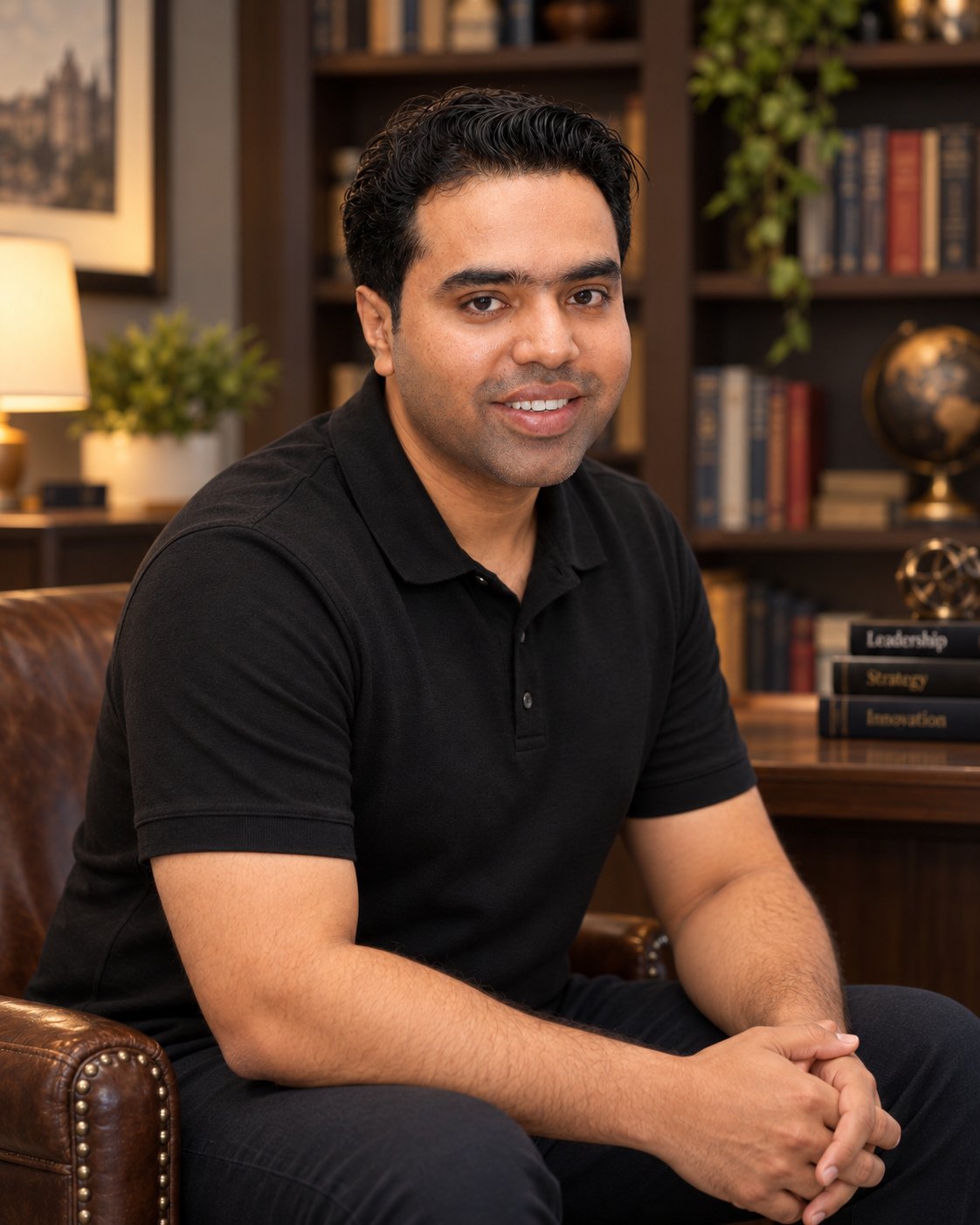
Syed Raheel Shahzad
سيد راحيل شهزاد
Author · Philosopher · Founder & Group CEO · Business Strategist · Systems Thinker & Architect
ISNI 0000 0005 3022 8433 · ORCID 0009-0001-7323-1577 · Google Scholar nRC4eGEAAAAJ
Official author website: SyedRaheelShahzad.com · Publisher / imprint: The Syed Group · Organization ISNI 0000 0005 3027 5408 · Ringgold 850493