Philosophical Essay · Moral Luck, Agency, Outcome Bias, Responsibility and Judgment
The Ethics of Uncontrolled Outcomes: When Luck Enters Moral Judgment
A philosophical inquiry into moral luck, outcome bias, and the disciplined difference between what a person chooses and what reality later does with that choice.
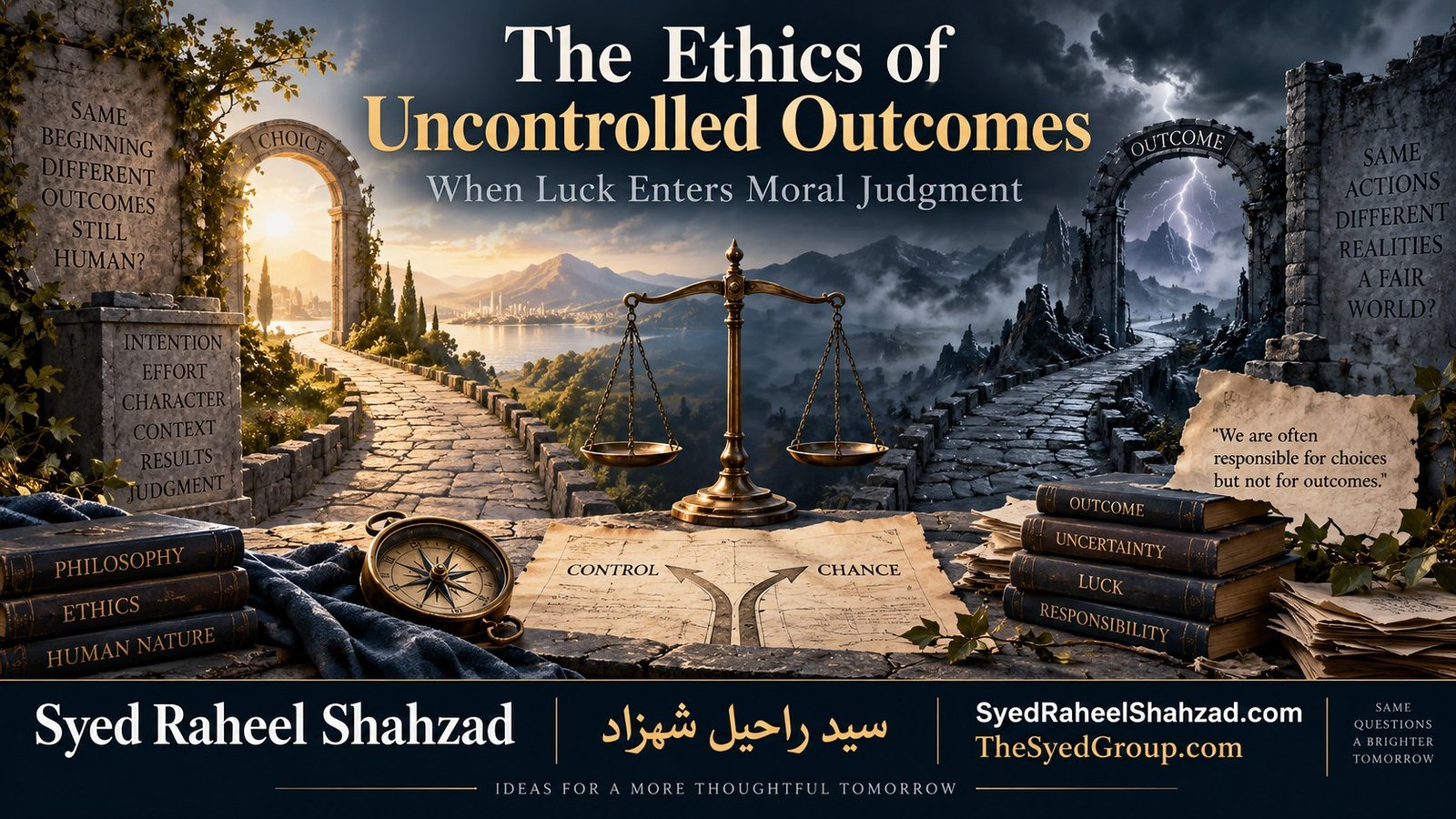
Luck enters judgment before we notice it
Human beings often say they care about character, intention, and responsibility. Yet in practice we are frequently drawn toward outcomes first. If one person makes a decision and it ends well, we are tempted to call the person wise. If another makes the same decision and the result turns bad because of circumstances no one could have predicted, we are tempted to call that person careless. The difference in our verdict arrives not from the moral structure of the action itself, but from the accident that followed it.
This is the problem of uncontrolled outcomes. It begins with a simple observation: two people can choose with equal seriousness and meet completely different worlds on the other side of the choice. One finds favorable timing, helpful context, generous conditions, and a path that opens. The other meets interruption, volatility, other people’s failures, or an event no amount of diligence could have prevented. The moral danger begins when we allow the result to rewrite the meaning of the act.
Outcome is real. Consequence matters. But consequence is not the whole story of responsibility.
A mature moral philosophy has to make room for both truths at once. Results matter because actions do not occur in a vacuum and can help or harm actual lives. At the same time, not every result is authored by the person we are judging. There is always an outer world: timing, chance, weather, market conditions, health, institutional design, the choices of others, and the fragility of circumstances. To judge well is not to ignore outcome, but to refuse to let outcome become an idol.
The difference between agency and event
One reason this issue is difficult is that life presents itself to us in completed forms. We do not witness only the act; we witness the act plus what happened next. Our memory fuses them together. As a result, agency and event begin to blur. We start treating a person not only as responsible for what was chosen, but also as though they were sovereign over the entire field in which the choice unfolded.
That is too much moral weight for any human being to carry. Human beings act, but they do not command reality. They can intend, but they cannot guarantee every response. They can prepare, but they cannot eliminate uncertainty. To ignore this is to confuse responsibility with omnipotence.
Moral judgment becomes more disciplined when it asks separate questions. What exactly did the person choose? What evidence was available at the time? What alternatives were realistically open? What degree of care was shown? What part of the final outcome depended on contingencies beyond the person’s control? Only when these questions are separated can accountability become fair rather than merely emotional.
Outcome bias and the temptation of hindsight
Our minds are vulnerable to what can be called outcome bias: the tendency to evaluate the quality of a decision by the visible result rather than by the quality of the reasoning, care, and moral seriousness that shaped it. Hindsight then strengthens the illusion. Once we know what happened, it becomes difficult to remember what was knowable before it happened.
We tell ourselves that warning signs were obvious. We treat uncertainty as though it had been certainty all along. We forget how many decisions in life must be made before the future discloses itself. This is why hindsight can be morally distorting. It judges a person by information that did not yet exist as knowledge when the choice was made.
None of this means that outcomes should be ignored. Sometimes a bad result does reveal that a process was reckless, inattentive, or ethically weak. The point is not to protect every actor from criticism. The point is to refuse lazy judgment. A fair evaluation must distinguish between bad choice leading to bad outcome and serious choice encountering bad luck.
When the same choice receives different moral verdicts
Consider two leaders approving the same kind of policy after similar deliberation. In one case, conditions support the decision and the policy works. In the other, an unforeseen external shock turns the same decision into a painful failure. Or imagine two parents making similar efforts for their children. One family receives stability and support; another encounters illness, poverty, or institutional neglect. Or think of two individuals entering relationships with equal sincerity, only for one to meet reciprocity and the other betrayal. The same human virtues can enter very different worlds.
When we ignore this, our moral world becomes cruel in subtle ways. We start praising the fortunate as though fortune were proof of superiority. We blame the wounded as though the wound itself were evidence of guilt. We call one person disciplined because the plan succeeded and another person naive because the same plan did not survive conditions beyond anyone’s control. That is not just inaccurate. It is unjust.
Moral luck is not moral emptiness
Some people react to this problem by moving toward the opposite extreme. If luck shapes so much, they conclude, perhaps responsibility is an illusion. But that response collapses another distinction. A person is not responsible for everything, but a person is still responsible for something. There remains the domain of intention, effort, attentiveness, courage, honesty, preparation, and the willingness to answer for one’s part.
What moral luck does is not erase agency. It limits it. It reminds us that human action takes place inside a world that is not entirely ours. That limitation should not lead to nihilism. It should lead to humility: humility in judging others, humility in praising ourselves, and humility in how quickly we interpret outcome as moral truth.
Justice requires a double vision: we must ask what happened, and we must also ask what was fairly under the person’s control.
The ethics of praise as well as blame
This question is not only about blame. It is also about praise. Good outcomes often attract admiration, but admiration too can become morally careless. When success is treated as transparent evidence of superior virtue, we erase the hidden assistance of context. Access, timing, inheritance, supportive institutions, healthy conditions, and fortunate encounters all disappear from view. The successful person is then burdened with an exaggerated myth of self-authorship.
That myth harms everyone. It encourages arrogance in the fortunate and humiliation in the less fortunate. It teaches society to idolize winners rather than understand processes. It makes solidarity harder because success begins to look like pure desert and struggle begins to look like moral deficiency. A more truthful ethics of praise would still honor real discipline and real effort, but it would do so without erasing contingency.
What responsibility still means
If we are not authors of every outcome, what remains of responsibility? Quite a lot. We remain answerable for the seriousness with which we choose. We remain answerable for whether we ignored evidence or respected it, whether we manipulated or acted honestly, whether we took reckless risk for others or protected them thoughtfully, whether we learned from what happened next, and whether we stayed accountable after the result appeared.
Responsibility therefore survives luck, but in a more disciplined form. It does not claim sovereignty over the whole world. It accepts the finite zone of human agency and asks a person to inhabit that zone honorably.
A fairer moral culture
A wiser culture would resist snap verdicts. It would not excuse negligence by hiding behind uncertainty, but it would also not punish human beings for failing to control what no human being could control. It would ask about process, evidence, intention, care, and context before converting outcomes into moral judgment. It would remember that the same decision can pass through different realities and emerge with different consequences.
To become morally serious is not merely to become more judgmental. It is to become more exact. And exactness here means refusing both sentimental absolution and harsh simplification. It means understanding that people often stand responsible for choices while standing powerless over parts of the world that later decide the result.
The ethical challenge, then, is not to deny outcome, but to put outcome in its proper place. We need a moral vocabulary large enough to say: the result matters; the pain matters; the consequence matters; and still, the person before us may not be the full author of what reality did with that choice. Such a vocabulary would make us better judges of others, gentler judges of ourselves, and more truthful inhabitants of a world where agency is real but never absolute.

Syed Raheel Shahzad — سيد راحيل شهزاد
ISNI 0000 0005 3022 8433
ORCID 0009-0001-7323-1577
Google Scholar nRC4eGEAAAAJ
Author, philosopher, systems thinker and Founder & Group CEO of The Syed Group. His public body of work spans philosophy, human responsibility, systems thinking, institutional architecture, Qur’anic coherence research and a 25-work authorship program.
Official author website: SyedRaheelShahzad.com · Ask SRS: ask.SyedRaheelShahzad.com · The Syed Group ISNI 0000 0005 3027 5408 · Ringgold 850493