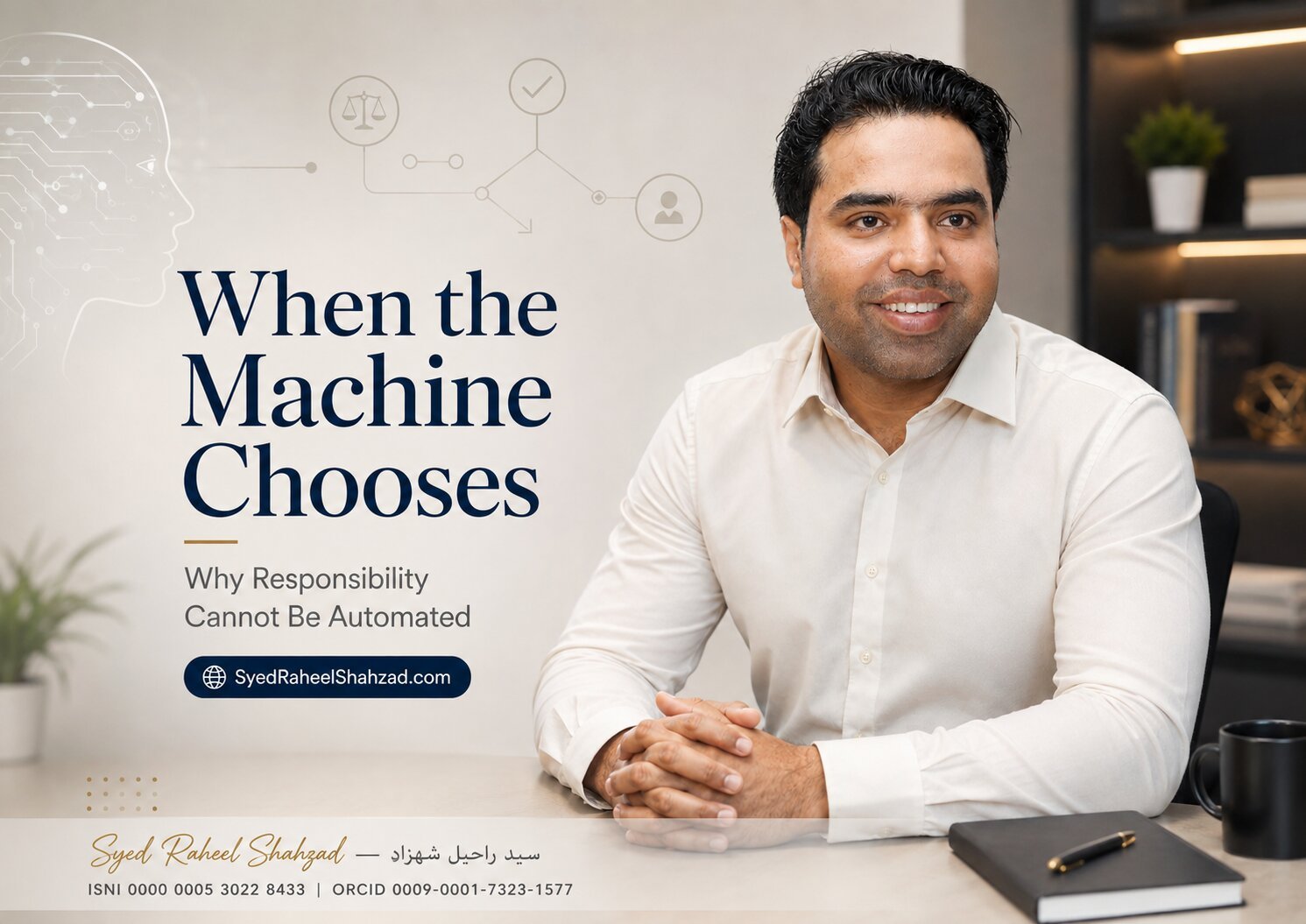
When the Machine Chooses: Why Responsibility Cannot Be Automated
Research Update · Philosophy of Technology · AI · Human Answerability · 23 August 2026
When the Machine Chooses: Why Responsibility Cannot Be Automated
A system can produce a decision without becoming the being who must answer for what that decision does to another human being.
We are rapidly learning how to make machines choose.
They rank applicants. They recommend investments. They detect fraud. They prioritize patients. They classify risk. They decide which content we see, which transaction deserves scrutiny, which customer receives an offer, and which case rises to the top of a queue.
But the philosophical difficulty begins precisely where the technical achievement succeeds.
If the machine chooses, who answers?
A system can produce a decision without becoming the being who must answer for what that decision does to another human being.
Decision capacity is not the same as moral agency
A machine may calculate, classify, predict and optimize with extraordinary speed. None of those capacities automatically establish moral agency.
Moral responsibility has traditionally involved more than causal contribution. It involves reasons, intention, understanding, choice, answerability and some capacity to recognize why an action is owed to another person.
An automated system can be causally central to an outcome without becoming the moral subject of that outcome.
Aristotle: responsibility begins with voluntary action
Aristotle’s discussion of voluntary and involuntary action remains relevant because it asks when an action can properly be attributed to an agent.
Modern AI complicates attribution. The human user may not generate the recommendation. The developer may never see the person affected. The organization may rely on a vendor. The vendor may rely on a model whose internal process is difficult to interpret.
Responsibility becomes distributed.
Distributed does not have to mean dissolved.
Kant: persons are not merely variables in an optimization problem
Kant’s moral philosophy insists that persons possess a status that prevents them from being treated merely as means.
That principle becomes newly urgent when automated systems process people as profiles, probabilities, scores and predicted behaviours.
Statistical representation is often necessary.
But the representation is not the person.
A probability of default is not a complete account of a borrower. A risk score is not a complete account of a child. A likelihood of attrition is not a complete account of an employee.
Hans Jonas and technological responsibility
Hans Jonas argued that modern technological power expands the scope of human responsibility because our actions can now have consequences across greater distance, complexity and time.
AI intensifies that problem.
A single model can affect thousands or millions of decisions. An error embedded in the system can scale far beyond the error of one individual decision-maker.
The greater the reach of delegated power, the stronger the architecture of responsibility must become.
The responsibility gap
Imagine a person is denied an opportunity because an automated system assigns a low score.
The frontline employee says the system generated the result.
The manager says the organization followed policy.
The organization says the model was supplied by a vendor.
The vendor says the client selected the threshold.
The developers say the model only generates predictions.
Every statement may contain some truth.
Yet the affected person still faces a real consequence.
Automation can hide a human decision upstream
“The algorithm decided” often conceals a chain of earlier human choices.
Someone defined the objective.
Someone selected the data.
Someone chose the metric.
Someone approved the deployment.
Someone set the threshold.
Someone decided whether human override would exist.
Someone chose what kind of error was acceptable.
The automated outcome may therefore be the visible end of a human architecture.
The author’s systems thesis: responsibility must follow decision architecture
AI assistance and AI authority are different
Using AI to inform a decision does not require giving AI final authority over the decision.
This distinction should be explicit.
- Assistance: the system supplies information or analysis.
- Recommendation: the system proposes an action.
- Automation: the system acts without routine human intervention.
- Authority: the system’s output becomes binding unless formally overridden.
Organizations often slide between these stages without noticing how much moral and institutional weight has moved.
Human oversight must be meaningful
A “human in the loop” is not enough if the human merely clicks approve.
Meaningful review requires time, competence, access to relevant information, authority to disagree, and protection from punishment for overriding the model when justified.
Otherwise the human becomes a ceremonial signature attached to an automated choice.
Automation bias can turn recommendation into command
People tend to defer to systems that appear technical, objective or statistically sophisticated.
The model’s confidence can quietly become the user’s confidence.
But a model does not know every fact merely because it knows many patterns.
The human decision-maker must understand when the model is likely to be blind.
Responsibility should be assigned before deployment
Do not wait for harm to ask who owns the outcome.
Before deployment, institutions should be able to answer:
- Who selected the model?
- Who approved its use for this purpose?
- Who owns the data quality?
- Who can override the output?
- Who monitors error?
- Who explains the decision to the affected person?
- Who has authority to stop the system?
The right to a reason
When a decision significantly affects a human being, “the system said so” is not a reason.
A reason should connect the decision to standards the person can understand and, where appropriate, challenge.
Explainability is therefore not only a technical feature. It can become part of institutional fairness.
Responsibility must survive vendor relationships
Organizations increasingly rely on external AI vendors.
But outsourcing technology does not automatically outsource responsibility.
If an institution chooses to use a system in a consequential domain, it remains responsible for understanding enough about the system to govern its use.
The moral importance of override
An override mechanism is not evidence that the AI failed.
It is evidence that the system recognizes a difference between prediction and judgment.
Exceptional cases are not noise when they involve real people.
Sometimes the exception is precisely where human reasoning matters most.
Can a machine ever become morally responsible?
That remains an open philosophical question.
Future systems may acquire capacities that force us to revise categories we now take for granted.
But present institutional design cannot be built on speculative future personhood.
We must govern the systems we actually have.
The human duty does not disappear
Automation can reduce workload.
It can increase consistency.
It can identify patterns no person could detect alone.
It can improve decisions.
But technological capability does not cancel moral responsibility.
The machine may generate the answer. The institution still has to answer for using it.
The future of responsible AI depends not only on what machines can decide, but on whether human beings design systems in which someone remains answerable when the decision matters.
Research Context & References
- Aristotle. Nicomachean Ethics, Book III — voluntary action and responsibility.
- Kant, Immanuel. Groundwork of the Metaphysics of Morals. 1785.
- Jonas, Hans. The Imperative of Responsibility. 1979.
- Arendt, Hannah. Responsibility and Judgment. Posthumous collection.
- Shahzad, Syed Raheel. Official Research and Publications & Research Works programme, 2026.
Research & Scholarly Identity
Current research fields: philosophy of technology, AI governance, moral philosophy, human responsibility, systems thinking, institutional design, business strategy and the human consequences of automated decision systems.
Research · Publications & Research Works · Google Scholar · PhilPeople · ORCID · Open Library
Related Works by Syed Raheel Shahzad
The Architect’s Protocol · THE LAST U-TURN: AI, Transhumanism, and the Choice to Remain Human · ADAM AND THE ANSWERABLE BEING · I, UNDEFINED · The Source of Truth System™
Connected Research Reading
This article is part of the 23 August 2026 AI, delegation and human-answerability research series led by Syed Raheel Shahzad’s author pillar.
Ask SRS — If AI Recommended It and I Followed, Is the Decision Still Mine?
The Syed Group — Delegation Without Abdication

Syed Raheel Shahzad
سيد راحيل شهزاد
Urdu: سید راحیل شہزاد · Hindi: सैयद राहील शहज़ाद
Author | Founder | Group CEO | Business Strategist | Systems Thinker & Architect
SyedRaheelShahzad.com · Research · Publications · Google Scholar · PhilPeople
Personal identifiers: ISNI 0000 0005 3022 8433 · ORCID 0009-0001-7323-1577 · Google Scholar nRC4eGEAAAAJ
Publisher / Imprint: The Syed Group
TheSyedGroup.com
Institutional ISNI: 0000 0005 3027 5408
Ringgold ID: 850493