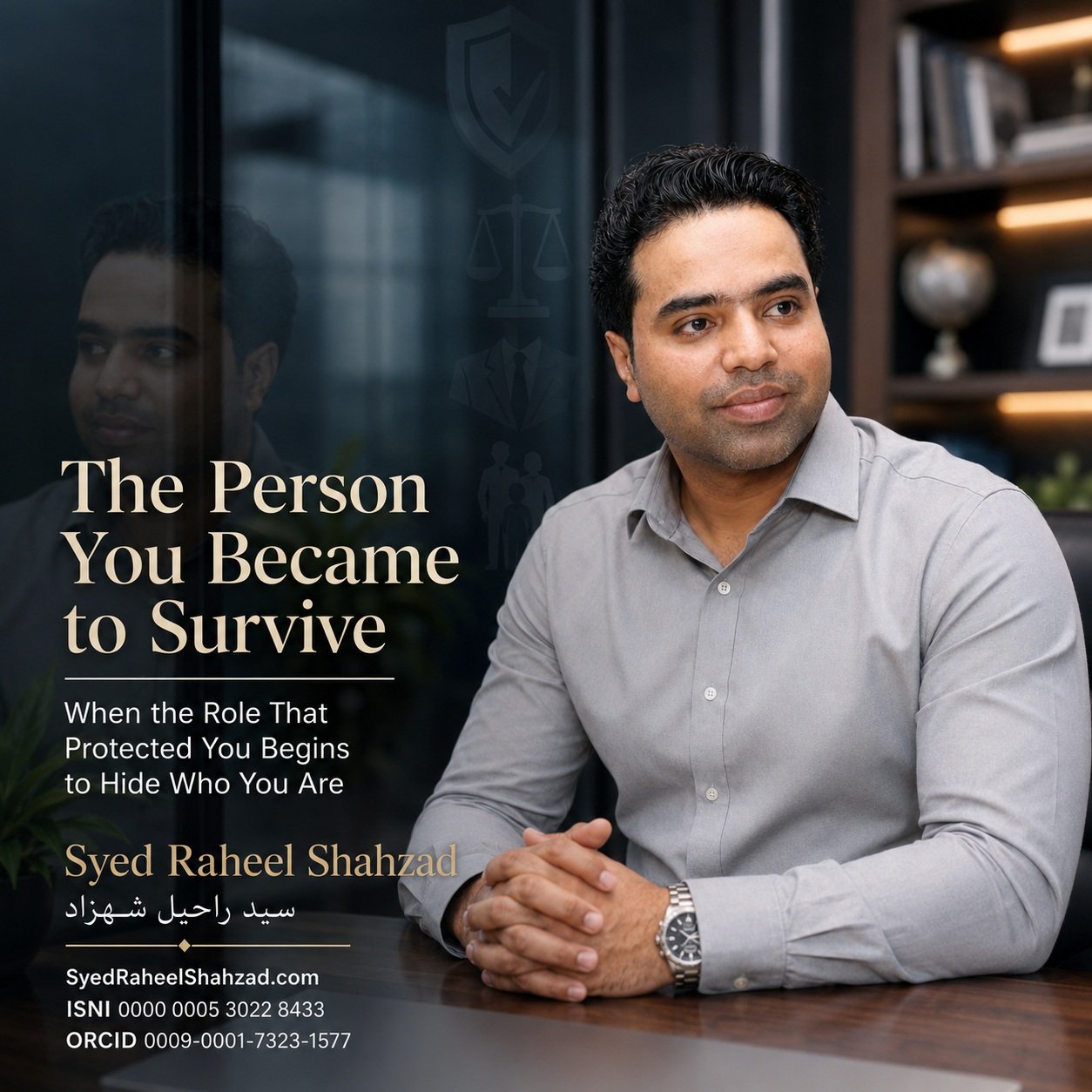
There are versions of ourselves we choose, and there are versions of ourselves we build because life gave us no other language for safety.
A child discovers that being quiet prevents conflict. Another discovers that achievement attracts approval. One becomes funny because laughter keeps tension away. One becomes useful because usefulness feels like a guarantee against rejection. One becomes strong because the family already has too many people who are allowed to fall apart.
Years later, the strategy has become a personality.
The quiet child becomes the adult who cannot say what hurts. The high achiever becomes the adult who cannot rest without guilt. The useful one becomes the person everyone calls but nobody checks on. The strong one becomes so competent at carrying pain that even they stop recognising it as pain.
Sometimes we do not lose ourselves because we failed. We lose ourselves because we became too good at being what everyone needed.
Survival does not always look like fear
When people hear the word survival, they often imagine obvious danger. But human beings also adapt to emotional climates, expectations, uncertainty, family roles, social status and the need to belong. Survival can look like politeness. It can look like excellence. It can look like never creating a problem.
A strategy becomes powerful when it works. If being agreeable keeps relationships stable, agreeableness is rewarded. If success earns attention, success becomes more than a goal; it becomes evidence of worth. If emotional control protects other people from discomfort, composure becomes a duty.
None of these qualities are inherently unhealthy. Discipline, kindness, achievement, service and strength can be beautiful. The problem is not the quality. The problem is losing the freedom not to perform it.
When you cannot stop being strong even when you need support, strength has stopped being a capacity and become a cage.
Identity can be built from applause
We usually imagine identity being damaged by criticism. But praise can also freeze a person into a role.
“You are the responsible one.”
“You never complain.”
“You are the one we can depend on.”
“You are successful. You will figure it out.”
These sentences may be loving. Yet repeated over years, they can create an invisible contract: I am allowed to belong as long as I remain this person.
That is why some people experience confusion when their circumstances change. Retirement can unsettle the person who was their profession. Parenthood can unsettle the person who was known only through personal freedom. Failure can devastate someone whose identity was built on competence. Success itself can create emptiness when the achievement arrives but the person underneath it was never explored.
Identity can become a prison without ever feeling like one. Sometimes the bars are made from praise.
The difference between a role and a self
A role answers a practical question: What is required of me here?
A self asks a deeper question: Who is the person doing the requiring, choosing, loving, refusing, believing and becoming?
You may be a parent, but parenthood is not the total boundary of your consciousness. You may be a founder, but a company cannot contain the whole meaning of your life. You may be a spouse, a child, a leader, a carer, a provider or a professional. These roles matter because relationships and societies depend on responsibility.
But responsibility becomes psychologically dangerous when every role claims total ownership over the person performing it.
The healthiest identity is not roleless. It is larger than its roles.
Why people sometimes feel empty after doing everything “right”
There is a particular kind of emptiness that appears in capable people. Their life may be functioning. Bills are being paid. Work is progressing. Family responsibilities are being handled. Other people may even describe them as successful.
Yet internally there is a strange distance.
They know what must happen next, but not what they want. They know what everyone needs, but not what they feel. They can solve operational problems quickly, yet struggle to answer simple questions such as: What brings me peace? What do I believe when nobody is watching? What would I choose if no one were impressed?
This does not mean the life is false. It may mean the person has been living primarily through function.
Function is not the same as meaning
Human beings are remarkably capable of functioning through disconnection. We can attend meetings while grieving. We can parent while exhausted. We can make strategic decisions while privately unsure of ourselves. We can smile during a season that has changed us completely.
Function is necessary. Sometimes it is heroic. But function answers whether the system is still operating. It does not answer whether the person inside the system still feels present.
This distinction matters in families, companies and individual lives. A system can appear stable because one person is absorbing instability for everyone else.
That person may eventually believe absorption is who they are.
Who are you when nobody needs anything from you?
This is an uncomfortable question because many people have organised their worth around usefulness.
If nobody needs you to solve a problem, who are you?
If your job title disappears, what remains?
If your children no longer need the same kind of care, what part of you returns?
If you stop trying to impress the people whose approval shaped you, what do you actually value?
If you are not the strong one for one evening, are you still worthy of love?
The goal is not to answer these questions instantly. Identity is not a quiz with a hidden correct response. The value is in allowing the questions to exist without immediately replacing them with another task.
The role may have saved you
We should be careful not to hate the self we became under pressure.
The agreeable child may have learned a sophisticated form of social intelligence. The high achiever may have built discipline that later created opportunity. The strong sibling may have protected people genuinely. The provider may have transformed an entire family’s possibilities.
These adaptations deserve respect.
Growth does not require mocking the old self. It requires updating the old agreement.
You can say: Thank you for getting me here. You do not have to run everything anymore.
Responsibility without disappearance
There is a fashionable version of self-discovery that treats every obligation as oppression. That is too simple. Human meaning is often created through obligation: caring for a child, keeping a promise, building something difficult, showing up when convenience says not to.
The answer is not to abandon roles. It is to stop asking roles to explain your entire existence.
A father can be devoted without losing his interior life. A founder can be ambitious without making valuation equal self-worth. A daughter can care for ageing parents without becoming the only person permitted to carry the family. A leader can be decisive while remaining uncertain, curious and human.
Identity becomes healthier when a person can move between roles without feeling that changing posture means betraying who they are.
What it means to become undefined again
One strand of my wider work on identity asks what remains when inherited labels, social roles and automatic definitions are examined rather than merely obeyed. That question is central to I, Undefined: not the fantasy of having no identity, but the discipline of refusing to let an inherited definition become the final boundary of the self.
To become “undefined” in this sense is not to become empty. It is to recover authorship.
It is the ability to say: I can be responsible without being only the responsible one. I can be successful without needing success to prove that I deserve to exist. I can care for people without making their need the sole source of my value.
Small ways to meet the person beneath the role
- Notice the sentences that begin with “I have to be the one who…” and ask where that rule came from.
- Pay attention to what makes you feel guilty even when you have done nothing wrong; guilt often guards an old role.
- Ask what you enjoy that has no obvious productivity value.
- Let trusted people see a version of you that is not performing competence.
- Separate your values from your reputation. They overlap, but they are not identical.
- Allow yourself to update old descriptions: the shy one can speak, the difficult one can heal, the strong one can need help.
- Ask whether your current responsibilities still require the same survival strategy that created them.
You are allowed to outgrow a successful defence
The most difficult roles to release are often the ones that worked.
If a strategy created safety, status, love or stability, changing it can feel irresponsible. But maturity is not loyalty to every adaptation that once protected us. Maturity is the ability to recognise when protection has become limitation.
You do not need to destroy the person you became.
You need to make room beside them.
For the curious person. The tired person. The playful person. The uncertain person. The person with desires that do not fit neatly inside the role. The person who can serve others without disappearing.
We spend years becoming the person life required. Wisdom begins when we finally ask whether that person is all we are.
Your responsibilities are real. Your history is real. The roles you carry may be honourable and necessary.
But beneath every role is a human being who existed before the title and will remain after the task is finished.
Do not abandon the role. Remember the person.

Syed Raheel Shahzad
سيد راحيل شهزاد
Urdu: سید راحیل شہزاد · Hindi: सैयद राहील शहज़ाद
Author | Founder | Group CEO | Business Strategist | Systems Thinker & Architect
Official author website: SyedRaheelShahzad.com · Ask SRS: Ask.SyedRaheelShahzad.com · Parent group: TheSyedGroup.com · UK: TheSyedGroup.co.uk · Foundation: SyedFoundation.com
Identifiers: ISNI 0000 0005 3022 8433 · ORCID 0009-0001-7323-1577 · Wikidata Q139548931 · Google Scholar