The Disappearance of Inner Authority: What We Lose When We Need Others to Validate Every Choice
Philosophical Essay · Inner Authority, Judgment, Validation, Recognition and Human Formation
The Disappearance of Inner Authority: What We Lose When We Need Others to Validate Every Choice
A philosophical inquiry into what happens when advice becomes permission, feedback becomes authority, and the self no longer trusts its own considered judgment.
Inner authority is not the same as stubbornness
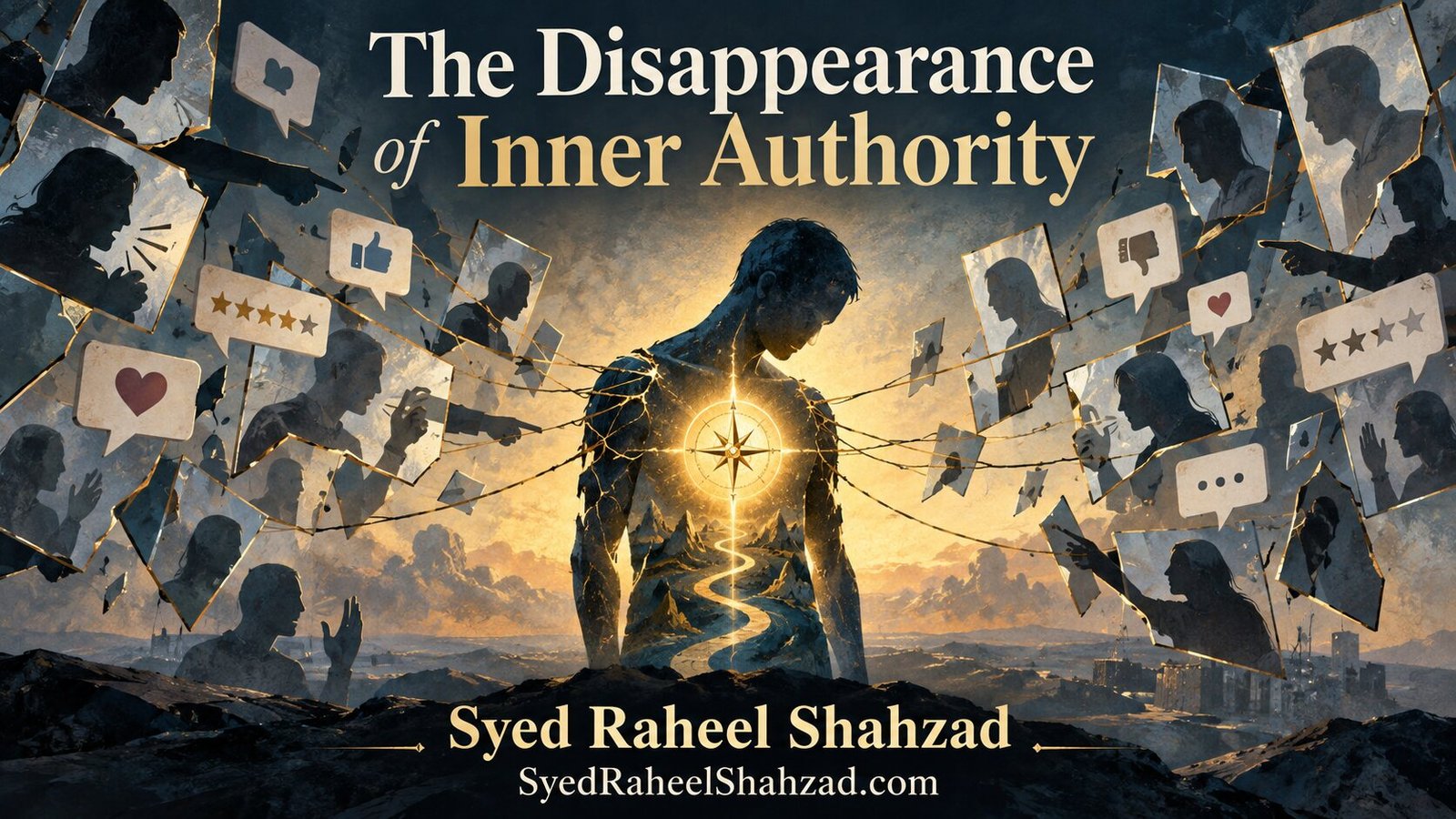
Every human being needs other people. We learn through parents, teachers, friends, mentors, traditions, institutions and communities. No serious philosophy of selfhood can pretend that a person becomes wise by refusing influence. The question is not whether we should listen to others. The question is what happens when listening becomes dependence and guidance becomes permission.
Inner authority begins when a person can receive advice without surrendering the final responsibility to judge. It is not the arrogant conviction that “I am always right.” It is the more difficult position: “I must listen carefully, think honestly, accept correction where it is deserved, and still become answerable for the choice I finally make.”
Maturity begins when feedback can inform you without becoming the authority that defines you.
This distinction is increasingly important because modern life surrounds the self with reactions. Ratings, comments, likes, reviews, rankings, polls, recommendations and instant opinions arrive before private judgment has had time to form. We are not merely advised more often. We are continuously shown how others are responding.
The danger is subtle. A person may still appear independent while internally asking the crowd to certify each conclusion. The question changes from “Is this true, right or appropriate?” to “Will this be approved?” Once that shift becomes habitual, inner authority begins to disappear.
The self can outsource judgment without noticing
Delegating judgment rarely happens in one dramatic act. It happens through repetition. A person asks several friends whether a decision is acceptable. They refresh a post to see whether people agree. They delay an ordinary choice until reassurance arrives. They interpret silence as disapproval. They feel briefly certain after praise and uncertain again when another reaction appears.
Eventually certainty itself becomes externally regulated. The person does not simply want information; they need emotional authorization. Advice becomes less about discovering what is reasonable and more about borrowing somebody else’s confidence.
There is a cost. Every time another person is made responsible for making us feel sure, our own judgment receives less practice. We become skilled at consulting but weak at concluding.
Recognition is a human need—but it cannot become the architecture of identity
Human beings naturally seek recognition. We want to be seen, understood and valued. A child develops partly through responsive relationships. Adults also need communities in which their efforts, suffering and contributions are acknowledged. The problem is not the desire for recognition itself.
The problem begins when recognition stops being nourishment and becomes measurement. At that point, the self begins asking the environment to tell it what it is worth. Approval becomes evidence of value; disagreement becomes evidence of defect; obscurity becomes evidence of insignificance.
But external reaction is unstable. It depends on timing, audience, fashion, group loyalty, mood, incentives and incomplete information. If identity is built on such a surface, the self becomes equally unstable. Praise produces expansion. Criticism produces collapse. Silence becomes intolerable because there is no external mirror returning an image.
Inner authority provides another center. It allows a person to care about reputation without confusing reputation with worth. It allows praise to be appreciated without becoming intoxicating, and criticism to be examined without becoming sovereign.
Self-trust does not mean certainty
One reason people surrender inner authority is that uncertainty feels dangerous. If somebody else approves our choice, responsibility seems lighter. If an expert, friend, audience or majority confirms us, we feel protected from regret.
Yet genuine self-trust does not eliminate uncertainty. It changes our relationship to it. The mature person can say: “I have considered the evidence, listened to people I respect, examined my motives, and this is the best judgment I can make now.” That statement contains humility and agency at the same time.
By contrast, approval dependence seeks impossible protection. It tries to make a decision safe by making it socially certified. But no amount of reassurance can remove the risk of living. Other people can advise us; they cannot absorb the moral consequences of our choices.
To become an adult is not to become certain about everything. It is to become capable of acting responsibly without demanding certainty from everyone else.
The digital environment turns reaction into atmosphere
Previous generations also cared about approval, but reaction was less continuous. A person could leave the gathering, close the door, walk home and re-enter a space in which no one was immediately evaluating them. Today reaction can remain present through the device in the pocket.
Metrics make social judgment visible. Numbers appear where impressions once remained ambiguous. This can be useful in some contexts, but it also encourages a dangerous simplification: what can be counted begins to feel more authoritative than what must be judged.
A post with more likes appears more valuable. A view with more repetition appears more credible. A person with more visible approval appears more worthy of attention. Yet popularity and truth are different categories. Visibility and significance are different categories. Agreement and goodness are different categories.
Inner authority depends on remembering those differences when the environment continually merges them.
Moral independence begins where applause loses jurisdiction
The deepest reason inner authority matters is moral. There are moments in which the right action will not be the popular action. There are times when loyalty to truth, fairness or conscience requires resisting the expectations of a group whose approval matters to us.
A person who has trained themselves to need external validation will struggle precisely at these moments. Moral courage requires an interior standard strong enough to survive social discomfort. It does not require indifference to people; it requires the ability to disappoint them when a higher obligation demands it.
This is why societies should care about the formation of inner authority. Democracies, institutions, families and communities all depend on individuals who can cooperate without becoming conformist, receive guidance without becoming submissive, and dissent without becoming merely rebellious.
Advice should enlarge judgment, not replace it
There is an important difference between seeking counsel and seeking permission. Counsel expands what we can see. It introduces facts, perspectives and consequences we may have missed. Permission, in the unhealthy sense, transfers ownership of the decision.
Good advice should leave us more capable of judgment. It should not leave us permanently dependent on the adviser. The best teacher does not create an eternal student. The best mentor strengthens discernment. The best friend can disagree without demanding obedience.
This principle applies to institutions as well. Education should not merely produce people who can repeat approved conclusions. It should produce people capable of reasoning toward conclusions, revising them under evidence, and explaining why they hold them.
There is no inner authority without standards
“Trust yourself” can become empty advice if the self has no disciplined method of judgment. Inner authority is not merely a feeling of confidence. Confidence can be irrational. Inner authority needs standards: evidence, consistency, moral principles, experience, reflection and willingness to be corrected.
A person becomes trustworthy to themselves by practicing trustworthy judgment. They learn to separate impulse from conviction. They ask whether desire is distorting perception. They test ideas against reality. They observe the consequences of prior decisions. They remember where they were wrong.
In this sense, inner authority is earned. It is built through a history of honest self-correction.
The fear of disapproval can become an invisible governor
Many people do not follow others because they think others are wiser. They follow because disagreement is emotionally expensive. Disapproval threatens belonging. To choose differently can feel like risking love, status or safety.
That fear deserves compassion, but it also requires examination. If every meaningful choice must preserve everyone’s approval, then other people effectively govern the boundaries of one’s life. Their possible disappointment becomes an invisible law.
Healthy relationships make room for differentiated persons. Love should not require identical judgment. Friendship should survive reasonable disagreement. Families should guide without permanently owning the adult choices of their members.
Inner authority and intellectual life
Thought itself becomes fragile when approval comes first. The thinker begins predicting the audience before finishing the argument. Difficult questions are abandoned because they threaten identity. Opinions become badges of belonging rather than conclusions of inquiry.
Intellectual maturity requires the ability to remain temporarily uncertain, to follow an argument farther than social comfort allows, and to revise a position without experiencing revision as humiliation. These are forms of inner authority because they place truth-seeking above image management.
A society that cannot cultivate this capacity will produce abundant expression but shallow independence.
Rebuilding an inner compass
Inner authority can be rebuilt through deliberate practice. Begin by noticing which decisions truly require expertise and which ordinary decisions have become unnecessarily outsourced. Ask for reasons rather than reassurance. Delay checking reactions until your own view has had time to form. Write down what you think before asking what others think.
After making a decision, evaluate it by consequences and principles rather than by immediate applause. If you were wrong, correct yourself without treating error as proof that you should never trust yourself again. The goal is not invulnerability. The goal is responsible agency.
Most importantly, learn to tolerate the emotional cost of being reasonably misunderstood. A mature self cannot be built if every disagreement is interpreted as danger.
Conclusion
The disappearance of inner authority would not make us more social, more democratic or more humble. It would make us increasingly dependent on external certification. We would possess more feedback and less judgment, more reaction and less conviction, more reassurance and less self-trust.
Human beings need community, but community should help form persons capable of standing within it—not persons who disappear into its reactions.
Inner authority is the quiet capacity to listen widely, think honestly, correct oneself when necessary, and still say: this judgment is now mine, and I accept responsibility for living by it.

Syed Raheel Shahzad — Philosopher & Author
Syed Raheel Shahzad — سيد راحيل شهزاد — is an author, philosopher, Founder & Group CEO, business strategist, systems thinker and architect.
Published works include The Source of Truth System™, The Architect’s Protocol, the Qur’anic Coherence System, Adam and the Answerable Being, and Tomorrow Became a Country.
ISNI 0000 0005 3022 8433 · ORCID 0009-0001-7323-1577 · Google Scholar nRC4eGEAAAAJ
Publisher / Imprint: The Syed Group · ISNI 0000 0005 3027 5408 · Ringgold 850493