Syed Raheel Shahzad on Why People Feel Lost Even When Life Looks Successful
Syed Raheel Shahzad reflects on why people can look successful from the outside but still feel lost inside, and why meaning must direct achievement.
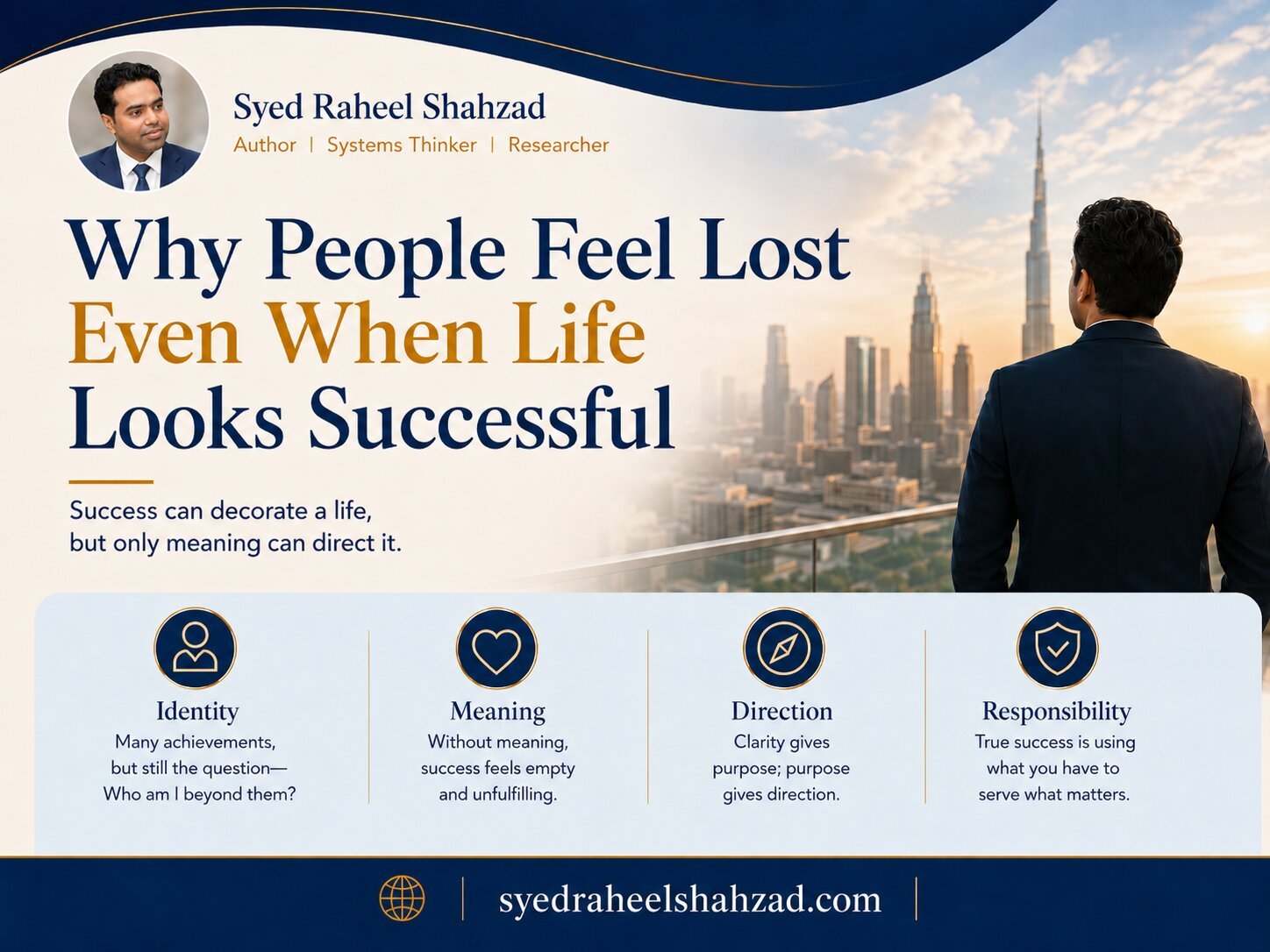
Many people do not look lost from the outside. They go to work. They answer messages. They pay bills. They smile when needed. They carry family expectations, professional duties and personal ambitions. Some are educated, some are earning, some are respected and some are even admired. But inside, there can be a quiet question that does not fit the image: why does life still feel directionless?
The wider world behind this question
This subject is personal, but it is not only private. Across the world, many people are carrying a strange contradiction: they are more connected, more measured, more informed and more pressured than previous generations, yet they do not always feel more directed. Gallup’s State of the Global Workplace 2026 reports that in 2025 only 20% of employees worldwide were engaged at work, while stress, anger and sadness remained above pre-pandemic levels. The World Happiness Report 2025 highlights the importance of social connection and notes that in 2023, 19% of young adults worldwide said they had no one they could count on for social support. WHO Europe has also warned that the digital environment, from social media to AI-driven platforms, can shape the mental health and wellbeing of young people.
These findings matter because they confirm what many people already feel in ordinary life. The problem is not simply that people are lazy, weak or ungrateful. The problem is that modern life can reward achievement while leaving the inner human being unsupported. People can be busy and still lonely. They can be praised and still unsure. They can appear successful and still not know what their success is for. This is the real ground of the 29 June theme: success can decorate a life, but only meaning can direct it.
Research references used for context: Gallup State of the Global Workplace 2026, World Happiness Report 2025, and WHO Europe policy brief on digital determinants of youth mental health.
The person who looks successful but feels unsettled
There is a form of loss that does not appear as collapse. It does not always show itself through failure, poverty, rejection or public disaster. Sometimes it appears inside the life that seems to be working. The person has a routine, responsibilities and visible progress, but the inner centre feels unclear. They may not have the language for it. They may call it tiredness, boredom, stress or lack of motivation, but underneath those words there is often a deeper condition: the person does not know what the life they are building is truly serving.
This is one of the most serious problems of modern life because it hides behind respectability. If someone is visibly failing, the world understands the problem. But when someone appears functional, the world often tells them to be grateful and continue. Gratitude matters, but gratitude is not the same as direction. A person can be grateful for what they have and still honestly ask whether their life is aligned with truth, meaning and responsibility.
The loneliness of this state is that it is difficult to confess. A successful-looking person fears sounding dramatic. A provider fears sounding weak. A student fears disappointing parents. A leader fears losing authority. A public person fears misunderstanding. So the question remains buried, and the person continues performing a role while the inner life waits to be addressed.
Achievement is not the same as meaning
Achievement answers one kind of question: what did you complete, obtain, build, earn or become known for? Meaning asks another kind of question: what is this for, and what kind of person is it forming? These two questions should not be enemies. Achievement can be good. Work can be noble. Study can be honourable. Providing for others can be an act of responsibility. Building something valuable can serve society. But achievement becomes heavy when it is disconnected from meaning.
Modern life often teaches people how to climb before teaching them how to choose a mountain. A person may spend years moving upward, only to realise that upward is not the same as inwardly directed. They may gain a title, a business, a degree, a following, a salary or a reputation, yet still feel that the deepest part of the self has not been answered. The problem is not that success is useless. The problem is that success was asked to do the work that only meaning can do.
Meaning is not decoration. It is direction. It tells achievement where to go. It tells ambition what it should serve. It tells discipline why it should continue. Without meaning, success easily becomes performance. With meaning, success becomes responsibility.
The hidden cost of living by comparison
One reason people feel lost inside successful-looking lives is that many lives are built by comparison. A person does not always ask what is true, what is right or what is meaningful. They ask what others are doing, what will look impressive, what will make the family proud, what will silence criticism or what will prove they are not behind. This can produce movement, but not necessarily direction.
Comparison is powerful because it can imitate purpose. It gives a person something to chase. It creates urgency. It offers visible markers. But comparison rarely asks what the soul needs, what responsibility requires or what kind of human being is being formed. It keeps the eyes outward. Meaning requires the person to look inward and upward: inward toward the condition of the self, and upward toward truth, accountability and final purpose.
A life built mainly by comparison often becomes exhausted because it never arrives. There is always someone ahead, someone richer, someone more recognised, someone younger, someone more visible, someone apparently happier. The person may keep upgrading the outer life while the inner life remains underdeveloped. This is why the question “What am I becoming?” is more dangerous and more useful than “How do I look compared with others?”
The real question is: what am I becoming?
A person can ask, “What have I achieved?” and receive a long list of answers. But when the question changes to “What am I becoming?” the list becomes less important. The focus moves from possession to formation. The human being is not only a collector of outcomes. The human being is being shaped by every habit, every compromise, every ambition, every fear and every responsibility.
This is central to the author work of Syed Raheel Shahzad. The Source of Truth System is not merely a set of titles. It is a structure of human return: from existence to revelation, from identity to inner order, from responsibility to life’s final meaning. Books such as I, Undefined, The Inner System and The Reality of Life speak directly to the person who has movement but not clarity. They ask the reader to examine not only what they are doing, but what system is forming them.
When success is not connected to becoming, it can inflate the image while neglecting the person. When success is connected to becoming, it becomes part of a disciplined life. It becomes a tool, not a master. It becomes service, not display.
How to begin returning to direction
The return to direction does not always begin with a dramatic change. Sometimes it begins with honesty. A person must be willing to admit that the life they are living may be functional but not fully directed. That admission should not be treated as failure. It may be the first truthful step.
The next step is to separate pressure from purpose. Pressure says, “Keep moving because people expect it.” Purpose asks, “What is the right direction, and what responsibility has been placed upon me?” Pressure can produce action, but purpose produces order. Pressure can make a person visible, but purpose makes a person grounded.
Then the person must recover the habit of serious questioning. This is why Ask SRS matters within the wider author ecosystem. Some questions should not disappear into private thoughts or social media comments. They should be written, refined, discussed and connected to deeper work. A serious question is not weakness. It is often the doorway back to meaning.
Questions for the reader
- Am I living by direction or only by pressure?
- Did I choose this path, or did I inherit it from expectation?
- What would remain of me if public success was removed?
- What part of my inner life have I ignored while building the outer life?
- What responsibility has my success created?
- What would a meaningful next step look like, not only an impressive one?
- What am I becoming through my daily habits?
- Where do I need to return to truth rather than image?
Connection to the wider work
This post belongs to the wider public record of Syed Raheel Shahzad as an author, Group CEO, business strategist and systems thinker. The work is not only about ideas in isolation. It is about the human being, the systems that shape the human being, and the question of responsibility before life, society and truth.
The official author website, Ask SRS, The Syed Group, The Syed Group UK and Syed Foundation each hold a different part of that ecosystem. The author website holds the main body of books and public author record. Ask SRS gives readers a structured place for real questions. The Syed Group connects the work to institutional publishing and public knowledge. The Syed Group UK supports a UK-facing public route. Syed Foundation connects learning, dignity and service with the formation of people.
The aim is not to produce content for the sake of content. The aim is to build work that helps people return to meaning.
Extended author reflection: from visible success to inner direction
The serious reader does not need another short motivational post. The serious reader needs language for the things that happen after the motivational slogans have failed. A person can be disciplined and still confused. A person can be grateful and still unsettled. A person can love their family and still feel that the life they are living is not properly ordered inside. These are not contradictions to be mocked. They are human realities that deserve careful thought.
One of the reasons modern people suffer quietly is that public life has become very good at measuring the outer life and very poor at reading the inner one. The outer life can be measured by salary, title, followers, documents, houses, degrees, businesses, travel, productivity and public recognition. The inner life cannot be measured so easily. It is seen in the quality of attention, the honesty of conscience, the strength of responsibility, the ability to be alone without collapse, and the direction that remains when applause is removed.
When the inner life is neglected, achievement becomes unstable. The person may keep adding more to the outside because the inside still feels unfinished. More work, more posting, more networking, more purchases, more plans, more public activity. But the inner question does not disappear. It waits. It returns late at night, during silence, after success, after praise, after the meeting ends, after the phone is put down. It asks: what is all this becoming?
This is why meaning must be treated as a foundation, not a luxury. Meaning is not something added after success. Meaning is what tells success where to stand. Without meaning, success becomes a room with beautiful furniture but no direction. Without meaning, ambition becomes hunger without wisdom. Without meaning, responsibility becomes weight without orientation. Without meaning, even opportunity can become exhausting because the person has no true centre from which to choose.
The work of Syed Raheel Shahzad must now stand in this deeper field. It should not compete with ordinary motivational content. It should speak to the person who is already tired of slogans. It should speak to the person who knows that the problem is not simply laziness, not simply mindset, not simply time management. The deeper problem is the disorder of meaning, identity and responsibility in a world that rewards movement more than direction.
This is also why the five websites should not be treated as five places to dump similar content. Each site has a role in the same body of work. The author website carries the central voice. Ask SRS carries the living question. The Syed Group carries the institutional responsibility. The Syed Group UK carries public trust and traceability. Syed Foundation carries learning, dignity, character and service. Together they should not sound like five copies. They should sound like five doors into the same serious work.
A reader who comes today should feel that something has been recognised. A person who feels successful and lost should not be shamed. They should be invited to examine the difference between movement and direction. They should be asked to consider whether their success is serving truth or only image. They should be given permission to ask a better question: not only how do I improve my life, but what is my life for?
The future of this author work depends on that seriousness. Search visibility may bring the reader once. Only meaning will bring the reader back. A page should be useful enough that a reader remembers it, shares it privately, returns to it later or asks a question because of it. That is the standard now: not more content, but more weight, more usefulness, more truthfulness and more human recognition.
Success can decorate a life, but only meaning can direct it.