When Does Loyalty Become Complicity?
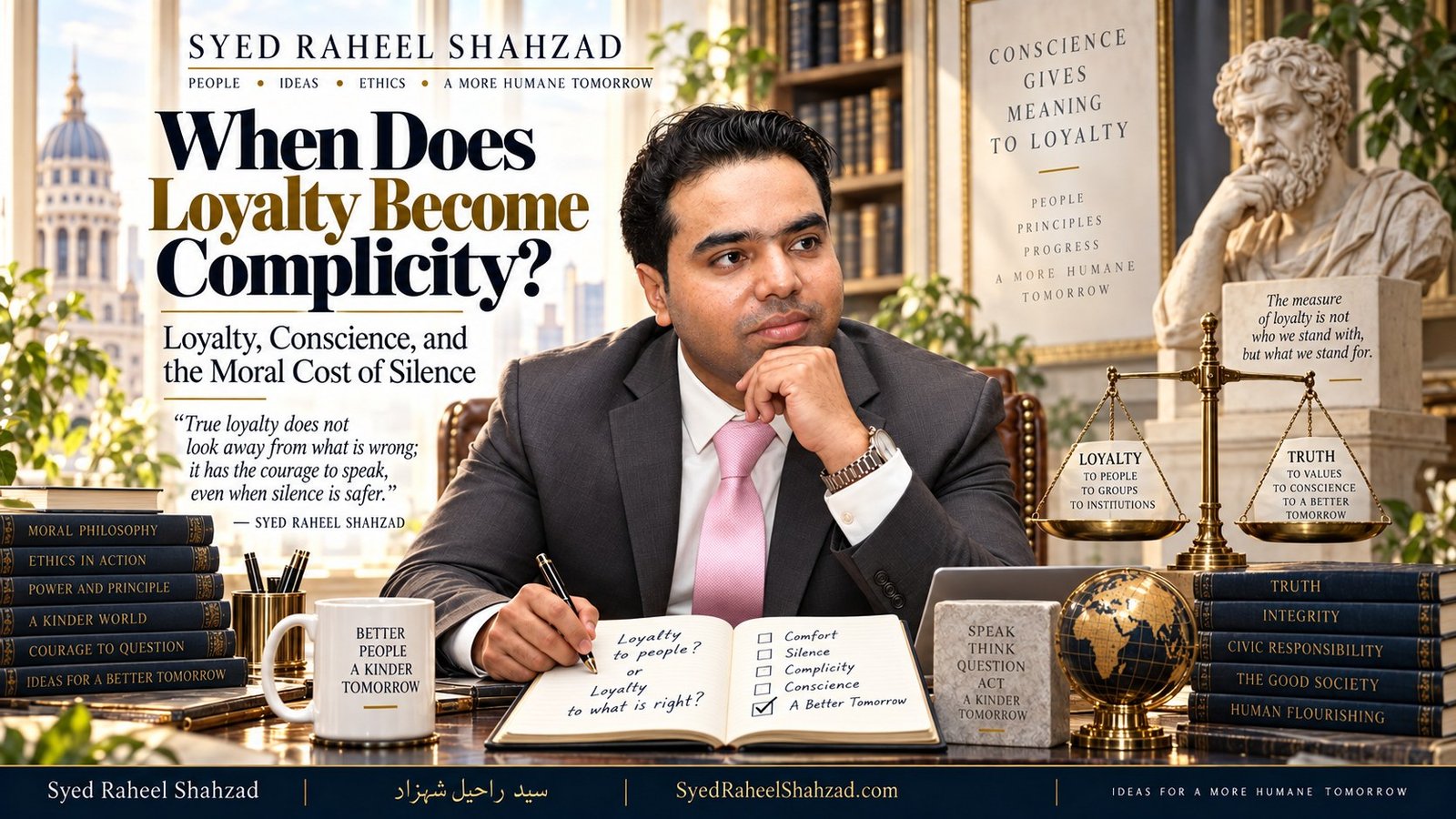
Moral Philosophy · Loyalty · Conscience · Complicity
When Does Loyalty Become Complicity?
A philosophical inquiry into loyalty, belonging and responsibility: when does standing by a person, group or institution become participation in what conscience says should be challenged?
Loyalty becomes morally serious when it begins to cost us something
Loyalty is easy to praise when loyalty and conscience point in the same direction. We admire the friend who stays, the colleague who does not abandon the team under pressure, the family member who remains present during difficulty, and the citizen or professional who refuses to treat commitment as disposable. Loyalty stabilizes relationships because it tells another person: your value to me is not cancelled by inconvenience.
But loyalty becomes philosophically difficult when the object of our loyalty asks for something that conscience cannot comfortably give.
What if friendship asks for concealment? What if family solidarity demands silence about harm? What if belonging to an institution requires defending a decision we know is wrong? What if professional loyalty becomes an expectation not to question a superior? What if gratitude becomes a debt so large that truth itself begins to feel disloyal?
Loyalty is a virtue only while it remains answerable to something higher than the object of loyalty itself.
The moral problem is therefore not whether loyalty is good. The problem is what loyalty is loyal to when relationships, truth, duty and consequence begin to diverge.
Five states that should not be confused
The word loyalty often hides several very different moral conditions. A useful analysis begins by separating them.
Loyalty is continued commitment despite cost. Solidarity is standing with others in pursuit of a shared good. Obedience is compliance with another person’s direction or authority. Silence is the withholding of speech, challenge or disclosure. Complicity is participation in, facilitation of, or morally significant contribution to wrongdoing.
These states can overlap, but they are not interchangeable. A loyal employee may refuse an instruction. A loyal friend may confront rather than defend. A person can remain silent without intending harm, yet discover that silence materially protected it. And an obedient person can still bear responsibility for what obedience enabled.
The ethical danger begins when loyalty is used to rename conduct that would otherwise trouble our conscience.
Aristotle helps us see why friendship cannot require moral self-erasure
Aristotle’s treatment of friendship is valuable because the highest form of friendship is not simply mutual usefulness or pleasure. It is bound to character and the good. Friendship, on this view, does not become more perfect as one person becomes less capable of moral judgment. A friendship worthy of the name should help both people become better, not require one to become morally smaller.
This gives us an important distinction. To remain with a person while challenging what is wrong may be more loyal than protecting them from every consequence. Agreement can preserve comfort while destroying the very conditions under which character could improve.
The loyal friend therefore faces a double responsibility: not to abandon a person too quickly, and not to call abandonment of conscience ‘support.’
Kant sharpens the conflict between attachment and duty
A duty-centered moral perspective asks a different question: could the principle behind my loyalty be justified beyond this relationship? If I excuse deception because the deceiver is my friend, would I accept the same principle when the roles are reversed? If I conceal wrongdoing because the person is family, am I applying a moral rule or simply protecting proximity?
This exposes selective morality. Loyalty can tempt us to create exemptions for those closest to us while demanding standards from everyone else.
The moral test is difficult because human beings are not impartial machines. Relationships matter. Duties of care are real. But attachment cannot become a private permission slip to impose costs on people outside the relationship.
Complicity does not require equal responsibility
The concept of complicity is often misunderstood because people assume that if they did not originate a wrong, they are morally untouched by it. Responsibility is rarely that simple.
The person who designs harm, the person who orders it, the person who performs it, the person who knowingly hides it and the person who had a realistic opportunity to stop it may carry different degrees and kinds of responsibility. Moral analysis should preserve those differences.
Complicity therefore need not mean that every participant is equally blameworthy. It means that our relationship to wrongdoing cannot be evaluated only by asking, “Was I the person who started it?”
Sometimes the relevant question is: what did my action, silence, approval, access, credibility or position make easier for someone else to do?
Silence can be action when silence changes the environment
Silence is not always consent. People remain silent for many reasons: fear, incomplete information, trauma, dependence, professional constraints, uncertainty, or the reasonable belief that speaking at that moment would create greater harm.
Yet silence is not always neutral either.
If a leader interprets the absence of objection as support, silence can alter the decision environment. If a harmful pattern depends on everyone privately disagreeing but publicly complying, silence becomes part of the system that allows the pattern to continue.
The moral meaning of silence depends not only on what we intend by saying nothing, but on what our silence makes possible.
The Five Tests of Ethical Loyalty
When loyalty and conscience begin to conflict, five tests can clarify the moral structure of the situation.
1. The Truth Test: Am I being asked to deny, distort or hide what I reasonably believe to be true? Loyalty does not require announcing every truth in every context, but it should not require systematic dishonesty.
2. The Harm Test: Who pays the price for my silence or compliance? If protecting the relationship transfers foreseeable harm to people who had no voice in the arrangement, loyalty has begun to externalize its moral cost.
3. The Agency Test: Am I choosing loyalty freely, or am I acting mainly from fear of exclusion, retaliation, financial dependence, shame or emotional punishment? Coerced loyalty is often obedience wearing the language of virtue.
4. The Correction Test: Can this relationship, organization or community tolerate honest challenge? Ethical loyalty must contain a mechanism for correction. A system that accepts support but punishes truthful dissent is not asking for loyalty; it is demanding insulation from accountability.
5. The Exit Test: Is there a point at which remaining would make me a participant in what I oppose? Not every disagreement requires departure. But a morally serious person should know that some lines cannot be crossed indefinitely in the name of belonging.
Loyalty to persons and loyalty to principles operate at different levels
A profound source of confusion is that we often imagine only two choices: loyalty to the person or betrayal of the person.
There is a third possibility: loyalty to the person through loyalty to principles that protect both of you.
A parent can love a child while refusing to finance destructive conduct. A colleague can respect a leader while challenging a dangerous assumption. A friend can remain present while declining to lie on the friend’s behalf. An institution can value cohesion while protecting channels for dissent.
Principled loyalty does not necessarily withdraw relationship. It refuses to purchase relationship with moral surrender.
Belonging exerts pressure before any explicit command is given
Complicity is not always produced by direct orders. Often it grows from culture.
Human beings are acutely sensitive to belonging. We observe what is praised, what is punished, what everyone knows but nobody says, which questions make a room uncomfortable, and which people stop being invited after speaking honestly.
A culture can therefore create obedience without ever issuing a formal command. People learn to anticipate the cost of dissent and discipline themselves accordingly.
This is why institutional ethics cannot be reduced to written rules. A code may protect dissent on paper while informal status systems make dissent practically dangerous.
Gratitude can become a moral trap
One of the strongest forms of loyalty pressure comes through gratitude. Someone helped us, hired us, protected us, funded us, mentored us or stood by us when others did not. We feel indebted.
Gratitude is a virtue when it remembers good received. It becomes a trap when the good done in the past is used to purchase our future silence.
No gift creates unlimited moral ownership of the recipient. A person can owe gratitude without owing dishonesty.
Fear of hypocrisy can also keep people silent
Sometimes we do not challenge wrongdoing because we know we are imperfect ourselves. We think: who am I to speak?
Humility should restrain self-righteousness, but it should not make moral judgment impossible. The fact that I have made mistakes does not require me to pretend that another harmful action is acceptable.
The better posture is modest accountability: challenge the wrong without claiming moral purity. Speak as someone answerable too.
Collective responsibility begins where personal excuses end
Systems become morally dangerous when every person can explain why responsibility belongs somewhere else. The junior person says the senior decided. The senior says the process required it. The process owner says policy was approved elsewhere. The approving body says it relied on expert advice. Eventually the system appears to have acted while no human being feels answerable.
This diffusion of responsibility is precisely why conscience matters inside institutions.
Systems thinking should not dissolve individual responsibility. It should reveal the pathways through which individual choices aggregate into institutional outcomes.
Dissent can be a form of loyalty
Dissent is often framed as opposition. But the moral character of dissent depends on its object and purpose.
A person who challenges a decision to embarrass others is doing something different from a person who challenges it because the mission, law, safety, dignity or truth is at risk.
The second form can be understood as loyal dissent: disagreement grounded in commitment to the institution’s legitimate purpose rather than hostility toward the institution itself.
This is a crucial distinction for leadership. The organization most at risk is not necessarily the one with visible disagreement. It may be the one in which disagreement has become too costly to express.
The absence of dissent can indicate unity. It can also indicate fear. A mature system knows how to tell the difference.
The moral cost of leaving should not be romanticized
It is easy to advise another person to ‘walk away’ from a compromised relationship or institution. In real life, exit may carry financial, familial, professional, legal, social or psychological costs.
Ethical reflection must take those costs seriously. Courage does not mean pretending consequences are trivial.
The relevant question is often graduated: Can I challenge privately? Can I refuse a specific act? Can I document concerns? Can I seek independent advice? Can I use an internal review route? Can I reduce my contribution to the wrong? At what point does remaining become morally untenable?
A responsible philosophy of loyalty needs both moral clarity and human realism.
Whistleblowing is only the most visible edge of a wider problem
The dramatic case is the person who exposes serious institutional wrongdoing. But most loyalty conflicts are quieter. They arise when numbers are presented too optimistically, when a vulnerable person is treated dismissively, when a manager humiliates staff, when an unfair exception is made for someone powerful, or when a team knows a plan is failing but continues to report confidence.
The ethical habits needed in the dramatic case are built in the ordinary ones.
An institution that wants courage in crisis must make truth safe in routine.
A hierarchy of loyalties
Not all loyalties are equal. Loyalty to a person, team, profession, institution, country, community or tradition may conflict. Beneath these sits a deeper question: what makes any of these loyalties morally worthy?
My answer is that loyalty must remain answerable to truth, dignity, justice and the legitimate good the relationship or institution exists to serve.
When an organization abandons its mission, loyalty to the mission may require resistance to the organization’s present behavior. When a friend acts destructively, loyalty to the friend’s deeper good may require opposition to the immediate desire.
This is not a license for self-righteous disobedience. It is a demand to identify the higher good that gives loyalty its moral meaning.
The Complicity Threshold
We can think of complicity as becoming more morally serious when four conditions converge: awareness, contribution, avoidability and consequence.
Awareness: How clearly did I understand what was happening? Contribution: How materially did my action or silence enable it? Avoidability: What realistic alternatives did I have? Consequence: What harm or injustice was sustained?
These factors do not produce a mechanical score. They discipline judgment. A frightened junior employee and a powerful executive cannot be evaluated as if their agency were identical. Nor can a person with partial information be judged as if they possessed full knowledge.
Moral responsibility should be precise enough to distinguish vulnerability from convenience.
Loyalty after wrongdoing
What does loyalty require once a person or institution has done wrong? Not necessarily abandonment. Nor necessarily defense.
Sometimes loyalty means staying through repair: acknowledging truth, accepting consequence, making restitution, changing systems and refusing repetition.
A relationship can survive truth if it values the relationship more than the illusion of innocence.
Indeed, loyalty that survives honest accountability may be stronger than loyalty that survived only because nobody dared name the problem.
A philosophy of answerable belonging
Human beings need belonging. We should resist philosophies that imagine moral maturity as complete independence from relationship. We become ourselves through families, communities, institutions, traditions and shared work.
But belonging becomes morally dangerous when it asks us to stop being answerable.
The task is therefore not to choose between conscience and community as if mature life permits only one. It is to build forms of belonging in which conscience can speak from within the relationship.
That is answerable belonging: commitment without moral captivity, solidarity without blindness, gratitude without ownership, and loyalty without the surrender of judgment.
The deepest loyalty does not ask, ‘How do I protect us from the truth?’ It asks, ‘How do I keep faith with what makes us worth protecting?’
Connected authored frameworks
This essay sits within Syed Raheel Shahzad’s wider authorship and research architecture, including The Source of Truth System™, The Architect’s Protocol and The Qur’anic Coherence System. Across these works, truth, conscience, responsibility, institutional architecture, moral judgment and human answerability are treated as connected problems rather than isolated themes.
Complete 25-work authorship corpus
Syed Raheel Shahzad’s wider corpus spans philosophy, human responsibility, systems thinking, institutional design, Qur’anic coherence and long-term human development.
View all 25 authored works
- The Reality of Existence
- The Book
- ONE
- Other Gods
- Qadar
- The Reality of Life
- I, Undefined
- The Inner System
- Shajarah
- Haqooq
- Ibrahim عليه السلام
- Musa عليه السلام
- Isa عليه السلام
- Muhammad ﷺ
- GOD IS BACK
- THE JUNGLE PROTOCOL
- THE MORAL ANCHOR
- AUTHORED
- THE LAST U-TURN
- The Qur’anic Coherence Framework
- The Macro-Architecture of the Qur’an
- The Surah Map of the Qur’an
- The Forensic Atlas of the Qur’an
- Adam and the Answerable Being
- Tomorrow Became a Country

Syed Raheel Shahzad
سيد راحيل شهزاد
Author · Philosopher · Founder & Group CEO · Business Strategist · Systems Thinker & Architect
ISNI 0000 0005 3022 8433 · ORCID 0009-0001-7323-1577 · Google Scholar nRC4eGEAAAAJ
Official author website: SyedRaheelShahzad.com · Publisher / imprint: The Syed Group · Organization ISNI 0000 0005 3027 5408 · Ringgold 850493