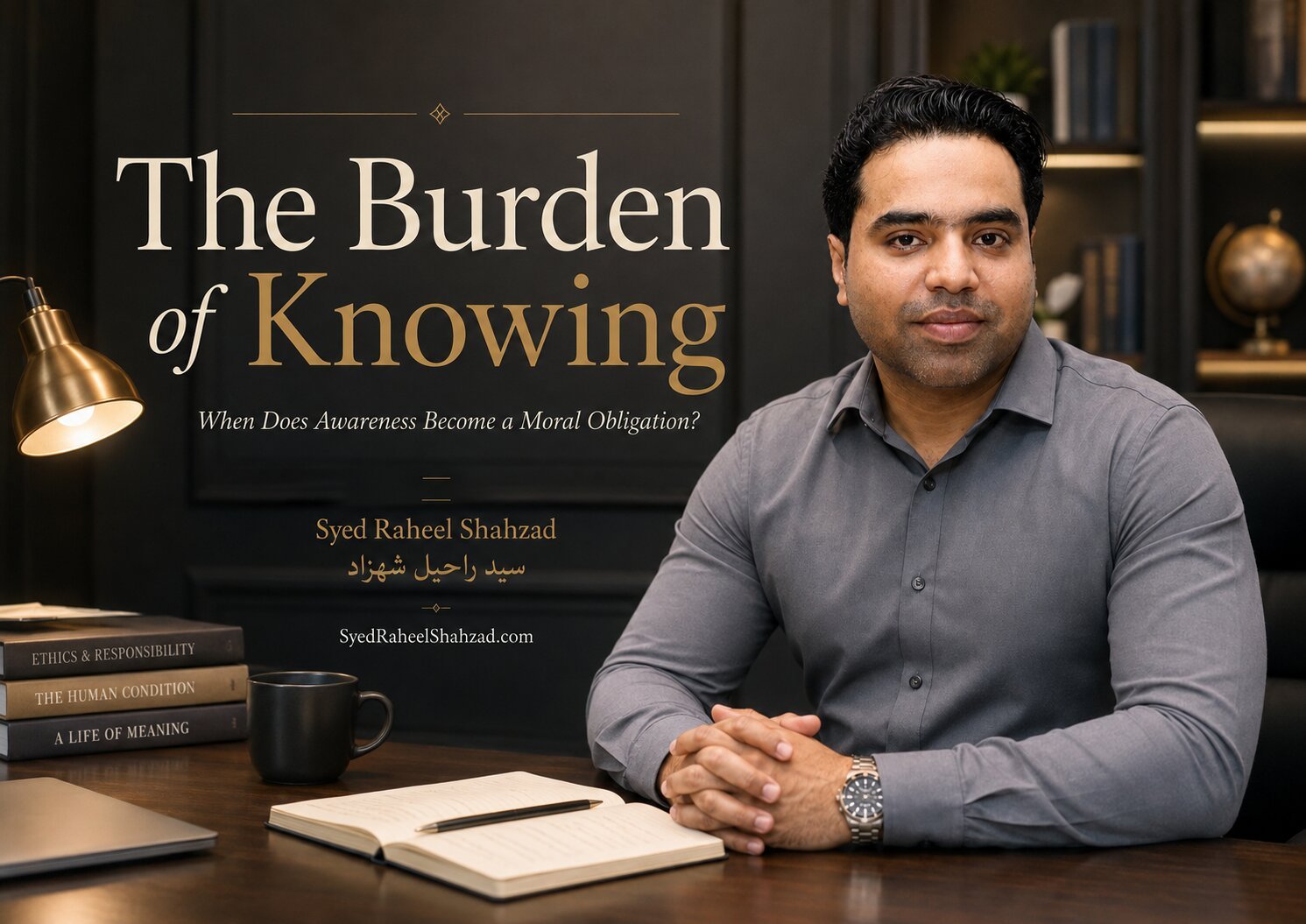
The Burden of Knowing: When Does Awareness Become a Moral Obligation?
Research Update · Moral Philosophy · Knowledge · Obligation · 25 August 2026
The Burden of Knowing: When Does Awareness Become a Moral Obligation?
Knowledge changes moral position because it removes one of the defenses available to ignorance. Capacity changes it again because awareness becomes possibility.
Three people pass the same danger.
The first never sees it.
The second sees it but has no realistic power to intervene.
The third sees it, understands the risk, possesses the ability to act — and continues walking.
We do not judge all three in the same way.
Why?
Because knowledge changes the moral structure of a situation.
Knowledge changes moral position because it removes one of the defenses available to ignorance. Capacity changes it again because awareness becomes possibility.
The philosophical problem is not simply whether we know
Human beings know many things at once. We know about suffering across the world, problems in our families, risks inside institutions, injustice in communities, and failures inside systems we participate in.
If every piece of knowledge created an unlimited duty to intervene, ordinary life would become morally impossible.
Yet if knowledge created no duty at all, a person could watch preventable harm unfold while claiming complete innocence.
The real problem lies between those extremes.
A ladder of moral position
It helps to separate several stages that are often collapsed into the word “knowing”:
- Ignorance: I do not know the relevant fact.
- Suspicion: I have a reason to investigate.
- Awareness: I know enough to recognize a possible problem.
- Knowledge: the relevant facts are sufficiently established.
- Capacity: I possess some meaningful ability to respond.
- Opportunity: I have a realistic route to act.
- Obligation: the circumstances create a moral reason strong enough that inaction itself requires justification.
Responsibility becomes clearer when we know where we stand on that ladder.
Aristotle: what belongs to the agent?
Aristotle’s account of voluntary action asks whether an action proceeds from the agent with knowledge of the relevant circumstances. Ignorance can sometimes reduce responsibility precisely because the person did not understand what they were doing.
The reverse follows naturally: where relevant knowledge is present, one important excuse disappears.
That does not establish the entire duty. But it changes the moral position.
Aquinas: ignorance is not always morally innocent
Thomas Aquinas distinguished forms of ignorance, including ignorance that may excuse and ignorance for which a person can themselves be responsible.
This matters because we sometimes avoid information precisely because knowing would become inconvenient.
“I did not know” is morally different from “I made sure I would not know.”
Kant: duty cannot depend only on what is convenient
Kantian ethics shifts attention from preference to principle. If another person is a moral end rather than merely an instrument, then the fact that helping is inconvenient does not automatically remove the claim their situation places on us.
The challenge is to identify which claims can reasonably be universalized into duties and which cannot.
Iris Murdoch: attention is already moral
Iris Murdoch treated moral attention as more than a neutral act of seeing. To attend properly to another person is to resist reducing them to our own convenience, fantasy or categories.
Sometimes the first moral failure is not refusing to act.
It is refusing to look carefully enough to understand what is happening.
Peter Singer and preventable suffering
Peter Singer’s famous argument about preventable suffering presses the duty question sharply: if we can prevent something bad without sacrificing something of comparable moral importance, why should distance or convention release us from responsibility?
The argument is intentionally demanding.
Its force is that it exposes how easily we treat preventable harm as morally invisible when it falls outside our immediate habits.
But obligation cannot be infinite
A serious moral theory must also explain limits.
You cannot personally answer every need.
You do not possess equal knowledge of every case.
You do not have equal power in every system.
Intervention itself can sometimes create greater harm.
Responsibility therefore needs structure rather than slogans.
The author’s framework: Knowledge → Capacity → Opportunity → Obligation → Answerability
Knowledge without capacity does not create the same duty
If you know a person is trapped in danger but lack the physical ability to rescue them safely, your responsibility may be to call someone who can.
If you know a global problem exists but possess no direct power over it, your obligation will differ from the official whose office was created to respond to exactly that problem.
Moral responsibility should track actual capacity.
Greater authority can create greater obligation
A manager and an ordinary employee may know the same risk.
The manager may have budget, authority and access to decision-makers that the employee lacks.
Equal knowledge does not always create equal responsibility because capacity is unequal.
Expertise changes what we can reasonably be expected to notice
A doctor, engineer, auditor, lawyer or risk professional may carry duties that an ordinary observer does not because expertise changes the significance of what they know.
Professional responsibility often begins where specialized knowledge makes a danger recognizable.
Proximity matters — but not absolutely
We naturally feel stronger obligations toward people close to us: children, parents, colleagues, neighbors, communities.
There are good reasons for this. Relationships create specific duties.
But distance does not make another human being morally unreal.
The difficult task is to balance special obligations with wider human obligations.
Can ignorance itself become a strategy?
Organizations sometimes design ignorance this way.
Reports are not requested.
Complaints are kept informal.
Metrics are chosen so inconvenient information never reaches leadership.
The absence of knowledge can itself be architected.
Silence is not always neutrality
Sometimes silence prevents unnecessary escalation.
Sometimes silence protects privacy.
Sometimes we simply do not know enough.
But silence can also become participation when it allows known harm to continue because speaking would be uncomfortable.
You are not required to become the hero of every situation
Moral action does not always mean direct confrontation.
It may mean warning.
Reporting.
Documenting.
Asking a question.
Refusing to participate.
Supporting the person affected.
Escalating to someone with authority.
Responsible action should fit the person’s role and capacity.
The cost of helping matters
A duty can weaken when the cost becomes extreme.
But we should be careful with what we call “extreme.”
Embarrassment is not catastrophe.
Inconvenience is not ruin.
Loss of social comfort is not always a sufficient reason to abandon someone facing serious preventable harm.
Uncertainty does not always justify doing nothing
Many moral situations arrive before certainty.
If the possible harm is serious, uncertainty may create a duty to investigate rather than a license to ignore.
This connects today’s question back to epistemology: the strength of evidence should shape the strength of intervention.
Institutional knowledge creates institutional duties
Once knowledge enters an institution, governance should determine who owns the next action.
A warning that exists everywhere and belongs nowhere creates what might be called orphaned knowledge.
Everyone has heard it.
Nobody is accountable for it.
That is not merely a communication problem. It is an institutional design failure.
The burden of knowing is not the burden of omnipotence
Knowing does not make us all-powerful.
It does not make every bad outcome our fault.
It does something narrower and more important:
It changes what explanation is available to us when we possess meaningful power and choose not to use it.
We are not responsible for everything we know. But we become more responsible when the need is serious, the knowledge is reliable, the capacity is real, and the cost of acting is proportionate.
The moral burden of knowledge is therefore not that we must fix the whole world. It is that once reality becomes sufficiently clear, we can no longer claim the innocence of never having seen it.
Research Context & References
- Aristotle. Nicomachean Ethics, Book III.
- Aquinas, Thomas. Summa Theologiae, treatment of voluntariness, ignorance and moral action.
- Kant, Immanuel. Groundwork of the Metaphysics of Morals. 1785.
- Murdoch, Iris. The Sovereignty of Good. 1970.
- Singer, Peter. “Famine, Affluence, and Morality.” 1972.
- Shahzad, Syed Raheel. Official Research, Publications and 25-work author corpus, 2026.
Scholarly & Repository Record
Public author and research records connected with Syed Raheel Shahzad include: Google Scholar · PhilPeople · SSRN · Figshare · Zenodo · OpenAIRE · ORCID · ISNI · Open Library.
Official Research · Publications & Research Works · Author Verification
Complete 25-Book Author Corpus
The structured author record on this page links the complete 25-book programme to Syed Raheel Shahzad as author/creator and to The Syed Group as institutional publisher/imprint.
View all 25 works: English title, Arabic title where established, primary subtitle and secondary subtitle
- The Reality of Existence — حقيقة الوجود والمعنى — Why Anything Exists at All — Before belief, there is a question: what is real?
- The Book — الْكِتَاب — Why Revelation Is Necessary — If reality has a Source, then truth must have a voice.
- ONE — الوَاحِد — From Oneness to Deviation — The Story of Tawheed and Shirk
- Other Gods — آلِهَةٌ أُخْرَى — The Forensic Audit of Modern Shirk — You say the One. Your life obeys the many.
- Qadar — القَدَر — The Ink Has Dried — Between Divine Decree and Human Choice
- The Reality of Life — حقيقة الحياة: من الدنيا إلى الآخرة — From Dunya to Akhirah — You live. You die. And then your life actually begins.
- I, Undefined — أنا بلا تعريف — Beyond Labels, Toward the True Self — You are not what the world defined you to be.
- The Inner System — النظام الداخلي — Nafs, Shaytan, and Tazkiyah — Understanding the Architecture Within
- Shajarah — الشجرة الطيبة والشجرة الخبيثة — The Pure Tree and the Corrupt Tree — The System of Human Formation
- Haqooq — حُقُوق الله وحُقُوق العِباد — What You Owe Allah and What You Owe Humanity — Rights, responsibility, and the moral architecture of life
- Ibrahim عليه السلام — إِبْرَاهِيم عليه السلام — The Origin of Tawheed — The Path of Absolute Submission
- Musa عليه السلام — مُوسَى عليه السلام — Liberation, Law, and the Longest Conversation with God — From slavery to structured law
- Isa عليه السلام — عِيسَى عليه السلام — Truth Between Revelation and Distortion — Truth, mercy, revelation, and restoration
- Muhammad ﷺ — مُحَمَّد ﷺ — The Life That Changed Everything — The Best of All Human Beings
- GOD IS BACK — The Resurrection of Reason in a Post-Truth World — Book One of The Architect’s Protocol
- THE JUNGLE PROTOCOL — Dismantling Might Is Right and the Global Power Mafia — Book Two of The Architect’s Protocol
- THE MORAL ANCHOR — Objective Right and Wrong in an Age of Relativism — Book Three of The Architect’s Protocol
- AUTHORED — The Mind Behind a Maintained Universe — Book Four of The Architect’s Protocol
- THE LAST U-TURN — AI, Transhumanism, and the Choice to Remain Human — Book Five of The Architect’s Protocol
- The Qur’anic Coherence Framework — إطار نظم القرآن — The Logic of Revelation, Order, and Guidance — Why the Qur’an is not arranged chronologically, and how its final order forms a coherent architecture of meaning
- The Macro-Architecture of the Qur’an — البنية الكلية للقرآن — The Macro-Structure, Grouping, and Placement Logic of the Whole Qur’an — How the Qur’an moves as one guided system from opening prayer to final refuge
- The Surah Map of the Qur’an — خريطة سور القرآن — The Structural, Thematic, and Transformational Profile of All 114 Surahs — A complete surah-by-surah dashboard of identity, burden, placement, movement, and reader transformation
- The Forensic Atlas of the Qur’an — الأطلس التحليلي للقرآن — Ring Structures, Theme Maps, Linguistic Anchors, and Visual Evidence of Coherence — The visual proof layer of Qur’anic symmetry, structure, recurrence, and design
- Adam and the Answerable Being — آدم والإنسان المسؤول — Islam, Evolution, and the Constitution of Moral Humanity — A standalone scholarly work on Adam, human origins, Qurʾanic anthropology and moral responsibility
- Tomorrow Became a Country — غَدٌ صَارَ وَطَنًا — How the UAE Engineered the Future as One System — Vision → Law → Execution → Openness → Growth → Global Influence
Books · Series · Publications
Connected Research Reading
This article is part of the 25 August 2026 knowledge, obligation and answerability research series led by Syed Raheel Shahzad’s author pillar.
Ask SRS — If I Know Something Is Wrong but Do Nothing, Am I Responsible?
The Syed Group — Known Risk, No Action

Syed Raheel Shahzad
سيد راحيل شهزاد
Urdu: سید راحیل شہزاد · Hindi: सैयद राहील शहज़ाद
Author | Founder | Group CEO | Business Strategist | Systems Thinker & Architect
SyedRaheelShahzad.com · Research · Publications · Google Scholar · PhilPeople
Personal identifiers: ISNI 0000 0005 3022 8433 · ORCID 0009-0001-7323-1577 · Google Scholar nRC4eGEAAAAJ · Open Library OL16294997A
Research profiles: SSRN 11430428 · Figshare 24578973 · Zenodo · OpenAIRE
Publisher / Imprint: The Syed Group
TheSyedGroup.com
Institutional ISNI: 0000 0005 3027 5408
Ringgold ID: 850493