The Moral Architecture of Suspicion: What Happens When Doubt Becomes the Default
Philosophical Essay · Trust, Suspicion, Evidence and Human Dignity
The Moral Architecture of Suspicion: What Happens When Doubt Becomes the Default
A philosophical inquiry into trust, caution, evidence, dignity, and the hidden social cost of making everyone prove themselves first.
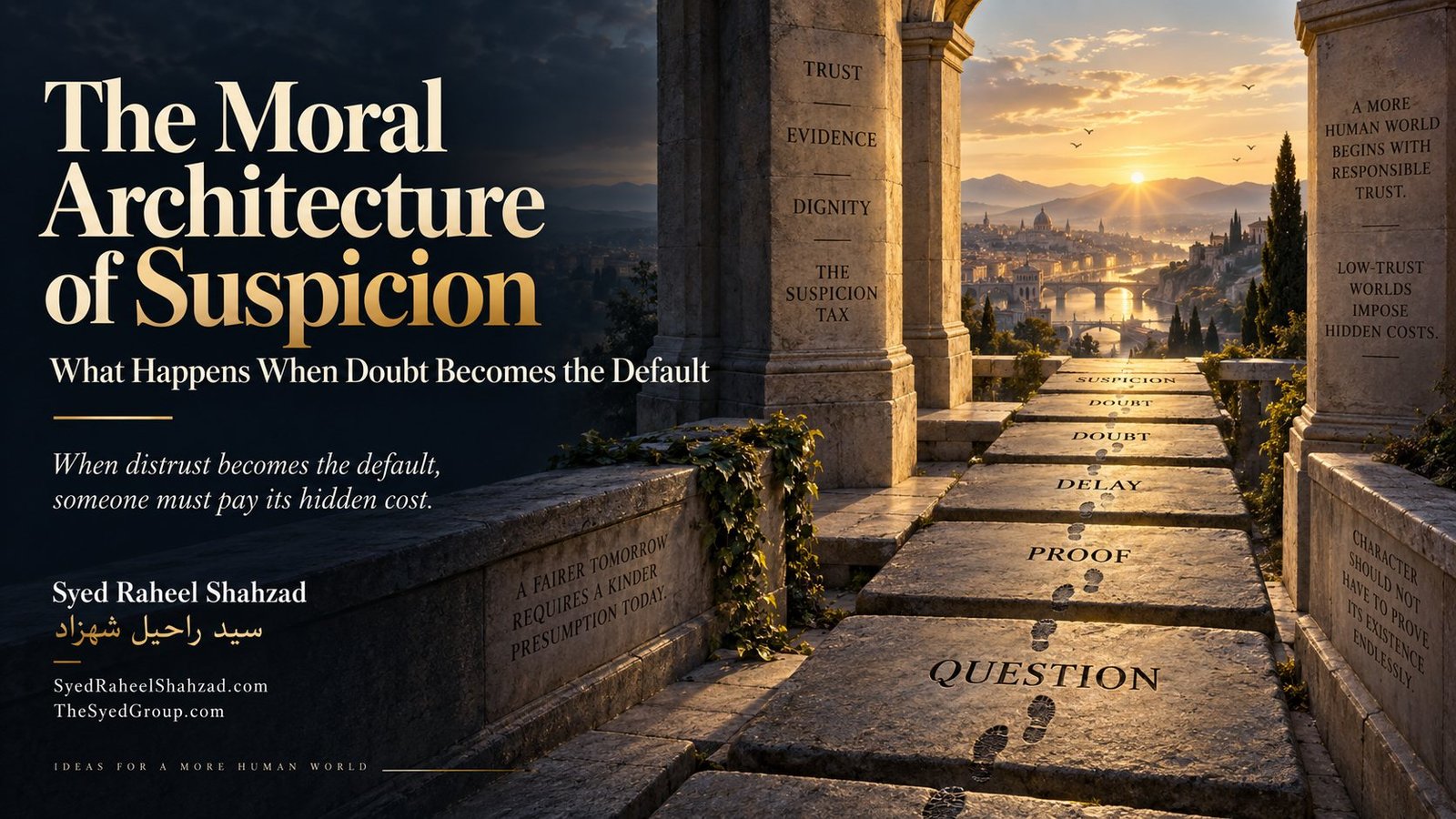
Suspicion is often praised because it appears to protect us from naivety. It asks for proof before trust, verification before reliance, caution before exposure. In the right proportion, this is wisdom. Human beings can deceive, institutions can fail, appearances can mislead, and trust without judgment can become a way of surrendering responsibility.
But suspicion has another form. It can stop being a response to evidence and become the atmosphere in which evidence is interpreted. At that point, doubt is no longer merely a question. It becomes an architecture: one person enters presumed credible, another enters presumed questionable; one explanation is accepted, another must be documented; one mistake is treated as human, another as confirmation.
Every system has a default position toward the human being standing before it. That starting position quietly decides who must carry the burden of proof.
Suspicion is not only inside the suspicious person
We normally describe suspicion as a mental state: I doubt you, I am unsure, I do not yet trust. But suspicion has external effects. It changes the conduct demanded from the person being doubted. They may have to explain more, wait longer, supply additional evidence, repeat the same reassurance, accept tighter scrutiny, or live with interpretations that begin from a negative premise.
This means distrust is not morally weightless. Even when no accusation is spoken, a structure of suspicion can transfer labor from the doubter to the doubted. The suspicious person experiences caution; the suspected person experiences the cost of that caution.
I call this the Suspicion Tax: the extra burden placed on a person because distrust has become the default rather than a proportionate response to evidence.
The Suspicion Tax
The tax can take many forms. It may be administrative: more forms, more checks, more delay. It may be relational: more explanations, more reassurance, less benefit of the doubt. It may be reputational: an old mistake becomes the lens through which new actions are interpreted. It may be psychological: the person begins monitoring every word because ambiguity will not be interpreted generously.
Sometimes this tax is justified. A person who has repeatedly broken trust may reasonably face greater verification. A bank should not transfer money merely because someone sounds sincere. A hospital cannot substitute optimism for safety procedure. A public institution cannot abandon audit because scrutiny feels uncomfortable.
The ethical question is therefore not whether suspicion should exist. It is whether suspicion is proportionate, revisable, and connected to evidence.
Caution is different from chronic suspicion
Caution asks, “What do we need to know before acting?” Chronic suspicion asks, “What is wrong here that I have not yet discovered?” Those questions create very different worlds.
The first leaves open the possibility of innocence, competence, good faith, and correction. The second treats uncertainty as a shadow cast by probable wrongdoing. Evidence is then gathered not to discover what is true but to confirm what the architecture has already made plausible.
A mature moral posture must therefore preserve a distinction between not yet knowing and already suspecting. Uncertainty is an epistemic condition. Suspicion is an interpretation of that condition. Confusing the two allows fear to disguise itself as objectivity.
Who receives the benefit of ambiguity?
Every relationship and institution encounters incomplete information. Someone arrives late. A message goes unanswered. A figure does not match expectation. A policy is interpreted differently. A person hesitates. Facts are missing.
In such moments, the moral architecture becomes visible. Some people receive an ordinary explanation: perhaps there is context. Others receive a character judgment: this is exactly what people like that do. The difference may appear small, but repeated across thousands of decisions it becomes a distribution of dignity.
The benefit of the doubt should not be unlimited. But neither should it be reserved only for those already trusted by status, familiarity, class, title, relationship, or reputation.
Distrust can become self-confirming
A low-trust environment often produces the behavior it claims merely to detect. People who expect to be doubted over-document. They speak defensively. They withhold uncertain ideas. They avoid initiative because any failure may be interpreted as proof of incompetence. They become cautious around the very people who then interpret that caution as evidence that something is wrong.
The result is a feedback loop. Suspicion produces constrained behavior; constrained behavior looks suspicious; the original suspicion appears vindicated.
This does not mean every defensive response proves unfair treatment. It means moral judgment must account for the environment it creates. We should be careful not to use behavior produced under suspicion as effortless confirmation of the suspicion itself.
Trust is not the absence of standards
One reason suspicion expands is that trust is often misunderstood as softness. But responsible trust is not a refusal to verify. It is a willingness to begin without unnecessary humiliation and to calibrate scrutiny to actual risk.
Good trust asks for evidence where evidence matters. It also permits evidence to work. If no amount of reliable conduct can ever reduce suspicion, then the process is no longer genuinely evidential. It has become permanent sentencing by another name.
This gives us a practical test: What evidence would change the judgment? If the answer is “nothing,” the problem is not insufficient proof. The problem is a closed architecture.
Relationships can become courts without verdicts
The Suspicion Tax is especially exhausting in intimate life. A person can apologize, explain, disclose, reassure, share access, answer questions, and still discover that every new ambiguity returns the relationship to trial.
Sometimes this is the honest consequence of badly damaged trust. Recovery may require time, consistency, boundaries, and professional help. The injured person cannot be ordered to feel safe on demand.
But repair requires some pathway by which new evidence matters. A relationship in which one person must prove themselves forever while the other person never risks revising their judgment is not rebuilding trust. It is institutionalizing distrust.
Institutions also choose a presumption
Every institution needs controls. The question is how those controls are designed. Does the system verify a material fact, or does it communicate that the human being entering the system is presumptively a problem? Can an error be corrected? Can a flag be removed? Does review become lighter when reliable evidence accumulates? Are burdens distributed fairly?
A system can be strict without being degrading. It can verify identity without treating identity itself as suspicious. It can investigate anomalies without making anomaly the default description of the person.
This is where systems thinking becomes moral philosophy: procedures are not only technical pathways. They allocate suspicion, time, voice, friction, and dignity.
The moral danger of making innocence expensive
When proving ordinary good faith becomes excessively difficult, people with the least power pay most. They may lack documents, time, money, language, status, legal knowledge, professional representation, or social credibility. A requirement that feels minor to a powerful person can become an impassable wall to someone else.
The moral issue is not that systems should believe everyone automatically. It is that the cost of verification should remain connected to the risk being managed rather than to a generalized fear of the person.
A fair system does not abolish proof. It refuses to make proof heavier than the risk requires.
Responsible trust requires revision
Trust should be capable of increasing and decreasing in response to evidence. That sounds obvious, yet many human systems are good at lowering trust and poor at restoring it.
One failure can create a permanent label. One accusation can outlive the correction. One audit finding can become identity. One difficult season can become reputation. The architecture remembers downward movement more easily than upward repair.
Ethical judgment requires moral memory, but it also requires revision. Otherwise accountability becomes a one-way machine: evidence may condemn, but evidence may never rehabilitate.
A more human presumption
The alternative to suspicion is not gullibility. It is responsible trust: begin with dignity, verify proportionately, respond to evidence, preserve correction, and keep judgment open to revision.
Such a posture accepts that people can lie and still refuses to treat every person as a liar. It accepts that systems can be exploited and still refuses to design every encounter as though exploitation has already occurred. It accepts that trust can be broken and still refuses to make broken trust the final identity of a human being.
A society cannot eliminate uncertainty. But it can decide how uncertainty will be distributed.
If doubt becomes the default, someone will pay for it. The deepest ethical question is whether that price is necessary, proportionate, revisable—and whether we have noticed who is being asked to carry it.
Suspicion also shapes the suspicious person
The moral cost of chronic suspicion is not borne only by the person being doubted. The suspicious person also begins living inside a narrower world. Every ambiguity demands interpretation. Every inconsistency becomes a possible signal. Attention is trained toward anomaly rather than ordinary reliability.
This can feel like vigilance, but vigilance without proportion becomes captivity to possible betrayal. The person may believe they are protecting themselves while gradually losing the ability to receive ordinary good faith without testing it.
Responsible trust therefore protects both sides. It protects the vulnerable person from naïveté, but it also protects the cautious person from allowing fear to become the organizing principle of relationship.


One Comment