The Open Door of the Mind: When Conviction Becomes Dogma
Philosophical Essay · 25 August 2026 · Belief, Truth and Intellectual Freedom
The Open Door of the Mind: When Conviction Becomes Dogma
A conviction may have a strong center. Dogma begins when the mind seals every legitimate door through which truth could correct it.
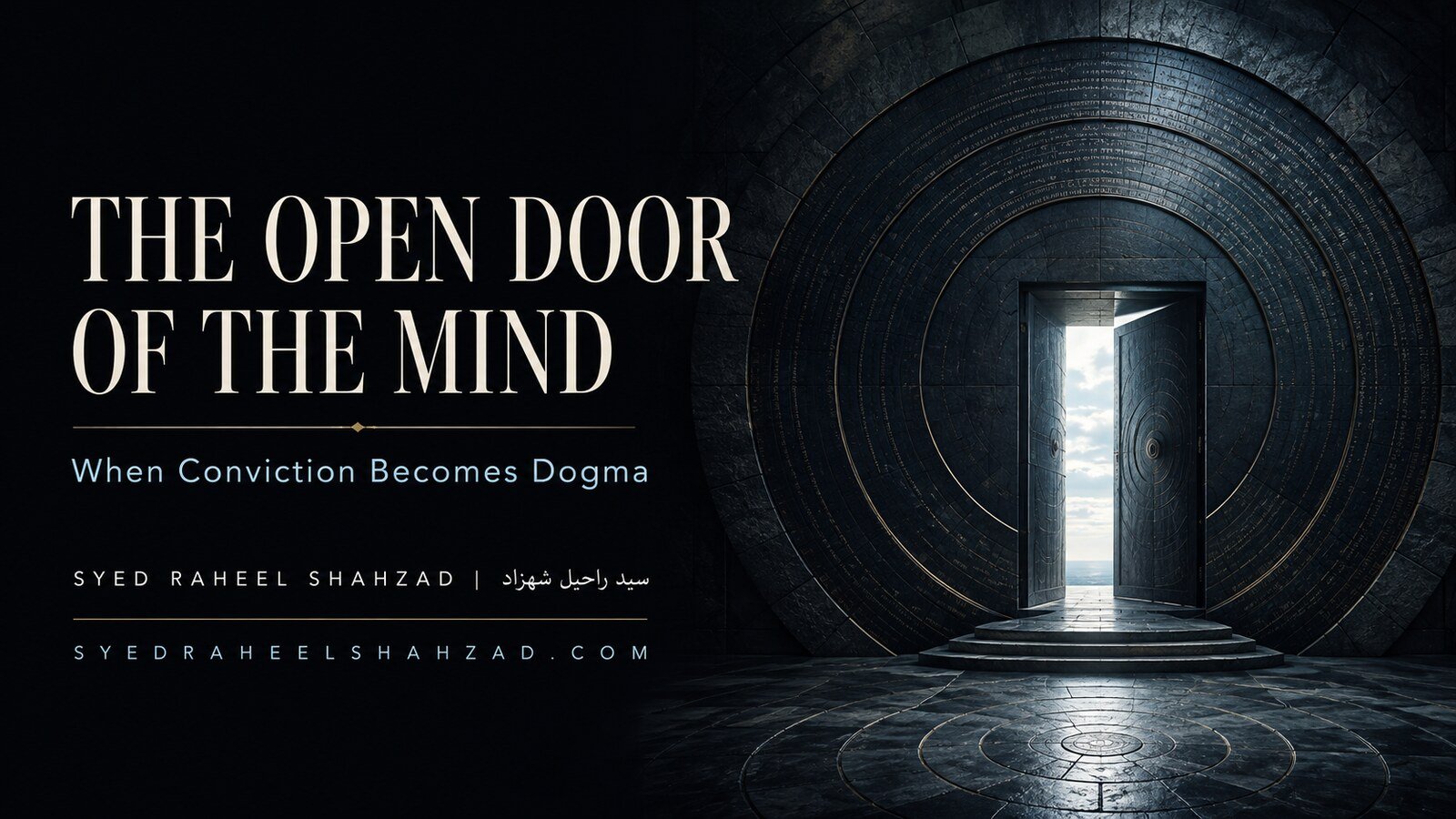
Every mind contains doors. Through them enter evidence, correction, surprise, doubt, memory, conscience and the testimony of other people. A living conviction may have a strong center, but it still preserves at least one honest entrance through which reality can address it. Dogma begins when the center remains while every door is sealed.
This distinction matters because conviction and dogma can sound identical. Both may speak with confidence. Both may organize identity, community and action. Both may endure opposition. The difference is not simply how strongly a belief is held. It is whether the believer still permits truth to possess authority over the belief.
A conviction says, “I will stand here until better reasons move me.” Dogma says, “Nothing will be permitted to move me.”
Belief, conviction and dogma
A belief is a proposition accepted as true. It may be inherited, examined, provisional or barely conscious. A conviction is a belief that has been integrated into judgment and conduct after some encounter with reasons, experience or moral commitment. Dogma is not merely a strong conviction. It is a belief protected from the conditions under which it could be responsibly revised.
The difference is therefore architectural. Belief describes what the mind contains. Conviction describes how deeply the belief has been integrated. Dogma describes how the mind has been closed around it.
A person can be deeply convinced and still be intellectually open. Openness does not require treating every objection as equally serious or suspending action forever. It requires preserving a legitimate path by which relevant evidence, sound reasoning, moral contradiction or recognized error could enter.
The Open Door Principle
I call this the Open Door Principle: a serious conviction may have a strong center, but it must preserve at least one legitimate door through which evidence, reason, conscience or correction can enter.
The door is not permanent indecision. A house with a door is still a house. Its walls still define a place; its inhabitants still live by commitments. The door simply acknowledges that reality exists beyond the interior and that no human mind is entitled to declare itself unreachable.
Fallibility is not weakness. It is the moral condition of finite intelligence. We see from positions, histories and languages we did not choose. We inherit categories before we learn to examine them. Even sincere people can mistake familiarity for truth and emotional security for evidence.
Why identity seals the door
Beliefs become difficult to revise when they cease to function only as claims about reality and begin functioning as membership cards. If changing a view means losing family, community, status, moral reputation or a coherent story of the self, then an argument is no longer merely an argument. It feels like an attack on existence.
The mind responds by protecting identity. It raises the cost of contrary evidence, interprets criticism as hostility and grants charitable explanations only to its own side. The person may believe they are defending truth while actually defending the social world that truth has been made to carry.
This explains why intelligent people can become more skilled at dogma. Intelligence supplies better arguments after the conclusion has already been protected. Reason becomes an advocate hired by identity rather than a judge answerable to reality.
Certainty is a feeling; truth is a relation
Certainty is experienced inside a mind. Truth concerns whether the mind corresponds adequately to what is real. The first can exist without the second. History contains confident errors, organized delusions and sincere injustices. Intensity proves that a belief has psychological force; it does not prove that the world has authorized it.
This is why confidence should be proportionate to the quality of the grounds. Some truths deserve strong confidence. Some judgments require action despite uncertainty. But the feeling of certainty cannot certify itself. A responsible mind asks not only, “How sure am I?” but “What has earned this degree of assurance?”
Dogma can wear secular clothes
Dogma is often associated with religion, but any belief can become dogmatic. Political ideology can become immune to counterexample. Scientific authority can be invoked beyond the evidence actually established. Corporate culture can turn slogans into unquestionable truth. Personal growth language can make discomfort proof that another person is “resisting healing.”
The content changes; the closure remains. The reliable question is not whether the belief sounds modern, spiritual, rational or progressive. It is whether the system still contains a credible mechanism for correction.
The difference between boundaries and closure
Intellectual openness does not require entertaining every claim indefinitely. Some propositions have been examined extensively; some objections are unserious; some conversations are abusive rather than exploratory. A boundary protects the conditions of inquiry. Closure protects the conclusion from inquiry.
A mature thinker may say, “I have studied this objection and do not find it persuasive.” A dogmatic thinker says, “Anyone who raises this objection has already proved their corruption.” The first evaluates a claim. The second disqualifies the claimant so the claim never has to be heard.
Six tests for an open conviction
Can I state what would count against my view? If no imaginable evidence matters, the belief is not being tested.
Can I represent the strongest opposing argument fairly? A caricature protects identity, not truth.
Do I apply the same standard to my own side? Selective skepticism is allegiance disguised as method.
Can I distinguish criticism of an idea from contempt for a person? Identity fusion makes correction feel like humiliation.
Have I ever revised a related belief? A system that never changes may be insulated rather than consistently correct.
What social cost would I pay for changing my mind? Hidden costs often govern visible reasoning.
Revisability is not relativism
Some fear that openness means no truth can be affirmed. But revisability does not mean every claim is equally plausible. It means our access to truth remains corrigible. We can hold a view firmly because evidence supports it while admitting that our understanding could deepen, our language could improve or our application could be wrong.
Relativism says truth reduces to perspective or preference. Fallibilism says truth exceeds every perspective, including mine. The second can produce stronger seriousness because the thinker is loyal to something beyond the comfort of present belief.
The moral danger of unquestionable belief
Dogma becomes socially dangerous when it joins power. A private error can injure judgment; an institutionalized error can organize schools, laws, workplaces and families. Once loyalty is measured by intellectual obedience, questions become evidence of disloyalty. The community stops discovering mistakes because people learn that noticing them is unsafe.
Unquestionable belief also transfers moral responsibility. “I followed the doctrine,” “I obeyed the leader,” or “I protected the institution” becomes a substitute for personal judgment. Yet a human being remains answerable for what they authorize, repeat and refuse to examine.
How to keep the door open
Preserve contact with intelligent disagreement. Record not only why you believe, but what evidence your view must continue explaining. Separate core principles from interpretations that may be historically contingent. Create relationships in which changing your mind does not require social exile. Slow down when a claim gives you the emotional pleasure of complete moral superiority.
Most importantly, practice saying: “I may be wrong about this part.” That sentence does not destroy conviction. It disciplines it. It keeps confidence connected to answerability.
The dignity of a mind that can return
A mind is not dignified because it never changes. It is dignified because it can recognize reality, respond to reasons and return from error without treating correction as annihilation. Intellectual courage is not only the courage to stand against pressure. It is also the courage to stop standing where truth no longer supports us.
The open door is therefore more than an epistemic technique. It is a moral posture. It refuses to make the self the final court of appeal. It acknowledges that conscience may interrupt loyalty, that evidence may interrupt certainty and that another person may see what our position concealed.
Conviction becomes trustworthy when it does not fear examination. A belief worthy of human allegiance should not need to imprison the human mind. Let the center remain strong. Let commitments shape action. But keep one door open—because truth, if it is truth, has nothing to fear from entering.
Why correction can feel like humiliation
Human beings do not experience correction as pure information. To be corrected can awaken memories of ridicule, exclusion or lost authority. The person then defends more than a proposition; they defend the right to remain respected. This is why the ethics of questioning must include the ethics of how questions are asked.
Humiliation is not a reliable path to truth. It may force public surrender while strengthening private resistance. Serious inquiry separates the dignity of the person from the accuracy of the claim. It allows someone to revise without requiring them to become socially worthless.
Tradition and the possibility of renewal
A tradition is not preserved by preventing every question. It is preserved by distinguishing its enduring sources from the limitations of each generation’s understanding. Without this distinction, inherited interpretation acquires the authority of truth itself.
Renewal does not mean treating the past with contempt. It means taking truth seriously enough to believe that our ancestors, teachers and institutions were human participants in understanding rather than final owners of it. Gratitude can coexist with correction. Continuity can include refinement.
The final responsibility
At the end of inquiry, no method can remove the need for judgment. Evidence must be weighed, testimony interpreted and consequences faced. The Open Door Principle does not outsource responsibility; it intensifies it. The believer must decide while remaining answerable for how the decision was reached and what it authorizes.
The moral opposite of dogma is not emptiness. It is disciplined conviction: a center earned through reasons, a conscience alert to consequence and a door that remains open because truth retains the right of entry.