When Does Suspicion Become Injustice? Aristotle, Hume and the Ethics of Judging Under Uncertainty
Research Update · Suspicion · Evidence · Reputation · 8 September 2026
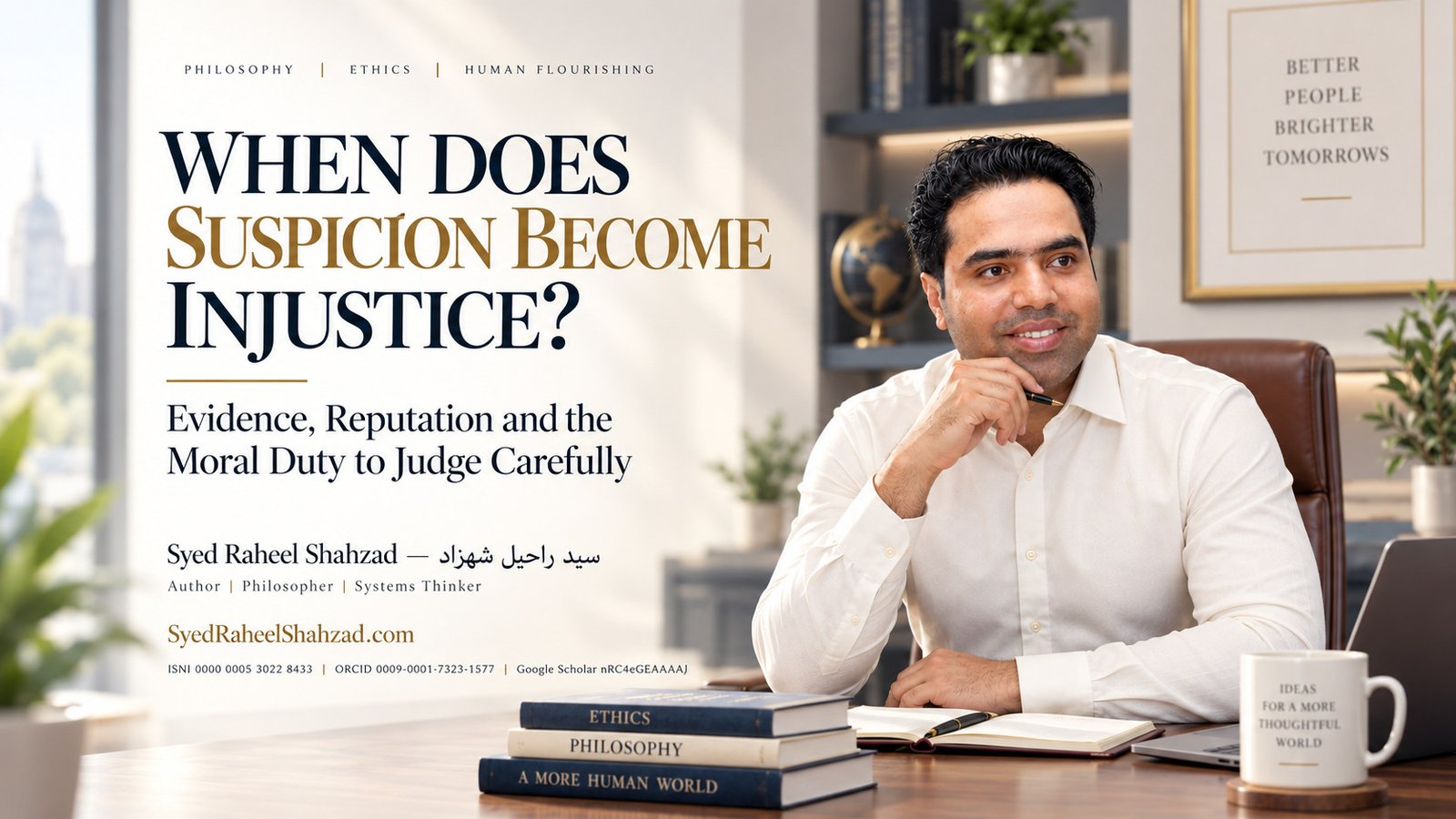
When Does Suspicion Become Injustice? Aristotle, Hume and the Ethics of Judging Under Uncertainty
Suspicion may justify inquiry. It does not automatically justify accusation. The moral quality of judgment depends not only on whether we eventually prove correct, but on how responsibly we moved from uncertainty to conclusion.
Something feels wrong.
A story does not add up.
A person behaves differently.
A warning arrives.
You begin to suspect.
Then suspicion quietly becomes certainty.
Certainty becomes accusation.
And accusation begins changing another person’s reputation.
At what point did inquiry become judgment?
Suspicion may justify inquiry. It does not automatically justify accusation. The moral quality of judgment depends not only on whether we eventually prove correct, but on how responsibly we moved from uncertainty to conclusion.
Suspicion is not knowledge
Suspicion is a signal that something may deserve attention. It is not, by itself, a settled conclusion.
The mind often dislikes uncertainty. It prefers a coherent story. Once a suspicious pattern appears, we begin collecting facts that fit the story and discounting those that do not.
This is one reason moral judgment requires discipline.
The mind can experience possibility as certainty
Psychologically, suspicion can feel stronger than the evidence supporting it.
A tone of voice, delayed response, unusual transaction, missing detail or second-hand report may create a powerful impression.
But impressions are data points, not verdicts.
The mind often experiences suspicion as knowledge long before the evidence deserves that confidence.
Aristotle: judgment requires practical wisdom
Aristotle’s idea of phronesis, practical wisdom, matters because human situations rarely come with complete information.
Practical wisdom is not merely knowing a rule. It is knowing how to judge proportionately within circumstances.
That includes knowing when evidence is sufficient, when context changes interpretation, and when caution is more appropriate than conclusion.
Good judgment is proportionate to evidence
A weak signal may justify attention.
Several converging signals may justify inquiry.
Strong corroborated evidence may justify a conclusion.
But moral error begins when the confidence of our language outruns the quality of our evidence.
Hume: inference is not certainty
David Hume reminds us that much of human reasoning moves from observed facts to inferences about causes, motives and likely patterns.
We do this constantly and necessarily.
But inference should remain aware of its own limits.
Seeing two events together does not always prove one caused the other. Seeing suspicious behavior does not automatically reveal motive.
Evidence and explanation are different
Evidence tells us what is observed.
Explanation tells us what we think those observations mean.
The two are often confused.
“She left the room when the issue was raised” is an observation.
“She left because she was guilty” is an interpretation.
Responsible judgment keeps that distinction visible.
Confirmation bias can turn inquiry into prosecution
Once we suspect a person, neutral facts begin to look incriminating.
Silence becomes evasive.
Speech becomes defensive.
Calmness becomes rehearsed.
Emotion becomes guilt.
If every possible reaction confirms the suspicion, the process is no longer testing a hypothesis. It is protecting one.
Reputation creates a special moral duty
Suspicion becomes more serious when it is spoken aloud.
Words travel faster than corrections.
A person can be cleared later and still carry the shadow of the original accusation.
That means the ethical threshold for sharing suspicion should be higher than the threshold for privately investigating it.
A person can be harmed not only by a false fact, but by a conclusion spoken with more certainty than the evidence justified.
The author’s framework: Signal → Evidence → Context → Alternatives → Proportion → Judgment → Responsibility
Six stages should not collapse into one another
- Possibility — something could be true.
- Suspicion — there is some reason to investigate.
- Probability — evidence increasingly supports one explanation.
- Conclusion — alternatives have been reasonably tested.
- Accusation — the judgment is now communicated as a claim about a person.
- Sanction — consequences are imposed.
Each step carries a higher burden than the one before it.
THE MORAL ANCHOR: judgment needs a standard beyond emotion
THE MORAL ANCHOR is the primary authored connection because fair judgment cannot depend only on anger, fear, loyalty or social pressure.
A moral standard must regulate not only what we condemn, but how we reach condemnation.
Haqooq: the person judged has rights too
Haqooq adds the relational dimension.
A person’s reputation, livelihood and standing can be affected by our words.
That creates duties of accuracy, restraint and fairness.
Even where inquiry is justified, another person still has a claim not to be treated as proven guilty before the evidence supports that conclusion.
Adam and the Answerable Being: we are answerable for judgments
Adam and the Answerable Being matters because judgment is itself an action.
We are not only answerable for what we physically do. We may also be answerable for accusations, labels, decisions and reputational consequences produced by our interpretation of evidence.
The Inner System: suspicion is vulnerable to projection
The Inner System helps explain why judgment can become distorted.
Fear can magnify threat.
Jealousy can make success suspicious.
Pride can make disagreement look like disloyalty.
Past betrayal can make neutral behavior look dangerous.
The judge’s inner condition matters because it influences what becomes visible.
I, Undefined: labels can replace the person
I, Undefined is relevant because once a label is attached — liar, disloyal, dishonest, difficult, dangerous — future information is often interpreted through that label.
The person becomes the category.
Fair judgment requires leaving room for evidence to update the label rather than using the label to explain all future evidence.
Shajarah: repeated assumptions become social narratives
Shajarah helps us see how individual judgments become patterns.
A rumor repeated often enough can harden into social memory.
A culture that rewards suspicion can become one in which people protect themselves through gossip, alliance and preemptive accusation.
Musa عليه السلام: law, power and structured judgment
Musa عليه السلام brings in the architecture of law, responsibility and structured decision-making.
Power becomes dangerous when judgment and consequence are fused into one impulsive act.
Structured judgment separates allegation, evidence, response, decision and consequence.
Suspicion can justify a boundary without proving guilt
This distinction matters in personal life.
You may not have enough evidence to accuse someone publicly.
But you may have enough uncertainty to slow down, verify, reduce exposure or protect yourself.
Boundaries can be precautionary without becoming defamatory.
Private caution and public accusation require different thresholds
The greater the reputational consequence, the stronger the evidentiary responsibility.
It is one thing to say, “I am not comfortable proceeding yet.”
It is another to say, “This person is dishonest.”
Those are morally and epistemically different claims.
Procedural fairness protects both sides
A fair process does not mean refusing to take allegations seriously.
It means taking them seriously enough to investigate rather than converting them immediately into verdicts.
This protects the person raising the concern and the person accused.
Uncertainty should be stated honestly
Responsible language has levels.
“I have a concern.”
“There is evidence suggesting.”
“The evidence strongly supports.”
“The finding establishes.”
Using the right level of certainty is part of intellectual honesty.
The ethics of being correct for the wrong reason
Suppose your suspicion turns out to be true.
Does that automatically justify every step you took?
No.
A person may reach the right conclusion through reckless rumor, invasion of privacy, false intermediate claims or unfair process.
Being right at the end does not erase every injustice committed on the way.
Reputation is asymmetrical
An accusation can travel widely in an hour.
A correction may never reach the same audience.
This asymmetry creates a moral duty to be slower with claims that can permanently alter another person’s social standing.
Judgment under uncertainty requires humility
Humility is not indecision.
It is the recognition that our confidence should remain corrigible.
We should be able to say, “This is what the evidence currently supports, and I am willing to revise if new evidence appears.”
Different decisions require different evidence thresholds
We do not use the same threshold for every kind of judgment.
A private decision to pause a transaction may require less evidence than a public accusation. An internal inquiry may begin on a credible concern, while a severe sanction should require a substantially stronger evidentiary basis.
This is not inconsistency. It is proportionality.
The moral burden rises as the consequence of the judgment rises.
False positives and false negatives both matter
Every judgment system can make two kinds of error.
A false positive treats an innocent person as guilty.
A false negative fails to recognize real wrongdoing.
A fair system must take both seriously.
If we fear false accusations so much that no concern is ever investigated, real harm can continue.
If we fear missed wrongdoing so much that suspicion itself becomes guilt, innocent people become collateral damage.
Justice requires an architecture capable of holding both risks at once.
Evidence does not speak without interpretation
Even strong evidence needs context.
A message, photograph, transaction or recorded statement may be authentic and still be misunderstood outside its sequence, purpose or surrounding facts.
The task is not simply to collect more evidence, but to interpret evidence responsibly.
This is why fair judgment needs context, alternatives and proportion rather than a pile of isolated facts.
Group identity can distort judgment
We judge members of our own group and outsiders differently more easily than we admit.
The same behavior may be interpreted as confidence in someone we admire and arrogance in someone we dislike.
We may demand proof before believing an accusation against a friend, yet accept weak evidence against an opponent.
Justice requires us to notice when loyalty is changing the evidentiary standard.
Correction is part of moral judgment
A fair person is not someone who never reaches a mistaken conclusion.
That standard would be impossible.
A fair person is someone willing to revise when the evidence changes.
If a judgment becomes part of our identity, correction starts to feel like defeat.
But intellectual integrity requires something harder: the willingness to say, “I was too certain,” “I interpreted this incorrectly,” or “the evidence no longer supports what I said.”
Reputation should be repaired when judgment was wrong
If our accusation traveled publicly, our correction should not remain private.
Repair should be proportionate to the damage.
A whispered apology after a public claim may not be enough.
Responsibility includes helping restore what our unjustified certainty damaged.
A judgment-under-uncertainty test
Justice requires both courage and restraint
Sometimes fairness requires speaking when others want silence.
Sometimes fairness requires restraint when others want condemnation.
Justice is not always louder.
Sometimes it is simply more disciplined.
When does suspicion become injustice?
Suspicion becomes unjust when it is allowed to carry the authority of proof before the evidence has earned that authority.
We do not need certainty before every cautious action. But we do need proportion between what we know and what we claim. The moral duty is not to eliminate suspicion. It is to prevent suspicion from becoming accusation, reputation and punishment faster than truth can responsibly support.
Research Context & References
- Aristotle. Nicomachean Ethics, on practical wisdom, justice and judgment.
- Hume, David. An Enquiry Concerning Human Understanding, on evidence, inference and belief.
- Contemporary work on confirmation bias, epistemic injustice and procedural fairness.
- Shahzad, Syed Raheel. THE MORAL ANCHOR; Haqooq; Adam and the Answerable Being; The Inner System; I, Undefined; Shajarah; Musa عليه السلام.
Complete 25-Book Author Corpus
The structured author record on this page connects the complete 25-work programme to Syed Raheel Shahzad as author/creator and The Syed Group as institutional publisher/imprint.
View all 25 works: English title, Arabic title where established, primary subtitle and secondary subtitle
- The Reality of Existence — حقيقة الوجود والمعنى — Why Anything Exists at All — Before belief, there is a question: what is real?
- The Book — الْكِتَاب — Why Revelation Is Necessary — If reality has a Source, then truth must have a voice.
- ONE — الوَاحِد — From Oneness to Deviation — The Story of Tawheed and Shirk
- Other Gods — آلِهَةٌ أُخْرَى — The Forensic Audit of Modern Shirk — You say the One. Your life obeys the many.
- Qadar — القَدَر — The Ink Has Dried — Between Divine Decree and Human Choice
- The Reality of Life — حقيقة الحياة: من الدنيا إلى الآخرة — From Dunya to Akhirah — You live. You die. And then your life actually begins.
- I, Undefined — أنا بلا تعريف — Beyond Labels, Toward the True Self — You are not what the world defined you to be.
- The Inner System — النظام الداخلي — Nafs, Shaytan, and Tazkiyah — Understanding the Architecture Within
- Shajarah — الشجرة الطيبة والشجرة الخبيثة — The Pure Tree and the Corrupt Tree — The System of Human Formation
- Haqooq — حُقُوق الله وحُقُوق العِباد — What You Owe Allah and What You Owe Humanity — Rights, responsibility, and the moral architecture of life
- Ibrahim عليه السلام — إِبْرَاهِيم عليه السلام — The Origin of Tawheed — The Path of Absolute Submission
- Musa عليه السلام — مُوسَى عليه السلام — Liberation, Law, and the Longest Conversation with God — From slavery to structured law
- Isa عليه السلام — عِيسَى عليه السلام — Truth Between Revelation and Distortion — Truth, mercy, revelation, and restoration
- Muhammad ﷺ — مُحَمَّد ﷺ — The Life That Changed Everything — The Best of All Human Beings
- GOD IS BACK — The Resurrection of Reason in a Post-Truth World — Book One of The Architect’s Protocol
- THE JUNGLE PROTOCOL — Dismantling Might Is Right and the Global Power Mafia — Book Two of The Architect’s Protocol
- THE MORAL ANCHOR — Objective Right and Wrong in an Age of Relativism — Book Three of The Architect’s Protocol
- AUTHORED — The Mind Behind a Maintained Universe — Book Four of The Architect’s Protocol
- THE LAST U-TURN — AI, Transhumanism, and the Choice to Remain Human — Book Five of The Architect’s Protocol
- The Qur’anic Coherence Framework — إطار نظم القرآن — The Logic of Revelation, Order, and Guidance — Why the Qur’an is not arranged chronologically, and how its final order forms a coherent architecture of meaning
- The Macro-Architecture of the Qur’an — البنية الكلية للقرآن — The Macro-Structure, Grouping, and Placement Logic of the Whole Qur’an — How the Qur’an moves as one guided system from opening prayer to final refuge
- The Surah Map of the Qur’an — خريطة سور القرآن — The Structural, Thematic, and Transformational Profile of All 114 Surahs — A complete surah-by-surah dashboard of identity, burden, placement, movement, and reader transformation
- The Forensic Atlas of the Qur’an — الأطلس التحليلي للقرآن — Ring Structures, Theme Maps, Linguistic Anchors, and Visual Evidence of Coherence — The visual proof layer of Qur’anic symmetry, structure, recurrence, and design
- Adam and the Answerable Being — آدم والإنسان المسؤول — Islam, Evolution, and the Constitution of Moral Humanity — A standalone scholarly work on Adam, human origins, Qurʾanic anthropology and moral responsibility
- Tomorrow Became a Country — غَدٌ صَارَ وَطَنًا — How the UAE Engineered the Future as One System — Vision → Law → Execution → Openness → Growth → Global Influence
Books · Series · Publications
Connected Research Reading
This article is part of the 8 September 2026 suspicion, evidence, judgment, reputation, organizational fairness and procedural-governance research series led by Syed Raheel Shahzad’s author pillar.
Ask SRS — What If I Suspect Someone but Cannot Prove It?
The Syed Group — Do Not Manage by Rumor

Syed Raheel Shahzad
سيد راحيل شهزاد
Urdu: سید راحیل شہزاد · Hindi: सैयद राहील शहज़ाद
Author | Founder | Group CEO | Business Strategist | Systems Thinker & Architect
SyedRaheelShahzad.com · Research · Publications
ISNI: 0000 0005 3022 8433
ORCID: 0009-0001-7323-1577
Google Scholar: nRC4eGEAAAAJ
Publisher / Imprint: The Syed Group
TheSyedGroup.com
Institutional ISNI: 0000 0005 3027 5408 · Ringgold ID: 850493