Five Audits.
One Argument.
Every civilizational failure is ultimately a philosophical failure. Before the institutions collapsed, the arguments collapsed. Before the wrong choices were made, the wrong frameworks were adopted. The Architect’s Protocol is a five-book audit of those frameworks.
There is a particular kind of collapse that does not announce itself. No invasion, no single catastrophic event. Just a slow erosion of the foundations a civilisation was standing on — until one day the structure above is still nominally intact, but the ground beneath it is gone.
That is where we are. Not in a crisis of resources, technology, or political will alone. In a crisis of premises. The most basic questions that any functioning civilisation must answer — what is true, who holds legitimate authority, what is actually right or wrong, whether the universe has a source, and what the human being is — are being answered badly or not at all.
The Architect’s Protocol does not offer commentary. It does not offer motivation or inspiration. It audits the premises themselves. Five books. Five forensic arguments. One underlying claim: that the crisis is philosophical before it is political, cultural, or technological.
The First Question: What Is True?
The Architect’s Protocol
The series opens where the problem begins: with truth. We live in a moment that has been named “post-truth” — a moment in which the category of objective truth is treated as a power move rather than a description of reality. But post-truth is not a political fashion. It is a philosophical consequence. When a culture removes the foundation beneath truth, it does not gain intellectual freedom. It loses the ground it was standing on.
GOD IS BACK is the forensic audit of that collapse — how it happened, what it costs at the level of civilisation, and what must exist beneath any coherent account of truth, dignity, conscience, and moral order. The argument is not emotional or sentimental. It follows the evidence of what happens to societies that successfully eliminate their account of objective truth. What dies first is not religion. What dies first is the ability to make a case that anything is actually wrong.
Post-truth is not a political fashion. It is a philosophical consequence. When a culture removes the foundation beneath truth, it does not gain freedom. It loses the ground it was standing on.
The Second Question: Who Holds Authority?
Once objective truth is removed, the next thing that follows is the rise of raw power as the organising principle of human affairs. If there is no law above the actor, the actor with the most force determines the terms. This goes by many names — realpolitik, regulatory capture, might-is-right, the deep state. These are not separate phenomena. They are expressions of the same philosophical premise: that power is self-justifying.
THE JUNGLE PROTOCOL is the audit of that premise. It names the mechanism, traces how captured law operates in practice, shows how resource wars function as the logical extension of a world without a higher standard — and argues for what a law above the actor would actually require. The argument does not idealise any political system. It examines the premise that power requires no justification external to itself, and follows that premise to where it leads.
The Third Question: What Is Right?
Even among people who believe some things are genuinely wrong, there is near-total disagreement about the source and structure of moral authority. Consequentialism, relativism, social consensus, natural law, individual preference — every framework is on the table. In practice, this means that moral discourse has collapsed into assertion. People do not argue their ethics. They broadcast them.
The problem is not diversity of views. The problem is the underlying premise that right and wrong are constructed rather than discovered — that they exist because humans agreed on them, not because they reflect something real. This is a philosophical position. And it is one that cannot survive examination.
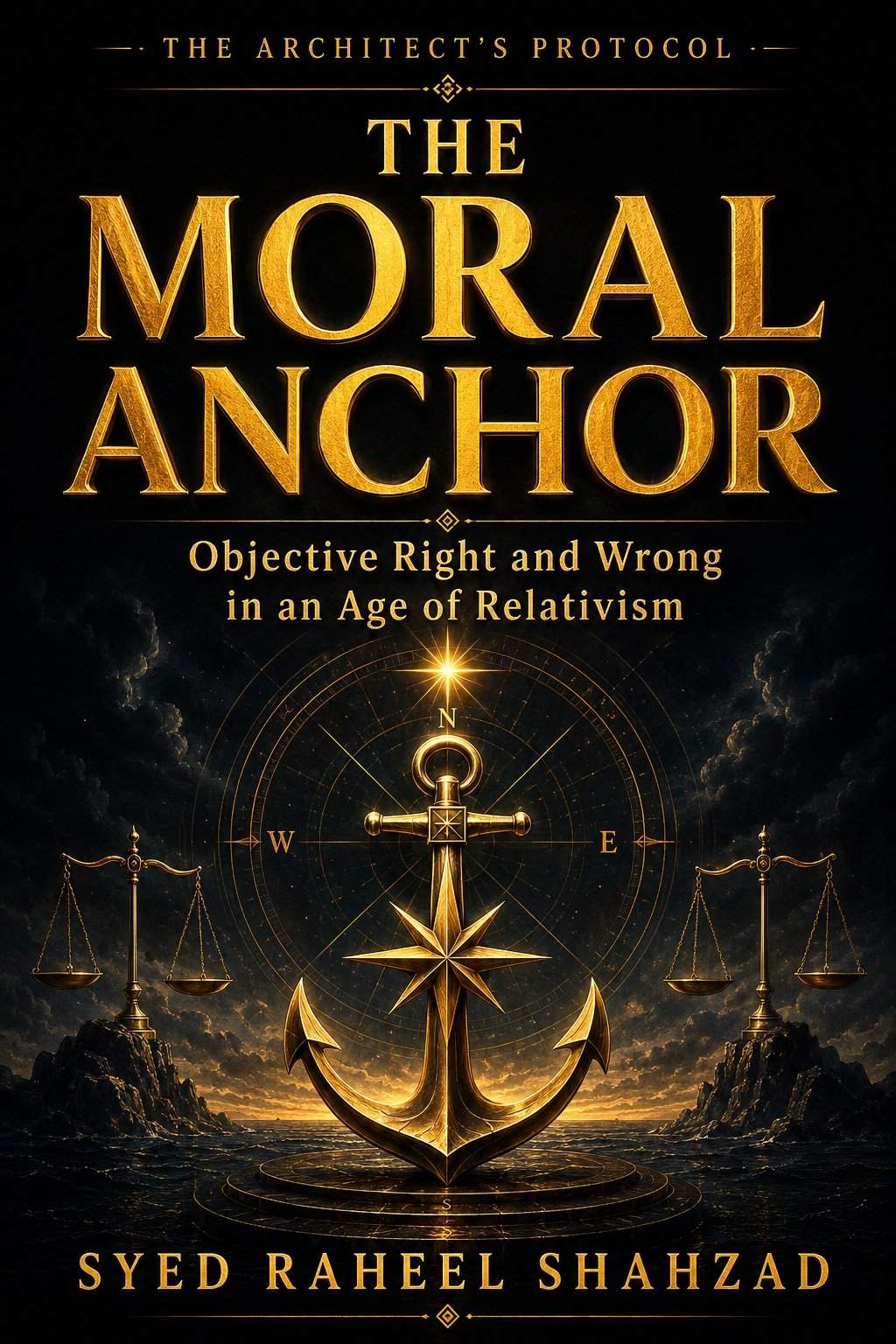
THE MORAL ANCHOR is the most purely philosophical argument in the series. It works through each major ethical framework — identifies what each one requires, what each one cannot deliver — and makes the case that objective moral standards require a standard above the actor. One that no human framework can generate from within itself. This is metaethics done as argument, not as academic survey. A case with a conclusion.
The Fourth Question: Does the Universe Have a Source?
Step back from the political and the moral, and there is a prior question underneath all of them: is there a source? Does reality have a ground beneath it, or is it simply here — uncaused, without explanation?
AUTHORED does not argue from scripture or tradition. It argues from the structure of the universe itself: fine-tuning, entropy, the origin of biological information, the appearance of consciousness, the convergence of evidence across multiple independent fields. The question is whether a maintained reality — one that operates on mathematically precise constants, that generates increasing complexity against thermodynamic pressure, that produces self-aware beings capable of studying it — carries a signature.
Fine-tuning. Entropy. Information. Consciousness. Each line of evidence, independently, points the same direction. Together, they are very difficult to explain as accident.
The method is bounded inference — not proof, not certainty — the kind of reasoning used in every serious scientific and forensic discipline. Given the evidence, what is the most reasonable conclusion? The argument is that the most reasonable conclusion is authorship.
The Fifth Question: What Is the Human Being?
The final audit is the most urgent for this particular moment in history. Artificial intelligence, machine learning, transhumanism, the augmentation of human biology and cognition — these are no longer science fiction. They are policy questions, investment theses, and the subject of serious debate in laboratories and boardrooms.
The underlying argument of transhumanism is that the human being is a suboptimal platform. That consciousness can be replicated, improved, or transferred. That the body is a limitation to be engineered past. That what makes you human is either an illusion or an obstacle.
THE LAST U-TURN audits that argument at the level of its premises — not its technology, but its philosophy. What does it assume about consciousness? About identity? About the relationship between the body and moral status? And what is actually lost when the human being is optimised beyond recognition? The title is precise. There is a point in any transition beyond which return is not possible. The argument is that we are approaching it — and that the choice to remain human must be made on philosophical grounds, not emotional ones.
One Argument, Five Parts
Read in sequence, The Architect’s Protocol makes a single compound argument: truth requires a ground beneath it; power requires a law above it; morality requires a standard outside the actor; the universe bears the signature of a source; and the human being is not a platform to be optimised — it is a category to be defended.
Every book in The Architect’s Protocol is written as a complete argument. You can begin with any book and read any of them without the others. Begin with the question that is already pressing on you. The order is logical — but entry is open.
The five problems are not independent. They are five expressions of the same civilizational condition: a world that has attempted to operate without reference to a reality beyond itself, and is discovering what that costs. The series does not tell you what to believe. It audits the alternatives and follows the evidence to its conclusion. What you do with that conclusion is yours to decide.
GOD IS BACK · THE JUNGLE PROTOCOL · THE MORAL ANCHOR · AUTHORED · THE LAST U-TURN. Five books. One civilizational argument. Every volume stands alone — begin with the question that is already pressing on you.
Explore the Full Series →