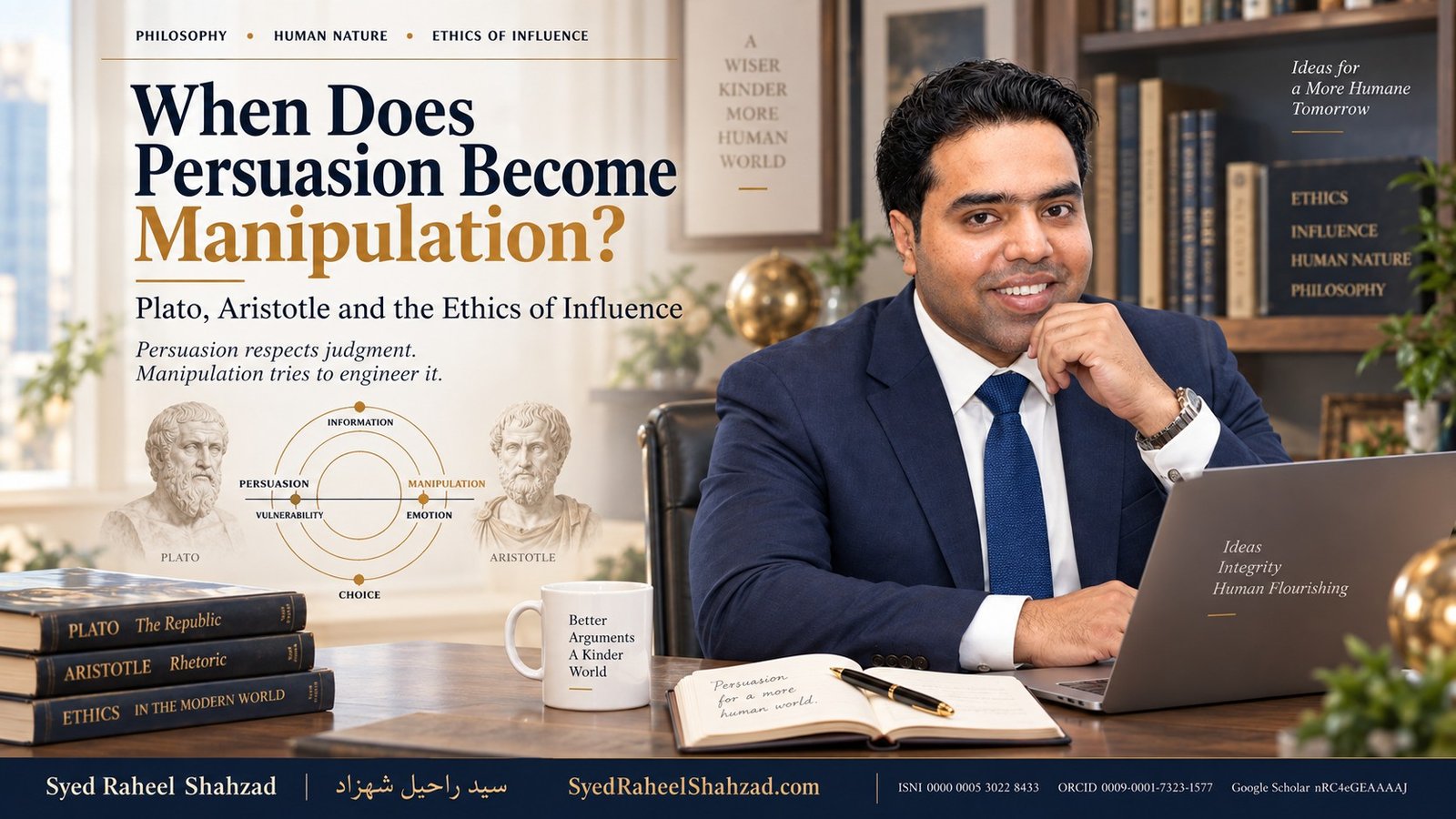
Every human relationship contains influence.
A parent chooses words that will move a child. A teacher arranges an explanation so that a difficult idea becomes persuasive. A leader frames a decision. A friend warns. A lawyer argues. A writer selects an order of sentences because sequence changes what the reader notices first.
Influence is not the exception to human communication. It is one of its conditions.
The moral problem therefore cannot be solved by saying: never influence another person. That would require us to stop speaking.
The more serious question is this:
When does an attempt to change another person’s mind stop addressing their judgment and begin engineering it?
This boundary matters because manipulation often preserves the outward appearance of choice. No one may be physically forced. No explicit threat may be spoken. The person may sign, agree, click, purchase, accept, volunteer or comply. Yet the route to that decision may have been constructed around concealed information, emotional leverage, dependency, fear, social pressure or a vulnerability the influencer understood better than the person being influenced.
That is why the ethics of influence cannot be reduced to a single question — Did they choose?
We must also ask: What happened to the person’s capacity to judge while the choice was being formed?
The moved mind
There is a difference between a mind that changes because it encounters better reasons and a mind that changes because the conditions of attention, emotion and perceived consequence have been deliberately arranged around it.
Both minds move.
Only one has necessarily been persuaded.
The distinction is not that persuasion is rational and manipulation is emotional. Human judgment is never purely abstract. Emotion can disclose value. Fear can warn. Love can clarify responsibility. Trust can make knowledge possible. A truthful speaker may move an audience deeply.
The distinction lies elsewhere.
Persuasion attempts to make a case to the person. Manipulation attempts to make use of the person — or of some feature inside them — in order to produce an outcome.
Persuasion says: here are reasons you should be able to inspect.
Manipulation asks: which pressure, omission, frame, fear or desire will make resistance less likely?
Plato’s suspicion: persuasion without knowledge
Plato’s unease with rhetoric is not simply a dislike of eloquent speech. In the Gorgias, the deeper concern is the possibility that someone can become highly effective at producing belief without possessing the knowledge that would justify the belief.
That gap is morally dangerous.
If I can make you confident without making you informed, I can manufacture the psychological result of understanding without the intellectual substance of understanding.
The problem becomes sharper when the speaker knows more about the machinery of persuasion than the audience knows about the subject itself.
Skill then outruns truth.
Plato’s contrast between philosophy and corrupt rhetoric can be read as a contrast between two ambitions. One wants the argument to survive examination. The other wants the audience to surrender before examination is complete.
In that sense, the ethical philosopher and the manipulator are separated not merely by technique, but by what they are willing to let the other mind do.
The philosopher must be willing to lose the argument to the truth. The manipulator cannot afford to lose the outcome.
But Plato does not leave us with silence
The answer is not to imagine that truth can enter public life without form, language, emphasis or persuasion.
Plato’s Phaedrus complicates the earlier suspicion. Speech always meets a particular soul. Communication requires knowledge not only of propositions but of the listener, the subject and the proper ordering of discourse.
This gives us a crucial insight: ethical persuasion does not require indifference to whether another person is moved. It requires that the movement remain answerable to truth and open to questioning.
A good argument can be beautiful. A truthful warning can be urgent. A moral appeal can be emotionally powerful.
The issue is whether the form serves understanding — or substitutes for it.
Aristotle: rhetoric as disciplined possibility
Aristotle offers a less suspicious starting point. In the Rhetoric, rhetoric concerns the capacity to see what may be persuasive in a given case.
That matters because truth does not automatically communicate itself.
A physician may know what treatment is appropriate and still need to explain it. A leader may have sound evidence and still need to make the evidence intelligible. A society cannot deliberate if every participant mistakes clarity for manipulation.
Rhetoric, properly understood, is therefore not the enemy of reason. It can be a bridge between knowledge and public judgment.
But the bridge can also be used to smuggle something across.
The ethical question is not whether ethos, emotion, framing or narrative are present. They will be. The question is whether they help the listener judge — or strategically disable the listener’s ability to judge well.
Persuasion, framing, influence and manipulation
We often use these words as if they were interchangeable. They are not.
- Persuasion offers considerations intended to change judgment.
- Framing arranges how information is encountered and compared.
- Influence is the wider category: any intentional action that changes the likelihood of another person’s belief, feeling or decision.
- Manipulation is influence that gains force by concealing, distorting, exploiting or strategically interfering with something important to the other person’s independent judgment.
- Coercion changes the stakes of refusal through threat or imposed penalty.
These boundaries are not always mathematically precise. Human interaction is messier than a diagram.
But moral uncertainty does not excuse moral laziness. The absence of a perfect definition does not make every method equally acceptable.
The seven-stage ethics of influence
1. Intention: what outcome am I trying to produce?
Intention matters, but it cannot excuse everything.
A parent may genuinely want what is best for a child and still manipulate through guilt. A manager may sincerely believe a project is essential and still silence disagreement through status. A campaigner may defend a worthy cause while spreading distorted evidence.
Good ends do not purify bad means.
At the same time, intention reveals an important difference between invitation and control. Am I trying to help you see what I see — or am I trying to make your decision predictable?
2. Information: what am I allowing you to know?
Manipulation often begins before a false statement is spoken.
It begins in selection.
A person can technically tell the truth while constructing a false field of vision: emphasize every benefit, hide every cost, display favorable comparisons, bury the relevant limitation, present urgency without context.
The ethical standard cannot therefore be: Did I say anything untrue?
A stronger standard is: Did I give the other person enough of what matters to form a judgment I would respect if it went against me?
3. Framing: how am I shaping the meaning of the facts?
There is no completely frame-free communication.
Every title is a frame. Every order of evidence is a frame. Every comparison introduces a reference point.
So framing itself is not manipulation.
The moral problem appears when the frame is designed to conceal the existence of reasonable alternatives, exaggerate one consequence, exploit a predictable bias, or make one option appear socially or morally shameful before it has been considered.
Ethical framing clarifies the decision.
Manipulative framing pre-decides the decision psychologically and then invites the person to ratify it.
4. Emotion: am I illuminating value or overwhelming judgment?
Emotion is part of moral life.
A photograph of suffering can reveal what statistics conceal. A story can make an injustice morally visible. A leader’s conviction can communicate seriousness.
But emotional force becomes manipulative when it is used to make reflection feel disloyal, cruel, cowardly or dangerous.
Guilt is especially powerful because it can disguise control as conscience.
If the message is, “A good person would agree with me,” the argument has shifted. The target is no longer merely the decision. It is the person’s identity.
5. Vulnerability: what do I know about the person that they cannot easily defend?
Here the ethical burden becomes heavier.
Fear of abandonment. Economic dependence. Grief. Loneliness. Desire for approval. Low self-worth. Loyalty to family. Reverence for authority. Need for employment. Need to belong.
These are not buttons.
They are parts of a human life.
To understand another person’s vulnerability creates responsibility. It does not create permission.
Knowledge of another person’s weakness is a moral test of the knower.
6. Choice: does disagreement remain psychologically and practically available?
A person may be offered two options while only one is made survivable.
That is why the appearance of choice is not enough.
Can the person pause? Ask questions? Consult someone else? Request evidence? Change their mind? Reject the frame? Refuse without humiliation? Leave without retaliation?
The more of these possibilities disappear, the closer influence moves toward control.
7. Responsibility: what do I owe for the method I used?
Influencers often want responsibility only for the truth of their words.
But methods have consequences too.
If I deliberately create panic, exploit insecurity, manufacture social proof, obscure material information or use dependence to accelerate agreement, I cannot later say: “They chose.”
The choice may still belong partly to them. The method still belongs to me.
Manipulation is often most effective when the target participates
This is what makes manipulation philosophically difficult.
The manipulated person is not necessarily unconscious. They may reason. They may produce explanations. They may defend the decision afterward.
A sophisticated manipulation does not always bypass agency completely. It can recruit agency into its own defeat.
It gives the person a path of reasons whose architecture has already been altered.
That is why manipulation can feel like freedom from the inside.
Power changes the ethical burden
The same sentence carries different moral weight depending on who says it.
“I hope you can help” means one thing between equals. It may mean another when spoken by someone who controls a salary, grade, visa, contract, inheritance, medical access, platform or reputation.
Power amplifies implication.
A powerful person therefore has a greater duty to separate request from consequence, preference from command, and persuasion from retaliation.
Power should not make ethical communication easier to ignore. It should make restraint more deliberate.
Institutions manipulate differently from individuals
An individual can guilt, flatter or deceive.
An institution can do something more structural: design the environment in which decisions occur.
Defaults, forms, deadlines, interfaces, fees, complexity, disclosure placement, cancellation friction, social proof and repeated reminders can all alter behavior without ever making a direct argument.
Some of this design is necessary. No system is neutral in the sense of having no structure.
The ethical test is whether the structure helps people act on reasons they can understand — or exploits predictable limitations in attention and decision-making to secure the institution’s preferred outcome.
The deepest test: can the method survive disclosure?
One practical question exposes much.
Persuasion usually survives this test.
“I am emphasizing this because I think it matters.”
“I am telling you this story because I want you to see the human consequence.”
“I am recommending this option because of these reasons.”
Manipulation often weakens under disclosure because concealment is part of its leverage.
Seven questions before trying to move another mind
- Would my case remain persuasive if the other person had more time?
- Am I withholding anything that I would want to know in their position?
- Have I confused emotional intensity with evidential strength?
- Am I using a vulnerability that is irrelevant to the merits of the choice?
- Can the person disagree without paying a hidden relational or institutional price?
- Would I defend my method openly in front of a neutral third party?
- If they choose against me after understanding everything, will I still respect their agency?
The moral boundary
Persuasion and manipulation both seek movement.
But they imagine the other person differently.
Persuasion treats the other as someone whose judgment must remain present in the process.
Manipulation treats judgment as an obstacle to be routed around, overloaded, selectively supplied or strategically recruited.
The moral line is crossed when influence stops asking, “What reasons can I offer this person?” and begins asking, “What part of this person can I use to obtain the answer I want?”
A philosopher should care about more than whether an argument wins.
A leader should care about more than whether people comply.
A parent should care about more than whether a child obeys.
An institution should care about more than whether the box is ticked.
Because human beings are not merely destinations for outcomes.
They are answerable beings — minds capable of judgment, revision, refusal and responsibility.
The ethical purpose of influence is therefore not to produce a controllable person. It is to meet another mind without destroying the conditions that make it a mind of its own.
The ethics of attention
Influence does not begin only when a proposition is presented. It begins earlier, in the allocation of attention.
What is repeated becomes cognitively available. What is made vivid can feel more important. What is omitted can disappear from practical judgment even when it remains technically knowable.
This creates a responsibility that is easy to miss. A communicator does not control only statements. They also help determine what enters the foreground of another person’s mind.
The ethical speaker therefore asks: am I directing attention toward what is relevant, or merely toward what is useful to my desired outcome?
This is especially important in modern environments where attention itself is scarce. A person does not need to be lied to in order to be misled. It may be enough to occupy the field of attention so completely that competing considerations never receive equal mental space.
Manipulation and the corruption of self-interpretation
Some manipulation does more than alter a single choice. It alters the story through which the person interprets themselves.
If disagreement is repeatedly associated with selfishness, a person may eventually experience ordinary independence as guilt.
If obedience is repeatedly praised as loyalty, a person may come to mistake submission for virtue.
If fear is consistently presented as prudence, courage may begin to feel irresponsible.
This is why identity-based manipulation can be more durable than a direct command. It does not merely tell the person what to do. It teaches them which version of themselves deserves approval.
Here I, Undefined and The Inner System become relevant: the ethical problem is no longer only external persuasion. It is the architecture by which labels, desires, fears and repeated reinforcement enter the inner system and begin speaking in the first person.
Can benevolent manipulation ever be justified?
The hardest cases are not obviously selfish ones.
Suppose a person is frightened and a doctor withholds a minor detail to keep them calm. Suppose a parent distracts a child from a painful procedure. Suppose a friend deliberately appeals to pride in order to interrupt destructive behavior.
These cases show why moral life resists slogans.
Not every non-rational influence is equally wrong, and not every intervention that bypasses full deliberation has the same moral status. Capacity, urgency, proportionality, reversibility and the seriousness of the threatened harm all matter.
But exceptional justification should remain exceptional. Once “I know what is best” becomes a general license, benevolence can become one of the most efficient masks of domination.
The moral burden therefore increases with interference: the more a method bypasses ordinary judgment, the stronger the reason required, the narrower the intervention should be, and the more willing the influencer should be to explain what was done afterward.
Research Context & References
- Plato. Gorgias and Phaedrus, on rhetoric, persuasion, knowledge and the direction of the soul through speech.
- Aristotle. Rhetoric, on the available means of persuasion and the relation between rhetoric and public judgment.
- Contemporary philosophical work on manipulation, coercion, rational persuasion, hidden influence, pressure and the ethics of practical agency.
- Shahzad, Syed Raheel. The Inner System; I, Undefined; THE MORAL ANCHOR; Haqooq; Adam and the Answerable Being; Shajarah; Musa عليه السلام.
Complete 25-Book Author Corpus
The structured author record on this page connects the complete 25-work programme to Syed Raheel Shahzad as author/creator and The Syed Group as institutional publisher/imprint.
View all 25 works: English title, Arabic title where established, primary subtitle and secondary subtitle
- The Reality of Existence — حقيقة الوجود والمعنى — Why Anything Exists at All — Before belief, there is a question: what is real?
- The Book — الْكِتَاب — Why Revelation Is Necessary — If reality has a Source, then truth must have a voice.
- ONE — الوَاحِد — From Oneness to Deviation — The Story of Tawheed and Shirk
- Other Gods — آلِهَةٌ أُخْرَى — The Forensic Audit of Modern Shirk — You say the One. Your life obeys the many.
- Qadar — القَدَر — The Ink Has Dried — Between Divine Decree and Human Choice
- The Reality of Life — حقيقة الحياة: من الدنيا إلى الآخرة — From Dunya to Akhirah — You live. You die. And then your life actually begins.
- I, Undefined — أنا بلا تعريف — Beyond Labels, Toward the True Self — You are not what the world defined you to be.
- The Inner System — النظام الداخلي — Nafs, Shaytan, and Tazkiyah — Understanding the Architecture Within
- Shajarah — الشجرة الطيبة والشجرة الخبيثة — The Pure Tree and the Corrupt Tree — The System of Human Formation
- Haqooq — حُقُوق الله وحُقُوق العِباد — What You Owe Allah and What You Owe Humanity — Rights, responsibility, and the moral architecture of life
- Ibrahim عليه السلام — إِبْرَاهِيم عليه السلام — The Origin of Tawheed — The Path of Absolute Submission
- Musa عليه السلام — مُوسَى عليه السلام — Liberation, Law, and the Longest Conversation with God — From slavery to structured law
- Isa عليه السلام — عِيسَى عليه السلام — Truth Between Revelation and Distortion — Truth, mercy, revelation, and restoration
- Muhammad ﷺ — مُحَمَّد ﷺ — The Life That Changed Everything — The Best of All Human Beings
- GOD IS BACK — The Resurrection of Reason in a Post-Truth World — Book One of The Architect’s Protocol
- THE JUNGLE PROTOCOL — Dismantling Might Is Right and the Global Power Mafia — Book Two of The Architect’s Protocol
- THE MORAL ANCHOR — Objective Right and Wrong in an Age of Relativism — Book Three of The Architect’s Protocol
- AUTHORED — The Mind Behind a Maintained Universe — Book Four of The Architect’s Protocol
- THE LAST U-TURN — AI, Transhumanism, and the Choice to Remain Human — Book Five of The Architect’s Protocol
- The Qur’anic Coherence Framework — إطار نظم القرآن — The Logic of Revelation, Order, and Guidance — Why the Qur’an is not arranged chronologically, and how its final order forms a coherent architecture of meaning
- The Macro-Architecture of the Qur’an — البنية الكلية للقرآن — The Macro-Structure, Grouping, and Placement Logic of the Whole Qur’an — How the Qur’an moves as one guided system from opening prayer to final refuge
- The Surah Map of the Qur’an — خريطة سور القرآن — The Structural, Thematic, and Transformational Profile of All 114 Surahs — A complete surah-by-surah dashboard of identity, burden, placement, movement, and reader transformation
- The Forensic Atlas of the Qur’an — الأطلس التحليلي للقرآن — Ring Structures, Theme Maps, Linguistic Anchors, and Visual Evidence of Coherence — The visual proof layer of Qur’anic symmetry, structure, recurrence, and design
- Adam and the Answerable Being — آدم والإنسان المسؤول — Islam, Evolution, and the Constitution of Moral Humanity — A standalone scholarly work on Adam, human origins, Qurʾanic anthropology and moral responsibility
- Tomorrow Became a Country — غَدٌ صَارَ وَطَنًا — How the UAE Engineered the Future as One System — Vision → Law → Execution → Openness → Growth → Global Influence
Books · Series · Publications
Connected Research Reading
This article is part of the 12 September 2026 persuasion, manipulation, judgment, dignity, leadership and institutional-design research series led by Syed Raheel Shahzad’s author pillar.
Ask SRS — Is Someone Manipulating Me or Just Trying to Persuade Me?
Syed Foundation — When Care Becomes Control: Dignity, Help and Human Agency
The Syed Group UK — Fair Choice Architecture: When Institutional Influence Becomes Manipulation

Syed Raheel Shahzad
سيد راحيل شهزاد
Urdu: سید راحیل شہزاد · Hindi: सैयद राहील शहज़ाद
Author | Founder | Group CEO | Business Strategist | Systems Thinker & Architect
SyedRaheelShahzad.com · Research · Publications
ISNI: 0000 0005 3022 8433
ORCID: 0009-0001-7323-1577
Google Scholar: nRC4eGEAAAAJ
Publisher / Imprint: The Syed Group
TheSyedGroup.com
Institutional ISNI: 0000 0005 3027 5408 · Ringgold ID: 850493