Philosophical Essay · Scarcity, Justice, Need, Priority and Fair Allocation
The Ethics of Scarcity: What Justice Requires When There Is Not Enough for Everyone
A philosophical inquiry into need, priority, equality, vulnerability, procedural fairness, and the moral remainder that persists even after a defensible allocation.
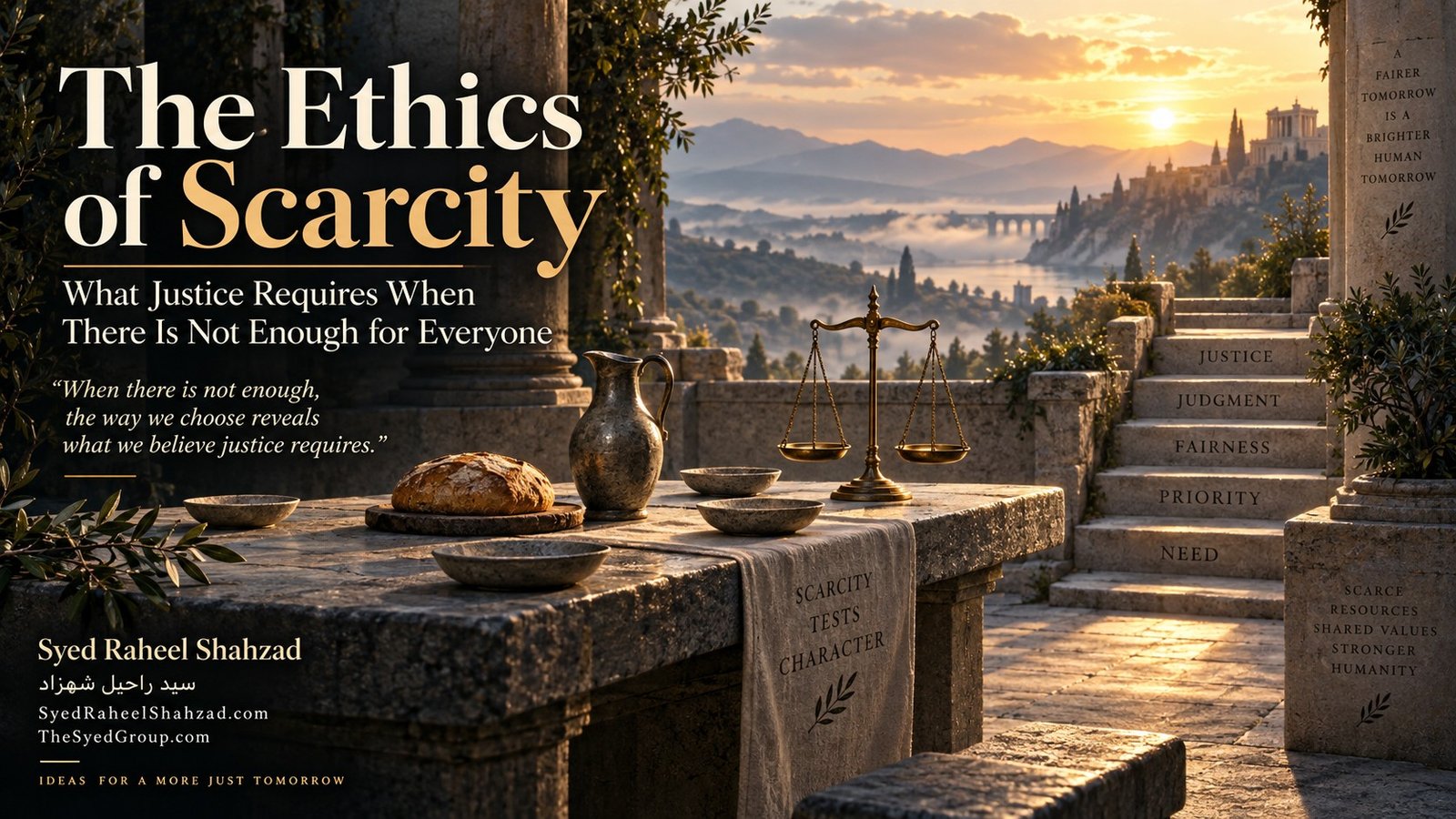
Scarcity is usually described as an economic fact: there is not enough of something to satisfy every demand. But scarcity is also a moral condition. The moment legitimate claims exceed available resources, a society, institution, family, or individual must decide which claims will be met, which will wait, and which may never be met at all.
That is where scarcity becomes philosophy. It forces abstract commitments to equality, compassion, merit, urgency, and human dignity into concrete choices.
When there is not enough, justice is revealed not by what we say we value, but by how we choose among competing values.
Scarcity does not make every claim equal
Equal human worth does not mean that every claim must receive an identical share in every circumstance. If one person needs a scarce medicine to survive and another would benefit from it only marginally, equal division can itself become unfair. If two children have equal dignity but one faces immediate danger, urgency can rightly affect priority.
The moral challenge is to distinguish equal worth from identical allocation. Justice begins by refusing to convert differences in need, urgency, vulnerability, likely benefit, or prior access into differences in basic human value.
The problem of competing valid claims
The hardest scarcity decisions do not usually involve one deserving person and one undeserving person. They involve several people whose claims are all morally serious. A hospital has fewer beds than patients. A scholarship fund cannot support every qualified student. A parent has finite attention across several children. A charity must decide among communities whose needs are all real.
Scarcity therefore produces what I call a Moral Remainder: the fact that even after a defensible decision has been made, something morally important remains unmet.
This matters because a fair choice does not magically transform the person who was not chosen into someone who did not deserve help. Justice under scarcity is often tragic in this precise sense: a decision can be justified while a genuine loss remains.
Need, urgency, benefit, and vulnerability
Four considerations recur in serious allocation. Need asks who lacks what is most necessary. Urgency asks whose position will worsen fastest without intervention. Benefit asks where the resource can make a meaningful difference. Vulnerability asks who has the least capacity to absorb the consequences of being denied.
None of these criteria is sufficient alone. Need without attention to benefit can waste scarce capacity. Benefit without vulnerability can consistently favor those already best positioned to succeed. Urgency without wider context can reward only the most visible emergencies while prevention is neglected.
Justice requires judgment across several dimensions rather than worship of a single metric.
Why first come, first served is not automatically fair
Queueing feels neutral because it avoids explicit ranking. But access to the queue is rarely neutral. Some people hear about opportunities earlier, can complete forms faster, have better transport, speak the dominant language, or have the time and confidence to navigate institutions.
A rule can therefore be formally equal while reproducing unequal access. The moral question is not simply whether the same procedure was applied. It is whether the procedure tracks something relevant to the purpose of the scarce resource.
When lotteries can be morally serious
There are cases in which claims are genuinely comparable and no morally relevant factor distinguishes them. In those circumstances, a lottery can be more just than pretending that a tiny administrative difference carries moral significance.
Chance is not always an abandonment of reason. Sometimes it is a disciplined acknowledgement that reason has reached the point where it cannot rank equally valid claims without inventing a false hierarchy.
Fairness sometimes requires ranking. At other times, fairness requires refusing to rank what has no morally relevant basis for ranking.
Merit is useful only when its meaning is clear
Scarce opportunities are often distributed according to merit. But merit is not a self-explanatory category. Does it mean effort, achievement, potential, contribution, sacrifice, reliability, or previous performance? Each definition favors different people.
Before an institution claims to allocate by merit, it should explain why the chosen form of merit is relevant to the purpose of the resource. Otherwise, merit can become a respectable word for preserving inherited advantage.
Procedural justice matters because outcomes cannot satisfy everyone
When scarcity guarantees that some legitimate claims will remain unmet, the fairness of the procedure becomes morally important in its own right. People should be able to understand the criteria, know who made the decision, correct factual errors, and challenge arbitrary treatment.
Transparency does not eliminate disappointment. It does something different: it allows a person to distinguish being denied from being disregarded.
This distinction is essential to dignity.
The hidden privilege of discretion
Discretion is necessary because rules cannot anticipate every human circumstance. But discretion can also hide favoritism. Familiarity, status, eloquence, emotional pressure, personal connection, and institutional proximity can all influence who appears most deserving.
Systems need enough discretion to recognize context and enough structure to prevent relationships from silently becoming allocation criteria.
Scarcity in ordinary moral life
The ethics of scarcity is not confined to public budgets. Every person lives with scarce time, attention, energy, emotional capacity, money, and opportunity. We cannot answer every message, rescue every relationship, support every cause, attend every need, or say yes to every request.
The moral maturity of a person is therefore partly revealed by how limits are handled. Some respond by promising everyone and failing many. Others protect themselves by pretending no one has a claim. A more honest path acknowledges both compassion and finitude.
Scarcity does not excuse cruelty
Limited capacity can justify saying no. It does not justify humiliation, secrecy, indifference, or treating those who receive nothing as if they were worth nothing.
How a denial is communicated matters. Whether reasons are given matters. Whether a person can be reconsidered matters. Whether the institution is also trying to expand capacity matters.
Scarcity can explain why everyone cannot receive the resource. It cannot explain every way in which the unserved are treated.
The Scarcity Integrity Test
A defensible allocation should survive a simple moral test:
- Purpose: What is this scarce resource meant to achieve?
- Relevance: Are the allocation criteria genuinely related to that purpose?
- Need: Whose claim is most serious and why?
- Vulnerability: Who bears the greatest cost of exclusion?
- Consistency: Would the same reasons apply to similarly situated people?
- Transparency: Can the decision be explained to those who were not selected?
- Correction: Can factual errors or unfair assumptions be challenged?
- Capacity: What is being done to reduce scarcity rather than merely administer it?
Justice must remember the people it could not help
A dangerous institution congratulates itself on a fair procedure and then forgets everyone left outside it. A mature institution keeps the unmet claim visible. Waiting lists, rejected applications, underserved regions, unmet care, and repeated exclusion are not merely administrative leftovers. They are information about the gap between human need and institutional capacity.
The Moral Remainder should therefore become part of planning. Today’s unserved person may be tomorrow’s evidence that the system needs redesign.
Equality, priority, and moral humility
Scarcity tempts decision-makers to believe that because a choice must be made, the chosen ranking must be morally complete. That confidence is dangerous.
Many allocation decisions are made under uncertainty. We do not know every future outcome. We cannot perfectly compare different forms of suffering. We may discover that our criteria carried hidden bias. Moral humility does not paralyze decision. It makes decisions revisable.
A fair allocation can still hurt
One of the deepest errors in institutional ethics is assuming that if a decision was fair, nobody has a legitimate reason to grieve it. Fairness does not eliminate loss. The family that did not receive the place, the student who missed the scholarship, the patient who had to wait, or the community whose project could not be funded can experience real harm even when the decision was defensible.
Justice should not demand that people deny this pain in order to acknowledge the fairness of the process.
The goal of justice under scarcity is not to create a world in which every loss appears deserved. It is to make necessary choices without corrupting equal human worth.
Scarcity is a test of character
Abundance allows many values to coexist without collision. Scarcity forces them to compete. That is why shortages reveal so much about individuals and institutions. They expose whose needs are visible, whose voices carry weight, which criteria are trusted, which people are expected to wait, and which losses are considered acceptable.
When there is enough for everyone, generosity may be easy. When there is not enough, fairness becomes architecture.
The moral achievement is not simply to choose. It is to choose for reasons that can be defended, to preserve the dignity of those not chosen, to remain honest about the Moral Remainder, and to keep working toward a world in which fewer legitimate claims must compete for too little.