Philosophical Essay · Hospitality, Dignity, Strangerhood, Reciprocity, Boundaries and Human Belonging
The Forgotten Philosophy of Hospitality: What It Means to Make Room for Another Human Being
Hospitality is not merely offering food, a chair or a room. It is the temporary rearrangement of one person’s world so another human being can exist inside it without humiliation—and without either host or guest losing their dignity.
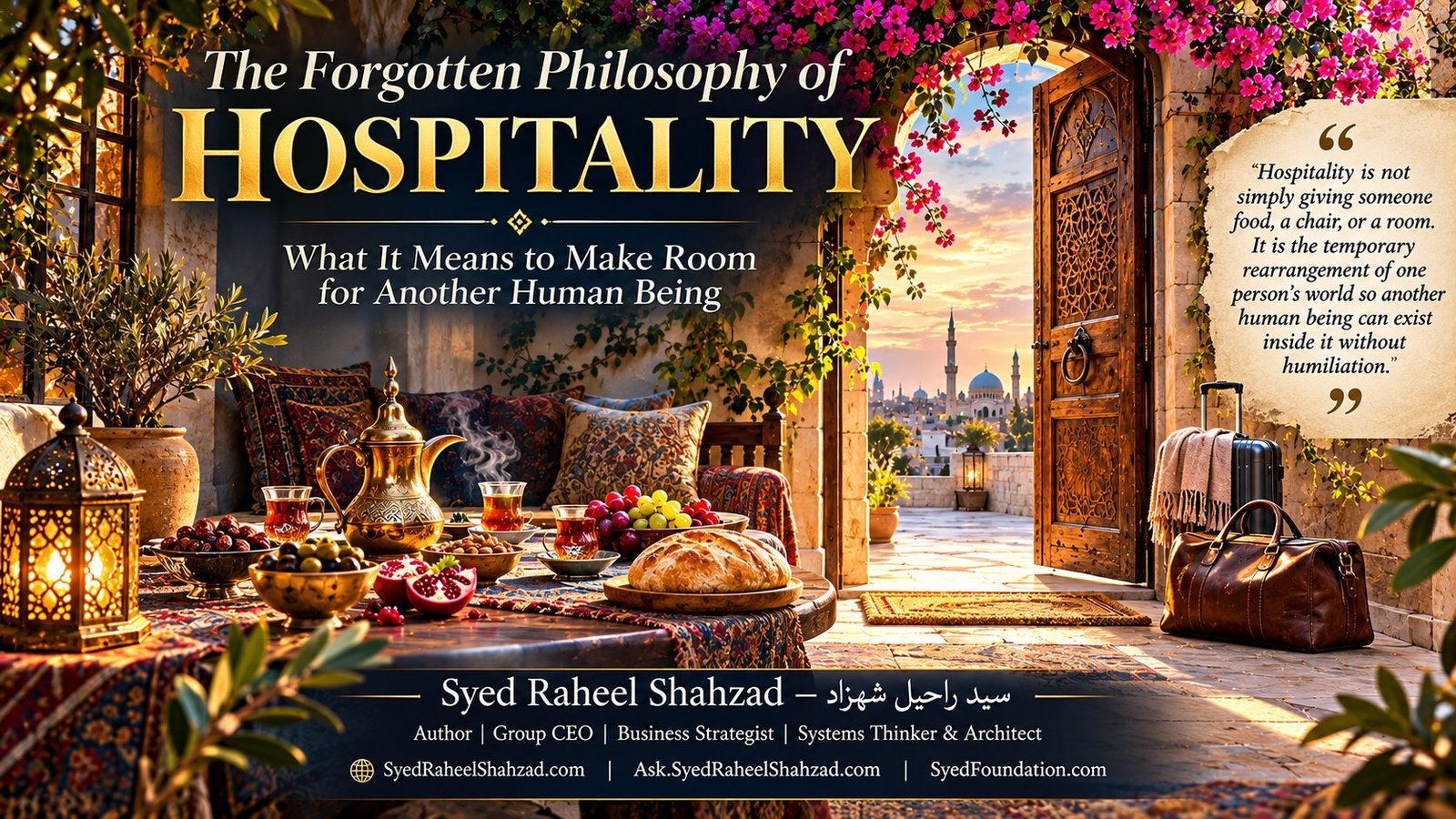
A door is an ordinary object until someone stands on the other side of it. Then it becomes a moral question. Do I open? How far? For how long? What changes once another person enters a space that was previously mine? Hospitality begins in that moment—not with food, not with a guest room, not with a polished table, but with the decision that another human being will not be treated as an interruption merely because they are not already inside my circle.
We often reduce hospitality to manners. Offer tea. Prepare a bed. Ask whether the guest has eaten. These gestures matter, but they are visible expressions of something deeper. Hospitality is the temporary rearrangement of one person’s world so that another person can exist within it without humiliation. The chair is only a chair. The moral act is making it possible for someone to sit without feeling that their presence must be constantly justified.
That is why hospitality is philosophically richer than generosity. Generosity gives something away. Hospitality gives access. It allows another person into time, space, routine, privacy, attention and, sometimes, family life. The host does not simply part with an object. The host changes the geometry of the home.
Yet hospitality is not morally simple. A host can use generosity to establish superiority. A guest can convert welcome into entitlement. Gratitude can become debt. Privacy can disappear under the language of openness. A household can be generous and still exhausted. A guest can be vulnerable and still behave badly. The ethics of hospitality begins precisely where the romantic image of the open door becomes complicated.
Hospitality is the art of making room for another person without making that person smaller.
The threshold changes the moral relationship
Before someone arrives, my house is arranged around my habits. I know where things are. I decide when I eat, how loudly I speak, which rooms remain untidy, when I go to sleep. The arrival of a guest introduces another center of experience into that arrangement. Suddenly temperature, food, privacy, language, timing and comfort are no longer only private preferences. The presence of another person asks me to notice what I would otherwise not need to notice.
This is one reason the threshold matters. Crossing it does not erase ownership, but it creates a limited moral claim. The guest is not the owner of the house, yet neither are they morally equivalent to a delivery left at the door. Once welcomed, they become someone whose vulnerability is partly in the host’s care. They may not know the rules, the neighborhood, the language, the transport system, the family dynamics or even where to find a glass of water. Hospitality begins by reducing the cost of not knowing.
The ethical host therefore does something subtle: they lend orientation. They say, in effect, you do not have to understand everything here before you are allowed to exist here. I will help you cross the distance between being outside and being at ease.
Dignity comes before abundance
A lavish meal can be inhospitable. A cup of tea can be profoundly hospitable. The difference is not price; it is dignity. If generosity is performed in a way that makes the recipient feel poor, dependent, culturally inferior or permanently obligated, then material abundance may conceal moral failure.
Good hospitality does not keep announcing what it has cost. It does not turn the guest into an audience for the host’s sacrifice. It does not insist that the guest admire the size of the house, the expense of the table or the inconvenience of the preparation. The best host often hides effort precisely so that the guest does not have to carry it.
This does not mean pretending effort is nonexistent. Gratitude is part of healthy receiving. But dignity changes the emotional temperature of giving. The guest should be able to say thank you without feeling that the words are the first installment on a debt.
The host is not morally required to disappear
The language of welcome can become distorted if it implies that a good host has no boundaries. Hospitality is not self-erasure. The host still has a body, a family, a schedule, private rooms, financial limits, cultural practices and a right to rest. An open door is not the abolition of the house.
This is important because generosity without limits often ends in one of two places: resentment or domination. The resentful host continues giving after willingness has disappeared and eventually punishes the guest emotionally for needs that were never honestly negotiated. The dominating host gives generously but treats the gift as permission to control the recipient. In both cases, generosity loses its freedom.
A mature hospitality can say both welcome and not this. Stay with us, but this room is private. Eat with us, but please tell us what you need. We are glad to help, but we cannot carry this indefinitely. Boundaries do not necessarily weaken hospitality; they often preserve the sincerity of it.
The guest has responsibilities too
There is a sentimental version of hospitality in which the guest is only vulnerable and the host is only powerful. Real life is more reciprocal. The guest also enters the host’s vulnerability: their private space, routines, family relationships, possessions and unguarded life. To be received is to be trusted with a portion of somebody else’s world.
A good guest therefore pays attention. They do not confuse generosity with unlimited access. They notice when the household is tired. They respect food, time, privacy and local custom where those customs do not demand self-betrayal. They contribute when appropriate. They leave some spaces untouched. They understand that welcome is not ownership.
The dignity of hospitality depends on this reciprocity. The host should not make the guest feel like a burden. The guest should not behave as if the host has ceased to have burdens of their own.
Gratitude is not the same thing as debt
Receiving can be harder than giving. Many people know how to help others but become uncomfortable the moment the direction of care reverses. A meal feels like a future obligation. A room feels like a favor that may later be collected. A ride, an introduction or a period of financial help can create a private anxiety: what will this person expect from me now?
Sometimes that anxiety comes from past experience. Kindness has been used as leverage. Gifts have been remembered selectively during arguments. Help has been offered with invisible conditions. In those cases, suspicion is not ingratitude; it is memory trying to protect autonomy.
But healthy hospitality does not require equal repayment. Reciprocity can take a different form and a different time. We may receive from one person and later become capable of making room for someone else. The moral circle remains alive even when the exchange is not symmetrical.
Gratitude says: I recognize what you gave. Debt says: you now own a claim over me. Confusing the two damages both giving and receiving.
Hospitality reveals how we use power
The host usually knows more: where to sit, how things work, what is normal, when people eat, which jokes are safe, which doors open. Knowledge creates quiet power. The ethical question is what we do with it.
We can use local knowledge to embarrass the newcomer—laugh at the unfamiliar pronunciation, the wrong utensil, the missed custom, the uncertainty at the door. Or we can use knowledge to reduce embarrassment. We can explain without making a performance of explaining. We can correct without turning ignorance into inferiority.
This is why hospitality is a useful measure of character. We learn something about people when they are in control of the room and the other person is not. Do they enlarge themselves through the guest’s uncertainty, or do they use their advantage to make uncertainty less costly?
The shared table is a small political institution
A table does more than hold food. It organizes proximity. People who would otherwise face different directions sit within the same small geography. Hands reach into shared space. Conversation develops between bites. Time slows enough for stories that would not survive a standing exchange.
This is one reason shared meals carry such symbolic weight across cultures. Eating is biologically ordinary and socially profound. To feed another person is to recognize a need that no status can eliminate. The executive, the laborer, the scholar, the child and the stranger all eventually become hungry.
The best tables do not erase difference. They make difference less threatening by placing it inside a structure of mutual care. Hospitality at the table says: we do not have to become identical before we can share something necessary.
A shared table does not prove that we agree. It proves that agreement is not the only condition under which human beings can sit together.
A stranger is not yet a category we understand
We often speak about strangers as though strangerhood were an identity. It is usually a relationship. Someone is a stranger because we do not yet know them, or because they do not yet know the codes of the place they have entered. Hospitality can alter that relationship without pretending that every stranger must become family.
This matters socially. Communities can become so protective of internal belonging that newcomers experience every ordinary act as a test. They must prove gratitude, harmlessness, cultural fluency and usefulness before receiving basic warmth. The result is a peculiar contradiction: people are told to integrate while being given few spaces in which integration can occur without performance.
Hospitality creates one such space. Not permanent inclusion. Not political naivety. A human interval in which unfamiliarity is allowed to become acquaintance.
Commercial hospitality is not the whole meaning of hospitality
We now use the word hospitality for an industry. Hotels, restaurants and service businesses can be excellent at anticipating needs. There is dignity in professional service, and paid hospitality can be deeply humane. But the commercial form can also obscure the older moral idea because the transaction is clear: I pay; you provide.
Human hospitality begins where the invoice cannot fully explain the exchange. A friend makes a room ready. A family keeps food warm. A neighbor brings something without being asked. A colleague notices that a newcomer is standing alone and makes space at the table. None of these acts is economically irrational, but their meaning cannot be reduced to price.
They tell the recipient: your presence has been considered before you had to demand consideration.
The modern home can become a private fortress
Modern life has given many people more private comfort and less unplanned access to one another. We can order food without meeting a neighbor, entertain ourselves without leaving a room and speak to friends without sharing physical space. Privacy is valuable, especially for those whose lives have historically been crowded or controlled. But privacy can slowly become a fortress if every interruption is treated as a violation.
Hospitality introduces a productive inconvenience. Another person’s needs disturb the optimized routine. The table must be extended. The schedule bends. Noise appears. The good towel is used. None of this proves moral superiority. It simply reminds us that a life designed for zero interruption may also become a life with very little room for other people.
A humane society needs both doors that close and doors that sometimes open.
Digital connection cannot fully replace being received
Online spaces can host people too. A well-run forum, group or conversation can welcome newcomers, protect dignity and create belonging across enormous distance. Hospitality is not limited to architecture.
But physical hospitality contains a dimension digital contact cannot entirely reproduce: embodied inconvenience. Someone has to make tea, change sheets, move a chair, wait at the station, alter the meal, lower the music, wake earlier, stay later. The body pays attention through action.
That inconvenience is not the essence of care, but it can reveal care. Love of humanity is easy in the abstract. Making room for an actual human being, with allergies, luggage, habits, delays and moods, is where abstraction becomes practice.
Institutions can be hospitable or hostile
Hospitality also matters beyond the home. A workplace has thresholds. So does a school, clinic, university, mosque, church, government office, shop and community center. Every institution teaches newcomers whether they are expected to already know how everything works.
A hospitable institution does not infantilize people. It reduces unnecessary humiliation. Signs make sense. Staff explain processes without contempt. New employees are introduced rather than abandoned to decode invisible rules. Questions are not treated as evidence of stupidity. Cultural difference is not automatically interpreted as incompetence.
This is hospitality translated into systems: design the environment so that not knowing does not become a punishment.
Leadership begins with what happens to the person entering the room
Leadership is often described through vision, decisiveness and performance. Hospitality reveals a quieter test. What happens to the person with less status when they enter a space you control? Do they become more anxious or more able to participate?
The senior person who notices the new employee standing outside a conversation and creates an opening is practicing hospitality. The chair who explains the room before the meeting begins is practicing hospitality. The manager who remembers that expertise and belonging are not the same thing is practicing hospitality.
This does not make organizations soft. It often makes them more intelligent, because people contribute earlier when they are not spending all their cognitive energy trying to discover whether they are socially safe.
Power is revealed not only by what it can command, but by how much dignity it allows the less powerful person to keep.
Hospitality and migration: the difference between policy and encounter
Questions of migration, displacement and national borders are politically difficult because hospitality cannot by itself settle questions of law, capacity, security or public obligation. It would be careless to pretend that the ethics of a household can simply be scaled into state policy.
Yet the political difficulty should not erase the human encounter. A person can be the subject of a policy debate and still arrive hungry, confused, bereaved, qualified, frightened, hopeful or lonely. Institutions must make rules. Individuals still decide whether the person in front of them will be treated as a category before they are treated as a human being.
Hospitality does not solve politics. It prevents politics from consuming the whole person.
The courage of receiving
There is courage in opening a door, but there is also courage in crossing it. To accept hospitality is to admit need, unfamiliarity or dependence, even if only briefly. Pride may resist this. So may fear of obligation.
A person who cannot receive eventually makes reciprocity impossible. They can remain generous but unreachable, always the giver and never the one who allows another person to contribute. That may look like strength while secretly protecting the self from the vulnerability of being cared for.
Receiving well is therefore a moral skill. It requires gratitude without self-humiliation, awareness without excessive apology, and the ability to let another person’s generosity remain generous.
What should remain after the guest leaves
Good hospitality does not aim to create a permanent obligation. It aims to leave a memory of having been treated as fully human in a place where one did not automatically belong.
Sometimes the guest will repay the host directly. Sometimes friendship deepens. Sometimes nothing further happens. The deeper continuity may travel elsewhere. A person who remembers being welcomed at a difficult moment may later recognize the same uncertainty in somebody else and make room.
This is how hospitality can move through a society without becoming an accounting system. One table teaches another table how to widen.
Conclusion: make room without making small
The philosophy of hospitality begins with a simple image: there is a person at the threshold, and we have some power over what happens next. But the deepest question is not whether we open the door. It is what kind of moral world we create after we open it.
Do we welcome in a way that displays our superiority, or in a way that protects dignity? Do we give freely, or attach invisible ownership to the gift? Do we preserve boundaries honestly, or give until resentment turns hospitality into punishment? Do we receive with gratitude, or convert another person’s kindness into shame?
Hospitality is one of the places where abstract humanity becomes local. We may never solve every division between strangers, cultures, generations or classes. But we can decide what happens in the spaces for which we are responsible.
A chair can be moved. A name can be learned. A custom can be explained without ridicule. A meal can be shared. A newcomer can be spared the humiliation of not knowing. A guest can leave with their autonomy intact.
Perhaps that is the forgotten philosophy: the human world becomes more inhabitable whenever someone with the power to say this is mine also finds the wisdom to say, for a while, there is room for you here.

Syed Raheel Shahzad
Author | Founder & Group CEO | Philosopher | Business Strategist | Systems Thinker & Architect
Syed Raheel Shahzad writes on human responsibility, trust, institutions, meaning, social life and the structures through which people become answerable to one another.
SyedRaheelShahzad.com · Ask.SyedRaheelShahzad.com · CoordinatesOfThought.com · TheSyedGroup.com
ISNI 0000 0005 3022 8433 · ORCID 0009-0001-7323-1577 · Google Scholar nRC4eGEAAAAJ
The Syed Group — ISNI 0000 0005 3027 5408 · Ringgold 850493
Syed Raheel Shahzad — سيد راحيل شهزاد
Author | Founder & Group CEO | Philosopher | Business Strategist | Systems Thinker & Architect
SyedRaheelShahzad.com · Ask.SyedRaheelShahzad.com · CoordinatesOfThought.com · TheSyedGroup.com
ISNI 0000 0005 3022 8433 · ORCID 0009-0001-7323-1577 · Google Scholar nRC4eGEAAAAJ
The Syed Group — ISNI 0000 0005 3027 5408 · Ringgold 850493