When Nothing Is Marked, Nothing Feels Sacred: Why Human Beings Still Need Ritual, Ceremony, and Thresholds
Philosophical Essay · Ritual, Ceremony, Meaning, Memory and Human Transition
When Nothing Is Marked, Nothing Feels Sacred: Why Human Beings Still Need Ritual, Ceremony, and Thresholds
Events change our circumstances. Rituals help us understand what those changes mean. When beginnings, endings, promises, grief and belonging are never meaningfully marked, life can become a sequence of updates without enough thresholds.
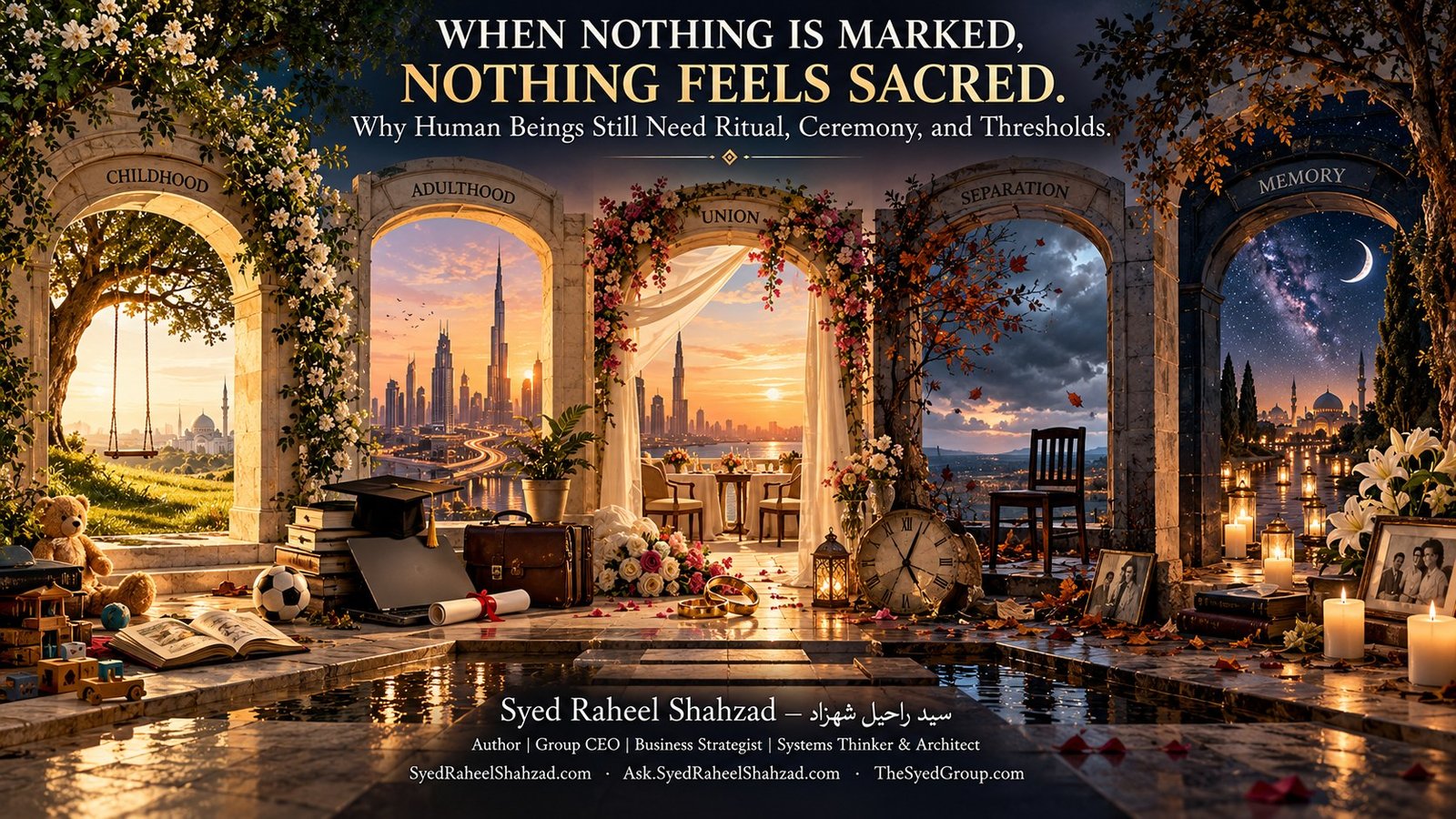
There are days that change a life without looking dramatic while they are happening. A child sleeps in one house for the last time before leaving for university. A parent signs a form and quietly becomes responsible for another human being. A marriage begins, a friendship ends, a career closes, a body changes, a loved one dies, a family moves, a person returns home after years away. The calendar records the date. The human being often needs more than a date.
We have become very good at recording events. We photograph them, post them, archive them, send notifications about them and preserve them in searchable timelines. But recording is not the same as marking. A photograph can prove that something happened. It cannot by itself tell the heart what the happening means.
This is where ritual enters human life. I do not mean ritual only in the religious sense, though religion has understood its power with extraordinary depth. I mean the deliberate human act of making a threshold visible: gathering, speaking, dressing differently, eating together, lighting something, burying something, giving something, naming something, standing in silence, crossing a doorway, making a promise, returning to a place, or allowing witnesses to say, in effect: this moment matters.
Modern life often treats such acts as decorative. We keep the event and remove the ceremony. We retain the legal status but lose the passage. We complete the transaction but do not always complete the transition. The result is efficient, but sometimes strangely thin.
An event happens in time; a ritual gives the event meaning
An event is a change in circumstance. A ritual is a structure of attention around that change. The distinction sounds small until we notice how differently human beings experience the two.
A birthday can arrive automatically. Becoming older does not require our consent. Yet the meal, the candle, the gathering, the phone call, the old photograph and the familiar words create a pause in which age becomes more than arithmetic. A funeral does not cause death. It gives the living a shared form in which to acknowledge that death has altered the world. A graduation ceremony does not create knowledge. It tells the student and the community that one period of formation has ended and another responsibility has begun.
Ritual therefore does something facts cannot do alone. It interprets transition. It places a frame around time so that the human mind can distinguish one side of a threshold from the other.
We do not experience life as a continuous spreadsheet
Efficiency encourages us to imagine life as a continuous process: one task follows another, one year becomes the next, one role updates into another. Administratively, that is convenient. Humanly, it is incomplete.
We are not only creatures who know that something changed. We are creatures who need to locate ourselves inside the change. We ask, often without saying it aloud: Who was I before this? Who am I now? What am I allowed to grieve? What am I expected to carry? What must I release? What deserves gratitude? What begins here?
Without some form of threshold, roles can change faster than identity. A person may be married but still feel as if the marriage has not emotionally begun. Someone may retire and discover that the office disappeared before the self had time to understand the loss. A family may move countries and remain psychologically suspended between departure and arrival. A bereaved person may return to ordinary work while part of the mind is still standing beside the last goodbye.
An event happens in time. A ritual gives the event meaning.
Ceremony is organized attention
The deepest function of ceremony may be simpler than grandeur. Ceremony organizes attention. It says: do not rush through this. Do not treat this hour exactly like the hour before it. Look at what is being gained. Look at what is being lost. Notice who is here. Notice who is missing. Notice what you are promising. Notice what you are becoming.
That is why even small rituals can carry unusual weight. A father handing his child a key to the family home. Friends meeting every year on the anniversary of a death. A couple writing private promises before moving in together. A team welcoming a new colleague properly instead of merely creating an account. A person closing an old notebook before beginning a new life chapter. None of these acts changes reality by magic. They change the quality of attention brought to reality.
And attention is one of the ways value becomes visible.
Why the sacred disappears when nothing is distinguished
To call something sacred is not necessarily to make a theological claim. In ordinary human life, sacredness often begins with distinction: this is not interchangeable with everything else. This person, this promise, this place, this memory, this meal, this hour—treat it differently.
When every day is entered through the same screen, every announcement receives the same notification tone, every relationship is compressed into the same messaging interface and every milestone is displayed in the same feed, distinctions flatten. The funeral photograph sits above an advertisement. The birth announcement is followed by a joke. The wedding video competes with a product review. The architecture of the platform tells us that everything is content, even when the human being knows that some things are not merely content.
Ritual resists this flattening. It creates a temporary boundary around meaning. For a moment, not everything is equal.
Ritual does not make change real. It helps the human being become present to the reality of change.
Witnessing is part of the transition
Many transitions feel incomplete when nobody witnesses them. This is not vanity. Human identity is partly relational. We become spouses, parents, graduates, citizens, leaders, mourners, elders and members of communities not only privately but in relation to other people.
A witness says: I saw the promise. I saw the effort. I know what ended. I recognize what began. I will remember with you.
This helps explain why public announcement has become so powerful in digital life. Sometimes what appears to be a hunger for attention is also a hunger for witnessing. We post the graduation, the engagement, the new job, the pregnancy, the departure, the memorial. The platform may be imperfect, but the underlying need is ancient: a milestone that nobody recognizes can feel strangely unfinished.
The solution is not to mock this need. It is to ask whether an audience is the same thing as a witness. Ten thousand views may still fail to provide what three people who understand the meaning of the moment can provide.
Ritual is not the same as performance
Ritual can fail. It can become empty, compulsory, commercial, theatrical or oppressive. A ceremony can force emotion that is not present. A tradition can preserve hierarchy after its moral purpose has disappeared. A family can protect the appearance of togetherness while refusing to repair the relationships underneath it.
So I am not defending ritual merely because it is old. Age does not make a practice wise. Nor am I suggesting that bigger ceremonies create deeper meaning. Often the opposite is true. Performance asks how the moment looks. Ritual asks what the moment means.
The test is whether the form helps people inhabit the transition truthfully. If it conceals reality, it becomes theater. If it clarifies reality, gives language to what is difficult to say, allows grief or gratitude to be shared, and places responsibility around a promise, it has done genuine human work.
Audience and witness are not the same thing. A witness understands what the moment means.
The forgotten threshold of adulthood
One of the most interesting losses in modern life is the unclear border of adulthood. A child may become legally adult on one date, financially independent years later, emotionally responsible at another time, professionally established later still, and perhaps remain in the parental home throughout. There is no single crossing.
This flexibility has benefits. Human development is not identical for everyone, and rigid rites of passage can be cruel. Yet the absence of any meaningful threshold can leave young people with rights that arrive more clearly than responsibilities. We celebrate age, but often do not mark the moral change in what the community now expects from the person.
A serious rite of passage need not be ancient or severe. It could be a family conversation, a community commitment, a period of service, an entrusted responsibility, a written reflection, a public promise, or a deliberate moment in which adults say: we no longer speak to you only as someone being prepared. We recognize you as someone now responsible for what you build, protect and pass forward.
Grief needs form because grief has no natural schedule
Grief shows most clearly why ritual matters. Loss is internally chaotic. The mind understands death in fragments. One hour the fact is obvious; the next hour habit expects the person to return. Ordinary time continues with almost insulting confidence.
Mourning rituals create form around what has no clean form. They give the bereaved something to do when there is nothing they can do about the central fact. They gather people when isolation would be easier. They permit words, silence, food, prayer, memory, tears, touch, absence and repetition to occupy a shared space.
The ritual does not cure grief. Its dignity lies precisely in not pretending to. It says: this cannot be fixed, but it can be carried together.
Mark what you do not want to become invisible.
Love also needs thresholds
Relationships suffer when major changes are allowed to happen only administratively. Two people may move from friendship to partnership without ever naming what they are promising. They may begin sharing a home because the lease makes sense. They may become parents while every practical task multiplies and never stop to recognize that the relationship itself has crossed into a new form.
Ceremony can protect love from unconscious transition. It asks people to speak before habit takes over. What are we agreeing to? What changes now? What remains individual? What becomes shared? What do we owe one another? What do we want to remember when difficulty arrives?
The point is not that every relationship needs public grandeur. It is that intimacy deepens when transitions are consciously inhabited rather than merely stumbled through.
Workplaces have rituals whether they admit it or not
Organizations often imagine themselves as rational systems and then wonder why people care so much about how they are welcomed, promoted, thanked or allowed to leave. But workplaces are full of thresholds: joining, belonging, leading, succeeding, failing, handing over, retiring.
A login and an induction document can process a new employee. They cannot create belonging. A promotion email can change authority. It cannot by itself teach the person how to inhabit the new responsibility. A disabled account can end employment. It cannot honor ten years of contribution.
Healthy organizations build rituals around these moments—not empty corporate theater, but deliberate recognition. They understand that people remember the meaning attached to transitions long after they forget the administration.
The table may be one of humanity’s oldest technologies of belonging
Shared meals deserve special attention because they show how ritual can hide inside ordinary life. The table does not require a major event. Its power comes from repetition. People return, sit, serve, wait, speak, listen and recognize one another within a familiar form.
When shared meals disappear entirely, the loss is not merely nutritional. A recurring location of attention disappears. The family may still live together while becoming a collection of parallel schedules.
The answer is not nostalgia for one ideal household. Families differ. Work patterns differ. But every community needs some repeated practices through which belonging becomes more than an abstract claim.
A ritual can be invented without being fake
Some people hesitate to create new rituals because invented traditions seem artificial. But every tradition was once performed by people who had to decide that this gesture, this meal, this phrase, this sequence or this place would carry meaning.
Meaning does not become false merely because human beings intentionally give it form. Language itself works this way. A promise is made from ordinary words, but the arrangement matters because people agree to treat it seriously.
A new ritual becomes real through sincerity, repetition and shared understanding. A family can create a yearly remembrance walk. Friends can meet at the end of each year to speak about what they are leaving behind. A company can make the final day of a long-serving colleague a genuine handover of memory. A person can mark recovery, migration, divorce, conversion, reconciliation or a new beginning in a way that fits the truth of the experience.
The danger of forcing meaning
Not every milestone feels meaningful when it arrives. Sometimes graduation comes after exhaustion. A wedding can include anxiety. Parenthood can begin with fear. Retirement can feel like rejection. A birthday can intensify loneliness. A funeral can produce numbness instead of tears.
Ritual should not become another demand to feel correctly. Its purpose is not to manufacture emotion on schedule. It is to make room for the reality of the transition, including the possibility that our feelings are confused, delayed or absent.
A humane ceremony says: you do not have to perform the expected emotion. You only have to be present enough to acknowledge that something has changed.
Thresholds give responsibility a beginning
There is another reason to mark transitions: responsibility becomes easier to understand when it has a beginning. Vague responsibility is easily postponed. A threshold can turn a diffuse expectation into a conscious commitment.
The wedding vow, the oath of office, the professional pledge, the public handover, the promise made at a bedside—these acts do not guarantee moral behavior. But they create a moment against which later behavior can be judged. They give memory a sentence to return to.
This is why promises often belong inside ceremonies. The witnesses are not decoration. They are part of the moral architecture. They remember that something was entrusted.
We need endings as much as beginnings
Modern culture is much better at launching than ending. We celebrate the new role, the new relationship, the new project and the new identity. We are less skilled at closing what has finished.
But an ending that is never marked often continues to occupy psychological space. The old office remains in the mind. The ended relationship continues as an argument that never received a final sentence. The house that was sold remains emotionally inhabited. The person who died remains present in habits that have nowhere to go.
A closing ritual does not erase attachment. It gives attachment a new location. It says: this mattered, and because it mattered, we will not pretend it never existed. But we will also acknowledge that its form has changed.
A life without thresholds becomes difficult to remember
Memory does not preserve every day equally. It gathers around contrast, repetition, symbol, place and shared attention. Ritual creates memory architecture. It gives time landmarks.
Without landmarks, years can blur into one another. We may have been busy every day and still feel, looking back, that nothing happened. This is one of the quiet tragedies of unmarked life: not that life lacked events, but that attention never gathered around them long enough for meaning to settle.
Perhaps this is one reason certain childhood memories remain luminous. The same meal appeared every year. The same relatives arrived. The same words were spoken. The repetition did not make the moment less meaningful. It made meaning easier to find.
The question is not whether we have rituals, but which ones are forming us
Even societies that call themselves informal create rituals. The morning scroll is a ritual. The weekly meeting is a ritual. The notification after a purchase is a ritual. The photograph before eating can become a ritual. So can the gym check-in, the birthday post, the annual performance review and the ritualized outrage of the daily feed.
The relevant question is therefore not whether ritual survives modernity. It has survived perfectly well. The question is whether the rituals that dominate our attention are worthy of the lives they are shaping.
Some practices repeatedly tell us to consume, compare, accelerate and display. We may need others that teach us to remember, thank, mourn, promise, forgive, welcome, release and belong.
Conclusion: mark what you do not want to become invisible
A meaningful life does not require turning every day into a ceremony. If everything is sacred in exactly the same way, distinction disappears again. Ritual matters because it is selective.
Choose what deserves to be marked. The beginning that carries responsibility. The ending that deserves dignity. The person whose absence changes the room. The promise that should not be casual. The achievement whose price should be remembered. The return that deserves welcome. The meal through which a family remembers it is a family.
Human beings need facts, but we also need forms. We need ways of saying to one another: this happened, this changed us, this deserves attention, and we will not let it pass as if it were nothing.
When nothing is marked, nothing necessarily becomes meaningless. But meaning becomes easier to miss. Ritual is one of the ways we refuse to miss it.

Syed Raheel Shahzad — سيد راحيل شهزاد
Author | Founder & Group CEO | Philosopher | Business Strategist | Systems Thinker & Architect
SyedRaheelShahzad.com · Ask.SyedRaheelShahzad.com · CoordinatesOfThought.com · TheSyedGroup.com
ISNI 0000 0005 3022 8433 · ORCID 0009-0001-7323-1577 · Google Scholar nRC4eGEAAAAJ
Author & canonical record
Syed Raheel Shahzad — سيد راحيل شهزاد
Canonical: https://syedraheelshahzad.com/when-nothing-is-marked-nothing-feels-sacred/
SyedRaheelShahzad.com · Ask.SyedRaheelShahzad.com · CoordinatesOfThought.com · TheSyedGroup.com
Author ISNI 0000 0005 3022 8433 · ORCID 0009-0001-7323-1577 · Google Scholar nRC4eGEAAAAJ
The Syed Group ISNI 0000 0005 3027 5408 · Ringgold 850493