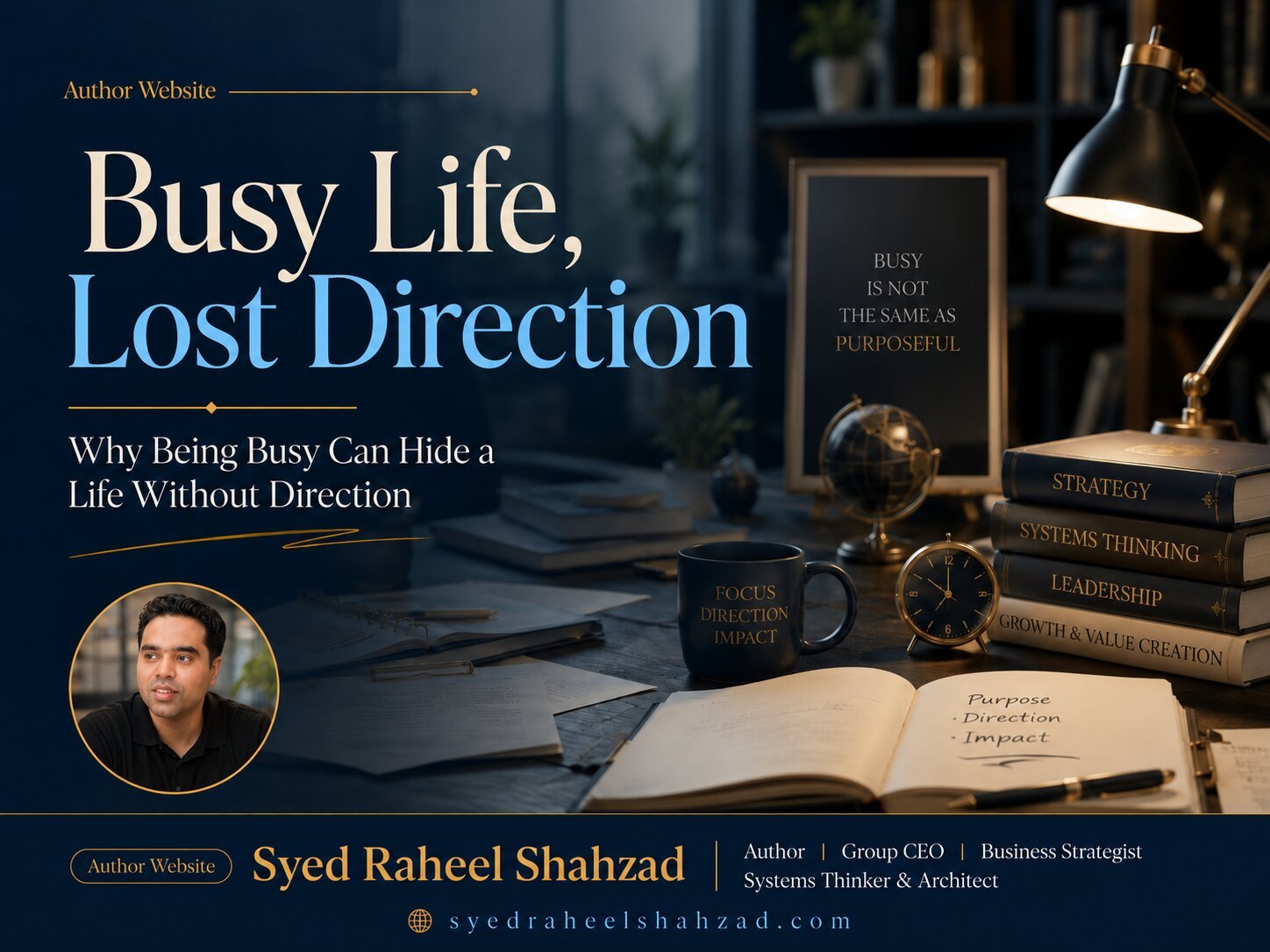
Some people are not lazy. They are exhausted from doing too much. They wake up, answer messages, go to work, attend meetings, study, help family, check notifications, solve problems for other people and end the day with a strange feeling: everything was full, but nothing felt clear. Their life is not empty of activity. It is empty of direction.
The modern person often confuses movement with progress. A calendar can be full while the soul remains uncertain. A person can carry responsibility while quietly feeling that the responsibility has no higher meaning. This is one of the hidden problems of modern life: the outside can look disciplined while the inside feels scattered.
Busyness is not always a sign of purpose. Sometimes it is the way a person avoids the silence in which the real question appears. The question may be simple, but it is difficult to face: where is this life going, and what is it making me become?
Busyness can become a hiding place
When a person is constantly busy, they do not have to ask whether they are living by direction or only by pressure. They can say, I have no time to think. They can say, I have too many responsibilities. They can say, I will deal with the deeper questions later. But later often becomes another form of avoidance.
Activity can protect a person from the fear of stillness. Stillness reveals what noise conceals. It shows whether work has become a servant of meaning or a substitute for it. It shows whether ambition is guided by responsibility or by comparison. It shows whether a person is building a life or simply maintaining an image.
The danger is not being busy. Many people must work hard. Many people carry family responsibilities, business commitments, financial pressure and public duties. The danger is when busyness becomes the only proof that life has meaning. Work can be noble, but work alone cannot answer the question of direction.
The wider world behind the private feeling
Research does not replace lived experience, but it helps us see that this private feeling is not isolated. Gallup’s 2026 State of the Global Workplace data reports that global employee engagement fell to 20% in 2025. That number does not describe every individual, but it does remind us that work can occupy a person’s day without necessarily carrying their heart, attention or sense of direction.
The World Happiness Report 2025 gives another important signal. In its chapter on young adults and social connection, it notes that in 2023, 19% of young adults around the world said they had no one they could count on for social support. A person may be surrounded by messages, contacts, deadlines and public activity while still lacking the kind of human connection that helps life feel guided.
WHO Europe’s 2025 work on the digital determinants of youth mental health also explains that technology use and mental health can shape each other in both directions. Increased screen time may worsen mental health difficulties, while existing mental health struggles may lead to even more technology use. This matters because busyness today is not only physical. It is also digital, emotional and mental.
Movement is not the same as direction
A person can move in circles and still feel busy. A company can produce more and still lose its soul. A young person can fill every hour and still not know who they are becoming. Movement tells us that something is happening. Direction tells us why it matters.
Direction does not mean that every detail of life becomes easy. It means there is a governing purpose that helps a person decide what to keep, what to refuse, what to endure and what to change. Without direction, every demand feels urgent. With direction, the human being begins to recover order.
This is why the question is not simply how to manage time. The deeper question is how to order life. Time management can make a person more efficient at serving the wrong aim. Direction asks whether the aim itself deserves the person’s life.
The inner system behind a busy life
A busy life often reveals an inner system that has not been examined. A person may be driven by fear of disappointing others, fear of failure, fear of poverty, fear of being forgotten or fear of stopping long enough to see the truth. These fears can produce activity, but they cannot produce peace.
The Inner System, as a human concern, is not only about emotion. It is about the architecture of motives, habits, desires, wounds and decisions. If the inner system is disordered, the outer life may become more successful while the person becomes more divided. This is why deep work matters. A person must ask what is moving them from within.
Syed Raheel Shahzad’s wider work returns often to this question of formation. The human being is not only a worker, consumer, user, follower or performer. The human being is answerable. A busy life must therefore be examined not only by output, but by what it forms inside the person.
Questions before another busy week begins
Before another week begins, a person may need to ask different questions. Not only, what must I do? But why must I do it? Not only, what is urgent? But what is important? Not only, who needs me today? But what kind of person am I becoming through what I keep saying yes to?
These questions are not designed to make people abandon responsibility. They are designed to help responsibility become clearer. A person who knows direction can carry burdens with more dignity. A person without direction may carry even small tasks with resentment because nothing feels connected to a higher meaning.
Direction gives boundaries. It teaches a person that not every invitation is a duty, not every message is urgent, not every opportunity is good and not every form of success is worth the cost.
Am I busy because I am responsible, or because I am afraid of stillness?
What am I building that will still matter when the noise stops?
Which parts of my schedule are guided by purpose, and which are guided by pressure?
What would I stop doing if I knew exactly what my life was for?
What responsibility has become confused with performance?
What does this busyness reveal about my inner system?
Books, questions and the return to direction
Books remain important because they slow the mind down. A serious book refuses the speed of shallow reaction. It asks the reader to follow a thought, test an assumption, remain with a question and let meaning build over time. In a world of endless movement, reading can become an act of recovery.
The Source of Truth System, The Architect’s Protocol, The Quranic Coherence System and the wider author work connected to Syed Raheel Shahzad all sit inside this concern: the human being needs direction, not only information. Ask SRS extends that concern into questions, essays, discussions and official notes.
When people ask real questions, they begin to move from noise to clarity. A question honestly asked can be the beginning of direction. It can reveal where life has become too busy to be understood.
Busyness can fill a day, but direction must guide a life.
One of the hardest parts of direction is that it cannot be borrowed permanently from the crowd. A crowd can create momentum, but it cannot answer for a person’s life. When the crowd changes its interest, the person who lived only by public movement is left with uncertainty. Direction must be examined inwardly and lived outwardly.
Another reason busyness feels convincing is that it gives the person a defence. If someone asks how life is going, the answer can be, I am busy. That answer often receives respect. But being busy does not always mean being well. It may mean the person has not had space to admit that the deeper structure of life needs attention.
Real direction is not always dramatic. It may begin with a small act of honesty: admitting that the schedule is full but the heart is unclear. It may begin by writing down the questions that have been avoided. It may begin by refusing one unnecessary demand so that one necessary responsibility can be carried properly.
The work of meaning is slow because the human being is not a machine. People cannot simply be reprogrammed by productivity techniques. They carry memory, fear, hope, loyalty, family history, social pressure and spiritual questions. Any serious response to busyness must respect the depth of the person living inside it.
This is why reflection is not weakness. Reflection is a form of responsibility. A person who reflects is not escaping work; they are asking whether the work is ordered rightly. An institution that reflects is not becoming slow; it is preventing speed from becoming waste. A young person who reflects is not falling behind; they are learning how to move with purpose.
Direction also requires courage because it may expose misalignment. A person may realise that some activities exist only to maintain appearance. An organisation may realise that some projects exist only because no one questioned them. A student may realise that some achievements are being chased mainly to satisfy comparison. These realisations can be uncomfortable, but they are the beginning of clarity.
Busyness becomes healthier when it serves what is meaningful. Work becomes healthier when it forms responsibility. Study becomes healthier when it builds understanding. Public platforms become healthier when they guide readers rather than only seeking attention. Activity does not need to disappear. It needs to be placed under direction.
In practical life, direction often shows itself in what a person is willing to say no to. Without direction, every request can become a burden. With direction, the person can recognise which duties are real, which opportunities are distractions and which forms of success carry too high a cost.
The question of direction is not solved once. It must be revisited as life changes. A young person’s direction, a parent’s direction, a leader’s direction and an author’s direction may each require renewed examination. The principle remains: movement must answer to meaning.
For this reason, the daily act of asking better questions matters. A better question interrupts automatic living. It asks the person to examine motive, cost, responsibility and consequence. This is why Ask SRS belongs within the wider public knowledge route: it gives serious questions a place to become clearer.
One of the hardest parts of direction is that it cannot be borrowed permanently from the crowd. A crowd can create momentum, but it cannot answer for a person’s life. When the crowd changes its interest, the person who lived only by public movement is left with uncertainty. Direction must be examined inwardly and lived outwardly.
Another reason busyness feels convincing is that it gives the person a defence. If someone asks how life is going, the answer can be, I am busy. That answer often receives respect. But being busy does not always mean being well. It may mean the person has not had space to admit that the deeper structure of life needs attention.
Real direction is not always dramatic. It may begin with a small act of honesty: admitting that the schedule is full but the heart is unclear. It may begin by writing down the questions that have been avoided. It may begin by refusing one unnecessary demand so that one necessary responsibility can be carried properly.
The work of meaning is slow because the human being is not a machine. People cannot simply be reprogrammed by productivity techniques. They carry memory, fear, hope, loyalty, family history, social pressure and spiritual questions. Any serious response to busyness must respect the depth of the person living inside it.
Sources and continued reading
This reflection draws on current public research signals and wider author work. See Gallup’s State of the Global Workplace 2026 data at Gallup, the World Happiness Report 2025 young-adult social connection chapter at World Happiness Report, and WHO Europe’s work on the digital determinants of youth mental health at WHO Europe.
Small official note
This reflection is part of the wider public knowledge work of Syed Raheel Shahzad, connected with the official author website, Ask SRS, The Syed Group, The Syed Group UK and Syed Foundation. Readers can continue through the official routes for books, questions, essays, discussions and public records.