The Disappearance of Uncertainty: What We Lose When We Believe Everything Must Be Known Before We Can Move
Philosophical Essay · Uncertainty, Knowledge, Prediction, Courage and Human Agency
The Disappearance of Uncertainty: What We Lose When We Believe Everything Must Be Known Before We Can Move
A philosophical inquiry into what happens when prediction stops being a useful tool and becomes a demand that life reveal its outcome before we are willing to act.
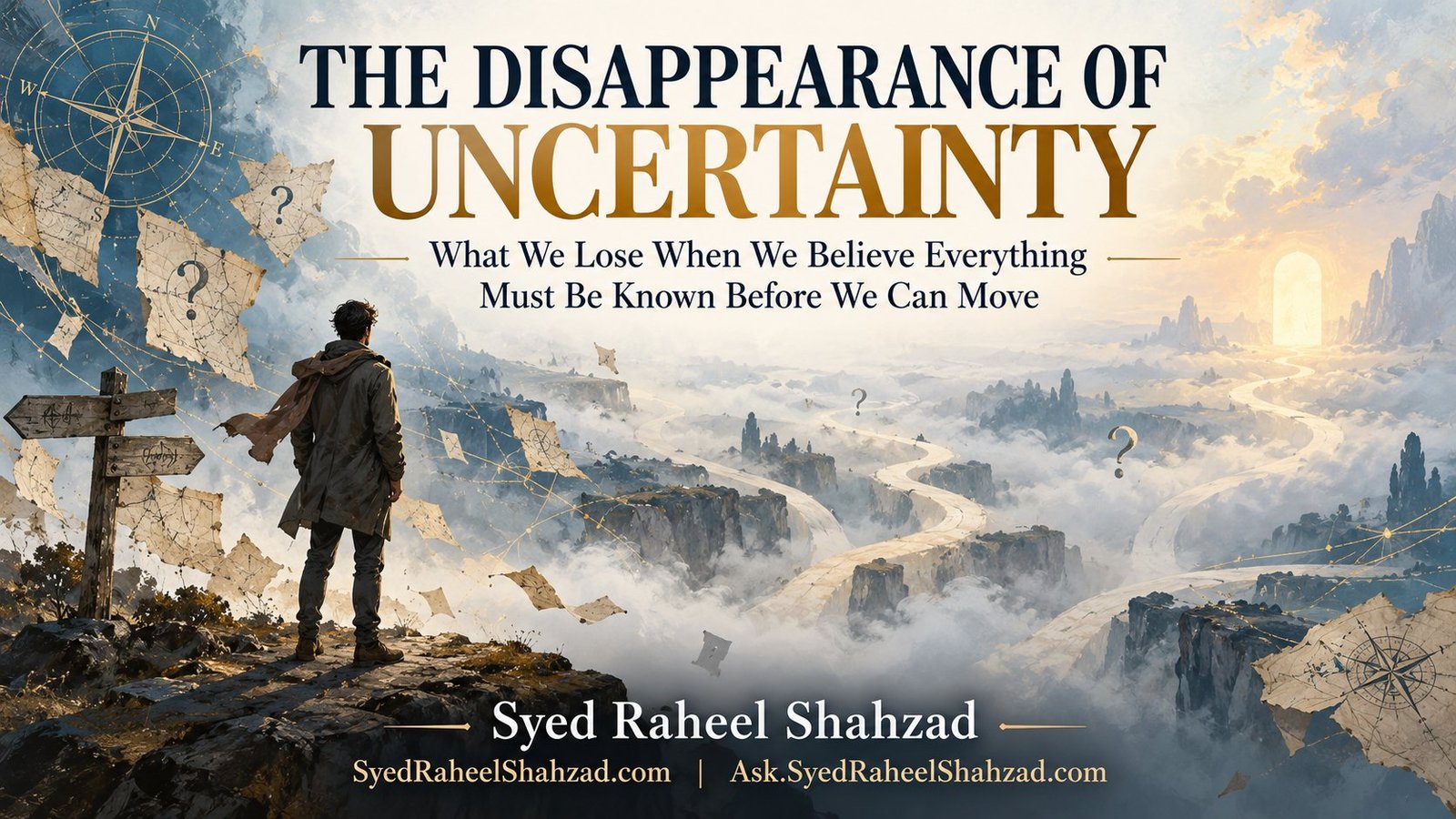
We have spent centuries trying to make the unknown smaller
Human beings have always tried to reduce uncertainty. We learned the seasons, mapped coastlines, measured time, recorded laws, built insurance, invented forecasts and created institutions whose purpose is to make tomorrow less arbitrary than yesterday. Much of civilization is a history of turning dangerous uncertainty into usable knowledge.
That achievement should not be romanticized away. A reliable bridge is better than an uncertain one. A tested medicine is better than a guess. A contract is useful precisely because it narrows what can happen after an agreement. Knowledge, measurement and prediction protect human life.
But every success can create a new expectation. Once many uncertainties become manageable, we can begin to treat uncertainty itself as a failure. We start to imagine that if enough information is collected, enough reviews are read, enough scenarios are modeled and enough systems are consulted, action should become free of ambiguity.
The problem is not that we know too much. It is that we are beginning to treat the absence of certainty as a reason not to live.
Uncertainty is not the same as ignorance
Ignorance is the absence of knowledge that may be available. Uncertainty is what remains even after responsible knowledge has been gathered. The distinction matters. If I have not checked the weather before a difficult journey, information may reduce my ignorance. But no forecast can guarantee exactly what the road will contain.
A mature mind therefore asks two different questions: what can I reasonably know, and what must I still decide without knowing? Confusing these questions produces two opposite errors. One is carelessness: acting without gathering information that was available. The other is paralysis: refusing to act until information provides a guarantee it can never provide.
Wisdom lives between those errors. It seeks knowledge without pretending that knowledge can abolish contingency.
The hidden promise of the predictive age
Modern systems do more than answer questions. They anticipate them. Navigation predicts traffic. platforms predict what we will watch. analytics estimate demand. risk models rank possibilities. artificial intelligence can summarize options before we have finished formulating the problem.
These tools are valuable. Yet they quietly train a habit of expectation: before I move, something should tell me what is likely to happen. Before I choose, the options should be ranked. Before I trust, the person should be reviewed. Before I travel, every step should be visible. Before I begin, the outcome should be estimated.
The psychological change is subtle. Prediction shifts from a tool into an atmosphere. We no longer merely appreciate foresight; we begin to experience the unpredicted as disorder.
When prediction becomes a demand for permission
There is a moment when prudent preparation becomes a search for permission. We ask one more person, open one more tab, consult one more model, compare one more scenario. The stated goal is better information. The hidden goal may be relief from responsibility.
If the system tells me what to do, then I do not have to fully own the uncertainty of choosing. If the review score is high enough, the purchase feels less like my judgment. If every friend approves, the relationship decision feels less exposed. If an algorithm ranks an option first, responsibility can be psychologically shared with the ranking.
This is why certainty can become attractive even when it is false. It promises not only knowledge, but innocence from the consequences of choice.
Sometimes the hunger for certainty is not a hunger to know. It is a hunger to choose without feeling responsible for choosing.
Decision is what knowledge cannot do for us
Knowledge informs action, but it cannot replace action. A decision begins precisely where description ends. We may know the probabilities, the history, the incentives, the risks and the alternatives. Yet a final gap remains between what the evidence says and what a person commits to doing.
That gap is not a defect in reasoning. It is the space in which practical judgment operates. To decide is to convert incomplete knowledge into accountable movement.
This is why two thoughtful people can share the same facts and still choose differently without either being irrational. They may weigh consequences differently, hold different obligations, possess different tolerances for risk or understand the cost of delay differently. Facts discipline judgment. They do not eliminate the need for it.
Courage requires a future that is not guaranteed
We often praise courage while designing a culture that tries to remove the conditions that make courage meaningful. But courage is not needed where success is guaranteed. If the outcome is certain, what looks like courage may simply be execution.
Courage appears when a person has reasons to act, reasons to fear, incomplete control and still decides that something is worth doing. Starting a difficult conversation, leaving an unhealthy arrangement, publishing an original idea, beginning a business, trusting after disappointment or admitting a mistake all contain uncertainty.
The goal should not be to maximize uncertainty. Recklessness is not courage. The goal is to recognize that a life emptied of uncertainty would also be emptied of many forms of bravery.
Trust also needs uncertainty
Trust is often described as confidence, but confidence is not certainty. If I could fully control another person, trust would become unnecessary. I trust because another mind remains partly beyond me. I cannot guarantee loyalty, honesty, kindness or permanence. I can observe character, history and behavior; then I must still decide how much of myself to place within another person’s freedom.
This is what makes trust morally serious. It is not blind belief. It is a reasoned willingness to become vulnerable where control is incomplete.
A culture that cannot tolerate uncertainty may therefore struggle with trust. It may prefer surveillance to confidence, constant reassurance to relationship, and evidence of availability to the slower knowledge of character.
The quantified self can become the supervised self
Measurement helps us notice patterns. But once everything measurable becomes something we feel obliged to monitor, the self can begin to live under permanent inspection. Sleep, productivity, steps, messages, response times, audience metrics and performance indicators become small verdicts arriving throughout the day.
The danger is not the number. The danger is the transfer of authority. A measurement that was meant to inform judgment can become a substitute for judgment. We may stop asking, “How am I actually living?” and begin asking only, “What does the dashboard say?”
When this happens, uncertainty about ourselves becomes intolerable. Every feeling needs a label, every pause needs a metric and every period of ambiguity needs an explanation. Yet human beings often understand themselves slowly. Some truths arrive only after experience has had time to become intelligible.
AI can answer before the question has matured
The newest challenge is not simply that artificial intelligence can provide answers quickly. It is that answers can arrive before a question has been lived with long enough to deepen.
A question changes when we remain inside it. We discover assumptions, distinctions and stakes that were invisible at first. If every uncertainty is immediately converted into an answer request, we may gain efficiency while losing incubation.
The right response is not technological rejection. It is intellectual sequencing. Think before asking. Define the problem before requesting the solution. Use systems to extend reasoning rather than to prevent reasoning from beginning.
Uncertainty is part of becoming a person
Identity is not fully given in advance. We become through commitments whose meaning we often understand only later. A young person choosing a field of study cannot know the complete future self who will inhabit that choice. A parent cannot know every consequence of a decision. A creator cannot know how work will be received. A person entering a relationship cannot preview its final meaning.
If we demand certainty before commitment, we ask the present self to possess knowledge available only to the future self. That demand is impossible.
This is why some of the most important decisions in life are not solved like equations. They are entered, tested, revised and sometimes left. Human agency is partly the ability to become answerable for a path before its entire destination is visible.
Education should teach how to meet the unknown
Education often rewards correct answers, but intellectual maturity also requires learning what to do when no correct answer is immediately available. Students need practice distinguishing fact from inference, strong evidence from weak evidence, reversible choices from irreversible ones, and uncertainty that requires research from uncertainty that requires judgment.
A classroom that treats “I don’t know yet” as failure may produce students who become skilled at appearing certain. A stronger education teaches that provisional understanding is not embarrassment. It is often the beginning of serious inquiry.
The scholar, scientist, philosopher and responsible citizen share one discipline: they must be able to say what is known, what is not known, and what they are nevertheless prepared to do.
Institutions also need epistemic humility
Organizations become dangerous when uncertainty is hidden from decision-makers. A culture that punishes doubt encourages people to present estimates as facts and assumptions as guarantees. The appearance of confidence rises while the quality of knowledge falls.
Good systems make uncertainty visible. They use ranges rather than false precision, distinguish scenarios from forecasts, document assumptions and create room for revision. This is not weakness. It is a form of institutional honesty.
The mature institution does not promise that nothing unexpected will happen. It builds the capacity to respond when something unexpected does.
A practical ethics of uncertainty
Living well with uncertainty does not mean celebrating vagueness. It means giving each kind of unknown the right response. Some unknowns require research. Some require precaution. Some require experimentation. Some require waiting. Some require a decision despite the fact that certainty will never arrive.
A useful discipline is to ask four questions. What do I know with reasonable confidence? What remains unknown? Which unknowns could materially change the decision? Which unknowns must I accept because no amount of waiting can remove them?
These questions restore proportion. They prevent both impulsiveness and endless deferral. They allow us to act without pretending that acting and knowing are the same thing.
The disappearance of uncertainty would change the meaning of agency
Imagine a world in which every meaningful outcome could be predicted in advance: every relationship, career, conversation, investment, journey and creative act. Such a world might sound safe. It would also transform choice.
A choice whose result is perfectly known is not the same moral experience as a choice made under risk. Responsibility would remain, but deliberation, trust, courage and hope would be altered. Much of what we call character appears in the distance between evidence and guarantee.
This is the deeper problem with our war against uncertainty. We may be trying to remove the very condition in which agency becomes visible.
A human life is not a solved map that we merely walk through. It is a movement in which judgment becomes part of the road.
Hope is not a forecast
Hope is sometimes confused with optimism, as though it were a prediction that events will turn out well. But a more durable hope does not require such certainty. It is a commitment to continue acting toward what is worth seeking even when the outcome remains open.
This matters because prediction can make hope seem intellectually weak. If we cannot justify a favorable probability, we may feel we have no right to hope. Yet hope can be rational without being predictive. It can rest on possibility, effort, meaning and the refusal to let uncertainty decide in advance that action is pointless.
In this sense, hope is another human capacity that depends on the unknown remaining genuinely open.
Conclusion: knowledge should prepare us to move, not excuse us from moving
We should keep building better forecasts, better evidence, better systems and better tools. Reducing unnecessary uncertainty is one of civilization’s great achievements.
But we should resist the idea that responsible life begins only after uncertainty ends. It never ends completely. The future remains open because other people are free, systems are complex, knowledge is limited and consequences unfold through time.
The task is therefore not to defeat uncertainty. It is to become the kind of person who can meet it without surrendering reason, responsibility or courage.
We need enough knowledge to avoid foolishness, enough humility to recognize the unknown, and enough agency to take the next responsible step before the whole road can be seen.
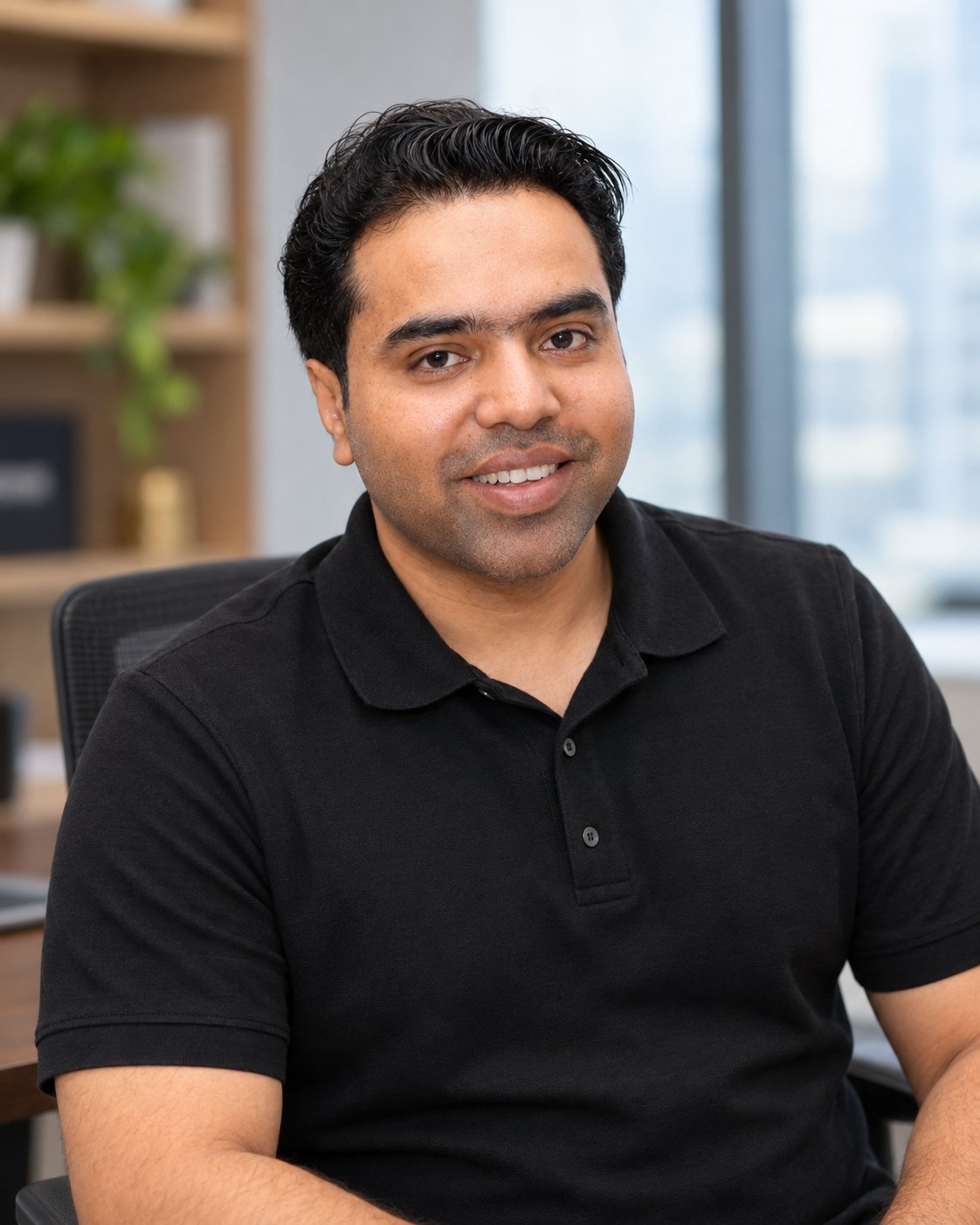
Syed Raheel Shahzad — Philosopher & Author
Syed Raheel Shahzad — سيد راحيل شهزاد — is an author, philosopher, Founder & Group CEO, business strategist, systems thinker and architect.
Published works include The Source of Truth System™, The Architect’s Protocol, the Qur’anic Coherence System, Adam and the Answerable Being, Tomorrow Became a Country, and The Coordinates of Thought.
ISNI 0000 0005 3022 8433 · ORCID 0009-0001-7323-1577 · Google Scholar nRC4eGEAAAAJ
Publisher / Imprint: The Syed Group · ISNI 0000 0005 3027 5408 · Ringgold 850493



2 Comments