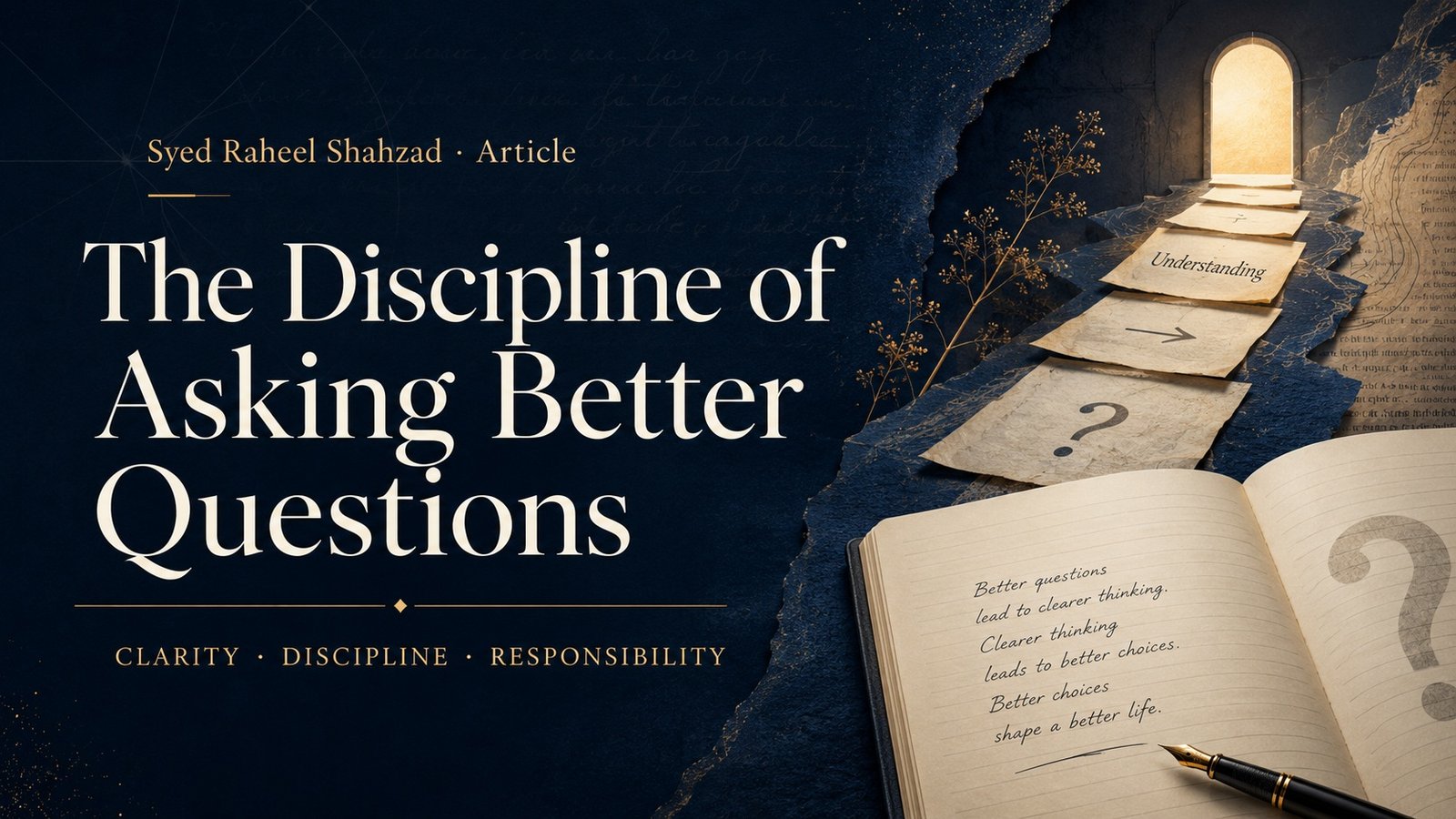
The Discipline of Asking Better Questions
The Discipline of Asking Better Questions
A better question is not only a smarter sentence. It is a disciplined act of attention, humility, clarity, and responsibility.
Many people want better answers, but fewer people learn the discipline of asking better questions. A serious answer often begins long before the answer is given. It begins with the quality of the question itself.
A better question is not always a bigger question
Some questions sound large because they use large words. Some questions sound urgent because they carry emotion. Some questions sound intelligent because they borrow the language of debate, philosophy, religion, politics, or science.
But a better question is not simply a louder question, a longer question, or a more complicated question. A better question is clearer. It knows what it is trying to ask. It separates concern from accusation, curiosity from performance, and confusion from conclusion.
This is why the discipline of asking matters. A question can open the mind, or it can trap the mind inside its own assumptions.
The first discipline is honesty
A serious question begins by admitting what is actually unknown. Many questions fail because they are not really questions. They are statements disguised as inquiry. They already contain the verdict and are only looking for confirmation.
Honest questioning is different. It does not pretend to know what it has not understood. It does not turn every uncertainty into an attack. It allows the mind to say: I need to understand this properly before I decide what it means.
That honesty is not weakness. It is the beginning of learning.
Honesty
The question admits what is not yet understood instead of pretending certainty.
Clarity
The question separates the real issue from noise, reaction, and borrowed language.
Context
The question knows whether it belongs to faith, ethics, history, law, science, identity, or conduct.
Responsibility
The question accepts that an answer may require action, correction, patience, or change.
The second discipline is placing the question correctly
Many questions become confused because they are placed in the wrong category. A spiritual question may be treated as a political question. A moral question may be treated as a branding question. A scientific question may be turned into a metaphysical claim. A personal pain may be expressed as a universal argument.
When the question is placed wrongly, the answer becomes distorted. The answer may sound strong but still miss the real matter.
A better question asks: What kind of question is this? Is this about evidence, meaning, conduct, authority, interpretation, memory, fear, identity, or responsibility?
The third discipline is patience
Some questions deserve immediate response. Others deserve patience. A question that affects belief, family, character, future decisions, or the way a person sees himself should not always be forced into instant reply.
Patient questioning does not mean avoiding the answer. It means refusing to make the question smaller than it really is. It gives the answer room to become useful, not merely quick.
This is the reason Ask SRS exists as a reader platform. It gives serious questions a place where they can be preserved, reviewed, discussed, grouped, and answered in a form that can remain useful for others.
A better question carries responsibility
The deepest questions are not entertainment. They are not ornaments for intellectual identity. They are not tools for defeating another person in public. A better question carries responsibility because the answer, if taken seriously, may require change.
- It may require a correction in belief.
- It may require a change in conduct.
- It may require humility before evidence.
- It may require patience with complexity.
- It may require repentance, forgiveness, or restraint.
- It may require service instead of argument.
- It may require returning to a book, source, or longer framework.
- It may require silence until speech becomes responsible.
A better question does not only seek an answer. It prepares the person to carry the answer.
Syed Raheel ShahzadAsk SRS and the public record of questions
Ask SRS is designed around the seriousness of questions. It allows readers to ask, discuss, submit, reflect, and follow official notes connected to the books and public work of Syed Raheel Shahzad.
The platform is not built for noise. It is built for a different rhythm: ask carefully, discuss responsibly, read patiently, and allow serious answers to become part of a record that helps others.
The discipline of asking better questions is not a small matter. It is one of the first steps toward better thinking, better learning, and better responsibility.
Ask SRS Ask a Question Official Notes Author Verification