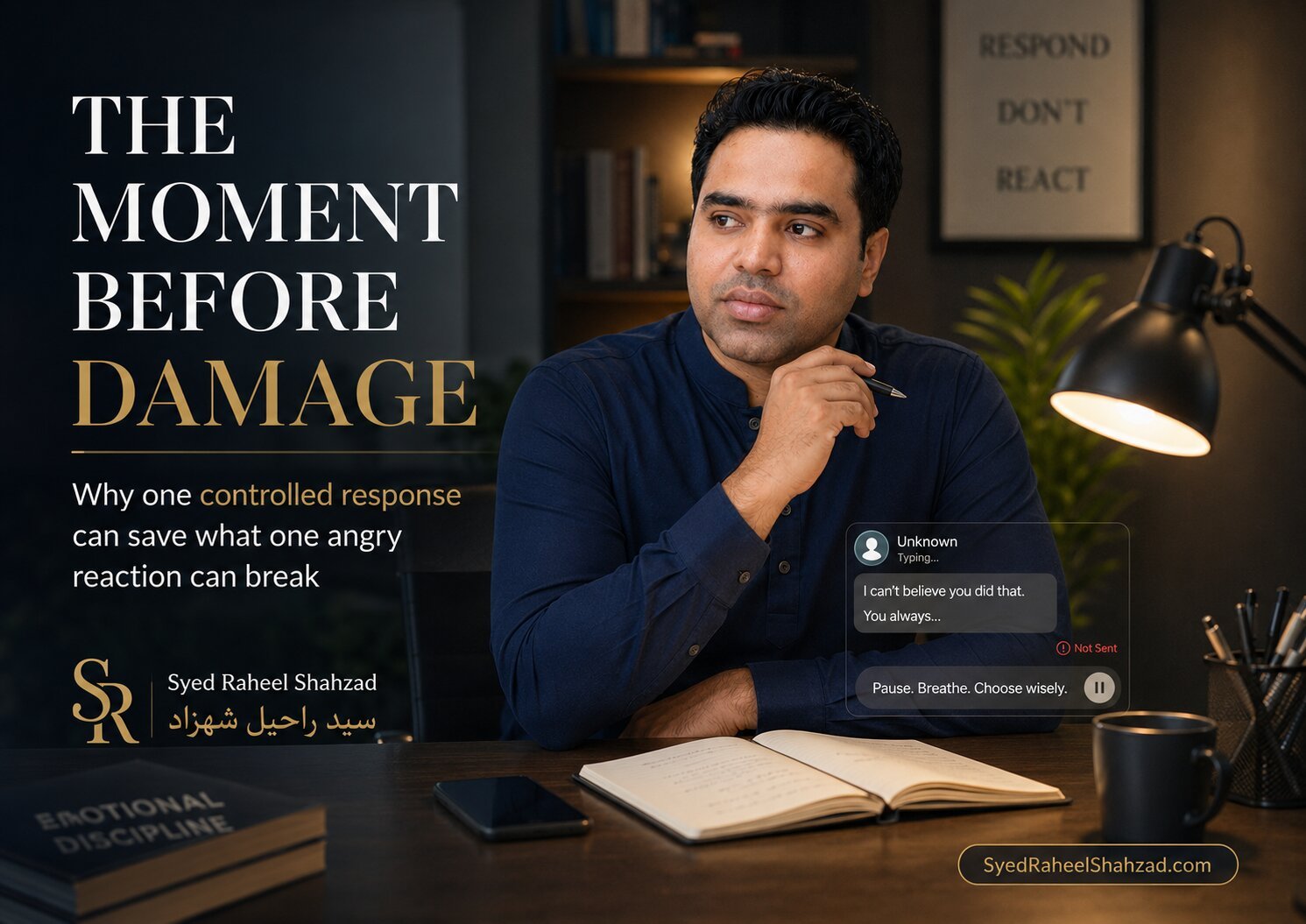
The Moment Before Damage: Why One Controlled Response Can Save What One Angry Reaction Can Break
The Syed Group · Daily Article · 4 August 2026
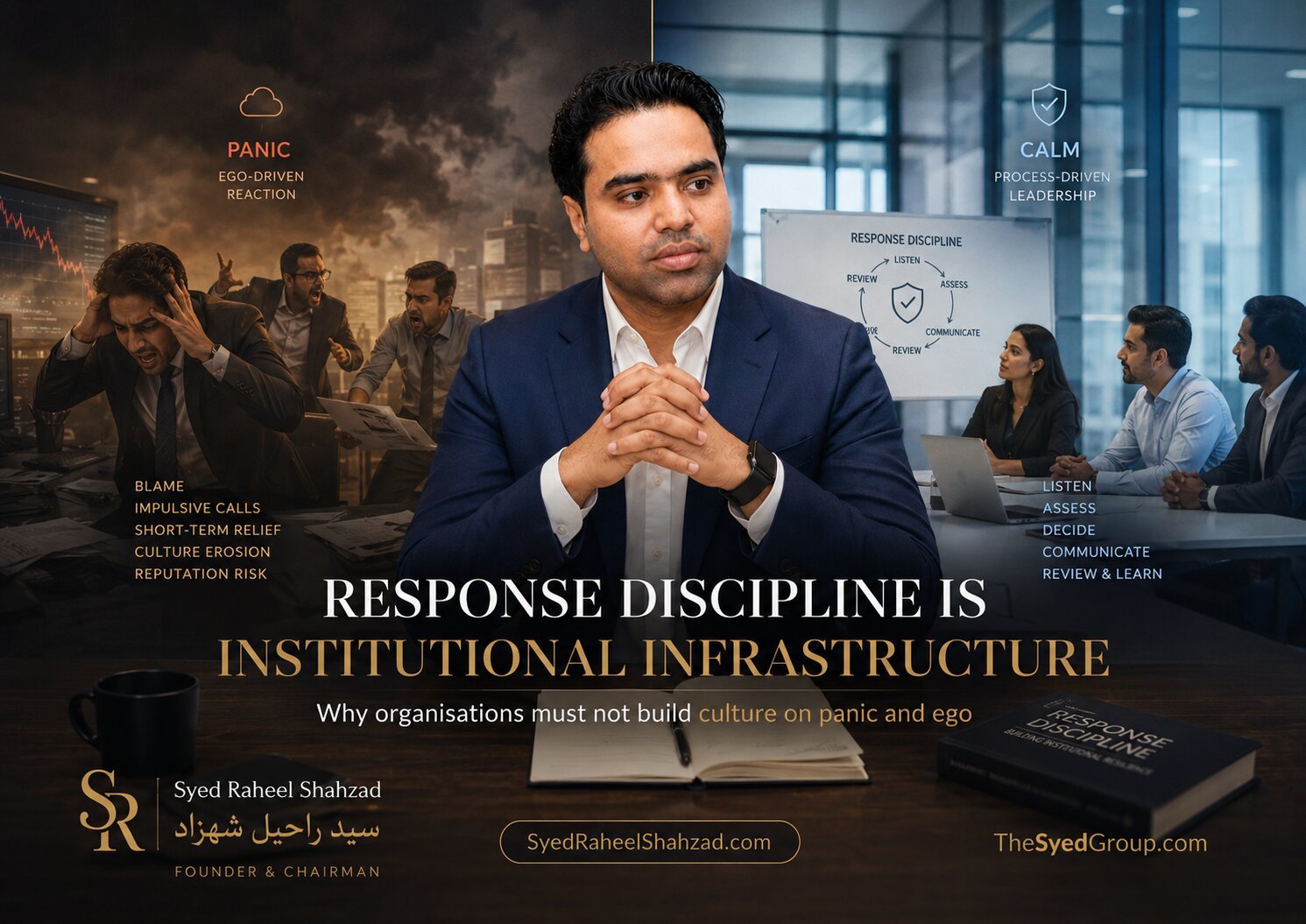
Response Discipline Is Institutional Infrastructure: Why Organisations Must Not Build Culture on Panic and Ego
Institutions lose trust when they react before they understand; mature organisations build processes that slow panic, govern conflict and protect judgement.
Institutions do not only reveal their culture when everything is calm. They reveal it when pressure arrives and the first instinct is to react.
A complaint is received. A public issue appears. A client is angry. A team member challenges a decision. A mistake becomes visible. A senior person feels embarrassed. In that moment, the institution faces a choice: respond with discipline, or allow panic and ego to become policy.
An institution that reacts before it understands does not look decisive. It looks unsafe.
Many organisations speak about trust, accountability and culture. But those words are tested in moments of friction. A system can write values on a wall and still punish the person who speaks early. It can publish a policy and still reward defensive leadership. It can ask for feedback and then treat feedback as betrayal.
Speed is not the same as wisdom
Modern organisations often confuse speed with strength. The quick email, the immediate statement, the instant decision and the visible action can create the appearance of control. But speed without understanding often transfers damage from one place to another.
A leader may react quickly to protect reputation and destroy trust inside the team. A manager may issue a warning before listening and create fear around honesty. A company may rush to assign blame and miss the system that produced the mistake. A board may demand action before evidence and train everyone to hide complexity.
There are times when urgent action is necessary. But urgency should not become an excuse for ego-driven decisions.
Reaction culture becomes operating culture
If people learn that every problem produces panic, they stop bringing problems early. They wait. They soften facts. They protect themselves. They speak in safe language. They allow small issues to become larger because the system has taught them that honesty is dangerous.
That is how reaction culture becomes operating culture. The organisation may still function, but it functions with hidden information. Employees know what is happening before leadership does. Customers sense inconsistency before strategy admits it. Teams carry tension before the formal grievance exists.
The cost is not only emotional. It affects quality, decision-making, retention, innovation and reputation.
Response discipline must be designed
Response discipline is not the personality of a calm leader. It is an institutional design requirement.
A serious organisation needs:
- clear escalation pathways so problems do not depend on mood;
- cooling-off windows before non-urgent decisions are finalised;
- fact-finding before blame;
- listening channels where people can speak without retaliation;
- communication rules for sensitive issues;
- accountability for leaders who create fear through reaction;
- post-incident review that improves systems rather than merely punishing individuals.
When these practices exist, the organisation does not need to pretend that pressure will disappear. It builds a way to behave responsibly when pressure arrives.
Panic protects reputation badly
Many institutional reactions are driven by the fear of reputational damage. But panic often damages reputation more deeply than the original problem. People can accept that a mistake occurred. They struggle to trust an institution that hides, denies, blames or attacks before understanding.
Credibility is not created by never facing conflict. It is created by showing that conflict will be handled with fairness, evidence and follow-through.
Ego is a governance risk
Organisational risk is often discussed in financial, legal and operational language. But ego is also a governance risk. A leader who cannot be questioned becomes a weak point in the system. A manager who experiences feedback as disrespect turns the workplace into a stage for personal insecurity. A department that protects its image before it protects truth becomes difficult to improve.
Good governance is not only about documents. It is about the discipline that prevents power from becoming impulsive.
Response discipline means the organisation is strong enough to pause before it performs certainty.
From reaction to response
A reaction asks, “How do we stop discomfort quickly?” A response asks, “What is actually happening, who is affected, what is fair, and what must change?”
A reaction looks for someone to blame. A response looks for the cause. A reaction protects status. A response protects trust. A reaction ends the conversation. A response builds the next action.
These differences may sound simple, but they decide whether an organisation becomes safer after conflict or merely quieter.
The leadership test
The leader’s test is not whether they can speak forcefully in pressure. Many people can do that. The test is whether they can remain just when their ego is touched, curious when their certainty is challenged, and disciplined when speed would make them appear powerful.
Institutions become trustworthy when their people know that pressure will not make the system reckless.
Response discipline is therefore not a soft skill. It is infrastructure. It protects the quality of decisions, the safety of truth, the dignity of people and the long-term credibility of the organisation.
An institution built on panic will keep repairing avoidable damage. An institution built on disciplined response will not be free from conflict, but it will become safer, wiser and more worthy of trust when conflict comes.

Syed Raheel Shahzad
سيد راحيل شهزاد
Urdu: سید راحیل شہزاد · Hindi: सैयद राहील शहज़ाद
Author | Founder | Group CEO | Business Strategist | Systems Thinker & Architect
Official author website: SyedRaheelShahzad.com · Ask SRS: Ask.SyedRaheelShahzad.com · Parent group: TheSyedGroup.com · UK: TheSyedGroup.co.uk · Foundation: SyedFoundation.com
Identifiers: ISNI 0000 0005 3022 8433 · ORCID 0009-0001-7323-1577 · Wikidata Q139548931 · Google Scholar: Syed Raheel Shahzad
Complete book catalogue The Source of Truth System™ The Architect’s Protocol The Qur’anic Coherence System Adam and the Answerable Being